The Trump administration is preparing to sell Israel a $2.8 billion package of 40,000 heavy bombs, the largest single sale of 2,000-pound munitions in years, according to the Washington Post and confirmed to Newsweek and Mediaite by a senior administration official. The deal has not been formally sent to Congress yet, but word of it already has former Fox News host Tucker Carlson and former Rep. Marjorie Taylor Greene, two of the loudest America First voices in Trump's own coalition, publicly telling him to stop.
What is actually in the package?
The sale would send Israel 20,000 MK-84 general-purpose bombs and 20,000 BLU-117s, a thermally protected version of the same bomb built for safer storage aboard ships, plus 20,000 I-2000 Penetrator warheads designed to punch through hardened, underground targets, according to the Post's reporting, relayed by Al Jazeera and AFP. The MK-84 is a 907-kilogram, 2,000-pound bomb that U.S. pilots nicknamed "the hammer" during the first Gulf War. It can punch through 15 inches of concrete and leave a crater 50 feet wide, according to Newsweek's reporting on the weapon.
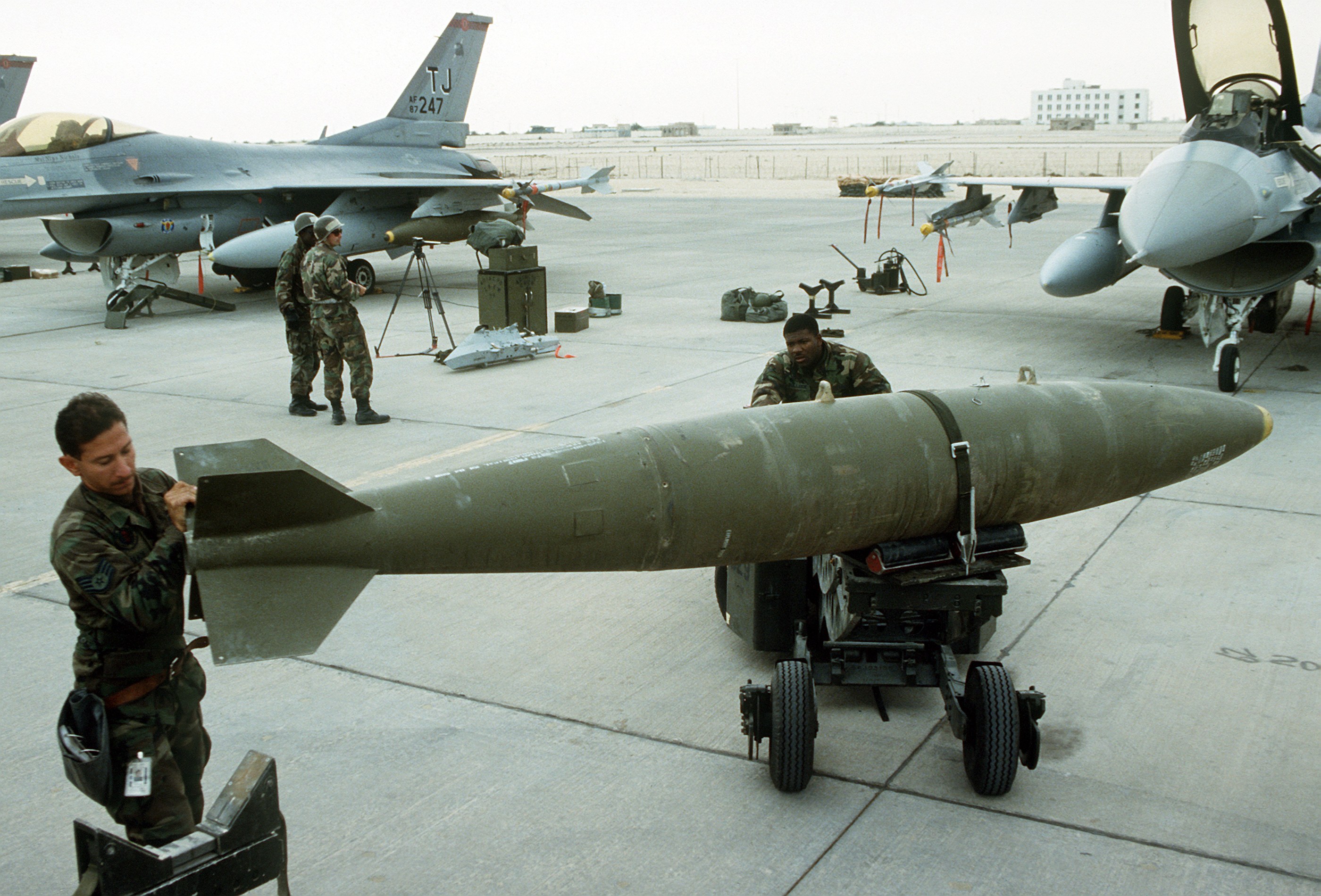
Airmen load MK-84 2,000-pound bombs, the same munition at the center of the proposed Israel sale, onto an F-16 during Operation Desert Storm in 1991. (U.S. Air Force photo by SSgt Lee F. Corkran, public domain, Wikimedia Commons)
Most of the money is expected to flow through Foreign Military Financing, the decades-old arrangement in which the United States hands Israel the cash and Israel turns around and buys American-made weapons with it. A senior administration official gave Newsweek and Mediaite nearly identical statements when asked to confirm the reporting: "All foreign arms sales are moving through the appropriate process. We do not comment on pending sales." A State Department official added to Newsweek that the department "does not confirm or comment on proposed arms sales until they have been formally notified to Congress." Congress has so far only received informal notice.
Why did Biden once refuse to send this same bomb?
This is not the first time the MK-84 has become a political flashpoint. The Biden administration paused a shipment of roughly 1,800 of the 2,000-pound bombs, along with 1,700 smaller 500-pound bombs, in the spring of 2024 over fears about how Israel was using them in dense, populated parts of Gaza. "I made it clear that if they enter Rafah, and they haven't entered Rafah yet, if they do, I will not supply the weapons that have historically been used to address the situation in Rafah and other cities," Biden told CNN at the time. Israel did enter Rafah. Trump lifted the pause within his first month back in office in 2025, and shipments resumed.
Who is already breaking with Trump over this?
Carlson posted a lengthy thread on X laying out the numbers and warning that "there is no precedent for what the Trump administration is doing." He argued the package amounts to roughly 40,000 tons of ordnance and, per Al Jazeera's account of the post, called it "a gift" to a government he said is "working to exterminate an unarmed civilian population in Gaza." Carlson has visited Israel during the war and has grown steadily more critical of U.S. support for the campaign there, telling followers that what Netanyahu's government has done in Gaza is "by any definition" genocide, a characterization Israel rejects.

Tucker Carlson, seen here at a 2023 Turning Point Action event, called the bomb package "a gift" to the Israeli government and urged Americans to speak out against it. (Gage Skidmore, CC BY-SA 2.0, Wikimedia Commons)
Marjorie Taylor Greene, who resigned her House seat earlier this year after her own public break with Trump over the Epstein files, shared Carlson's post and added her own reaction, quoted verbatim by both Newsweek and Al Jazeera: "We did not vote for this. America does not support this. Our tax dollars and weapons have been used to kill tens of thousands of innocent people. My God, what comes next?" It is a sharper version of a line she has used before. When the United States struck Iranian targets earlier this year she wrote almost the identical sentence, swapping out the target: "I did not campaign for this. I did not donate money for this. I did not vote for this."
Does Carlson's World War Two comparison actually check out?
Carlson's post leaned hard on a historical comparison: he wrote that the largest American air raid of World War Two, the Eighth Air Force's mission against Berlin, involved roughly 2,023 Allied aircraft and dropped about 3,000 tons of bombs, a fraction of what he says Trump is now sending to one country in a single sale. That claim is checkable, and it mostly holds up. According to the National WWII Museum, the March 18, 1945 raid on Berlin, the largest wartime raid on the German capital and the biggest mission the Eighth Air Force ever flew, sent up 1,329 bombers and 733 fighters, 2,062 aircraft in total, and dropped more than 3,000 tons of bombs on the city. Carlson's aircraft count is off by roughly 40 planes and he did not mention that only 1,221 of the bombers were actually assigned to hit Berlin itself, but his tonnage figure lines up almost exactly with the museum's own record. Whatever one thinks of the comparison as an argument, it is not the exaggerated number it might sound like at first.
What are Van Hollen and other critics in Congress saying?
Sen. Chris Van Hollen, D-Md., who has spent much of the past two years pushing resolutions to block or condition arms sales to Israel, said he intends to try to stop this one too, accusing Trump of "sending bombs paid for by American taxpayers to a government led by a wanted war criminal." That is a reference to the International Criminal Court's November 2024 arrest warrant for Israeli Prime Minister Benjamin Netanyahu on war crimes and crimes against humanity charges tied to the Gaza campaign, a warrant Israel does not recognize and that Hungary, among other states, has said it would not enforce. Van Hollen has previously teamed with Sens. Jeff Merkley and Peter Welch on resolutions targeting a combined $658 million in weapons sales to Israel; none of those efforts has succeeded on the floor, and Rep. Thomas Massie's push to strip $3.3 billion in annual aid to Israel failed in the House as well.
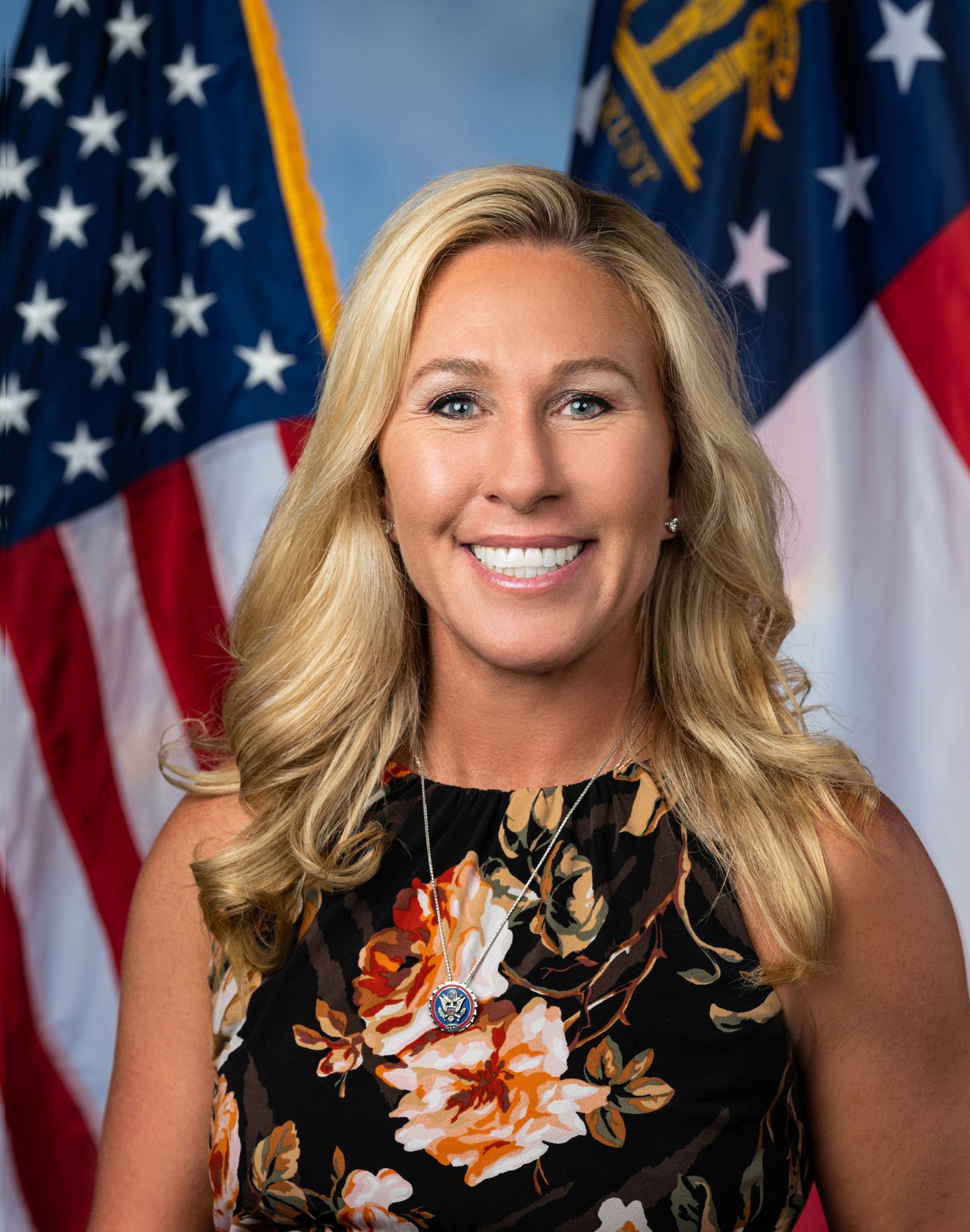
Former Rep. Marjorie Taylor Greene, seen in her official congressional portrait, shared Carlson's post and wrote, "We did not vote for this." (House Creative Services, public domain, Wikimedia Commons)
Brian Finucane, a senior adviser at the International Crisis Group who tracks U.S. arms transfers, told the Post the sale "sends a vote of confidence to Israel" even if that is not the administration's intent, at a moment when Trump's own team says it wants to calm the region rather than fuel it further. That timing is awkward. Trump has spent recent weeks pressing Netanyahu to accept the next phase of his own Gaza ceasefire plan, and the two leaders' relationship has been rockier than the alliance's public face suggests: Trump himself confirmed to NPR in June that he called Netanyahu "crazy" and used an expletive on a call over Israeli strikes on Lebanon, while insisting the two "still get along." Al Jazeera's own reporting frames the sale's timing as no accident on Israel's side, a chance to lock in a large commitment now while a friendly administration is still willing to sign off on one.
Is this really just routine paperwork, as the White House says?
In one narrow sense, the administration's "appropriate process" line is accurate. Arms sales to Israel funded through Foreign Military Financing are a routine, decades-old mechanism, and the current ten-year agreement between the two countries already commits the United States to roughly $3.3 billion a year in this kind of assistance, per the program's own history. But the scale here is what has even some longtime supporters of the U.S.-Israel relationship uneasy. Mediaite reported that a $2.04 billion munitions sale to Israel in 2025 already bypassed the normal congressional review window, and this proposed package would be nearly $800 million larger than that one, on top of everything the country has already received since October 7, 2023, which the Quincy Institute's William D. Hartung estimates at more than $21 billion in additional military assistance alone.
What happens now?
Congress has only received informal notice of the deal so far, which is normal practice for a sale this size before the formal notification period that starts the clock on any disapproval vote. Van Hollen and his allies have tried this play before and lost every time, and nothing about the current Senate math suggests this attempt ends differently. That is the uncomfortable reality sitting underneath all the public outrage from Carlson and Greene: the legal mechanism to stop a Foreign Military Financing sale exists on paper, but it has never once succeeded when it has mattered. Unless a critical mass of Senate Republicans decides to join Van Hollen's resolution when it actually comes to a vote, which none has signaled they will, this sale goes through the same way every large one before it has. The fight over it will be loud. The outcome is not really in doubt.