Six West Texas landowners and a conservation nonprofit sued the Department of Homeland Security on September 14, arguing the agency invented a border crisis in one of the emptiest stretches of the entire southern border to justify seizing their land. The lawsuit lands in a place few border fights ever go: a coalition that includes Republican sheriffs, a Republican senator, and a Republican former county judge, all telling Secretary Markwayne Mullin's DHS that the Big Bend wall project is aimed at the wrong target.
What did the landowners actually file?
The suit, Conserve Big Bend v. U.S. Department of Homeland Security, was filed in the U.S. District Court for the District of Columbia on behalf of the nonprofit Conserve Big Bend and six named landowners: Charles L. Cecil IV, John Ferguson, David Keller, Nadine Pineda Mata, Joe Pineda and Leo Nunez Pineda. It names DHS, Customs and Border Protection, Mullin and CBP Commissioner Rodney Scott as defendants, according to the Big Bend Sentinel, which covered the press conference outside the Presidio County Courthouse in Marfa.
"Landowner resistance has slowed this project to a crawl," Keller, an archaeologist who works with Conserve Big Bend, told a crowd of about 150 people. "People have refused access agreements. Survey and construction schedules have fallen months behind." It is the sixth lawsuit filed against the wall project in this region since April, per the Sentinel, and the government is now facing challenges from ranchers, a Lipan Apache preservation group, a river-guide business and a Texas municipal development district all at once.
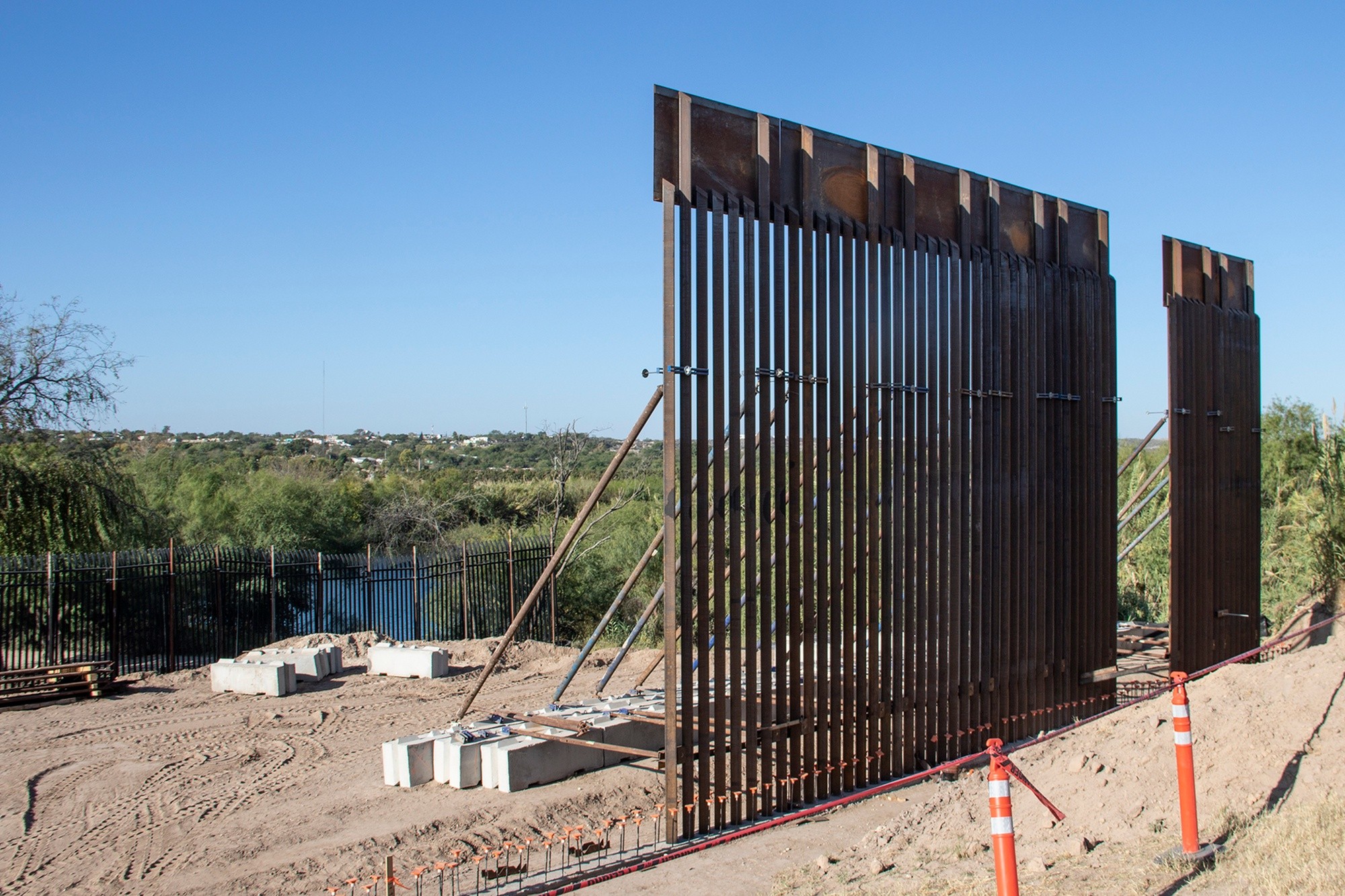
U.S. Army Corps of Engineers contractors build bollard-style barrier panels near Del Rio, Texas, in a 2020 file photo illustrating the same construction method now planned for the Big Bend Sector. (Photo by Orville Collins, U.S. Army Corps of Engineers, public domain via DVIDS)
Why do they say Big Bend isn't an "area of high illegal entry"?
The whole project runs on one legal hook. Section 102 of the Illegal Immigration Reform and Immigrant Responsibility Act lets the Homeland Security Secretary waive dozens of environmental, contracting and historic-preservation laws, but only in places officially designated an "area of high illegal entry." Then-Secretary Kristi Noem made that designation for the Big Bend Sector on October 15, 2025, and it is the only legal justification for everything that has happened since.
The landowners argue the designation does not hold up. Their complaint divides five years of CBP apprehension data by sector mileage and finds Big Bend at 5.99 apprehensions per mile, the lowest of any southwest border sector, against 61.29 in Yuma and 831.7 in San Diego, according to the Sentinel's reporting on the filing. Big Bend Sector also recorded just 3,096 apprehensions in fiscal year 2025, about 1.3 percent of the 237,538 recorded along the entire southwest border, and the sector has posted the fewest annual apprehensions of any southwest sector for more than five decades, per the Texas Tribune.
Official record
Determination Pursuant to Section 102 of the Illegal Immigration Reform and Immigrant Responsibility Act of 1996, as Amended, 90 Fed. Reg. 48286-48287 (Oct. 15, 2025), Doc. No. 2025-19543.
"The United States Border Patrol Big Bend Sector is an area of high illegal entry. Between fiscal year 2021 and July 2025, the United States Border Patrol apprehended over 88,595 illegal aliens attempting to enter the United States between border crossings in the Big Bend Sector. In that same time period, Border Patrol seized over 86,851 pounds of marijuana, over 863 pounds of cocaine, over 12 pounds of heroin, over 1,084 pounds of methamphetamine, and over 94 pounds of fentanyl." — Kristi Noem, Secretary of Homeland Security
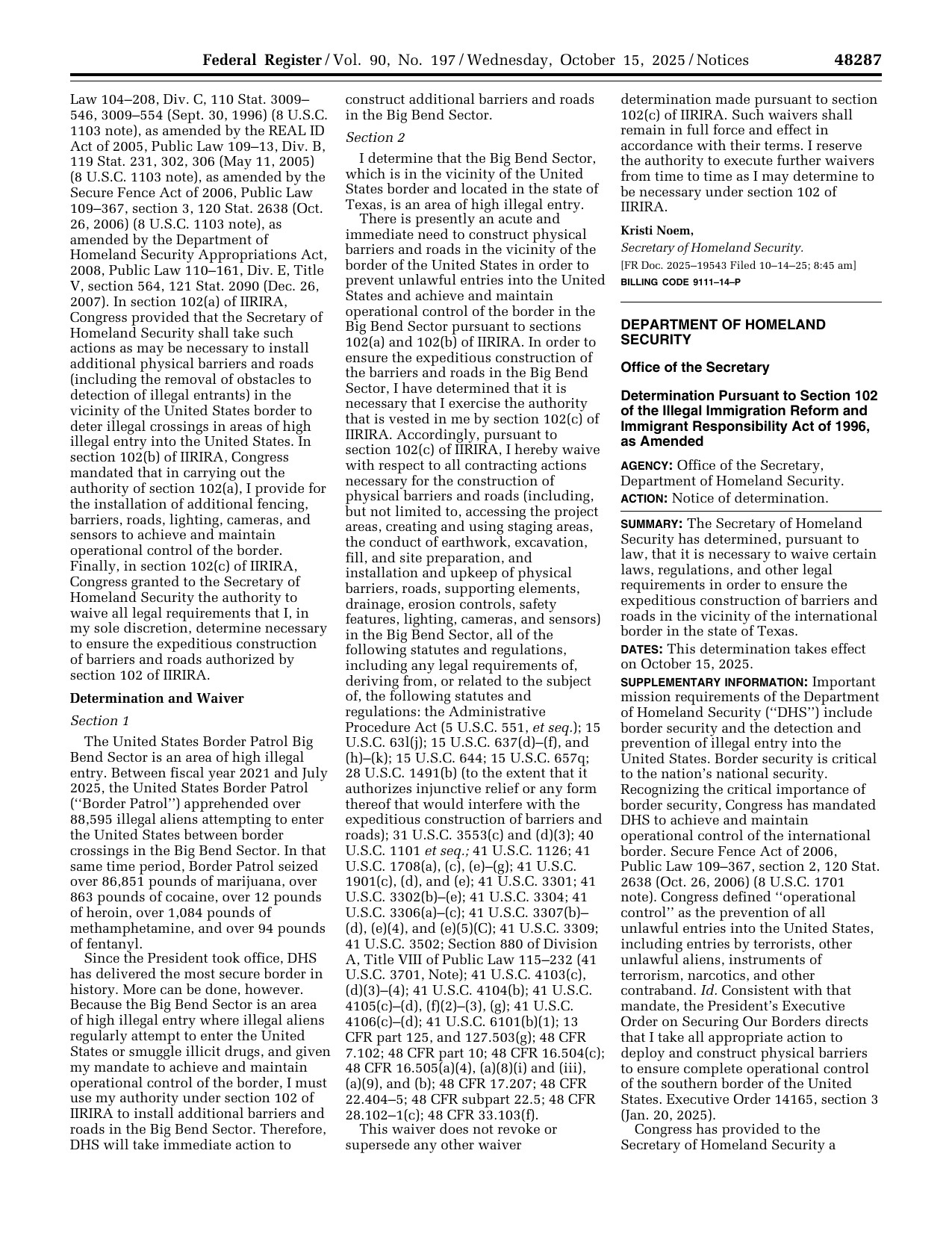
Read or download the full 2-page determination (PDF) · view the docket for Conserve Big Bend v. DHS
Do the numbers actually support DHS's case?
Here is where both sides are telling the truth about different things. The 88,595 figure in Noem's determination is real and checkable. It is also a four-and-a-half-year cumulative total, and the complaint calls 2021 and 2022 "a statistically anomalous period" within it, tied directly to Title 42, the pandemic-era policy that let Border Patrol expel single adults back across the border in minutes with no penalty. That produced heavy repeat-crossing: the same people counted as new apprehensions two, three, four times in a week, inflating the sector total without reflecting sustained traffic.
Neither the lawsuit's coverage nor the government's own notice spells out just how lopsided that split is, but the sector's own later numbers do the work. Apprehensions fell to 11,823 by fiscal 2023, then to 3,096 in fiscal 2025, a 74 percent drop, and the current fiscal year's first seven months logged only 1,236 encounters, down another 42.5 percent year over year. A designation built on a five-year sum that leans heavily on a two-year, Title 42-driven spike is not fabricated, but it also is not describing the sector DHS is waiving laws to build in today.
Why are Republicans leading the opposition?
This is not an environmentalist-versus-Trump story. Five county sheriffs from Brewster, Culberson, Hudspeth, Presidio and Terrell counties, a mix of Democrats and Republicans, wrote in April that "construction of a continuous physical border wall in the Big Bend region would not represent the most practical or strategic approach to border security in this area," per the Texas Tribune. Terrell County Sheriff Thaddeus Cleveland, a Republican who spent 26 years in Border Patrol and calls Commissioner Scott a personal friend, told CBS News he supports vehicle barriers where they make sense but not a wall against cliffs some of which top a thousand feet. "If they're willing to cross that, and they do, then a 30-foot barrier on top of a thousand-foot cliff is not going to stop them," Cleveland said.
Republican Sen. John Cornyn sent Mullin a letter on August 12 asking DHS to meet with residents before continuing construction. Texas Land Commissioner Dawn Buckingham, also a Republican, sent CBP contractor Barnard Construction a cease-and-desist letter in July over what her office called illegal clearing of state land in Presidio County. Gov. Greg Abbott, who has spent years pushing for more wall on Texas's own dime through Operation Lone Star, told CBS on August 20 that federal officials assured him "they would not be building any wall, any fence, any barrier like that" inside the park, an assurance CBP's own public statements only partially matched.
Sen. John Cornyn, R-Texas, sent DHS Secretary Markwayne Mullin a letter in August asking for a meeting with Big Bend residents before construction continued. (Official U.S. Senate portrait, public domain)
What does Big Bend National Park actually get?
Commissioner Scott paused construction inside the national park on August 17 for what he called a personal, on-the-ground evaluation after bulldozers working near Santa Elena Canyon drew national attention. He has been consistent that the 30-foot bollard wall used elsewhere on the border will not go up inside the park itself. "It would be kind of silly to put like a 30-foot border wall on top of a 90-foot granite cliff," Scott said in an interview cited by the Texas Tribune.
Instead, CBP's plan for the park itself is roughly 17 miles of four-to-six-foot vehicle barriers, more than 200 miles of paved and repaved patrol roads, and detection technology, tied to a roughly $1.7 billion contract, according to CBS News. The agency says it had already deployed 55 autonomous surveillance towers across the wider sector by late 2025. Total border security contract awards across the entire 517-mile Big Bend Sector run to roughly $7.5 billion, or about $14.5 million for every mile, though the money is not spread evenly. The bigger footprint sits outside park boundaries, where three large contractors plan more than 165 miles of actual wall, 200 miles of roads and 182 miles of vehicle barriers on private land, per the Sentinel.
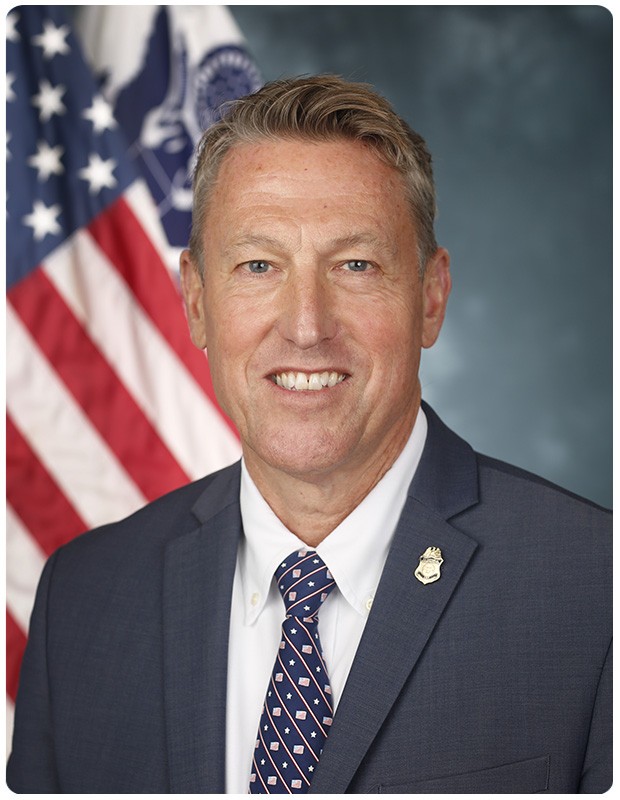
CBP Commissioner Rodney Scott paused construction inside Big Bend National Park on Aug. 17 for what he called a personal evaluation, while maintaining the sector cannot be left open for cartels to exploit. (Official CBP portrait, public domain)
What happens to landowners who don't sue?
That private-land wall is where eminent domain becomes unavoidable. Federal law gives landowners no ability to refuse a taking, only the right to negotiate compensation after the fact, and the Justice Department is currently hiring assistant U.S. attorneys in the Western District of Texas specifically for "owner and witness interviews, confirming land titles, property negotiations, and federal eminent domain litigation," according to a DOJ job posting reported by the Sentinel.
The government's newest tool is a "right of entry-construction" agreement that lets crews begin building immediately rather than surveying first and negotiating later. Laura Allen, a Republican former Val Verde County judge, told the Sentinel she was offered $5,000 for a route crossing more than eight miles of her land, sent by ACH transfer form for her signature. "The short answer to that is, 'Hell no,'" she said. Redford farmer Joaquin Peña put the stakes in plainer terms: a wall would cut him off from the pump he uses to irrigate his crops. "This place is a staple in my family's history and I refuse to just let it get taken away," he said.
What happens next?
The Real ID Act of 2005 stripped most non-constitutional claims out of these cases, meaning arguments about flood risk, contracting irregularities or economic harm rarely survive on their own; a court has to find an actual constitutional violation, and the Supreme Court has historically been reluctant to take these cases up at all. That is the uphill climb Conserve Big Bend faces, on top of five other pending suits over the same project from a Lipan Apache preservation group, a river-outfitter business, a historic-church preservation group, the Center for Biological Diversity and the city of Presidio's economic development district.
None of that makes the underlying question go away. A Republican administration is using an emergency waiver built for the busiest, most dangerous parts of the border to build through one of its quietest, defended by a designation whose own supporting number is mostly leftover math from a policy nobody defends anymore. The sheriffs, the senator, the land commissioner and the ranchers pressing this case are not asking Washington to leave the border unsecured. They are asking it to prove the emergency before it takes the land.