Rep. Ralph Norman signed Thomas Massie's discharge petition on Monday, becoming the third Republican on a document that needs 218 names to force a House vote the leadership of both parties has spent a year trying to avoid. Massie says he needs exactly one more. The math says he needs more than that, and the House leaves town Thursday.
What Ralph Norman Actually Signed
Norman, a retiring South Carolina Republican, added his name to Discharge Petition No. 27 on Monday, joining Massie and Rep. Nancy Mace as the third and newest Republican signature. The petition targets H.R. 9694, the Epstein Files Transparency Act II, and if it reaches 218 signatures the House is required to hold a floor vote whether Speaker Mike Johnson schedules one or not. Massie thanked Norman directly on X: "If just one more Republican signs this discharge petition, we'll be able to force the vote and pass this important bill. Has your Representative signed?"
Massie and Mace told Axios they are now working the phones on retiring members and Republicans in vulnerable districts, betting that a lawmaker with nothing left to lose politically is more willing to cross Speaker Johnson and the White House than one running for reelection. "Ralph Norman did it. He's a new one, and I think there are other new ones out there that we can get," Massie said.

Rep. Ralph Norman (R-S.C.), the third Republican to sign Massie's discharge petition. (Official congressional portrait, U.S. House of Representatives, public domain)
Why a Single Republican Signature Carries This Much Weight
The House currently sits at 218 Republicans, 214 Democrats and one independent, with two vacancies, according to the House Press Gallery's own party breakdown. A discharge petition needs 218 signatures regardless of how many seats are actually filled. Congress's own research service is explicit about why: a Congressional Research Service report on discharge procedure, updated in February, states the 218 threshold "is fixed, representing a majority of the total membership of the House (435)." It does not shrink when seats sit empty, and it does not care which party holds them.
That fixed number is what makes every individual Republican signature disproportionately valuable to Massie. As of a Newsweek count on September 4, the petition had 106 signatures: 104 Democrats and two Republicans, Massie and Mace. Even if every sitting Democrat eventually signs, 214 Democrats plus those two Republicans tops out at 216, two short. Norman's signature on Monday moved that ceiling to 217. It is still one short of 218, which is the arithmetic behind Massie's public math ever since he relaunched this fight: "We need four Republicans, myself and three others," he told journalist Pablo Manríquez that week, when only Mace had joined him. Eleven days and one signature later, he is telling Axios he has "one hero slot left."
The Part of the Math Nobody Is Saying Out Loud
Here is what the "one signature away" framing leaves out: it assumes near-total Democratic participation that has not actually happened yet. Newsweek's September 4 count showed 104 of 214 Democrats on board, not all of them. Every fresh Republican signature raises the theoretical ceiling, but the petition still has to close that separate gap on the Democratic side of the ledger to actually reach 218. Ro Khanna, the petition's lead Democratic cosponsor, told CNN he expects it to happen before the end of the year regardless of what happens in the next few days, calling it a matter of "logistics" rather than persuasion. Massie has made the identical argument about his own side: "I haven't found any Democrat who's against it."
Both men may be right that the votes exist on paper. Neither number is filled in yet.
What the Bill Actually Does, Beyond the Vote-Counting
The underlying legislation is not a repeat of last year's fight, it's an enforcement mechanism for it. The original Epstein Files Transparency Act, which Congress passed and President Trump signed into law on November 19, 2025, ordered the Department of Justice to release its full investigative record on Jeffrey Epstein within 30 days. H.R. 9694 exists because that deadline came and went without the department fully complying, in Massie's telling. The new bill would let Epstein survivors, state attorneys general, district attorneys and members of Congress sue the U.S. Attorney General directly over withheld, delayed or improperly redacted records, and it would expose DOJ and FBI officials to penalties for concealing or misrepresenting files. It also guarantees survivors access to their own complete, unredacted records, a protection the original law did not spell out.
"The government continues to withhold over three million files," Massie said in a statement introducing the bill in July, alongside Reps. Ro Khanna, Teresa Leger Fernández, Sens. Jeff Merkley and Ben Ray Luján. "That's why we've introduced the Epstein Files Transparency Act II, to bring the fight to the state courts, accountability to the Department of Justice and closure for survivors."

Rep. Nancy Mace (R-S.C.), the second Republican signature on the petition, alongside Massie since early September. (Official congressional portrait, U.S. House of Representatives, public domain)
Official record
H.R. 9694, Epstein Files Transparency Act II, 119th Congress, introduced July 15, 2026 by Rep. Thomas Massie. Full text below via GovInfo.
"To amend the Epstein Files Transparency Act with respect to enforcement by an attorney general of a State, and for other purposes." — H.R. 9694, as introduced
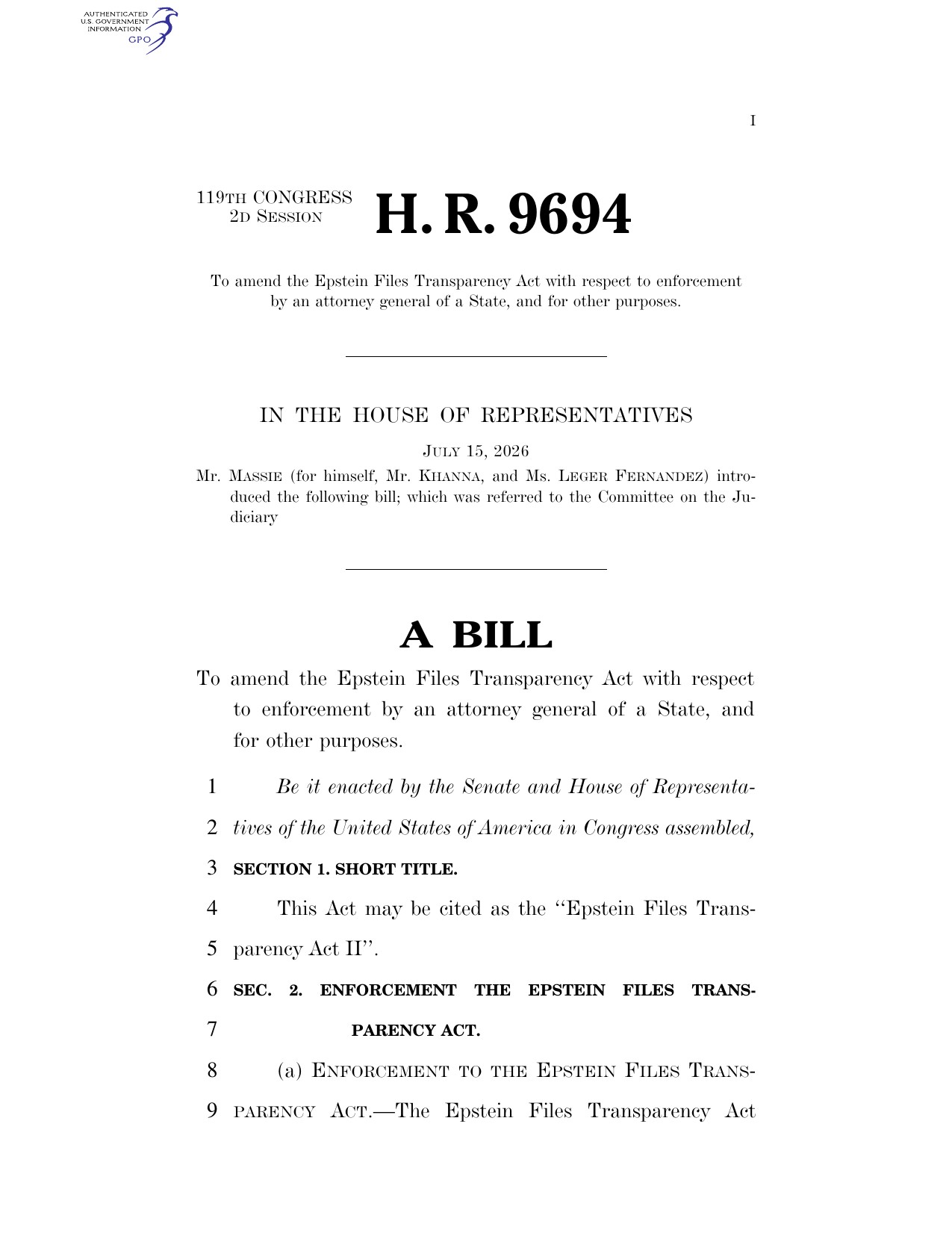
Read or download the full bill text (PDF) via GovInfo · view the live discharge petition count at the Clerk of the House
Why Massie Says Johnson Is Racing the Clock on Purpose
Even a completed petition would not guarantee a quick vote. Johnson's office has canceled two of the House's three remaining September work weeks, and the chamber is set to leave Washington on Thursday and stay out until after the November midterms. Any floor showdown on the discharge petition, even one that clears 218 signatures this week, would land after voters have already cast their ballots.
Massie says that timing is deliberate, not coincidental, and points the finger above Johnson's head. "He got a call from somebody that's above his pay grade that said, 'Take those two days off the calendar. Don't you dare give Massie the runway to get that plane off the ground,'" Massie told Axios. Johnson had called the idea of an extended recess "stupid" and "nonsensical" just weeks earlier, before his own office announced one.
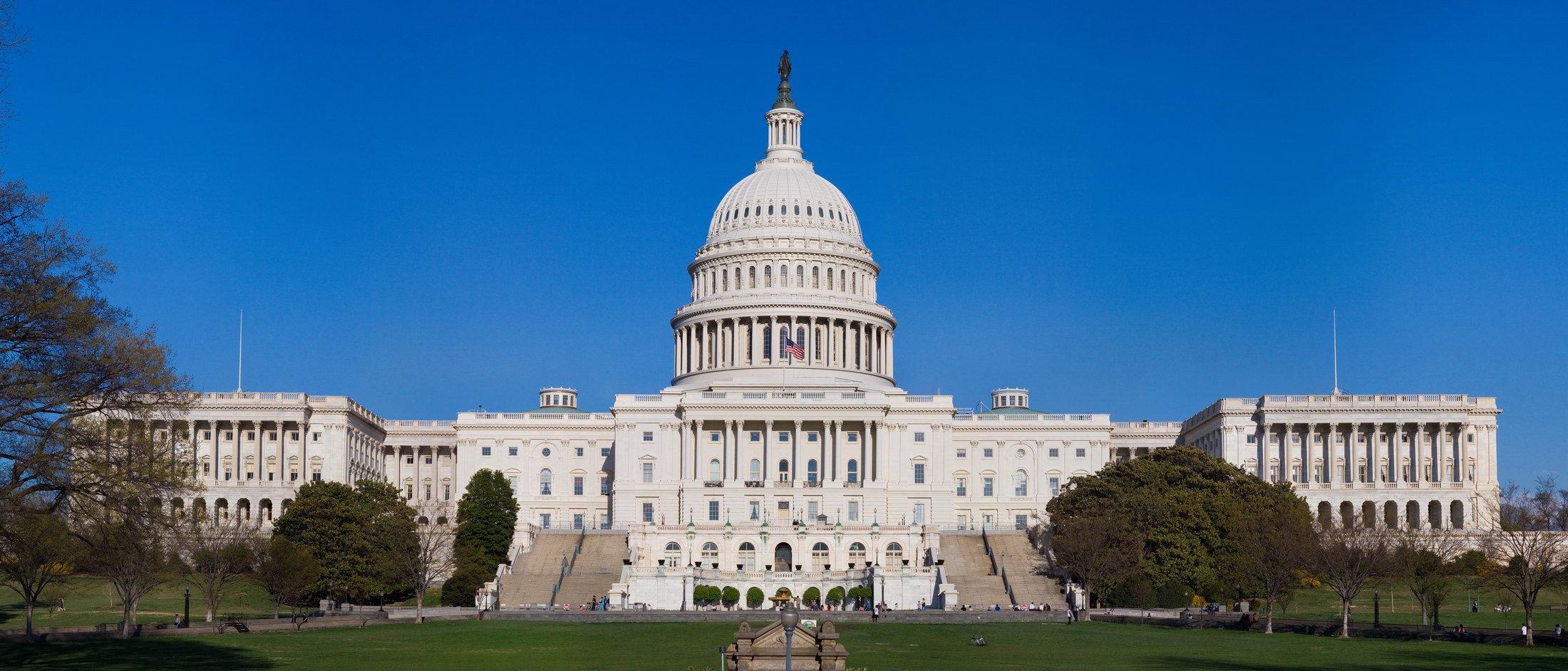
The U.S. Capitol. The discharge petition process lets 218 members force a floor vote over leadership's objection, but only once the House is actually in session to act on it. (Wikimedia Commons, public domain)
Who Is Actually Left to Ask
Massie says he is not counting on the four Republicans who signed the original 2025 petition to do it twice. Rep. Lauren Boebert, one of those original four, told Axios she is "considering" signing again and has been talking with Massie, but he is not banking on her. "Anybody who did the first one is not obligated to put their head in the guillotine again," Massie said. "I think it's somebody else's turn." Instead, he and Mace say they are focused on members who are retiring, like Norman, or running well behind in their own districts, where Massie's pitch is blunt: sign now and campaign on it, or lose anyway without it. "There are a few Republicans who are on the fence, and they understand the power of this issue," Khanna told CNN.
What Actually Happens If the Fourth Name Shows Up
If Massie and Mace land both a fourth Republican and the remaining Democratic signatures before the petition freezes at 218, the names get printed in the Congressional Record and the discharge motion moves to the House Calendar, where it becomes eligible for a floor vote on a designated day regardless of what Johnson's own schedule says. That is exactly what happened a year ago, when the original discharge petition hit 218 and forced a vote that passed the House by an overwhelming margin. Whether that repeats before or after the midterms is now a question of whether one more member of Congress is willing to put a name on a piece of paper the Speaker very clearly does not want signed.