The Justice Department has told the federal government it can no longer force churches, synagogues and faith-based charities to leave their religion at the door to receive taxpayer money. In an August 25 opinion made public and now drawing reaction from religious liberty lawyers and church-state separation groups alike this month, the Department of Justice's Office of Legal Counsel concluded that decades-old federal laws barring "sectarian worship, instruction, or proselytization" in taxpayer-funded programs violate the Free Exercise Clause.
What Did the Justice Department Actually Say on August 25?
The 39-page opinion, titled "Constitutionality of Religious Restrictions on the Use of Federal Funds," was written in response to a request from the Department of Health and Human Services. HHS asked OLC to decide whether it must keep enforcing statutory language that bars faith-based organizations from using certain federal grants for religious activity, according to the Deseret News.
The answer, signed by Assistant Attorney General T. Elliot Gaiser and Deputy Assistant Attorney General Joshua J. Craddock, is blunt: the restrictions are not required by the Establishment Clause, and they violate the Free Exercise Clause because they single out religious groups for a burden secular grant recipients never face. The opinion applies to three federal laws HHS administers: the Personal Responsibility and Work Opportunity Act of 1996, the Public Health Service Act, and the Child Care and Development Block Grant Act.
Why a Church Soup Kitchen Couldn't Say Grace Over the Meal It Funds
The opinion does not deal in abstractions. It walks through exactly what the old rules required and why OLC now says that is unconstitutional discrimination. A secular food bank can post messages on its walls or make announcements before a meal on any subject it wants. A church-run soup kitchen receiving the same type of federal support could not hold a communal prayer before serving that meal, under the very statutes at issue.
The opinion states plainly that recipients of federal funds cannot be required to "forgo[], segregat[e], or bifurcat[e] their religious activities" just to take part in a program open to everyone else. It gives a second, more pointed example: a secular organization running a sex-education curriculum is free to teach its own values about human sexuality, but a religious organization running the identical program could not teach its own religious view of human dignity and chastity.
Official record
Constitutionality of Religious Restrictions on the Use of Federal Funds, 50 Op. O.L.C. __ (Aug. 25, 2026), U.S. Department of Justice, Office of Legal Counsel.
"Although federal funding for these programs is generally available to private providers, religious providers who otherwise meet program requirements must clear an additional hurdle...A secular food bank may post advertisements on its walls or announce messages before meals on countless topics, while a church soup kitchen cannot hold a communal prayer before serving a meal." — DOJ Office of Legal Counsel opinion, pp. 29-30
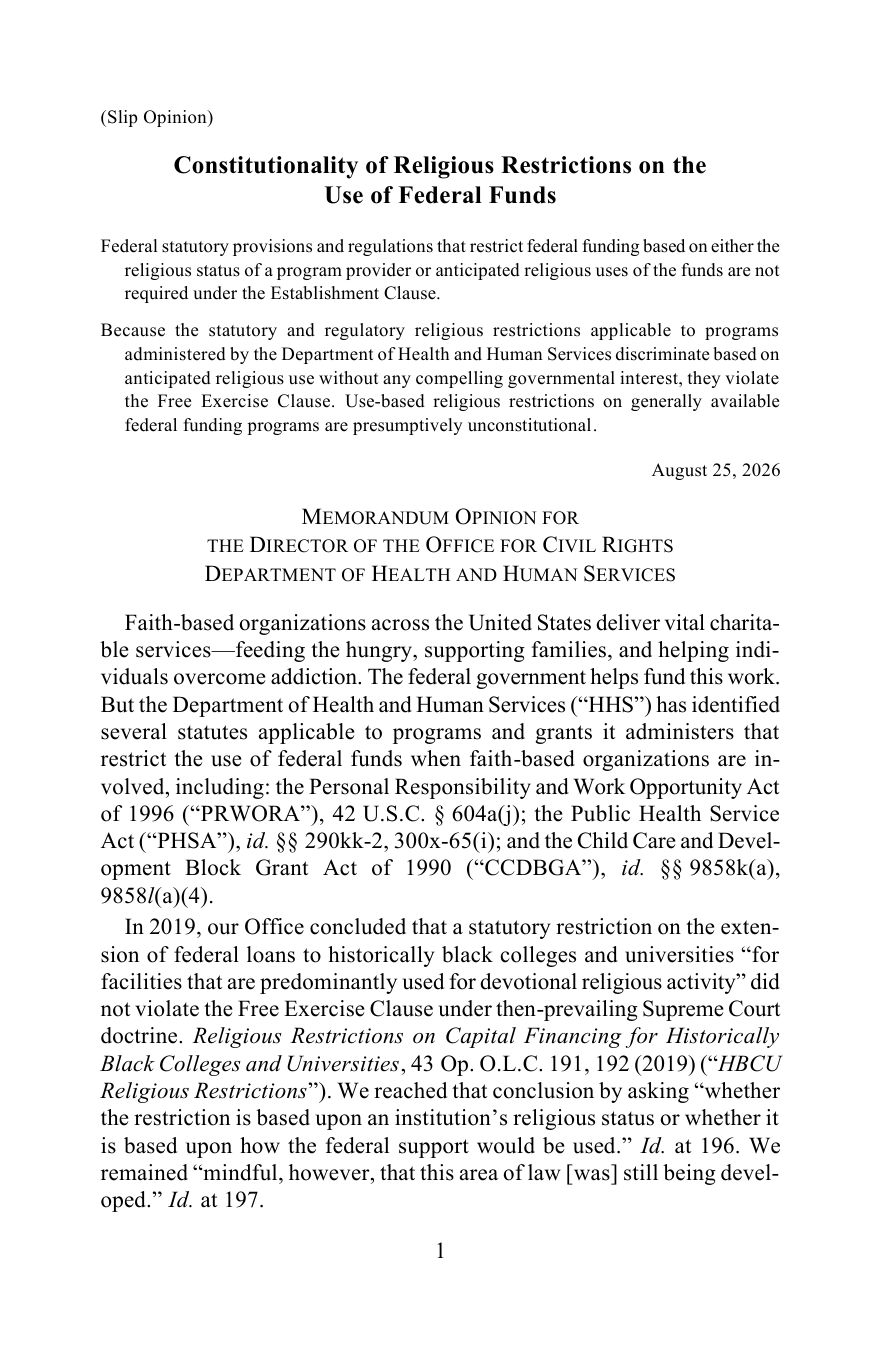
Read the full 39-page opinion (PDF) · view it on the Office of Legal Counsel's opinion page
Three Supreme Court Cases the DOJ Says Changed Everything
OLC's reasoning leans on a trio of Supreme Court rulings decided after its last word on this subject in 2019. In Espinoza v. Montana Department of Revenue (2020), the justices struck down a state rule blocking a tax-credit scholarship from reaching religious schools. In Carson v. Makin (2022), the Court ruled Maine could not exclude religious schools from a tuition program open to secular private schools. And in Kennedy v. Bremerton School District (2022), the Court sided with a public high school football coach fired for praying at midfield after games.
The U.S. Supreme Court building in Washington, D.C. Photo via Wikimedia Commons, CC BY-SA 4.0.
Those three rulings did not directly address the HHS statutes. But OLC concluded they rewired the underlying test: strict scrutiny now applies any time a government benefit is denied or burdened because of a recipient's religious status or its planned religious use of the money, and a state cannot dodge that by redefining its own program as "secular." In 2019, OLC had upheld a similar restriction on federal construction loans to historically Black colleges and universities. That 2019 opinion is now withdrawn.
The Line the Government Says It Can No Longer Draw
Reading the opinion in full turns up an argument that has gotten less attention than the headline conclusion: OLC says the government cannot even draw a clean line between "worship," "instruction" and "proselytization" in the first place, because that line depends on theology, not neutral fact.
The opinion leans on last year's unanimous Supreme Court decision in Catholic Charities Bureau v. Wisconsin Labor and Industry Review Commission, decided 9-0 in June 2025, which struck down a Wisconsin tax rule after noting that "Catholic teachings distinguish between 'evangelization,' which involves sharing one's faith, and 'proselytization,' which seeks to influence or coerce others into accepting one's religious views." If a Catholic agency and a Baptist one define those words differently, OLC reasons, then any federal official who has to decide which activities cross the line is making a theological judgment call the Constitution does not let the government make.
The opinion applies that logic even to programs with no obvious religious content. A footnote states that if the government funds a STEM scholarship, it can exclude subjects unrelated to STEM, but it must let a religious provider "integrate their faith into STEM instruction," including "discussing the relationship between faith and science or the theological basis for mathematics." The Freedom From Religion Foundation seized on that exact footnote in its August 27 statement, with Deputy Legal Director Liz Cavell calling it proof of "just how extreme this theory is."
What Happens to HHS Programs From Here?
OLC did not strike the statutes down itself. It concluded the religious restrictions in the three laws are severable, meaning the rest of each program can keep running with the restrictions simply not enforced. The opinion closes by telling HHS that if it adopts a policy of not enforcing the unconstitutional provisions, it must report that decision to Congress within 30 days, citing 28 U.S.C. § 530D.
That is a real, near-term mechanism, not a symbolic gesture. TANF-funded child care, job training, homeless shelters and family programs, SAMHSA behavioral health and addiction-treatment grants, and CCDBGA child care vouchers are the ones directly named in the opinion. Whether HHS moves on that opening is now the number one thing to watch, and neither the department nor the White House has announced a formal policy change as of this week.
Who Is Already Fighting Over It?
First Liberty senior counsel Mike Berry, whose organization argued Kennedy v. Bremerton before the Supreme Court, wrote that the opinion "represents a major victory for religious liberty" and that "for far too long, people of faith have had to tolerate religious discrimination in government funding," in an August 28 post on the group's site.
The Freedom From Religion Foundation calls it a plan to "turn federal social service programs into government-financed vehicles for evangelism." FFRF Co-President Annie Laurie Gaylor said in the group's statement that "the First Amendment does not require the government to bankroll prayer, preaching or proselytizing," and pledged the group will track HHS for any move to stop enforcing the current rules.
What's Actually at Stake for Faith-Based Charities
Strip away the legal citations and the fight is over something concrete: whether a pregnancy center, a homeless shelter, a substance-abuse ministry or a church-run child care program has to pretend it is not religious to get the same federal grant dollars a secular nonprofit gets automatically. For years, groups like Catholic Charities, Lutheran Social Services and countless local ministries have taken federal money and then had to build walls inside their own buildings, in time or physical space, to keep prayer separate from the funded activity.
OLC's opinion does not create new law by itself, and a future administration could withdraw it just as this one withdrew the 2019 version. But it hands HHS a legal green light it did not have a month ago, and it puts every religious nonprofit that receives federal money on notice that the ground under the old rules has shifted. The next real test will not be a memo. It will be whether HHS actually stops enforcing PRWORA's restriction, and whether FFRF or another group sues the moment it does.