The Associated Press has spent nineteen months in federal court portraying itself as a First Amendment martyr, banned from the Oval Office for refusing to call the Gulf of Mexico the "Gulf of America." A New York Times report published September 12 says that was never the whole story. According to two people briefed on a private 2025 lunch between Trump aides and network anchors, the AP's refusal to hand the White House usage rights to Evan Vucci's photo of Trump raising his bloodied fist after the Butler, Pennsylvania shooting was fueling the ban too.
What did the Times actually report?
The Times cited two sources with direct knowledge of a 2025 lunch where White House aides told network anchors that AP's refusal to license the Butler photo was part of what hardened the administration's stance toward the wire service. Fox News confirmed the reporting and got a response from an AP spokesman, who said the outlet is "focused on continuing to stand for the right of the public and the press to speak freely without government retaliation or control." A separate source told Fox the White House never actually communicated that reasoning to the AP directly.
The Gulf of Mexico dispute has never been a secret. The White House barred AP reporters from the Oval Office, Air Force One and the press pool in February 2025, and Deputy Chief of Staff Taylor Budowich called the AP's continued use of "Gulf of Mexico" misinformation at the time. What's new is the photo angle, and it changes the shape of the story considerably.
Why does one photograph carry this much weight?
Vucci's image from the July 13, 2024 Butler rally, Trump's fist raised and blood on his cheek moments after Secret Service agents pulled him up from the stage floor, is one of the most reproduced news photographs of the decade. Trump was mid-sentence about immigration under the Biden administration when gunfire rang out; a Secret Service sniper killed the shooter, Thomas Matthew Crooks, who had also killed rallygoer Corey Comperatore and wounded two others.
Vucci described sprinting to the side of the stage on instinct, expecting Trump to be moved that direction, and switching to a wide lens so the flag overhead would frame the shot. "I knew immediately that it was going to be one of the most important things I'll ever photograph," he told Fox News Digital in July 2024.
That instinct was correct. The photo ran on front pages worldwide and became the defining image of a presidential campaign. AP owns the copyright, and Trump's team wanted the rights to use it freely. The AP said no.
What does the AP's own lawsuit say the fight was about?
Here is where the story gets interesting for anyone willing to read past the press releases. The AP sued Budowich, Press Secretary Karoline Leavitt and Chief of Staff Susie Wiles on February 21, 2025, in Associated Press v. Budowich, case No. 1:25-cv-00532, before Judge Trevor N. McFadden in the U.S. District Court for the District of Columbia. The complaint and every filing that followed built one argument: the White House was punishing the AP for its editorial word choice on the Gulf of Mexico, a textbook case of viewpoint discrimination.
Judge McFadden's 41-page memorandum order granting the AP a preliminary injunction on April 8, 2025 recounts testimony from AP photographer Evan Vucci himself, called as a witness to describe how the ban degraded the wire service's coverage. The order runs through the mechanics of the press pool, the White House Correspondents' Association, and the history of the Gulf of Mexico executive order in granular detail.
Official record
Associated Press v. Budowich, No. 1:25-cv-00532 (D.D.C.), Memorandum Order granting preliminary injunction, filed April 8, 2025. Full docket available via the Civil Rights Litigation Clearinghouse and CourtListener.
"About two months ago, President Donald Trump renamed the Gulf of Mexico the Gulf of America. The Associated Press did not follow suit. For that editorial choice, the White House sharply curtailed the AP's access to coveted, tightly controlled media events with the President." — Judge Trevor N. McFadden
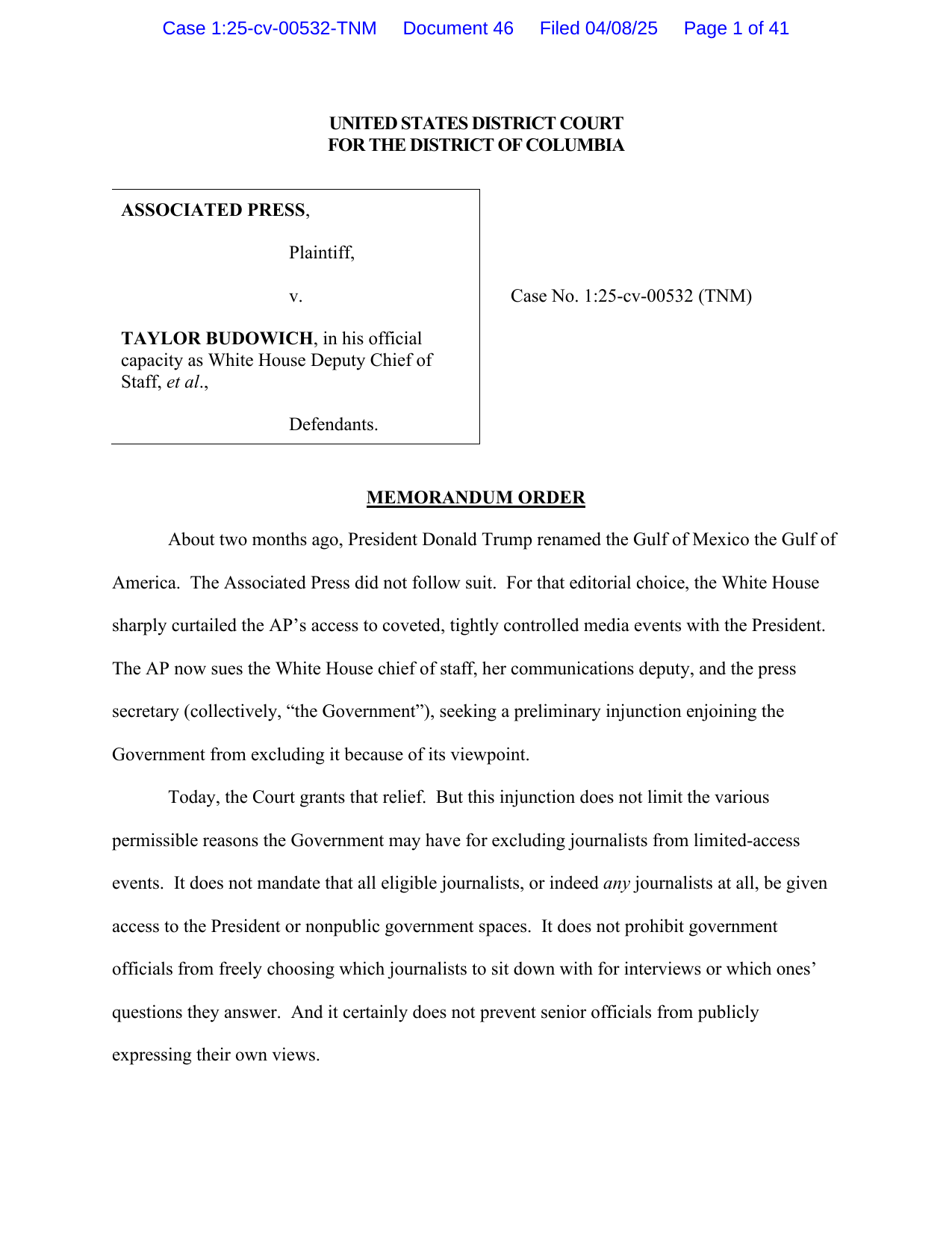
Read the full 41-page memorandum order (PDF) · view the case docket
Did the sworn court record ever mention the photo dispute?
We read the full memorandum order, along with the case docket, looking for any reference to the Butler photo, Vucci's licensing dispute, or the fist image at all. It isn't there. Not once, in 41 pages built substantially around Vucci's own testimony about the ban's effect on his ability to shoot the president, does the photo-rights dispute surface as a motive, a defense, or even a stray footnote.
That is the detail every rewrite of the Times story missed. The AP's entire legal theory, argued under oath, cross-examined by government lawyers, and weighed by a federal judge for over a year now, rests on a clean narrative: a wire service punished purely for a word choice. If aides really were also settling a licensing dispute over the most valuable photo either side has ever owned, that fact never made it into a single motion, declaration, or hearing transcript the AP itself filed.
The Associated Press headquarters at 50 Rockefeller Plaza in New York City. (Alterego / Wikimedia Commons, CC BY-SA 3.0)
Is the AP's "free press" framing the full picture?
None of this means the Gulf of Mexico dispute is fake or that viewpoint-based access restrictions raise no real legal questions. Judge McFadden sided with the AP at the preliminary injunction stage, and a divided D.C. Circuit panel later found the Oval Office, Air Force One and similar spaces fall outside the First Amendment's reach for these purposes, splitting the difference. Both rulings deal with the case the AP actually brought.
What the new reporting adds is a second, less flattering motive sitting alongside the free-press one: a for-profit news organization protecting the commercial value of its own copyrighted image, taken of a sitting president who nearly died, while its own executives cast the fight purely as a defense of democratic principle. Readers weighing who is right in AP v. Budowich deserve to know both motives were reportedly in play, since the AP only put one of them in its complaint.
Where does the case stand now?
The D.C. Circuit heard oral argument on the government's appeal on November 24, 2025, with nearly four dozen news organizations, including Fox News Channel, The New York Times and The Washington Post, filing a brief backing the AP's access claim. Ten months later, the appeals court still hasn't ruled. The underlying case remains stayed at the district court level pending that decision, and AP photographers and reporters continue operating under the partial restrictions the 2025 panel left in place.
The AP has not disputed the Times' photo-rights reporting on the record; it has only restated its First Amendment position. The White House, per Fox News Digital, did not respond to a request for comment on the photo angle at all.
Why should readers care which motive is real?
A White House barring a wire service purely because it wouldn't use a preferred name is a genuine press-freedom problem, and PatriotAddict readers who value the First Amendment should take it seriously regardless of who occupies the Oval Office. But a White House also unhappy that the same wire service wouldn't hand over rights to the single most valuable photograph of Trump's political life is a business dispute wearing a free-speech costume.
The AP got to choose which version of that story it told a federal judge for a year and a half. It chose the one that made it look like a martyr instead of a copyright holder. That's worth remembering the next time a network anchor cites this case as proof of an administration at war with the truth, because the AP's own filings suggest the fight was never quite that simple either.