President Trump says the Iran war is paid for well into the new year. "Up until really the end of January, pretty much, you know, we're funded," he told the New York Post in an Oval Office interview Tuesday. The law that actually keeps the Pentagon's lights on says something different: it runs out on Dec. 11, three weeks before Democrats take over Congress, and Republicans who still run the Senate are already talking about attaching limits to the next one.
What did Trump actually say?
Asked whether his window to keep striking Iran was closing now that Democrats won both chambers in the Nov. 3 midterms, Trump said he found it hard to believe they would "take a win and make it into a loss," then added the funding line, according to the Post interview as quoted by Israel Hayom and ZeroHedge.
He made the case that the war is already won. "Their navy's gone, their air force is gone, their anti-aircraft, everything's gone. Their leaders are gone," he said, per ABC News. "We can put that war to bed anytime we want." He also said regime change "was never a criteria for me" and that his goal is keeping Iran from getting a nuclear weapon.
What Trump did not say is which pot of money he meant. Congress has never passed a dedicated war appropriation, and the Pentagon has not published an account-by-account breakdown showing what is left.
So what does the law say?
The federal government, Pentagon included, is running on the Continuing Appropriations and Extensions Act, 2027, which Trump signed on Sept. 2 as Public Law 119-103. Section 106 says the money is available until the earliest of three events. The third is a flat date: "December 11, 2026."
The new Congress is sworn in on Jan. 3. That means the next funding fight happens while Republicans still hold both chambers, not in January under Democratic control. Trump's "end of January" is about seven weeks past the date written into law.
Official record
Continuing Appropriations and Extensions Act, 2027, Public Law 119-103 (H.R. 6500), signed Sept. 2, 2026, 140 Stat. 989, page 3 of 10.
"...appropriations and funds made available and authority granted pursuant to this Act shall be available until whichever of the following first occurs: ... (3) December 11, 2026." Section 106
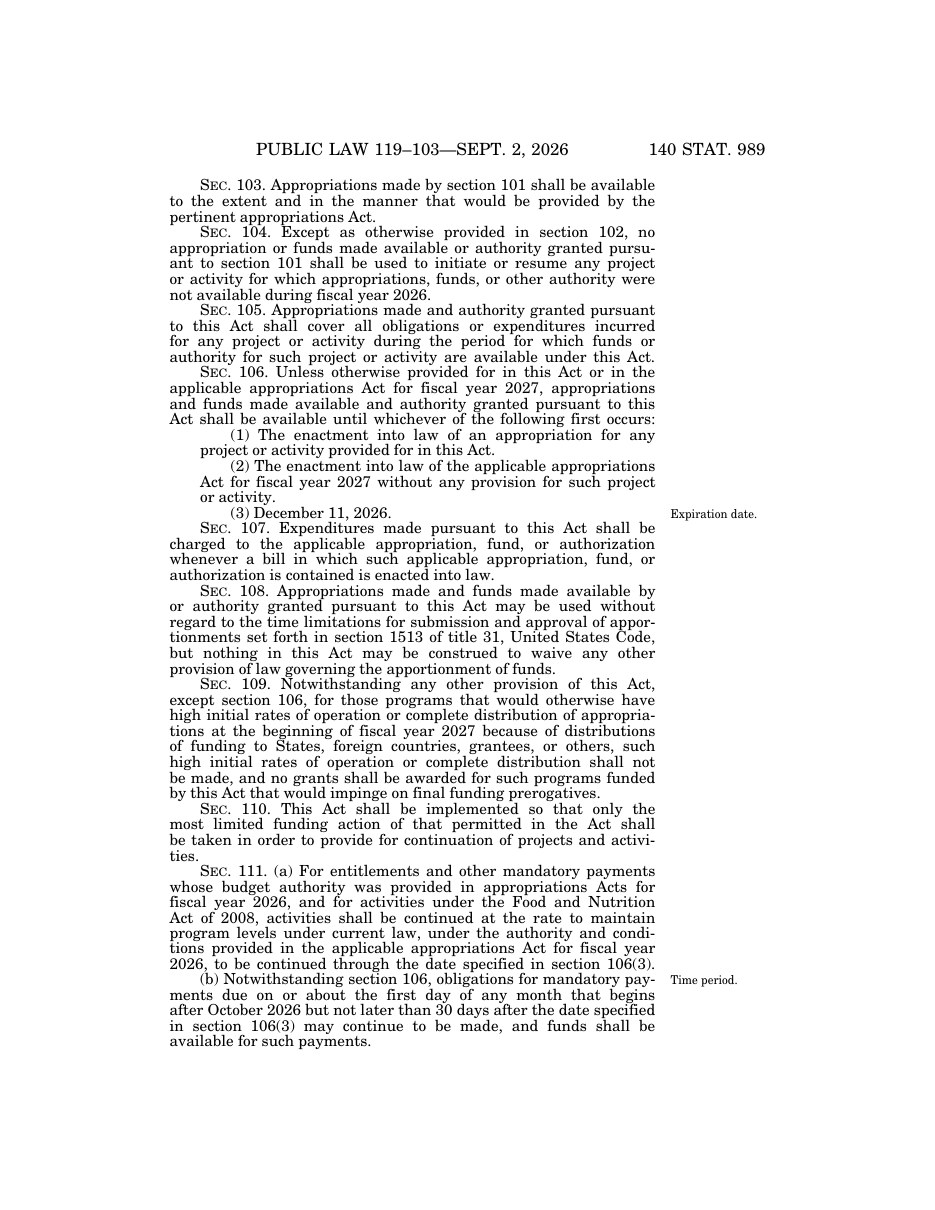
Read or download the full 10-page law (PDF) or view the official copy on Congress.gov.
Does the stopgap pay for more missiles?
Not at a faster clip. Section 102 of the same law bars the Defense Department from using stopgap money to raise production rates "above those sustained with fiscal year 2026 funds," or to start producing anything not already funded. That matters because the biggest piece of the war's bill is replacing weapons.
The Pentagon told Congress the war had cost an estimated $47.1 billion as of Oct. 16, according to Central Command figures obtained by the AP and reported by Federal News Network. About $29 billion of that is munitions replacement, about $11.9 billion is operations, and about $6 billion is lost equipment. The tally rose $3.5 billion in roughly six weeks. The White House has asked Congress for a $95 billion package that would help pay for the war, and separately wants a $350 billion military package through a party-line reconciliation bill that Majority Leader John Thune has said lacks the votes, per HNGN.
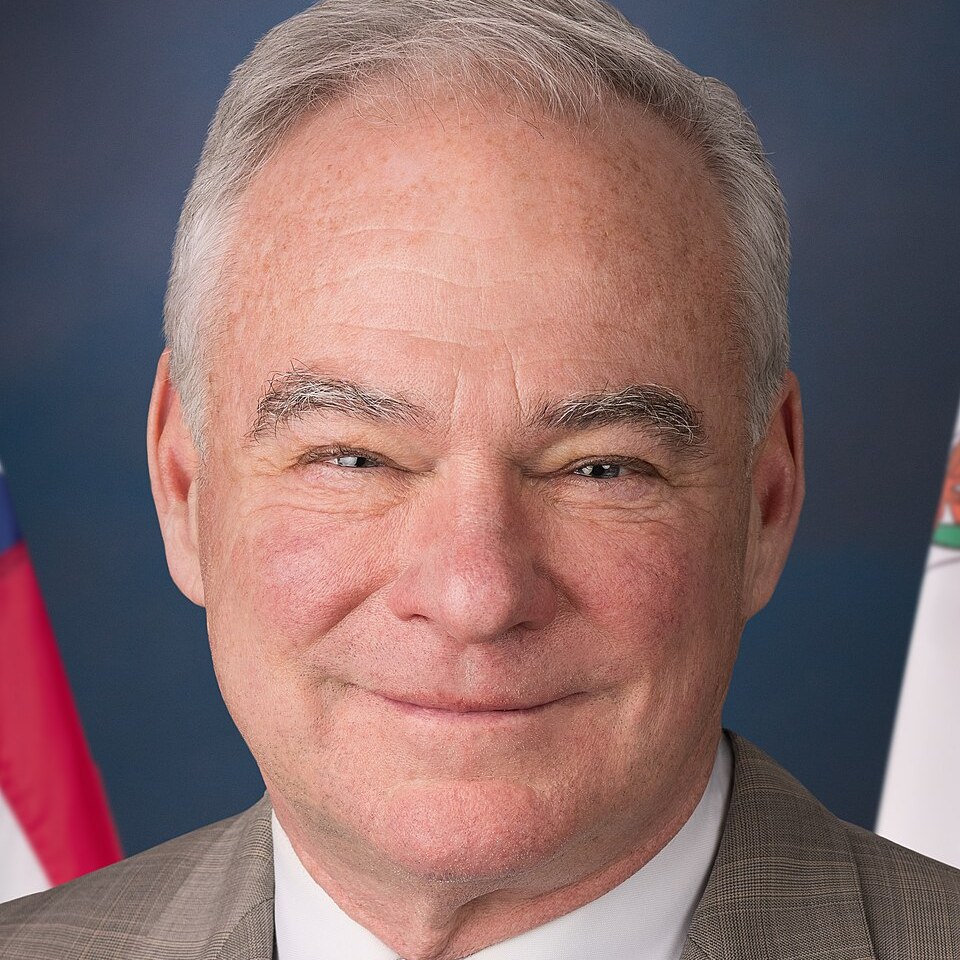
Sen. Tim Kaine (D-Va.) is drafting language to bar money for offensive operations in Iran unless Congress authorizes them. Official U.S. Senate portrait, 119th Congress, via Wikimedia Commons, public domain, cropped.
Who wants to put strings on the money?
Democrats, first. Sen. Tim Kaine is drafting a provision that would block appropriated funds for offensive operations against Iran without congressional authorization, while still paying for defense of U.S. forces and evacuations, HNGN reported. Sen. Chris Van Hollen says he won't vote for anything that funds the war. Sen. Michael Bennet's letter urging Democrats to filibuster any bill carrying war money was covered here last week.
The surprise is on the Republican side. Asked about a deal that restocks munitions while cutting off money for the war itself, Senate Appropriations Chair Susan Collins said, "I'm looking at language that might be able to do that," according to the Washington Post as cited by the Daily Caller. Majority Leader Thune said he was open "to anything that keeps the government funded and makes sure that we've got our military," in a quote the Daily Caller trimmed. Sens. John Hoeven and Josh Hawley have also signaled room to negotiate, per HNGN.

Sen. Susan Collins (R-Maine), who chairs the Senate Appropriations Committee until Jan. 3. Official U.S. Senate portrait, 2014, via Wikimedia Commons, public domain, cropped.
Can Democrats actually stop the war with a shutdown?
Not cleanly. Republicans hold 53 Senate seats, so any spending bill needs at least seven Democrats to clear 60 votes, and Trump has said he will veto liberally, HNGN reported. Even Rep. Rosa DeLauro, the top House Democrat on appropriations, argues a shutdown would not necessarily end the war. Sen. John Kennedy puts the odds of a shutdown at better than even.
There is also a timing problem for Democrats. Senate Democrats hold a leadership vote on Dec. 1, with Van Hollen challenging Chuck Schumer over the war, and Sen. Mike Rounds says they will be hard to deal with until it's settled. That leaves about 10 days to write a bill.
What happens next?
Both chambers return Nov. 30. Trump framed January as the deadline and Democrats as the threat. The law he signed puts the real deadline on Dec. 11, and the first people writing restrictions into the next bill could be his own party's appropriators. If the war is the "total win" Trump describes, he has about two weeks to persuade Republicans like Collins to pay for it on his terms, before anyone in a Democratic majority casts a single vote.
Top photo: President Trump in the White House Situation Room on June 21, 2025, the night of U.S. strikes on Iranian nuclear sites, with Vice President JD Vance in the foreground. Official White House photo via Wikimedia Commons, public domain.