Bangor Christian Schools won at the U.S. Supreme Court in 2022, yet more than four years later it is still shut out of Maine's tuition program, and two new petitions filed Friday ask the justices to finally end what they call Maine's "clever legislative trick." The Crosspoint Church petition and the St. Dominic Academy petition put a 2022 tweet from Maine's own House Speaker in front of the Court. The state's own court record shows just one religious school in the program the school year after the ruling.
What did the Supreme Court tell Maine in 2022?
Maine lets families in towns without a public high school send their kids to an approved private school on the town's dime. From 1981 on, the state barred "sectarian" schools from that program. In Carson v. Makin, decided June 21, 2022, the Court struck that ban down 6-3 under the Free Exercise Clause.
Bangor Christian, run by Crosspoint Church, was one of the two schools at the center of that case. The Carson family wanted to send their daughter there and had to pay the tuition themselves.
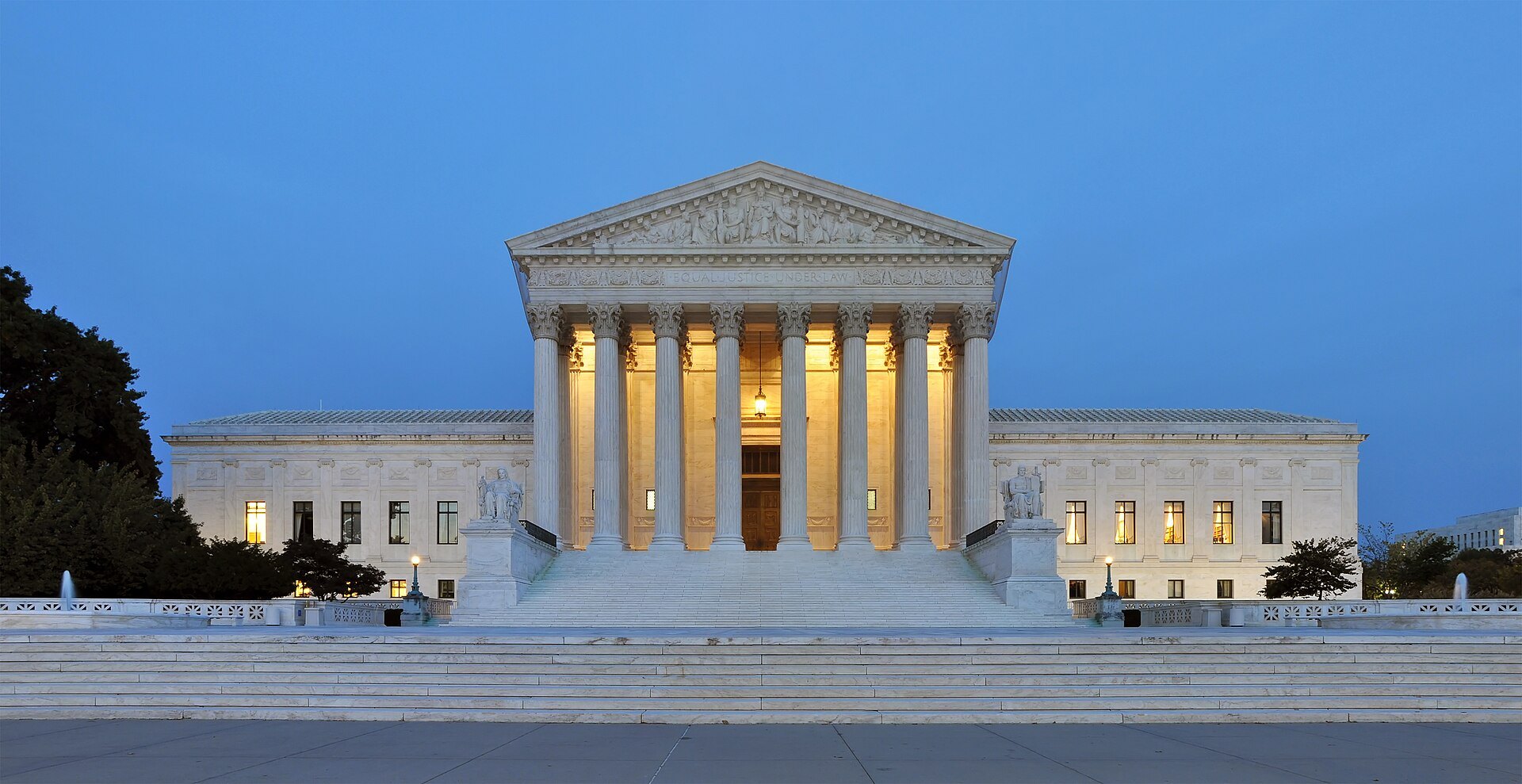
The U.S. Supreme Court, which ruled for Maine's religious families in Carson v. Makin in 2022 and now has two new petitions from Maine schools. Photo by Joe Ravi via Wikimedia Commons (CC BY-SA 3.0).
How did Maine keep the schools out anyway?
While Carson was still pending, the Legislature passed LD 1688, which took effect in October 2021. According to the Crosspoint petition, the old law said its sexual orientation rules did "not apply to any education facility owned, controlled or operated by a bona fide religious corporation." The new text, now in Title 5, Section 4602, protects only a religious school "that does not receive public funding." The amendments also added religion as a protected class, which bars a Catholic school from preferring Catholic families in admissions.
Any private school approved for tuition falls under the Maine Human Rights Act. A district court opinion reprinted in the St. Dominic petition's appendix lists the penalties: up to $20,000 for a first violation, $50,000 for a second and $100,000 after that.
Maine saw the result coming. In its Carson merits brief, quoted in the Crosspoint petition, the state told the justices it was "highly unlikely" the schools would take public money, because accepting it "would result in a significant change in how BCS ... operate[s]."
Official record
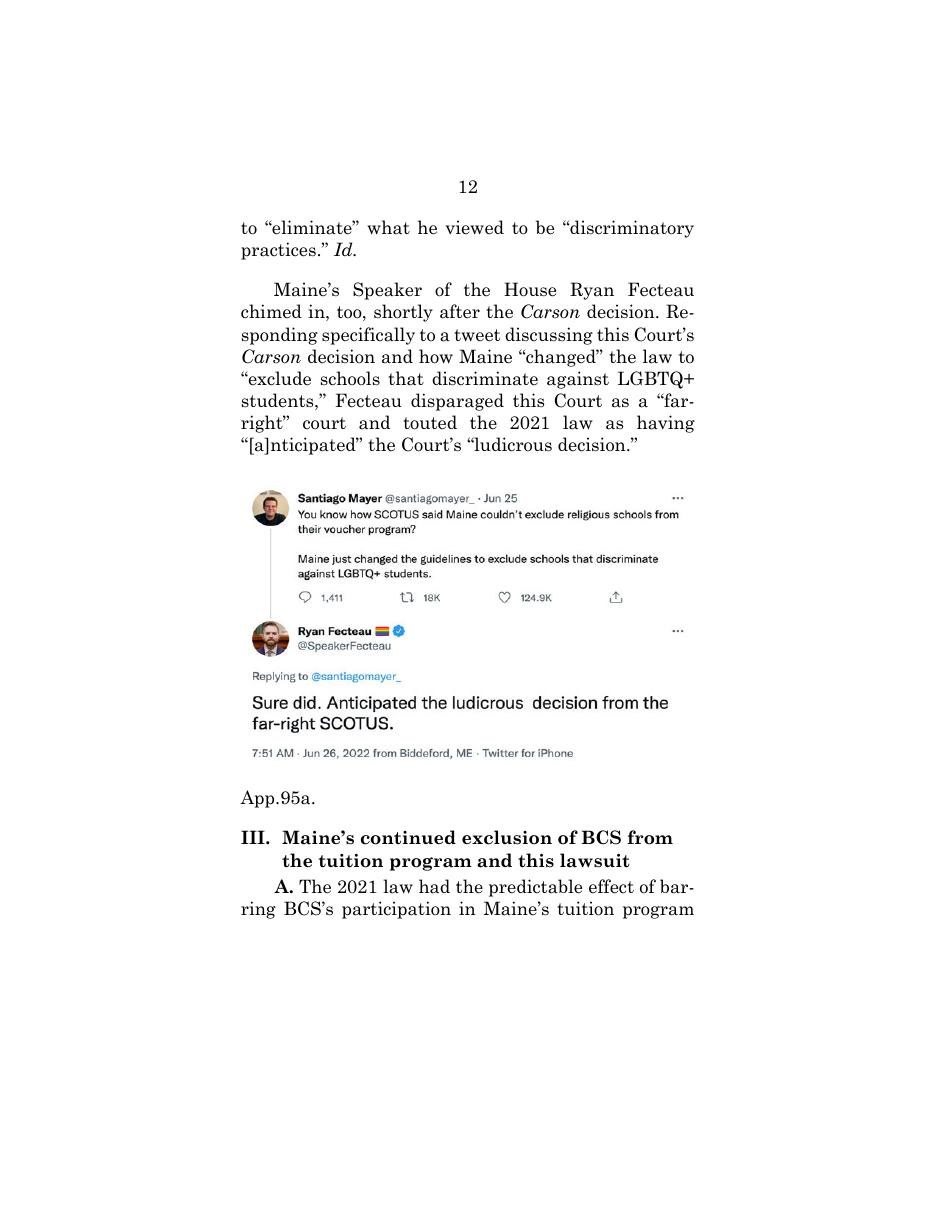
Petition for a Writ of Certiorari, Crosspoint Church v. Makin, filed Nov. 20, 2026, from First Circuit No. 24-1590. Page 12 reproduces the June 26, 2022 tweet from then-Speaker Ryan Fecteau that the church cites as proof of Maine's motive.
"Sure did. Anticipated the ludicrous decision from the far-right SCOTUS." Maine House Speaker Ryan Fecteau, June 26, 2022, as reproduced in the petition
Read or download the full 185-page petition with appendix (PDF) or view it on First Liberty's site.
What did Maine's leaders say out loud?
The petitions lean hard on the public record. The day Carson came down, Attorney General Aaron Frey called the education at the schools "inimical to a public education" and promised to look at ways to make sure "public money is not used to promote discrimination, intolerance, and bigotry," according to his statement reprinted in the Crosspoint appendix. Five days after the ruling, Fecteau posted the tweet shown above.
Both petitions also cite a New York Times op-ed by law professor Aaron Tang, published two days after Carson, headlined "There's a Way to Outmaneuver the Supreme Court, and Maine Has Found It." Tang called Maine's approach a "model for lawmakers elsewhere," per the St. Dominic petition.
Can a religious school join at all?
Technically, yes. The district court record in the St. Dominic case says Cheverus High School, a Jesuit Catholic school in Portland that sets its own policies apart from the diocese, was the only sectarian school in the program in the 2022-23 school year. Five students attended it at public expense, according to the same appendix.
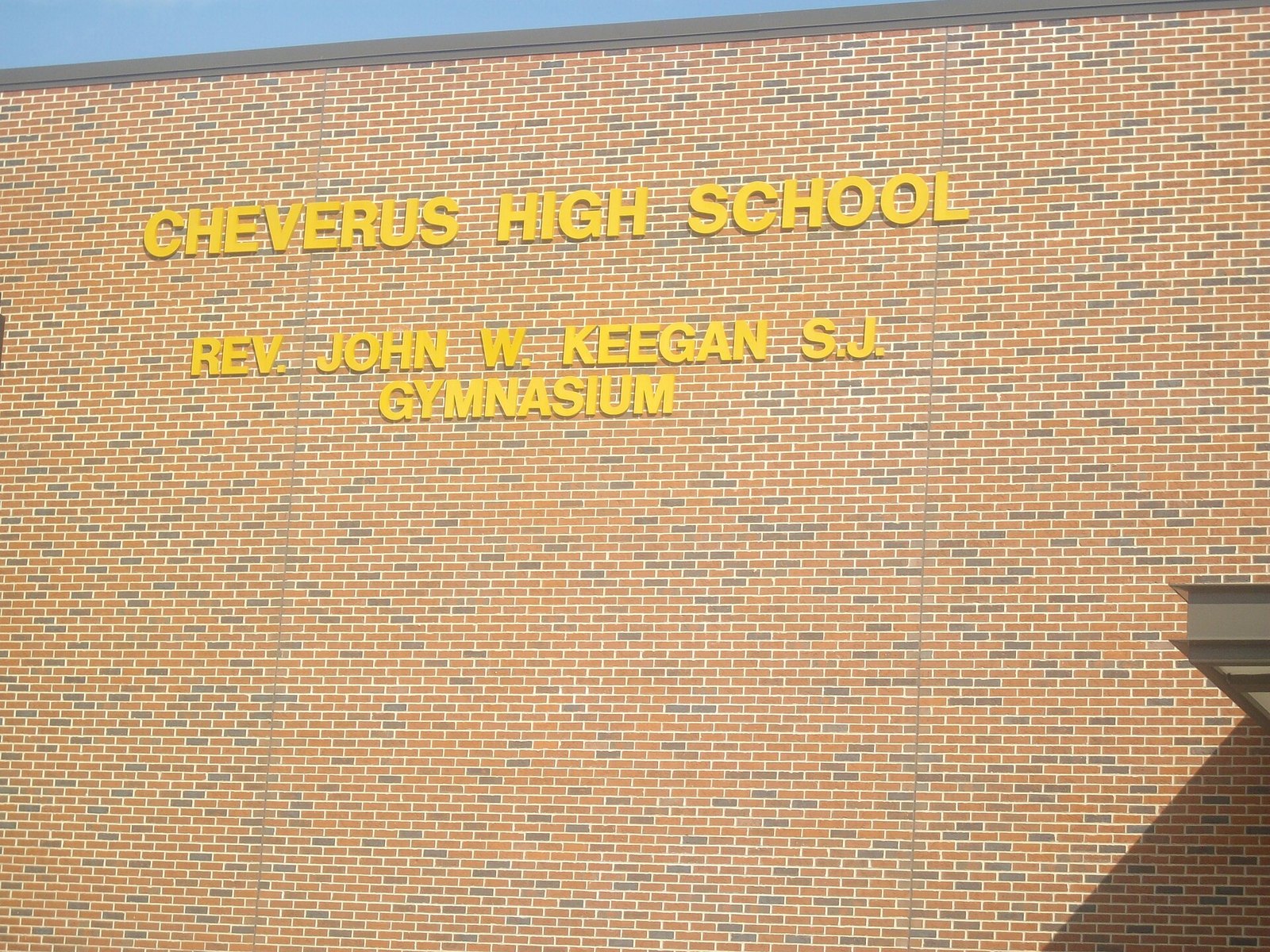
Cheverus High School in Portland, the one religious school the court record lists in Maine's tuition program for 2022-23. Photo by Thomas.macmillan via Wikimedia Commons (CC BY 3.0).
Schools that hold to traditional teaching on marriage and sex are another matter. Bangor Christian requires students to dress according to their biological sex, according to the Crosspoint petition, and St. Dominic says in its petition it will not use pronouns that don't match a student's sex or help hide a gender change from parents. Under Maine's rules, both would have to drop those policies to take tuition.
What did the First Circuit actually decide?
On July 2, 2026, the First Circuit handed the schools one narrow win. It struck the rule that a school allowing religious expression "cannot discriminate between religions," calling it facially non-neutral. Everything else survived. The court read Carson as applying only when a state excludes schools "solely because" they are religious, and applied the lenient standard of Employment Division v. Smith instead. It called the Speaker's tweet a "one-off" statement, the Crosspoint petition says.
The Maine attorney general's office declined to comment on that ruling, according to The Maine Monitor's report via AP. The American Civil Liberties Union of Maine said in that report that all schools taking state money should "play by the same rules."
What happens next?
St. Dominic, represented by the Becket Fund, asks the Court to overrule Smith outright. Crosspoint, represented by First Liberty Institute, asks at minimum that the justices hold its case until they decide St. Mary Catholic Parish v. Roy, the Colorado Catholic preschool case argued this month. Its petition says Justices Gorsuch and Barrett raised Maine's maneuver from the bench during that argument.
"Free-exercise rights cannot be nullified with a clever legislative trick," the Crosspoint petition says. Maine has 30 days to respond, The Maine Monitor reports, and Becket expects the justices to take up the petition in early 2027. For the families who won in 2022, the question is simple: did the win mean anything?
Top photo: The Maine State House in Augusta, where lawmakers passed the 2021 Human Rights Act amendments. Photo by Quintin Soloviev via Wikimedia Commons (CC BY 4.0).