Headlines this week say President Trump's administration is cutting Medicare for 300,000 legal immigrants. That number is real, but it counts letters, not people losing coverage. CMS's own final rule, published Nov. 9, says its actuaries expect about 32,000 people to actually lose Medicare starting in 2027, and anyone holding a green card keeps it under the law Congress passed in July 2025.
What are the letters saying?
The Social Security Administration has started mailing notices to Medicare enrollees whose immigration status it cannot confirm, The Washington Post reported on Nov. 24. A redacted notice obtained by the Post reads, "A review of our records shows you may no longer qualify for Medicare due to a change in the law," according to Newsweek's account of the Post's reporting. Newsweek ran the story under the headline "Trump Admin Cuts Medicare Coverage for 300,000 Legal Immigrants."
The key word in that notice is "may." SSA's own Medicare eligibility page tells recipients to "read the notice carefully" because it "will explain what steps, if any, you need to take," and says anyone who believes they were wrongly flagged can upload documents through a my Social Security account, call, or visit an office. Coverage for people who are not eligible generally runs through Jan. 31, 2027, "with coverage termination effective February 1, 2027."
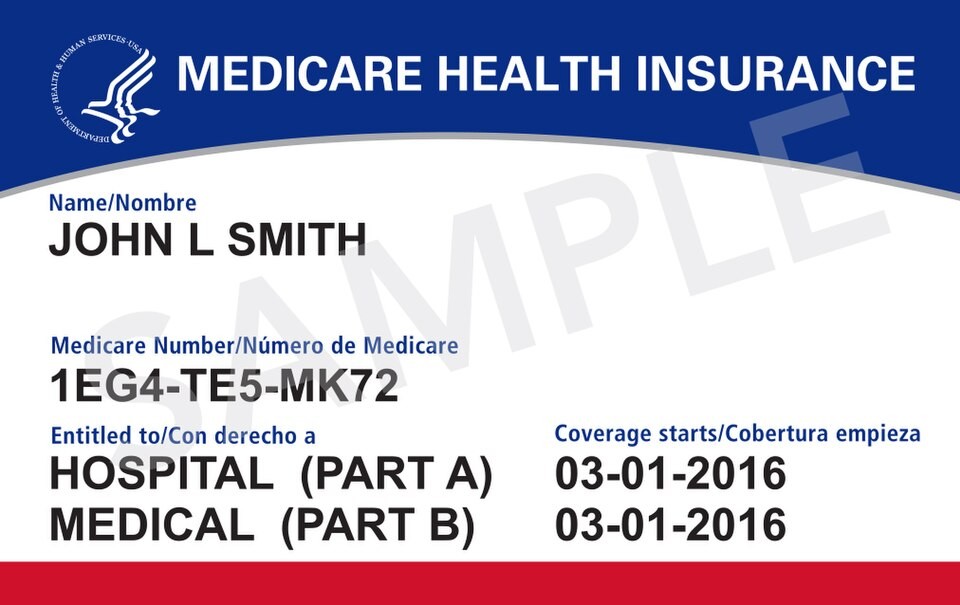
A sample Medicare card. Under the 2025 law, the card stays valid only for citizens and nationals, green card holders, Cuban and Haitian entrants, and Compact of Free Association migrants. Image from Medicare.gov via Wikimedia Commons, public domain.
Who does the law actually cut off?
Section 71201 of Public Law 119-21, the bill Trump signed on July 4, 2025, added a new section 1899C to the Social Security Act. CMS's final rule says the section limits Medicare to four groups: U.S. citizens or nationals, lawful permanent residents, Cuban and Haitian entrants, and people living here under a Compact of Free Association. The rule calls the law the "Working Families Tax Cut" legislation, the administration's name for what most people know as the One Big Beautiful Bill.
Before that law, Medicare was an outlier. The rule explains that the 1996 welfare reform law barred most noncitizens from federal benefits but carved out Medicare, which stayed open to anyone "lawfully present." That opened the program to people on temporary statuses. Newsweek lists the groups now losing eligibility as refugees, asylum grantees, Temporary Protected Status holders and certain trafficking victims. The rule itself describes the affected population as "certain immigrants with temporary protections."
So where does 32,000 come from?
It comes from the government's own number crunchers. In the rule's regulatory impact section, CMS writes that its Office of the Actuary projects "approximately 32,000 individuals" will lose Medicare starting in 2027, about 0.05 percent of total Medicare-aged enrollment. The same page says SSA recently estimated it would send about 300,000 notices in November, and that those people "will get the opportunity to provide the necessary documentation to continue eligibility so the actual number who lose coverage remains unknown."
CMS did not revise the 32,000 figure. The rule says the actuaries kept it "because of this, and significant time constraints." One likely source of the gap: people whose Social Security records still show an old status, such as asylum or parole, even though they later got a green card or became citizens. CiberCuba flagged exactly that risk for older Cuban Americans in Miami. Neither agency has published a breakdown of the 300,000.
Official record
Medicare and Medicaid Programs; CY 2027 Payment Policies Under the Physician Fee Schedule, final rule, Centers for Medicare and Medicaid Services, 91 FR 70992, published Nov. 9, 2026. Regulatory impact analysis, "Impacts Related to the Limiting Medicare Coverage of Certain Individuals," page 71657.
"Recently, the SSA has estimated that approximately 300,000 notices will be sent out in November 2026 to individuals who may lose coverage. These individuals will get the opportunity to provide the necessary documentation to continue eligibility so the actual number who lose coverage remains unknown." CMS final rule, page 71657
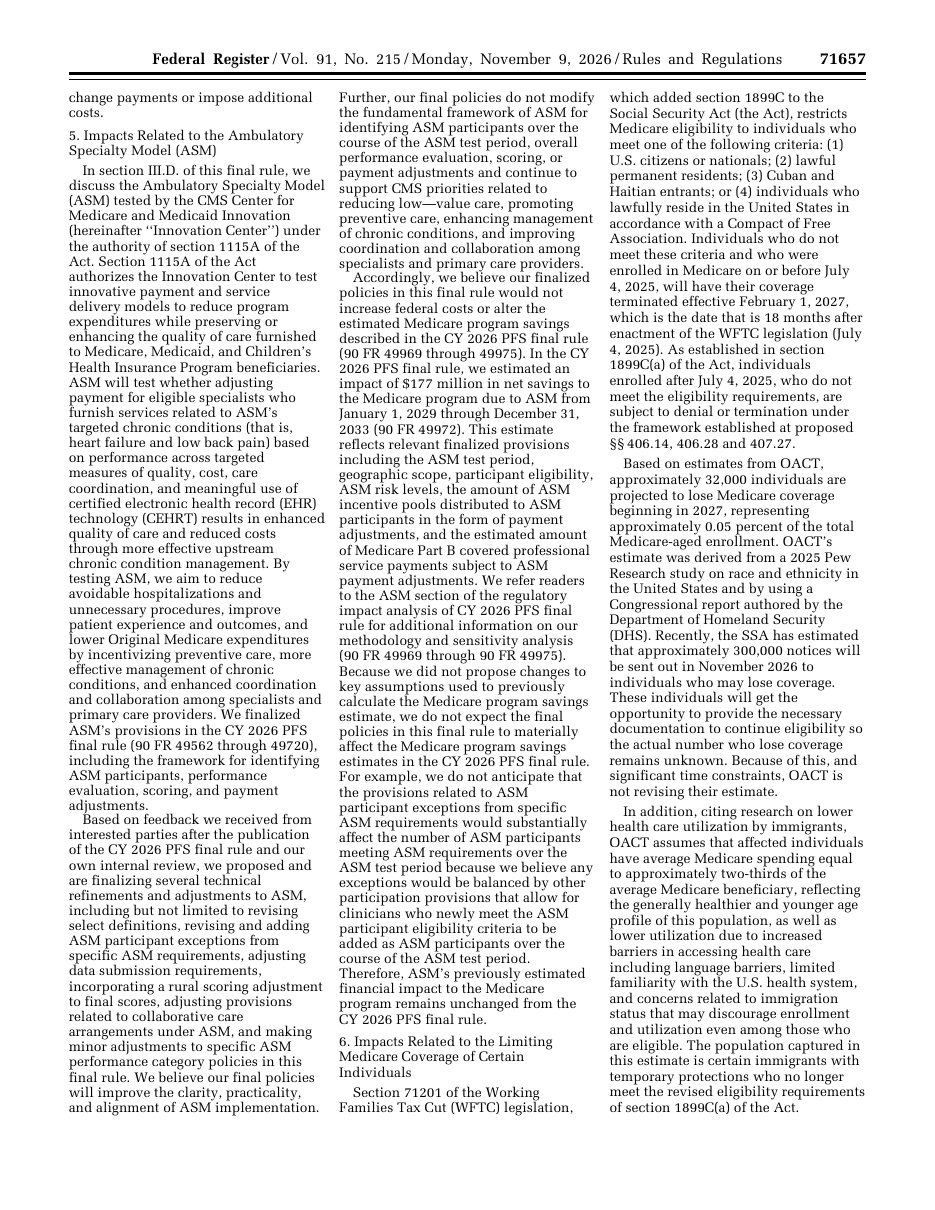
Read a 15-page excerpt with the Medicare eligibility sections (PDF) or the full 1,029-page rule from GovInfo (PDF, about 120 MB).
What happens between now and Feb. 1?
The rule lays out the steps. The November letters are preliminary notices asking for updated proof. Toward the end of December, SSA sends a formal termination notice to people it still finds ineligible, and coverage ends Feb. 1, 2027, with appeal rights under SSA's existing reconsideration rules. Medicare Advantage and Part D drug plans drop affected enrollees automatically when SSA updates its records.
The door is not shut for good. CMS created a special enrollment period so people can rejoin if their status changes, for example when a refugee or asylee gets a green card. Since the rule was proposed, CMS has raised its estimate of who will use it from 3,200 a year to about 30,000, 10 percent of the 300,000 notices. According to the Center for Medicare Advocacy, SSA says the change does not touch Social Security retirement or disability payments.

A Social Security field office in Corning, New York. Notice recipients can bring proof of status to an office like this one or upload it online. Photo by J. Passepartout, 2025, via Wikimedia Commons (CC BY-SA 4.0).
Who is objecting, and what does it save?
The Center for Medicare Advocacy told Newsweek that "for the first time in the history of the Medicare program, coverage is being stripped away from groups of people," and that "these are folks who have paid into Medicare for years." Newsweek, citing federal data, put their past payments above $6 billion. That is a fair point for people who worked here legally for a decade. CMS, answering similar objections in the rule, wrote that it "is obligated to implement" the new eligibility requirements as Congress wrote them.
On the other side of the ledger, CMS's actuaries put the 10-year Medicare savings at about $4.97 billion, rising from roughly $220 million in 2027 to $680 million in 2036. The conservative Paragon Health Institute notes the old law named who could enroll but "did not specifically prohibit other groups from joining the program." The Congressional Budget Office, as summarized by Georgetown's Center for Children and Families, projected the provision would add 100,000 people to the uninsured rolls by 2034.
What should a notice recipient do?
Answer it. Green card holders and naturalized citizens who got a letter are covered under the law and need to prove it before the deadline in their notice, by uploading a Permanent Resident Card, naturalization certificate or passport through my Social Security, visiting an office, or calling SSA at 1-844-507-7131. The difference between 300,000 letters and 32,000 projected losses is mostly paperwork. The people who ignore the envelope are the ones most likely to end up on the wrong side of that math on Feb. 1.
Top photo: President Donald Trump signs the One Big Beautiful Bill Act into law on the South Lawn of the White House on July 4, 2025, as Speaker Mike Johnson and lawmakers applaud. Official White House photo via Flickr, public domain.