A federal judge in Providence ruled Tuesday that Rhode Island gun owners' challenge to the state's 10-round magazine limit is "plainly meritless." His 8-page order also shows something the headlines skipped: the gun owners had already told him he was bound by an appeals court to rule against them, and they wanted a final judgment they can take back up the ladder.
What did the judge actually decide?
The case is Ocean State Tactical v. Rhode Island, No. 1:22-cv-246, filed in 2022 by Big Bear Hunting and Fishing Supply and four gun owners within days of the state's ban taking effect. Chief U.S. District Judge John McConnell Jr., an Obama appointee, denied their motion for summary judgment on Nov. 24 and granted the state's, closing the case at the trial court level, as WJAR reported.
The law itself is strict. It makes it a felony to "manufacture, sell, offer to sell, transfer, purchase, possess, or have under his or her control" any magazine that holds, or can be readily extended to hold, more than 10 rounds. Owners got 180 days starting June 20, 2022, to modify, surrender or sell what they had, according to the order.
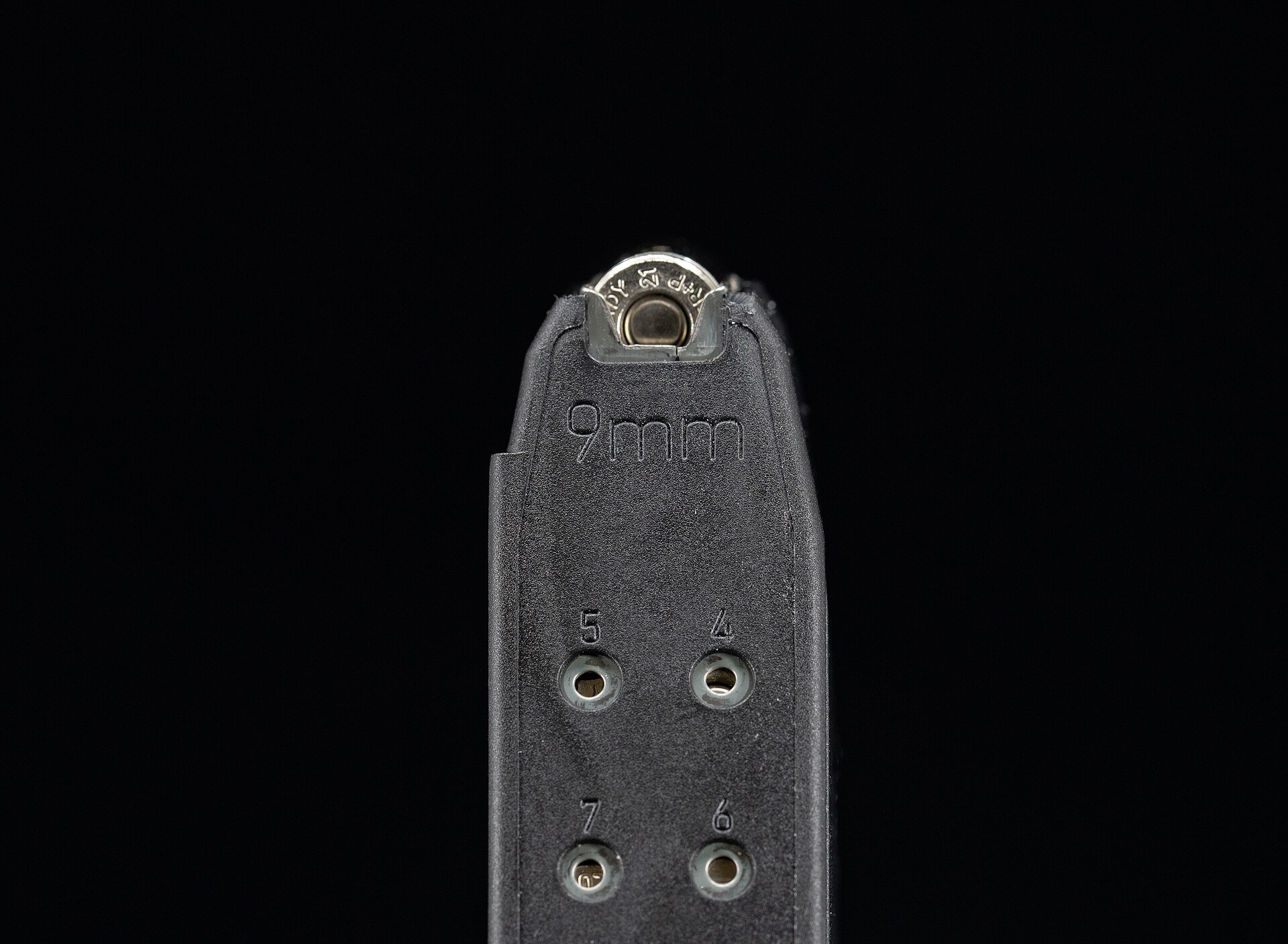
A loaded Glock 9mm handgun magazine. Many standard pistol and rifle magazines hold more than 10 rounds, the line Rhode Island's 2022 law draws. Photo by Tony Webster via Wikimedia Commons (CC BY-SA 2.0).
Why did the gun owners lose so fast?
Because the First Circuit had already spoken. Back in 2022, McConnell refused to block the law and wrote that large-capacity magazines are not even "Arms" under the Second Amendment. The First Circuit upheld that denial in 2024 on different grounds: it assumed magazines are arms, then found the ban fits a historical tradition that includes limits on sawed-off shotguns, Bowie knives and stockpiled gunpowder. The court later treated that ruling as binding "law-of-the-circuit" when it upheld Massachusetts' assault weapon and magazine ban in Capen v. Campbell, then reaffirmed it this year in Recchia v. Campbell.
The gun owners did not pretend otherwise. According to the order, they told the court they "recognize that the First Circuit has treated its decision in this case as controlling" and "acknowledge that no material facts have changed." They asked for a win only "[t]o the extent the Court does not deem itself bound to rule otherwise." Their real argument was aimed higher: that two 2026 Supreme Court decisions, United States v. Hemani and Wolford v. Lopez, show the First Circuit got it wrong. Wolford is the June 25 ruling that struck down Hawaii's "vampire rule" banning carry on private property open to the public unless the owner says yes.
Official record
Order, Ocean State Tactical, LLC v. State of Rhode Island, No. 1:22-cv-00246-JJM-RLA, U.S. District Court for the District of Rhode Island, Document 73, filed Nov. 24, 2026, page 7 of 8. Published by the federal courts on GovInfo.
"Given this, and based on the First Circuit's precedent and the Supreme Court's refusal to grant certiorari, the Plaintiffs' claims are plainly meritless, and the State is entitled to summary judgment in its favor." Chief Judge John J. McConnell Jr., page 7
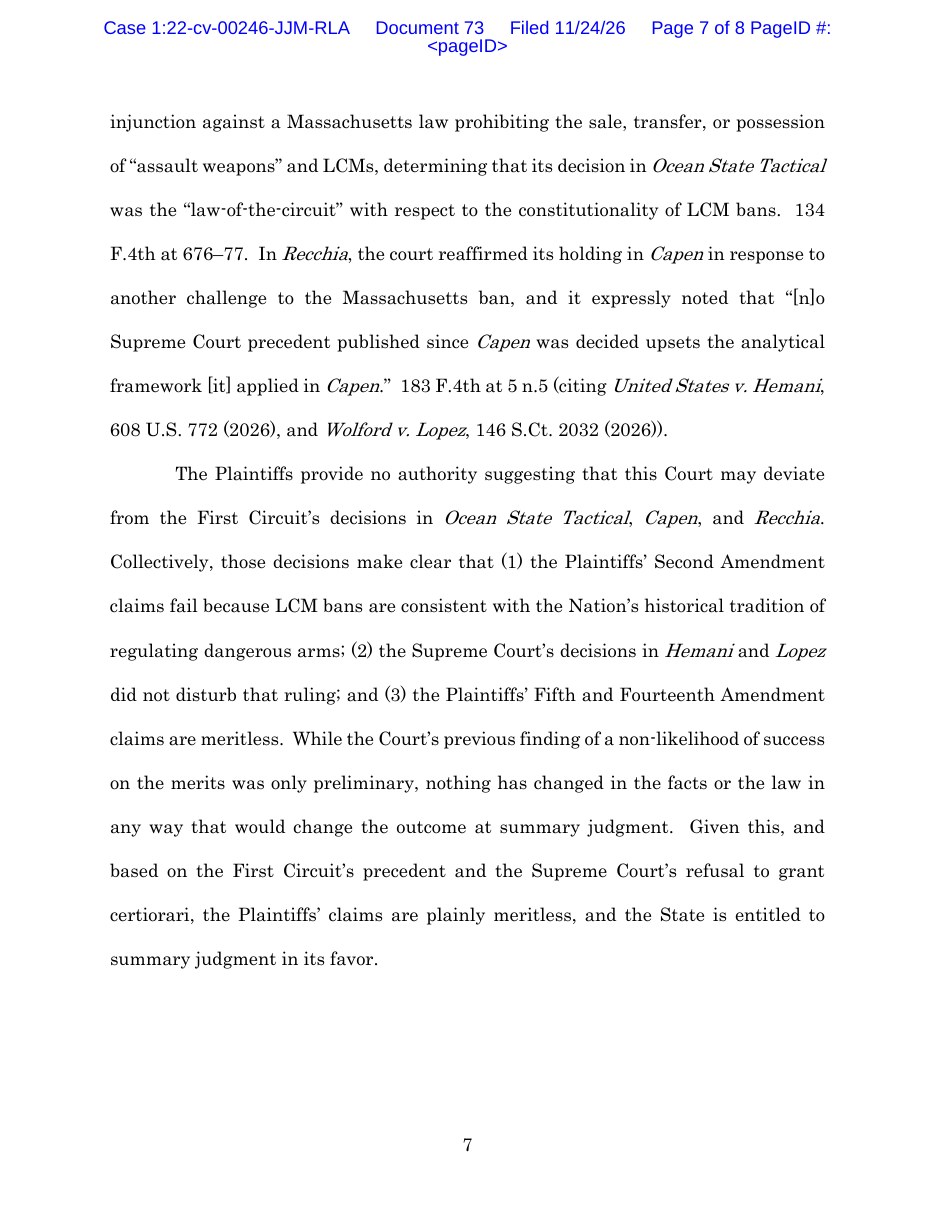
Read or download the full 8-page order (PDF) or view the case on GovInfo.
Does "the Supreme Court's refusal" mean the justices agreed?
No. McConnell leaned on the fact that the Supreme Court turned down this same case on June 2, 2025. But a denial of review decides nothing on the merits, and the Supreme Court's docket shows Justices Thomas, Alito and Gorsuch would have taken it. That was one vote short of the four needed.
The order's reasoning rests on a ruling that was preliminary to begin with. The judge admits as much, writing that his earlier finding "was only preliminary" but that "nothing has changed in the facts or the law in any way that would change the outcome." For gun owners, that means no trial and no fresh look at the history. It also means a final judgment, which is the ticket to a full appeal.
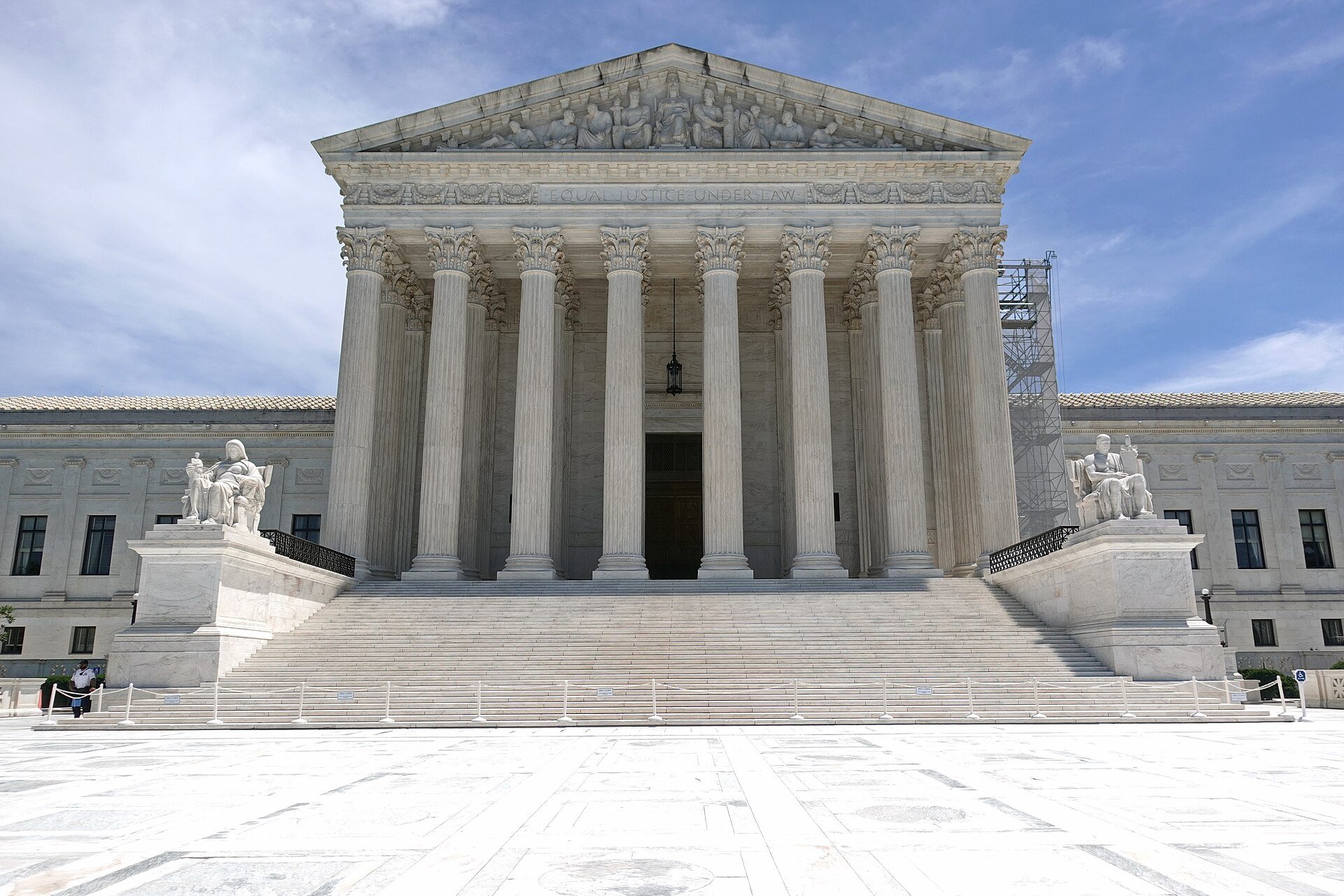
The U.S. Supreme Court Building, where the AR-15 cases will be argued Dec. 2. Photo by 颐园居, June 2024, via Wikimedia Commons (CC BY-SA 4.0).
What is waiting at the Supreme Court?
Timing is the story here. On Dec. 2, six days after this order, the justices hear Viramontes v. Cook County together with Grant v. Higgins, a Connecticut case. The question they agreed to decide is "Whether the Second and Fourteenth Amendments guarantee the right to possess AR-15 platform and similar semiautomatic rifles." On Nov. 24, the same day McConnell ruled, the Court put off Cook County's request to throw the case out as moot until after argument.
That question is about rifles, not magazines. The magazine fight is parked in a different spot: California's case, Duncan v. Bonta, has been sent to the justices' private conference again and again since November 2025, most recently for June 29, 2026, with no decision on whether to hear it. The docket does not say why.
What happens next?
The plaintiffs had not said publicly whether they will appeal, according to WJAR, and the Rhode Island Attorney General's office did not immediately comment to the station. If they do, the First Circuit will almost certainly follow its own rulings again. The real target is the Supreme Court, and a strong AR-15 opinion next year would hand them, and the California gun owners in Duncan, a new set of arguments. Until then, owning a standard 15-round pistol magazine in Rhode Island remains a felony.
Top photo: The Federal Building and U.S. Courthouse in Providence, home of the U.S. District Court for the District of Rhode Island. Photo by Carol M. Highsmith via the Library of Congress, public domain, cropped.