

Saturday's headlines said President Trump does not want to restart the Iran war "for now." Those two words came from an unnamed U.S. official, not from Trump. On the record this week, Trump said Iran is "militarily effectively over" and that U.S. forces are "locked and loaded," while the Pentagon's own tally of the war's cost has reached $47.1 billion.
Who actually said "for now"?
Anadolu Agency ran the headline "Trump does not want to resume war with Iran 'for now'" on Nov. 14. The story rests on a Washington Post report and one line from an unnamed U.S. official: "It's become pretty clear that Trump does not want to go back to war for now." No one is named, and Trump never said it.
Reuters published its own version the same day, headlined "Trump tells advisers he may hold off on Iran attacks barring new provocations, sources say." Its central claim, that Trump told senior advisers he may hold off unless Tehran or the Houthis provoke new action, comes from three people who spoke on condition of anonymity. Reuters says Trump has made no final decision.
Other claims in the Reuters story also rest on unnamed people. According to two people familiar with the call, Trump told Saudi Crown Prince Mohammed bin Salman on Oct. 31 that he planned to attack after the elections, and the crown prince urged him to wait. A third aircraft carrier is moving into the region to replace one of the two already there, according to people familiar with military planning. The only on-record White House response in the piece is a single sentence from an unnamed White House official: "Only President Trump knows what he will do, and when."
What has Trump said in public?
Plenty, and it is not the same message as "for now." On Nov. 8, Trump told CNN by phone it was "highly unlikely it's going to be necessary" to resume strikes, but tied that to whether Iran signs "a very strong agreement," RFE/RL reported.
The next day, after meeting with Qatar's prime minister, Trump walked into the White House briefing room unannounced. "Iran militarily is effectively over," he said, according to the Associated Press. "We're just keeping it the status quo." He also said "the military action doesn't seem to be a very necessary thing," and added that "we're locked and loaded, ready to go for any reason that changes."
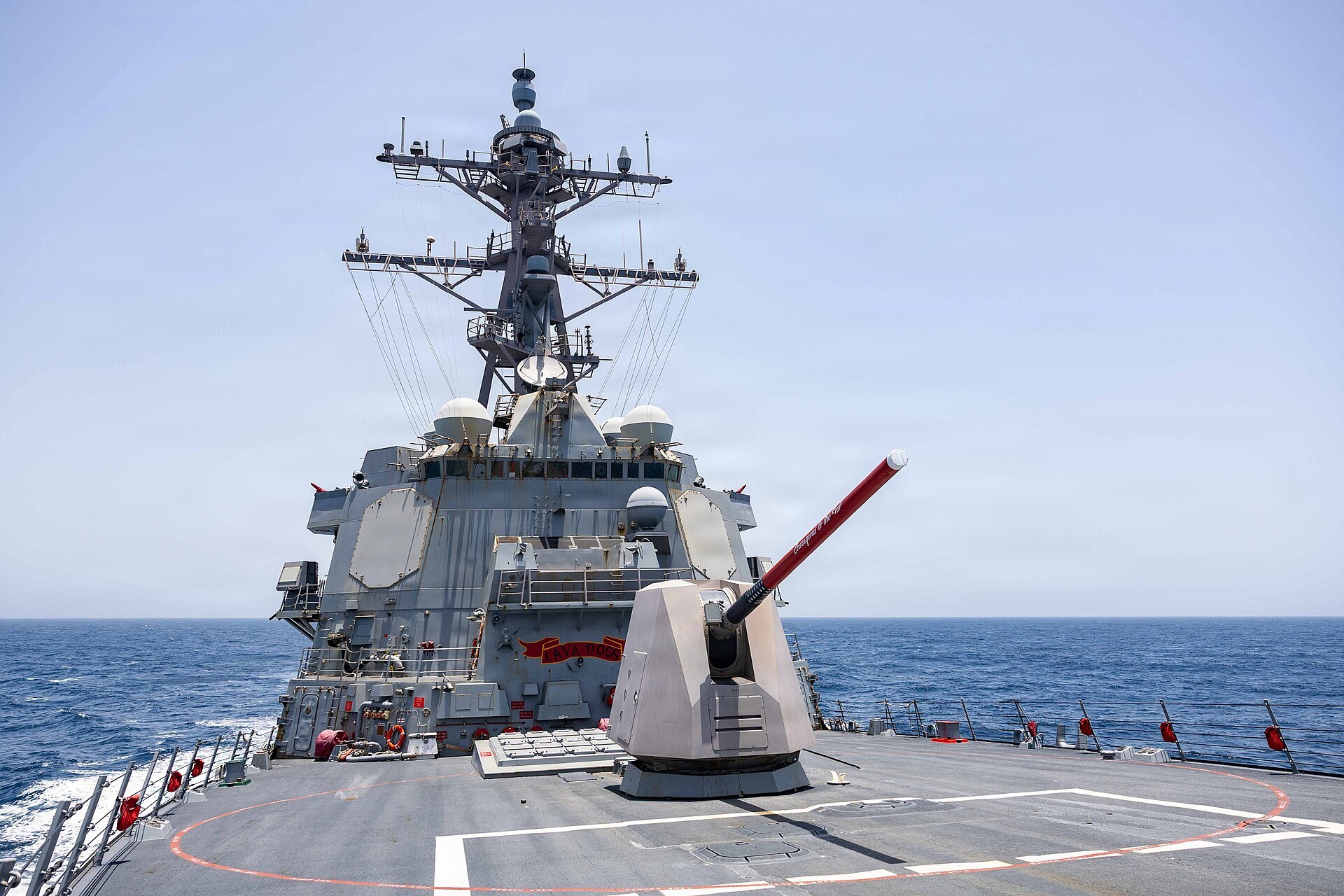
The destroyer USS Rafael Peralta (DDG 115) patrols the Arabian Sea while enforcing the maritime blockade against ships entering or leaving Iranian ports, May 18, 2026. U.S. Navy photo via Wikimedia Commons (public domain).
The clearest public explanation for the pause came from Trump himself, in an interview with Stephen A. Smith released Nov. 12. "I could end it immediately," he said, as quoted by The Jerusalem Post. "Saudi Arabia has asked me to please just let it be the way it is now for a while because they're disintegrating." He went on: "So they've asked me to do that and I'm doing that. I'm not sure I agree with it, but we've taken them largely out."
That is the on-the-record version of the anonymous reporting, and it is sharper. Trump is not describing reluctance. He is describing a request from Gulf allies that he says he is honoring while doubting it.
What about the Israeli plot warning?
Gulf News folded a second item into its coverage: an Israel Hayom report that Mossad passed the CIA details of an alleged Iranian drone plot against Trump and senior officials. Gulf News notes the claim "has not been independently confirmed," and no U.S. or Israeli official has put a name to it. Treat it as unverified until someone goes on the record.
Where do the cost numbers come from?
The Hill ran the headline "Trump says the Iran war 'effectively over.' It's still costing the US billions." The direction is right. The useful question is whose billions, because four different official figures are in circulation and they do not measure the same thing.
The first came on April 29, when acting Pentagon comptroller Jules Hurst III told the House Armed Services Committee, "Approximately, at this day, we are spending about $25 billion on Operation Epic Fury, most of that is in munitions," Military Times reported. In September, a Pentagon document sent to Congress and viewed by CQ Roll Call put the total at $43.6 billion through Sept. 3: $11.2 billion already obligated plus $32.4 billion in unfunded replacement costs.
The newest figure is at least $47.1 billion as of Oct. 16, from a Pentagon estimate given to Congress and obtained by the Associated Press. About $29 billion of that is replacing munitions, about $11.9 billion is operations and about $6 billion is lost equipment. The AP says it "does not include damage to U.S. bases in the Middle East," which Iran has attacked.
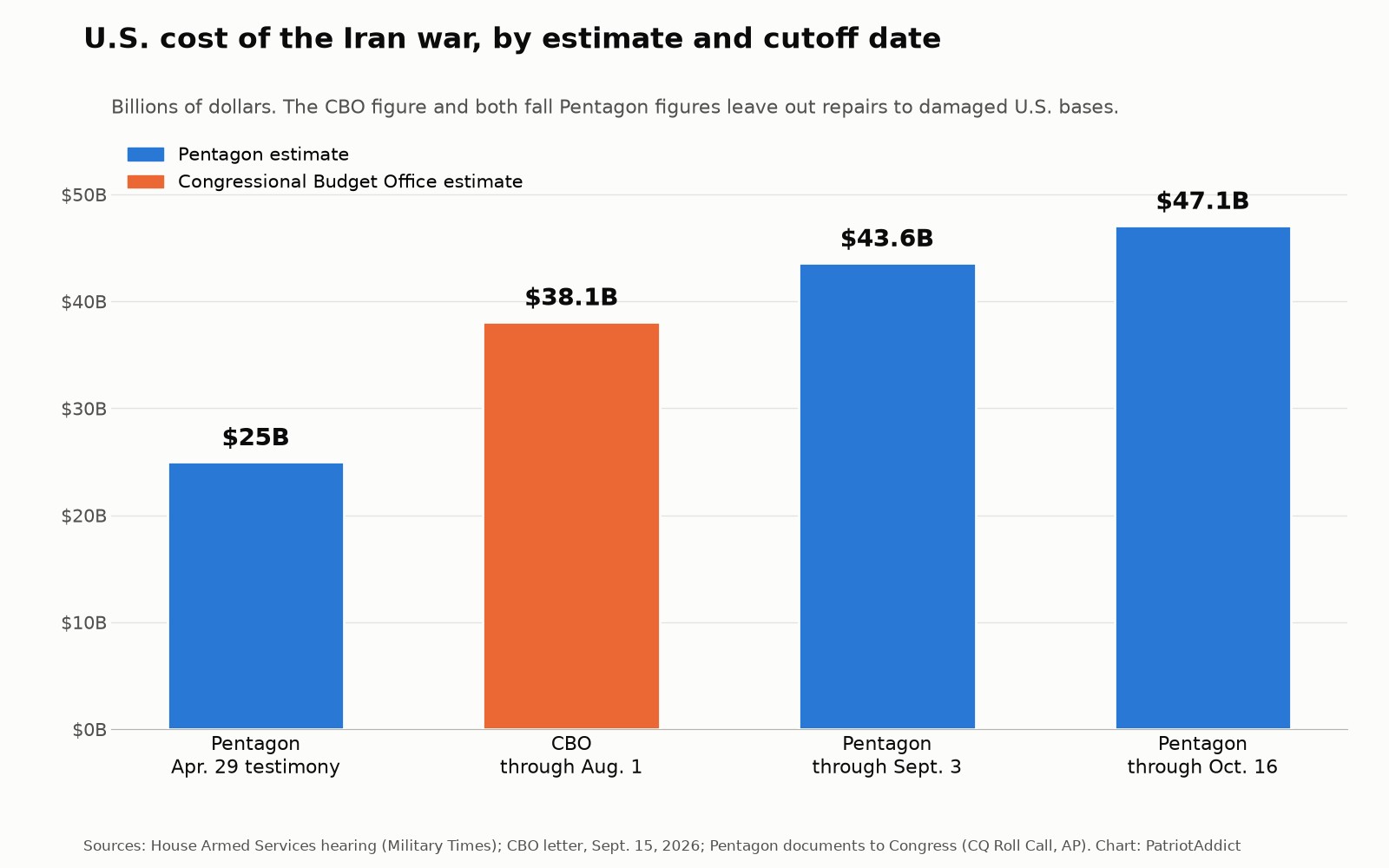
Official estimates of the U.S. cost of the Iran war, 2026. Chart by PatriotAddict from Hurst's April 29 testimony, the CBO letter of Sept. 15 and Pentagon estimates reported by CQ Roll Call and the AP.
What did the Congressional Budget Office find?
The CBO is the only outside scorekeeper here. Its Sept. 15 letter to Rep. Brendan Boyle, the top Democrat on the House Budget Committee, put Defense Department costs at about $38 billion through Aug. 1. CBO says it relied on government databases and public reports because the Pentagon did not answer its requests for information.
Official record
Congressional Budget Office, "Estimating the Cost of Combat Operations Against Iran," letter to Rep. Brendan F. Boyle, Sept. 15, 2026.
"CBO estimates that as of August 1, 2026, the armed conflict with Iran has cost DoD approximately $38 billion." Congressional Budget Office
CBO breaks that into $21.7 billion to replace munitions, $10.4 billion in extra flying hours, $2.7 billion in fuel, $1.9 billion in equipment lost in battle and $1.5 billion in other operations. It leaves out base repairs, casualty and veterans' costs, and costs to other agencies. Read the full CBO letter (PDF).
CBO also estimated that each additional month at a relatively low level of fighting costs about $2 billion to $3 billion. That is the "still costing billions" in plain terms. A blockade and standing carriers run up the bill even when no bombs drop.
Then there is the money Congress has been asked for. On June 24, budget director Russ Vought sent Speaker Mike Johnson a request for an $87.6 billion supplemental, about $67 billion of it for the Pentagon's war costs, the Washington Examiner reported. The Center for the Study of the Presidency and Congress says some Republicans see the lame-duck session as their last chance to secure war funding, with government funding set to run out Dec. 11.
What do official releases say about U.S. forces now?
U.S. Central Command has not published a troop count. Its most detailed recent statement is a Nov. 7 release on disabling the St. Kitts-flagged cargo ship M/V Huda in the Gulf of Oman after its crew ignored repeated warnings. The release says that since the blockade began in July, 147 commercial vessels have turned around after complying, five merchant ships have been disabled and 10 Iranian commercial oil tankers were destroyed earlier. CENTCOM announced Task Force Iron Gate the same day, which PatriotAddict covered Nov. 10.
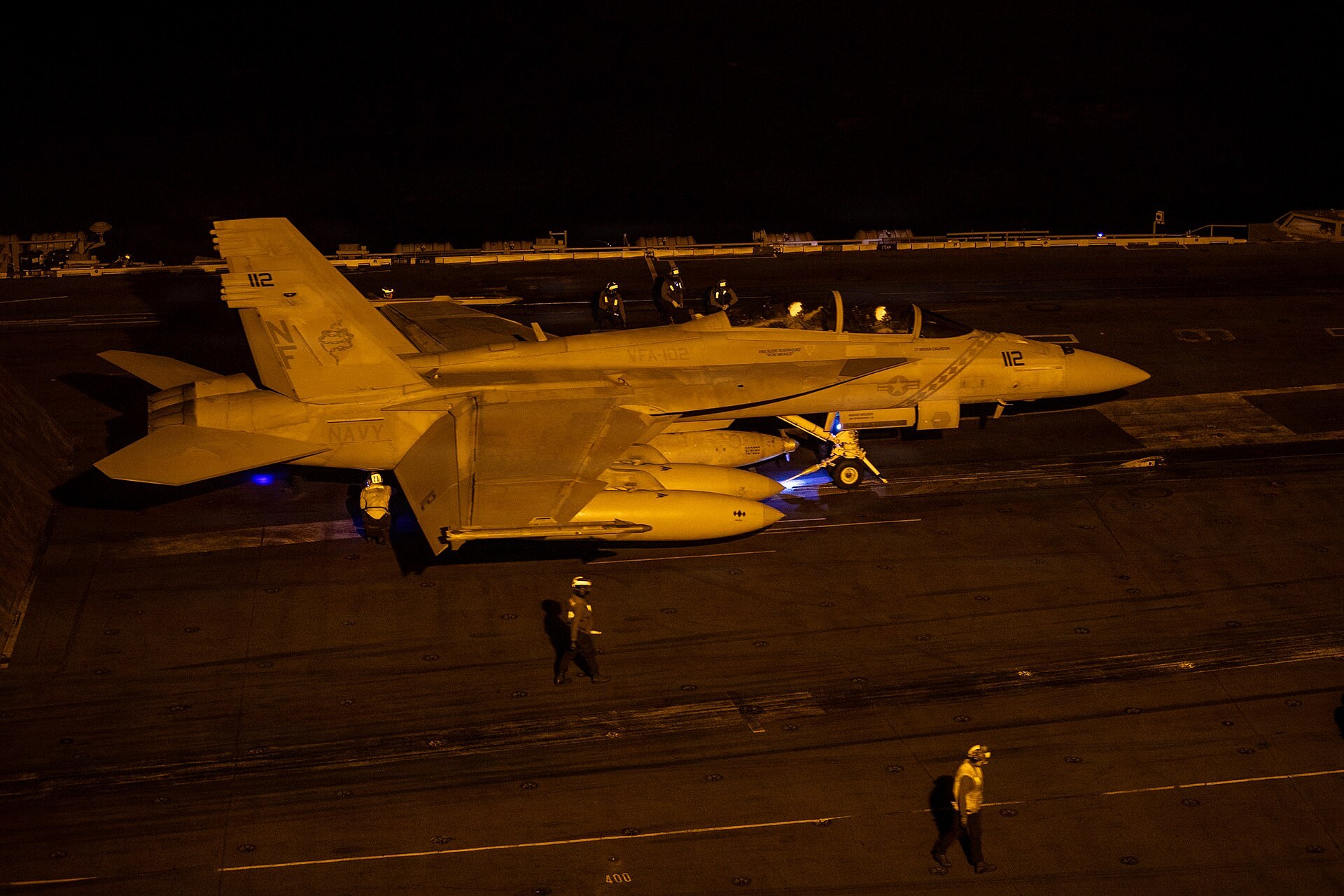
An F/A-18 Super Hornet from Strike Fighter Squadron 102 prepares to launch from the carrier USS George Washington (CVN 73) in the Arabian Sea, Aug. 24, 2026. U.S. Navy photo by NAVCENT Public Affairs via Wikimedia Commons (public domain).
Navy imagery places the carrier USS George Washington in the Arabian Sea in late August. The USS Theodore Roosevelt left San Diego in late September for the Middle East, Stars and Stripes reported.
What happens next?
Strip out the anonymous sourcing and the record is simple. Trump says the war is militarily over, the blockade stays, and he is holding fire at the request of Gulf allies while keeping strikes ready if Iran changes the picture. The Pentagon says the bill was at least $47.1 billion by mid-October and does not yet count the damaged bases. CBO says every quiet month adds $2 billion to $3 billion more.
A Reuters/Ipsos poll cited by Reuters and taken shortly before the Nov. 3 elections found 55% of Americans said the war was not worth the cost. With funding expiring Dec. 11 and the war supplemental still pending, the next real signal will not come from an unnamed official. It will come from whether Congress pays the bill, and from Trump's next on-camera answer.















