DHS says ICE deported 483,200 people and made more than 491,000 arrests in fiscal 2026, the most in the agency's 23-year history. The release came four days after President Trump told 60 Minutes his deportation policy "might be too tough," and it leaves out two numbers that matter: how many of those deportations were formal removals, and how many people had criminal records.
What does the DHS release actually count?
The Nov. 12 release, also posted by ICE, covers the federal fiscal year that ran from Oct. 1, 2025, through Sept. 30, 2026. That puts the whole year inside Trump's second term, and leaves out October 2026. The headline figures, as reported by CBS News and the Associated Press, are 483,200 deportations and more than 491,000 arrests, of which 474,850 were administrative arrests for civil immigration violations.
Those are big numbers by any yardstick. Deportations rose about 9% over the previous record of 442,640 set in fiscal 2025, and about 78% over the 271,484 removals in fiscal 2024, Joe Biden's last full year. August's 50,925 arrests set a monthly record, and September topped 48,000.
"Fiscal Year 2026 saw the highest number of ICE deportations and arrests for any year in ICE's history," Homeland Security Secretary Markwayne Mullin said. "Thanks to President Trump's leadership, ICE has been unleashed to target and remove illegal aliens so that we can save American lives."
Are all 483,200 formal removals?
The release does not say. It uses the word "deportations" and gives no split between removals, which carry a bar on legal reentry for years, and returns, which do not. That split matters for comparing years. When ICE sent its fiscal 2027 budget request to Congress this spring, it put the fiscal 2025 total at 442,637 and broke it into roughly 330,000 formal removals and 110,000 voluntary returns, according to The Washington Times, which reviewed the document. In other words, about one in four of last year's "record" was a return.
Syracuse University's Transactional Records Access Clearinghouse, which obtained case-level DHS data through a Freedom of Information Act lawsuit, reported Nov. 11 that removals made up 63% of all deportations in July and August 2026, with voluntary departures at 31% and voluntary returns at 6%. TRAC's database covers both ICE and Customs and Border Protection, so its totals are not the same measure as ICE's. With border crossings at historic lows, there are far fewer border removals to count, which pulls a combined DHS figure down even as ICE's interior work climbs.
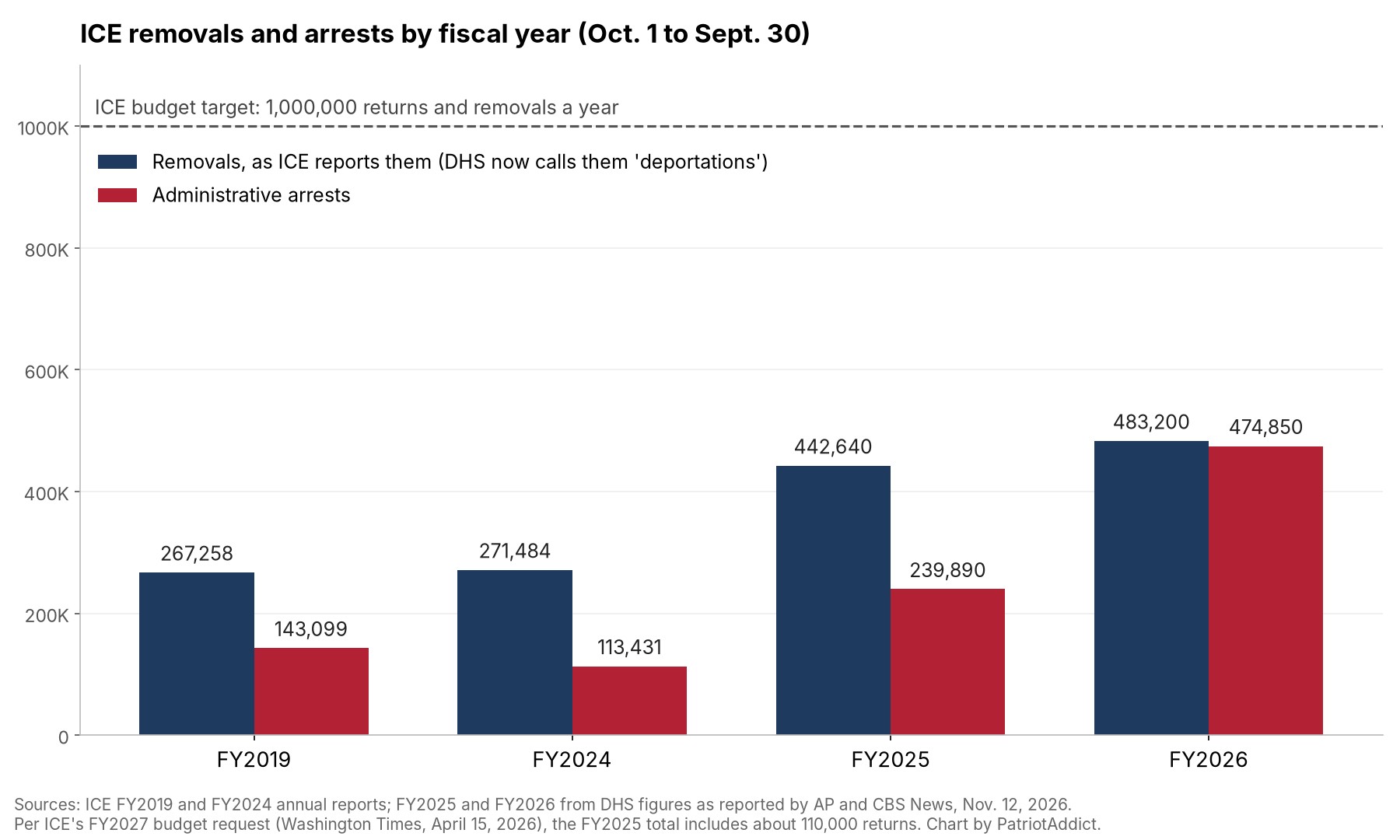
ICE removals and administrative arrests, FY2019 to FY2026, against ICE's stated target of 1 million returns and removals a year. Chart by PatriotAddict from ICE's FY2019 and FY2024 reports and DHS figures reported by AP and CBS News.
How does fiscal 2026 compare with ICE's own past reports?
ICE used to publish the criminal share alongside its totals. In fiscal 2019, the agency said more than 86% of the roughly 143,000 people it arrested had criminal convictions or pending charges, and it removed 267,258 people. Its fiscal 2024 report listed 113,431 arrests, 71.7% with convictions or pending charges, and said 32.7% of the 271,484 people removed had criminal histories.
This year's release gives no such figure for the full year. It names individual cases instead, including a Mexican national charged with second-degree murder in Virginia and a Honduran woman DHS says was convicted of trying to kill her newborn son. ICE's most recent overall number came from Todd Lyons, the official running the agency, who told House appropriators in April that of nearly 457,000 people arrested from Jan. 20, 2025, through March 30, 2026, more than 281,000 had criminal histories. That works out to about 61%.
Outside counts run lower for deportations. The Migration Policy Institute found that about 20% of roughly 980,000 deportations by ICE and CBP from January 2025 through July 2026 involved someone with a criminal conviction. A CBS News analysis found that in July 2026 more than half of ICE arrests involved people with no conviction and no pending charge. Those are outside analyses, not ICE's. Only DHS can settle the question, and the release does not.
What is the "new goal"?
Some coverage, including The Mary Sue, says the DHS secretary "reveals" a new goal. Mullin's statement contains no target. The number those stories cite, about 19,000 arrests a week, comes from CBS News, which attributed it to "sources familiar with the agency's planning" and said it was set before the midterms. Nineteen thousand a week is about 988,000 a year, roughly double fiscal 2026's average of about 9,400 arrests a week.
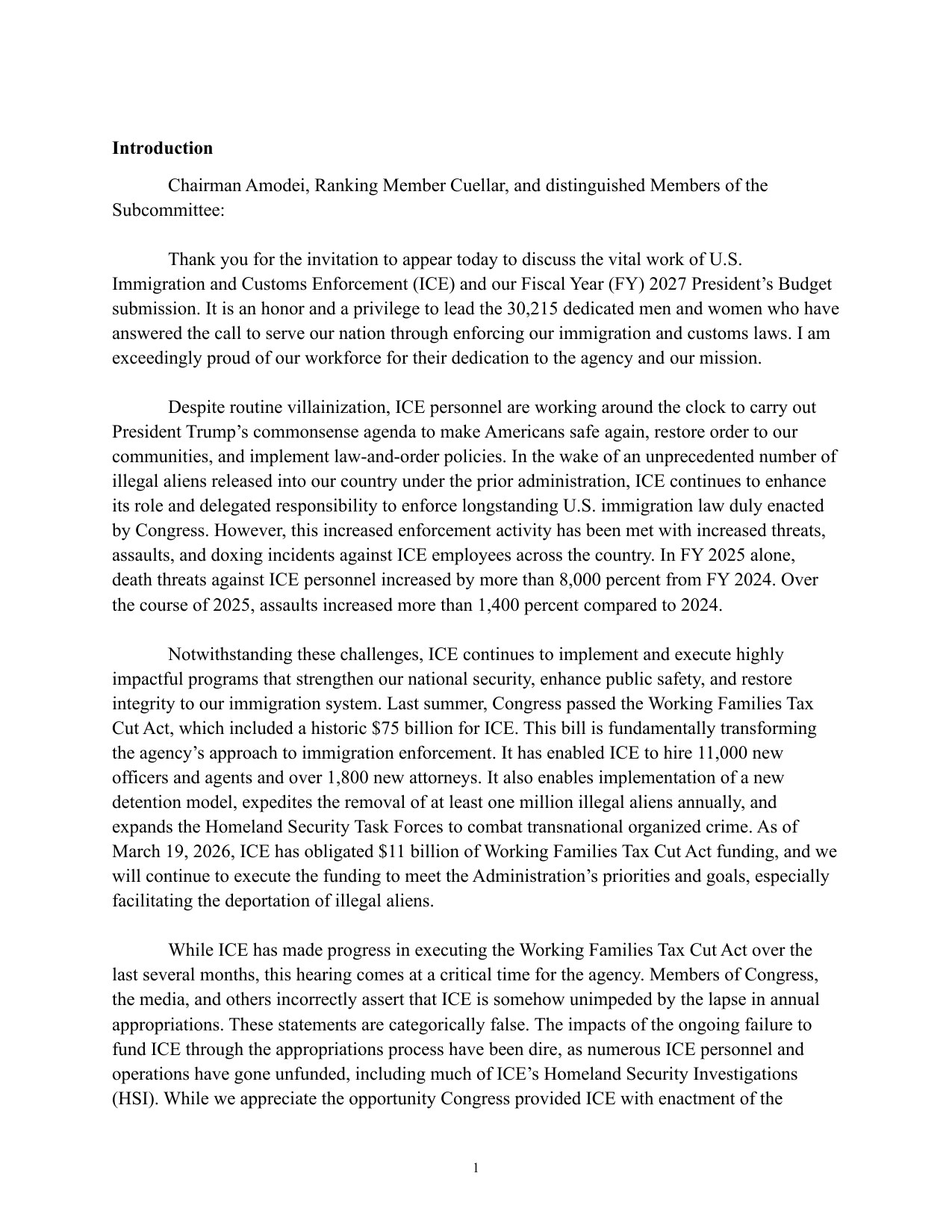
The million mark is not new. Lyons put it in sworn testimony, saying last year's $75 billion for ICE "expedites the removal of at least one million illegal aliens annually." ICE's budget request set a target of 1,000,000 returns and removals a year, plus 500,000 removals or returns of people with criminal histories, according to The Washington Times and the Center for Immigration Studies. Measured against that, 483,200 is about 48% of the way there, and the criminal target cannot be checked at all from what DHS released.
Official record
Written testimony of Todd M. Lyons, Senior Official Performing the Duties of the Director, U.S. Immigration and Customs Enforcement, before the House Appropriations Subcommittee on Homeland Security, "The Fiscal Year 2027 Budget for the U.S. Immigration and Customs Enforcement Agency," April 16, 2026. Page 1 of the testimony is shown below; the arrest figures are on page 2.
"It also enables implementation of a new detention model, expedites the removal of at least one million illegal aliens annually, and expands the Homeland Security Task Forces to combat transnational organized crime." Todd M. Lyons, ICE
Read or download the full 9-page testimony (PDF) or view it on the House committee repository.
What exactly did Trump say was "too tough"?
The remark came in a 60 Minutes interview with Ross Douthat, taped at the White House on Friday, Nov. 6, and aired Sunday, Nov. 8. Asked whether the crackdown hurt Republicans, Trump said it "both helped and hurt," that he got "an A+ for closing up the border," and that he was hurt because "we also took people that had good jobs." Douthat asked whether the policy "went too far." Trump answered, "Too tough." Douthat: "It was too tough?" Trump: "I think it might be too tough, yeah."
That hedge got lost in places. CBS's own news story on the ICE numbers quotes him as saying "I think it was too tough," which is not what its network's transcript shows. Newsweek framed the release as coming "days after" the remark.

ICE officers during a worksite enforcement operation at a Philadelphia car wash, the kind of arrest Trump described in the interview. U.S. Immigration and Customs Enforcement photo via Wikimedia Commons (public domain).
Trump was specific about who he meant. "Get the killers out," he said, and "Get the drug dealers out." For people "here for ten and 15 years," he wants to "work a deal." He said "a group of people that I would say on the sort of pretty far right" want "everybody taken out," and answered "Yes" when asked if some work in his administration. CBS reported that an hour after the interview, Stephen Miller replaced Susie Wiles as chief of staff.
So which message is the real one?
Both are on the record, and they point in different directions. The release celebrates a year in which nearly all arrests were civil arrests. The President says the people who deserve to go first are killers and drug dealers, and that long-settled workers may deserve a deal. The one number that would show how well ICE's record lines up with Trump's own priorities is the criminal share, and DHS left it out.

Markwayne Mullin is sworn in as Secretary of Homeland Security by Attorney General Pam Bondi as President Trump looks on, March 2026. White House photo via Wikimedia Commons (public domain).
Democrats take both chambers of Congress in January, though much of ICE's money was already appropriated in last year's $75 billion package. If DHS wants its record taken at face value by a skeptical House, the quickest fix is a table it used to publish every year: removals versus returns, and how many had criminal convictions. Publish that, and the record speaks for itself.