

Florida Attorney General James Uthmeier says the state's 2018 bump stock ban violates the Second Amendment, and his office will no longer defend convictions under it. One headline said Florida "axes" the law. His own six-page opinion, dated Nov. 13, leaves the statute on the books, and the Legislature let a repeal bill die eight months ago.
What did Uthmeier actually decide?
The opinion answers one question: "whether the bump-fire stock prohibition in section 790.222, Florida Statutes, contravenes the Second Amendment to the United States Constitution." His answer, in the first paragraph: "After careful consideration, I have determined that it does."
The core holding fits in two sentences on page 1. Section 790.222 "imposes a categorical prohibition on an entire class of firearm components that can increase a semiautomatic weapon's rate of fire," and "No identifiable historical tradition justifies prohibiting their possession and use by law-abiding citizens for sporting, defensive, or other lawful purposes."
He posted the signed letter on X Friday afternoon. "People are being arrested and prosecuted under a 2018 law that banned 'bump stocks,'" he wrote, adding that "the overly broad law" reaches parts gun owners use "for lawful purposes, subjecting them to five years in prison."
Official record
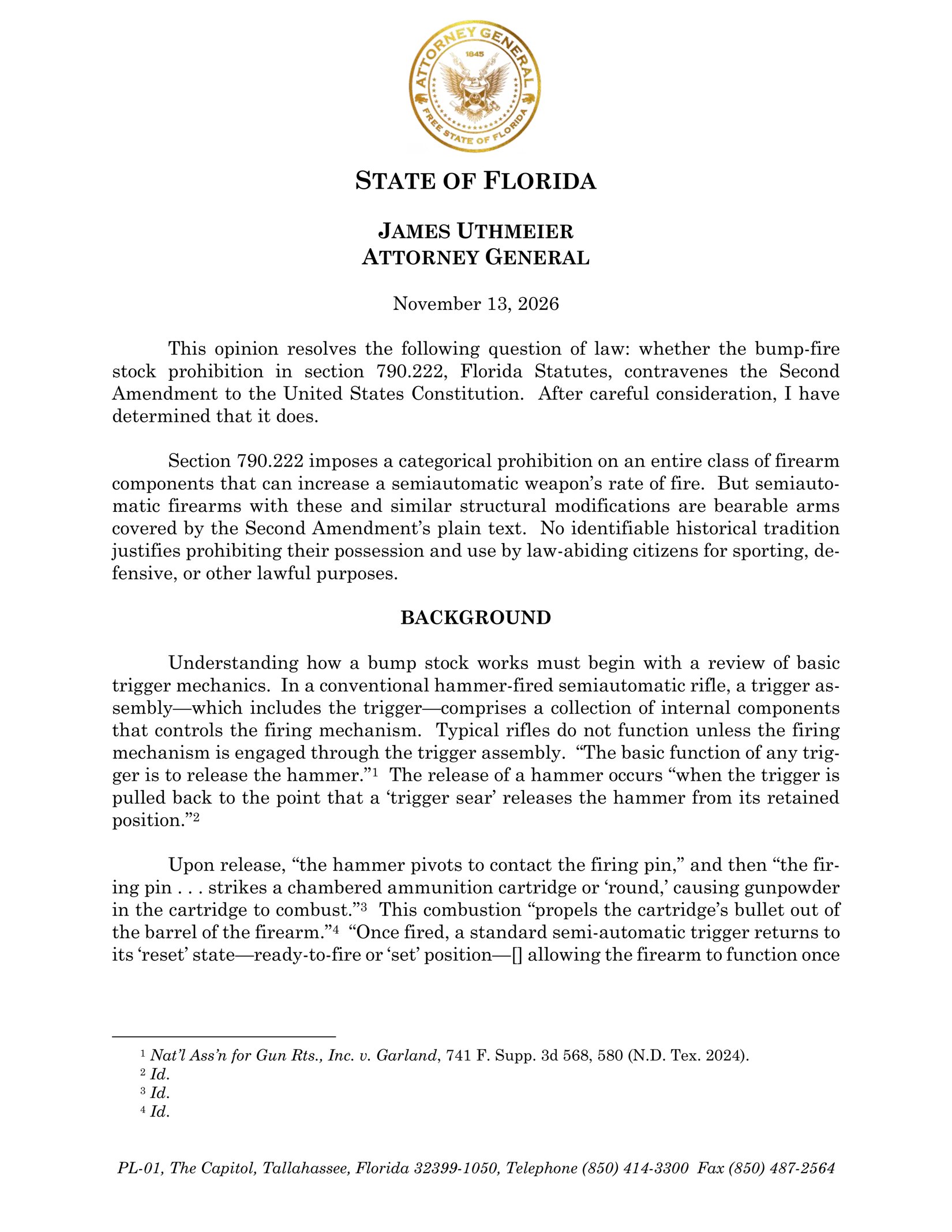
Opinion of Florida Attorney General James Uthmeier on section 790.222, Florida Statutes (Nov. 13, 2026), page 1 of 6.
"Section 790.222 imposes a categorical prohibition on an entire class of firearm components that can increase a semiautomatic weapon's rate of fire. But semiautomatic firearms with these and similar structural modifications are bearable arms covered by the Second Amendment's plain text." Attorney General James Uthmeier
Read the full 6-page opinion (PDF), compiled from the page images the Attorney General posted on X, or see the signed original on the Attorney General's website.
Why does he say a bump stock is protected?
The opinion follows the two-step test from Bruen and this year's Wolford v. Lopez. Step one asks whether the Second Amendment's text covers the item. Uthmeier says it does, because the amendment "extends, prima facie, to all bearable arms," and a bump stock is something one may "wear, bear, or carry" on the person.
He also takes on the "dangerous and unusual" argument a defender of the law would make. Bump stocks are built for the AR-15 platform, "one of the most common rifle platforms in this country's history," and he cites the ATF's own 2018 estimate that "over half a million bump-fire stock devices are in private circulation." He leans on the U.S. Supreme Court's 2024 ruling in Garland v. Cargill, which held 6-3 that a rifle with a bump stock "does not fire more than one shot 'by a single function of the trigger,'" so it is not a machinegun under federal law.

A Slide Fire Solutions bump fire stock mounted on a WASR-10 AK-pattern rifle, the kind of device Florida's 2018 law bans. Photo by WASR via Wikimedia Commons, CC BY-SA 3.0.
At step two the state has to show a historical tradition of similar bans. Uthmeier writes that he is "unable to find such a tradition," noting that lever-action and revolving arms in the 1800s already fired faster than the muzzleloaders before them. He also answers former Gov. Rick Scott, who signed the 2018 law after the Parkland shooting and reportedly said "[a]ll have to give a little and make a compromise." The opinion's reply: "The Constitution, however, brooks little compromise when it comes to citizens' fundamental rights."
Is the bump stock ban gone?
No. An attorney general's opinion is not a court ruling and not a repeal. CBS Miami reported that the ban remains on the books, with no court striking it and no legislative repeal. That makes the Joe.My.God headline "Florida Axes Gun Law Sparked By Parkland Massacre" wrong on the facts, even if it is the outcome gun owners want.
The statute still says a person "may not import" or "possess" a bump-fire stock, a third-degree felony. The Legislature had its chance this year. HB 6021, filed Jan. 5 by Rep. Toby Overdorf, would have repealed the ban outright. It was referred to the House Criminal Justice Subcommittee and died there on March 13 without a recorded vote.
Official record
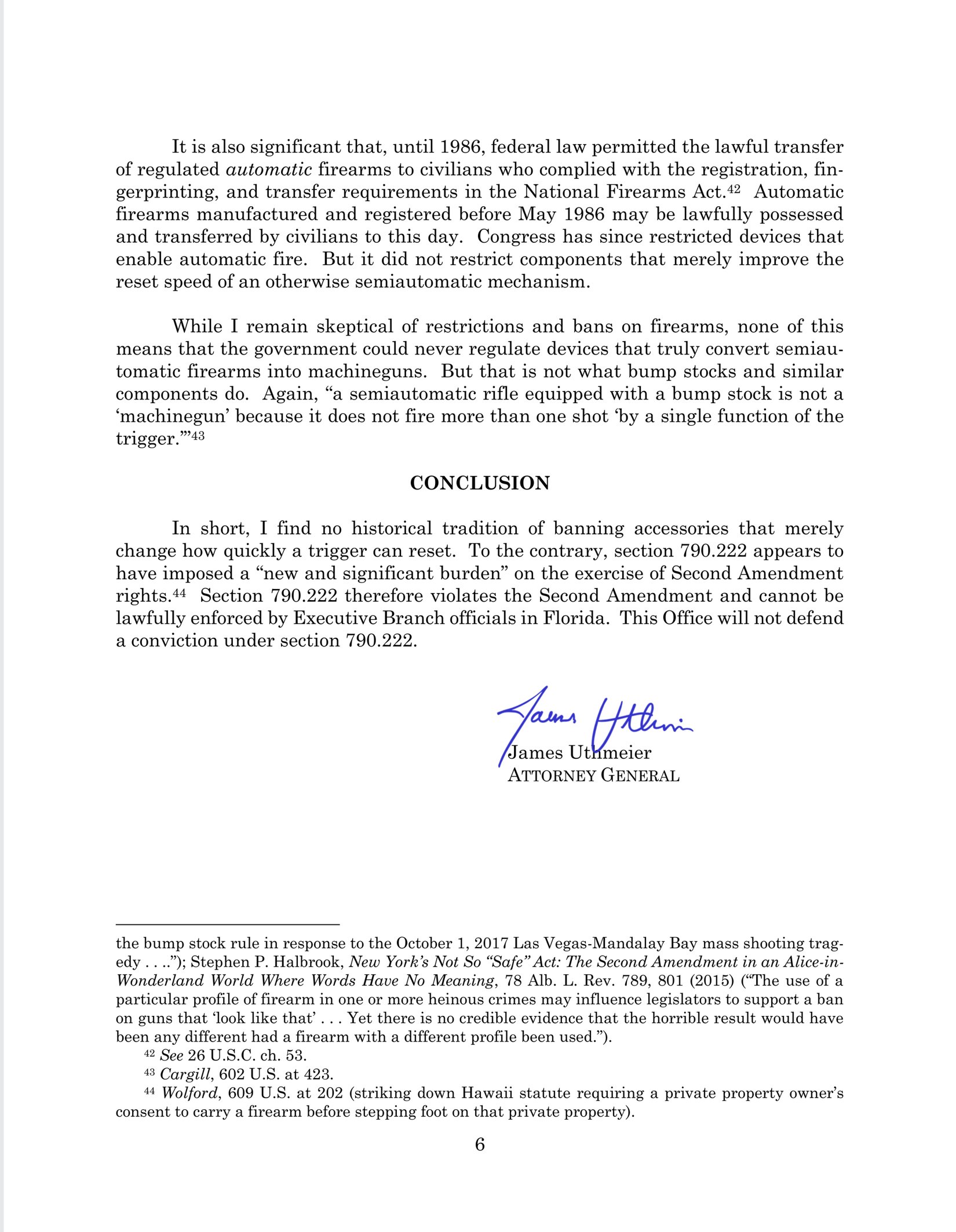
Opinion of Florida Attorney General James Uthmeier on section 790.222 (Nov. 13, 2026), conclusion, page 6 of 6.
"Section 790.222 therefore violates the Second Amendment and cannot be lawfully enforced by Executive Branch officials in Florida. This Office will not defend a conviction under section 790.222." Attorney General James Uthmeier
Who is still bound by the law?
The practical promise is about appeals. The Attorney General's office is the state's lawyer when a conviction is appealed, so a defendant convicted under 790.222 would face no state defense of that conviction. The opinion goes further and says the law "cannot be lawfully enforced by Executive Branch officials in Florida."
It does not say how that reaches the people who file the charges. Florida's 20 elected state attorneys hold offices created in Article V of the Florida Constitution, the judicial article, and the opinion names no requesting official and carries no opinion number. A judge in a pending case is not bound by it either.
That matters for at least one man. Skyeler "Bleau" Jackson, a 24-year-old from San Antonio, was arrested Feb. 11 by the Palm Beach County Sheriff's Office after undercover deputies bought forced reset triggers from him at a West Palm Beach gun show, according to reporting by Lee Williams of the Second Amendment Foundation's journalism project. Jackson says he was charged with two counts of possessing a bump stock, spent nine days in jail and is "the first person ever charged with that statute." That account comes from Jackson and has not been confirmed through court records. TheGunMag reported Friday that his prosecution is still active.
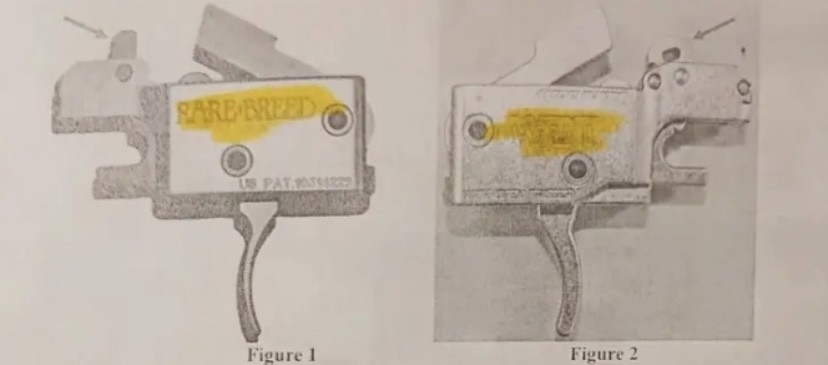
Forced reset trigger assemblies pictured in ATF Technical Bulletin 22-01. Florida's statute never uses the term, but its definition of a bump-fire stock covers any "device" that increases a rifle's rate of fire. Bureau of Alcohol, Tobacco, Firearms and Explosives via Wikimedia Commons (public domain).
Does the opinion cover forced reset triggers?
Only in passing. Page 4 lists "short or forced reset triggers" alongside trigger kits and buffer weights as "widely available components that can be swapped in to improve a firearm's firing characteristics." The conclusion speaks of "accessories that merely change how quickly a trigger can reset." Uthmeier also writes that the government could still regulate "devices that truly convert semiautomatic firearms into machineguns."
This is the second time this month he has told police and prosecutors to stand down on a gun charge. A Nov. 6 memorandum said Floridians may now possess short-barreled rifles and shotguns "without fear of prosecution," after the federal tax on them went to zero, Fox 49 reported.
What happens next?
The durable fix is the one the House skipped in March. Governor-elect Byron Donalds, who takes office in January, voted against the 2018 package as a state lawmaker, CBS Miami noted. A repeal he signs would bind every prosecutor and judge in the state. Uthmeier's letter binds his own office and puts a target on the statute, and until lawmakers act, a Florida gun owner with a bump stock is relying on a promise, not a change in the law.
Top photo: Official portrait of Florida Attorney General James Uthmeier, Office of the Attorney General of Florida, via Wikimedia Commons (public domain).















