

FAA Administrator Bryan Bedford says there is "zero evidence of anything nefarious" behind Friday's nationwide ground stop, and in the same Saturday briefing his agency said it is still running a root cause analysis. Both statements can be true at once. The FAA's own advisories and the Transportation Department's transcript show what officials found, what they still don't know, and why a September GAO report matters now.
What did the FAA order, and when?
The order came Friday, Nov. 13, not Saturday. FAA Command Center Advisory 111, signed at 20:54 UTC (3:54 p.m. Eastern), ground stopped every airport in the country "due to extraordinary circumstances and for reasons of safety." Planes already flying were allowed to land, and inbound international flights were handled "on a case by case basis."
Almost two hours later, Advisory 120 gave the reason in three words: "communications failure." Advisory 005 cancelled the stop at 01:19 UTC, or 8:19 p.m. Eastern. That is about four hours and 25 minutes, which Al Jazeera called the longest nationwide ground stop in 25 years.
Official record
FAA Air Traffic Control System Command Center advisories 111 and 120 (Nov. 13, 2026) and 005 (Nov. 14, 2026 UTC), as posted on the FAA's public advisory database. Times are in UTC.
"The FAA Command Center ground stop remains in effect. As enroute facilities recover, flights will be allowed to depart through coordination with the Air Traffic Control System Command Center." FAA Advisory 120, reason listed: "Communications failure"
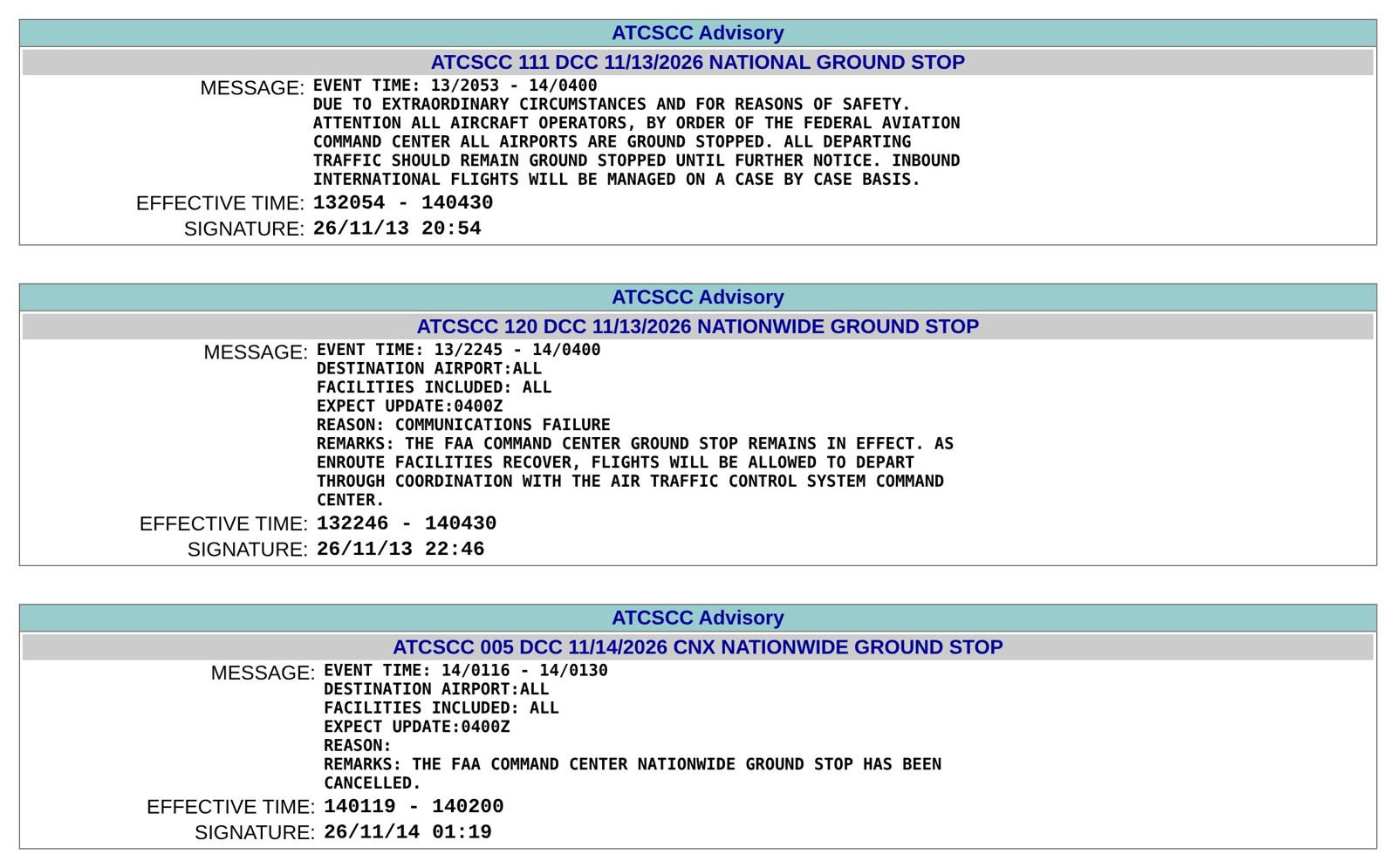
Read the originals: Advisory 111 · Advisory 120 · Advisory 005.
What actually failed?
Not the radars, and not the controllers. Bedford said at Saturday's Transportation Department briefing that as many as 17 of the FAA's 22 en route centers were affected, but none "actually went dark," CNN reported. Frequencies were "going in and out," forcing centers to flip between primary and backup. "If that had been a single facility, we would have just worked through it," he said. The stop came because the agency saw it spread to "two, three, 10, 17 facilities" and could not say why.
Secretary Sean Duffy laid out the chain in the DOT's transcript of the briefing. Contractor L3Harris was swapping copper telecom lines for fiber at a remote FAA site. "Either through contractor error or a faulty piece of equipment, that router that was being replaced as we switched from copper to fiber, it started flooding other routers in our air traffic control system," he said, with "over 1,000 connection attempts every four to five seconds."
The FAA's acting chief technology officer, Rebecca Guy, said the agency found "two places" pinging the network at that rate, shut both off, and stabilized the system, TechCrunch reported. Officials told Reuters there may have been router problems in both Arkansas and Texas.
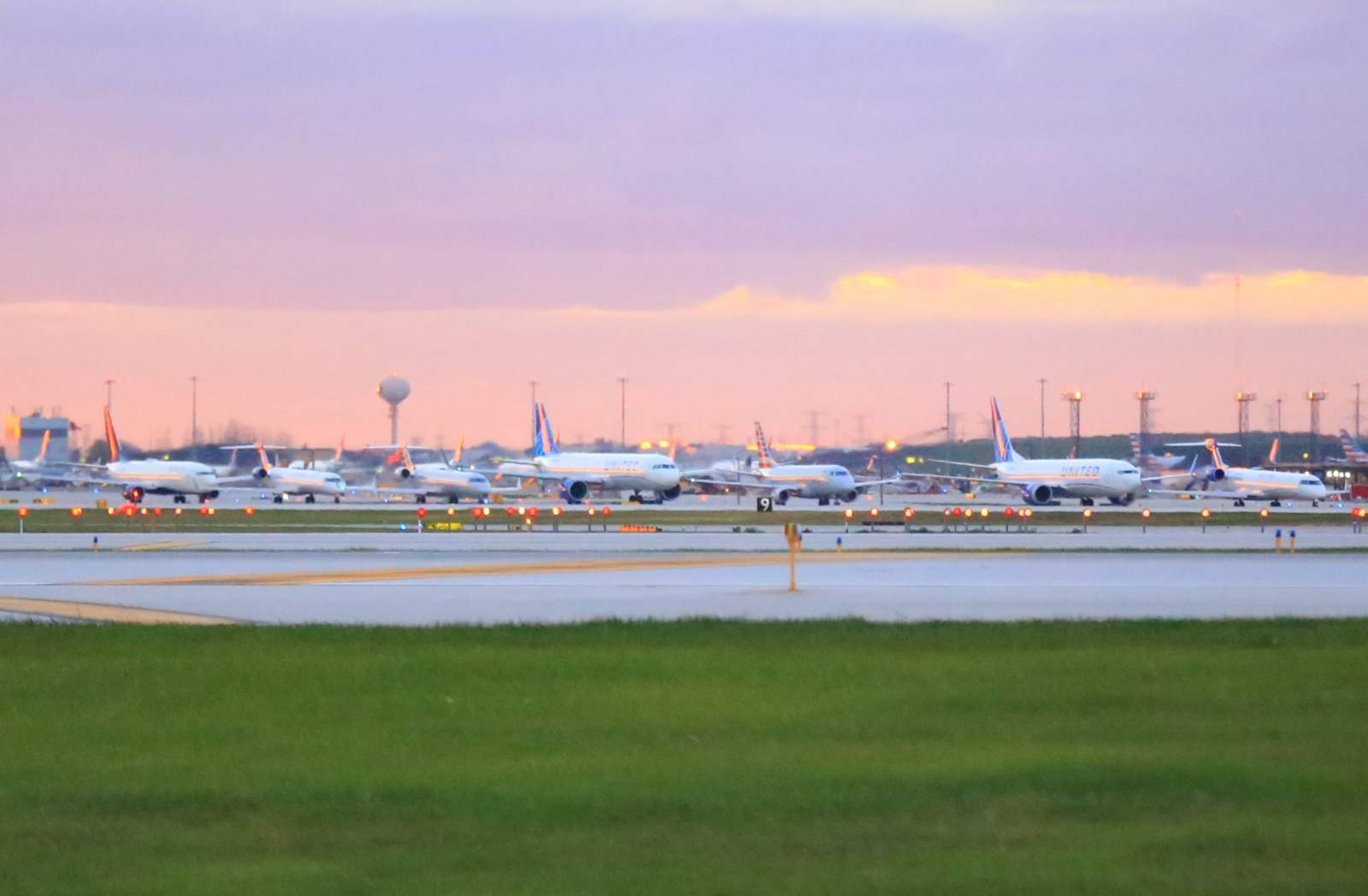
Aircraft queued on a taxiway at Chicago O'Hare International Airport during the Nov. 13 ground stop. Photo by Spelg33 via Wikimedia Commons (CC0, public domain dedication).
So how can they rule out sabotage without a root cause?
Because they found the trigger, just not the reason it fired. "We see zero evidence of anything nefarious, and zero evidence of anything AI-related," Bedford said, adding, "we're working through what this defective piece of equipment was," and "when we have that root cause analysis complete, we'll share it with you," per ABC News.
Duffy was blunter about the open question. "We're working to determine whether we had incompetence, meaning was it user error or installer error from L3Harris, or did they install a faulty router? We haven't determined what the fault was," he said. His cyber answer was a belief, not a finding: "we don't believe this was cyber at all." The logic he gave is that once the remote work was isolated, "all of our systems came back online."
That is a reasonable working conclusion, and it is also a shift in tone. On Friday night at the White House, Homeland Security Secretary Markwayne Mullin said "we're not ruling out anything," while stressing "the public was never at danger through this process," Roll Call reported. CNBC's Saturday headline captured the rest: the root cause is unknown.
How many flights were hit?
The numbers depend on who is counting. Duffy said, "We had 3,500 aircraft in the air," and the DOT release says "over 8,000 flight operations resumed" Friday night once the stop lifted. FlightAware data cited by ABC News showed more than 9,000 cancellations Friday, more than 6,400 Saturday and 910 already scrubbed for Sunday as of Saturday night. Reuters put the total disrupted at more than 20,000 flights.
Bedford said airlines expect "full schedule integrity by the close of business on Sunday." American Airlines extended its change-fee waiver through Wednesday, Nov. 18.
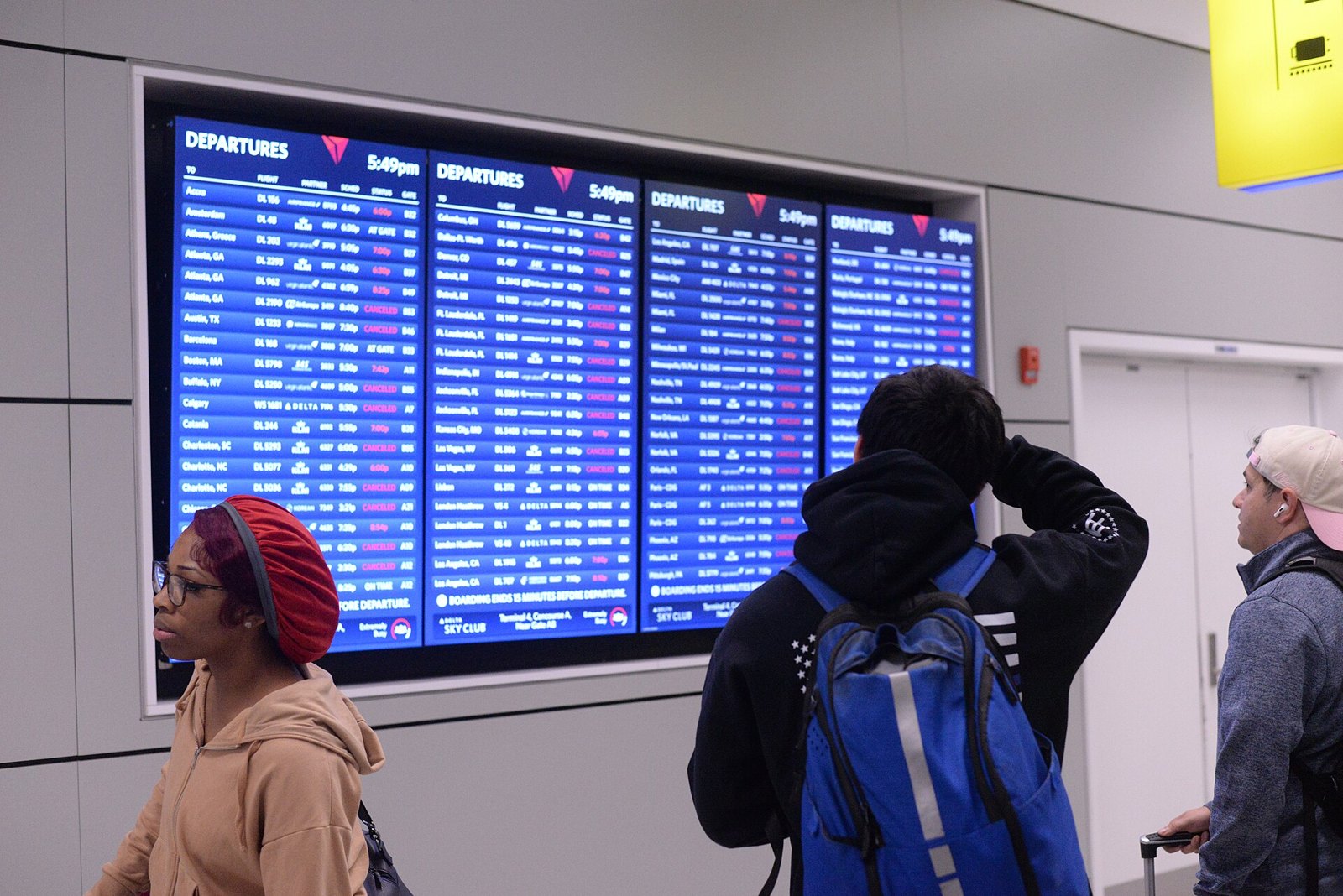
Travelers check a departures board at JFK Airport during the Nov. 13 ground stop. Photo by Sashimi-b via Wikimedia Commons, CC BY-SA 4.0.
Was this the modernization program, or not?
The administration has given two answers. Friday night, Duffy called it "an emergency" and raised his ask to $50 billion. "President Trump is a builder. He's going to build this network and deliver for the American people. But the president can't deliver for America unless the Congress delivers the money," he said, per Roll Call. Mullin said piecemeal upgrades may have overwhelmed old gear: "Nickel and diming it together does not work." A day earlier, Duffy and budget director Russ Vought had asked appropriators for $30.1 billion, on top of the $12.5 billion in the July 2025 reconciliation law.
On Saturday, Bedford drew a line. The FAA is "constantly replacing 2,000 Cisco 600 routers with Juniper routers" as routine work, he said in the DOT transcript, and "this is not part of the Peraton-FAA $12.5 billion modernization effort, so let's not conflate those two things." The agency spends "a billion dollars a year maintaining and sustaining the existing 1980's" telecom network. In the same briefing, Duffy counted the copper-to-fiber swap as progress, saying "we have replaced 69% of the copper communications." L3Harris told Reuters it has finished more than 70% of that conversion.
What did GAO warn about two months ago?
On Sept. 14, the Government Accountability Office published GAO-26-107992, a 52-page review of the new air traffic control overhaul. It found the FAA "has not developed an integrated master schedule for phase 1" and is instead juggling 11,389 separate project schedules, so installations can land at the same sites without being sequenced to limit disruption.
Official record
U.S. Government Accountability Office, "Air Traffic Control Systems: Ambitious New Modernization Effort Needs to Improve Cost and Schedule Planning," GAO-26-107992, Sept. 14, 2026. DOT partially concurred with both recommendations, and both remain open.
Without a reliable cost estimate and schedule, FAA "could end up causing air traffic disruptions or prolonging reliance on severely outdated systems." U.S. Government Accountability Office
If Bedford is right that the router swap sits outside the $12.5 billion program, GAO's schedule finding does not directly cover it. The lesson still carries. Duffy conceded the Friday afternoon timing was a choice, saying remote switchovers happen during the day and "there'll be a reevaluation of when we do this work." The union for FAA technicians, PASS, said its members "were not involved in the upgrades that led to the ground stop."
What comes next?
L3Harris says it is "supporting the FAA in its investigation to understand the conditions that led to the Nov. 13 ground stop." Duffy said, "we're going to hold people accountable." Outgoing Speaker Mike Johnson told Fox News, "We don't really need any investigation to understand we need further investment," CNN reported.
Readers should hold officials to the promise Bedford made. The administration has a credible account of the trigger and no evidence of an attack. It does not yet have the root cause, and Congress is being asked for $50 billion before that report exists. The FAA said it will publish its findings. With Thanksgiving travel less than two weeks out, that report should come before the money vote, not after.















