

The federal government ran a $404 billion deficit in October, the first month of fiscal 2027, and headlines called it the biggest October shortfall ever. Treasury's own report says a large slice of it is November's bills paid early, while tariff collections are recovering and interest on the debt topped $103 billion in a single month.
What did Treasury actually report?
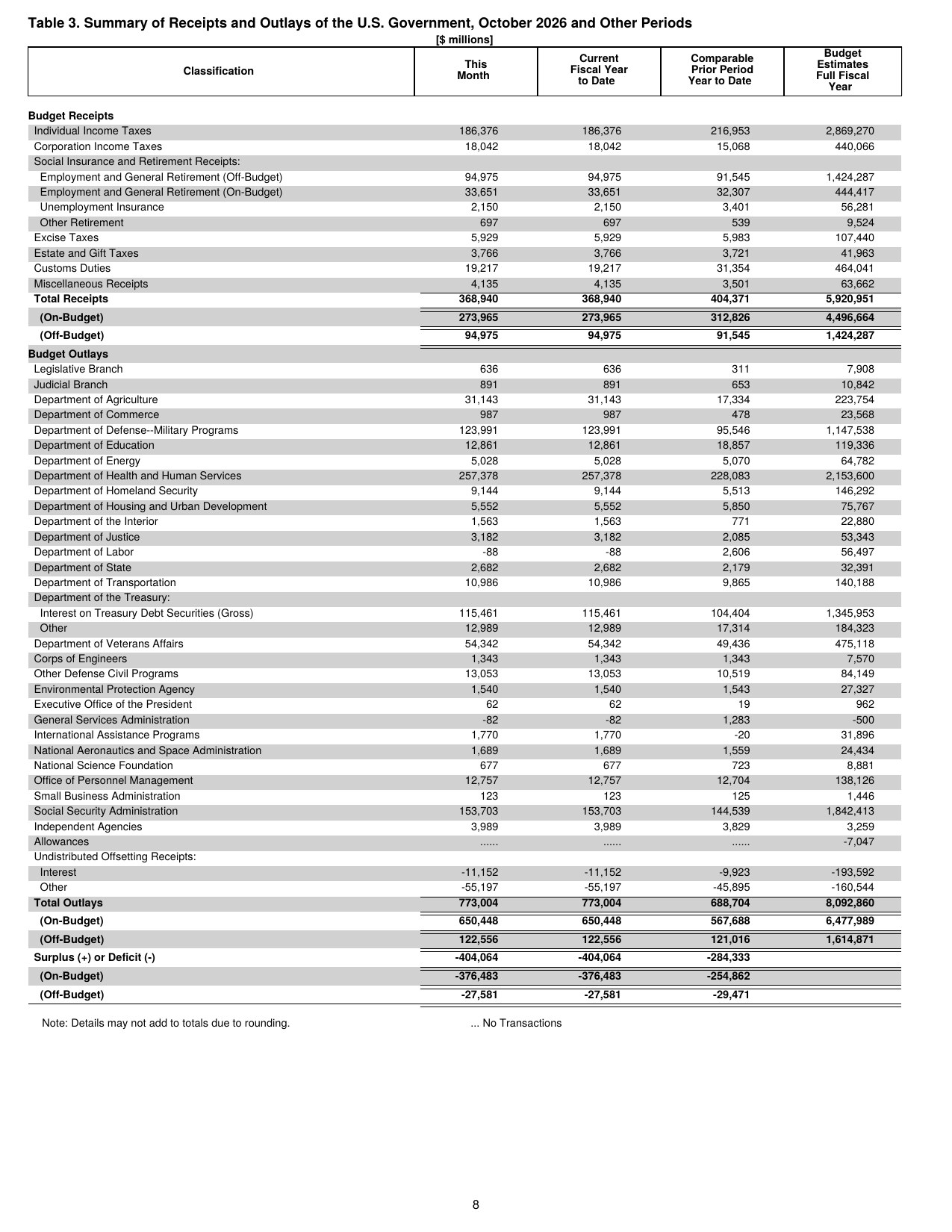
The Monthly Treasury Statement released Nov. 12 shows receipts of $368.9 billion and outlays of $773.0 billion in October. That leaves a deficit of $404.1 billion, up from $284.3 billion in October 2025. Revenue fell 8.8% from a year earlier and spending rose 12.2%.
24/7 Wall St. ran it as "The U.S. Just Ran Its Biggest October Deficit Ever," and Bloomberg led with the $404 billion figure. The Congressional Budget Office had estimated $409 billion three days earlier in its Monthly Budget Review. The number is real. What it measures is the question.
How much of October was really November?
A lot of it. The first page of Treasury's statement says so in plain English. Payments for military pay and retirement, veterans' benefits, Supplemental Security Income and Medicare Advantage and drug plans "accelerated into October, because November 1, 2026, the normal payment date, fell on a non-business day." Nov. 1 was a Sunday.
The same thing happened last year, when Nov. 1, 2025, fell on a Saturday, so both Octobers carry an extra month of those checks. Adjusted for the calendar, Treasury put October's deficit at $285 billion, according to Reuters figures relayed by The FINANCIAL and 24/7 Wall St. That is roughly $119 billion smaller than the headline.
Here is the part the "record" framing skips in the other direction. That adjusted $285 billion is up 49% from the adjusted figure a year ago, a faster climb than the 42% jump in the raw number. Strip out the calendar and the trend looks worse, not better.
Official record
U.S. Department of the Treasury, Bureau of the Fiscal Service, "Monthly Treasury Statement of Receipts and Outlays of the United States Government for Fiscal Year 2027 Through October 31, 2026." Table 3 (page 8) is shown below; the quoted text is on page 3.
"Outlays for military active duty and retirement, veterans' benefits, Supplemental Security Income, and Medicare payments to health maintenance organizations and prescription drug plans accelerated into October, because November 1, 2026, the normal payment date, fell on a non-business day." U.S. Treasury, Monthly Treasury Statement
Read or download the full 38-page statement (PDF) or view it on Treasury's FiscalData site.
Did tariff money really fall 39%?
On a net basis, yes. Customs duties came to $19.2 billion in October, down from $31.4 billion a year earlier. 24/7 Wall St. noted Treasury "gave no reason beyond that high base."
Table 4 of the statement gives the reason. It splits customs into money collected and money sent back. Gross collections were $26.0 billion in October, down from $33.1 billion a year earlier but the most in any month since January. Refunds were $6.7 billion, against $1.7 billion in October 2025. So about $5 billion of the $12 billion drop is money going back out the door, and the rest is lower collections.
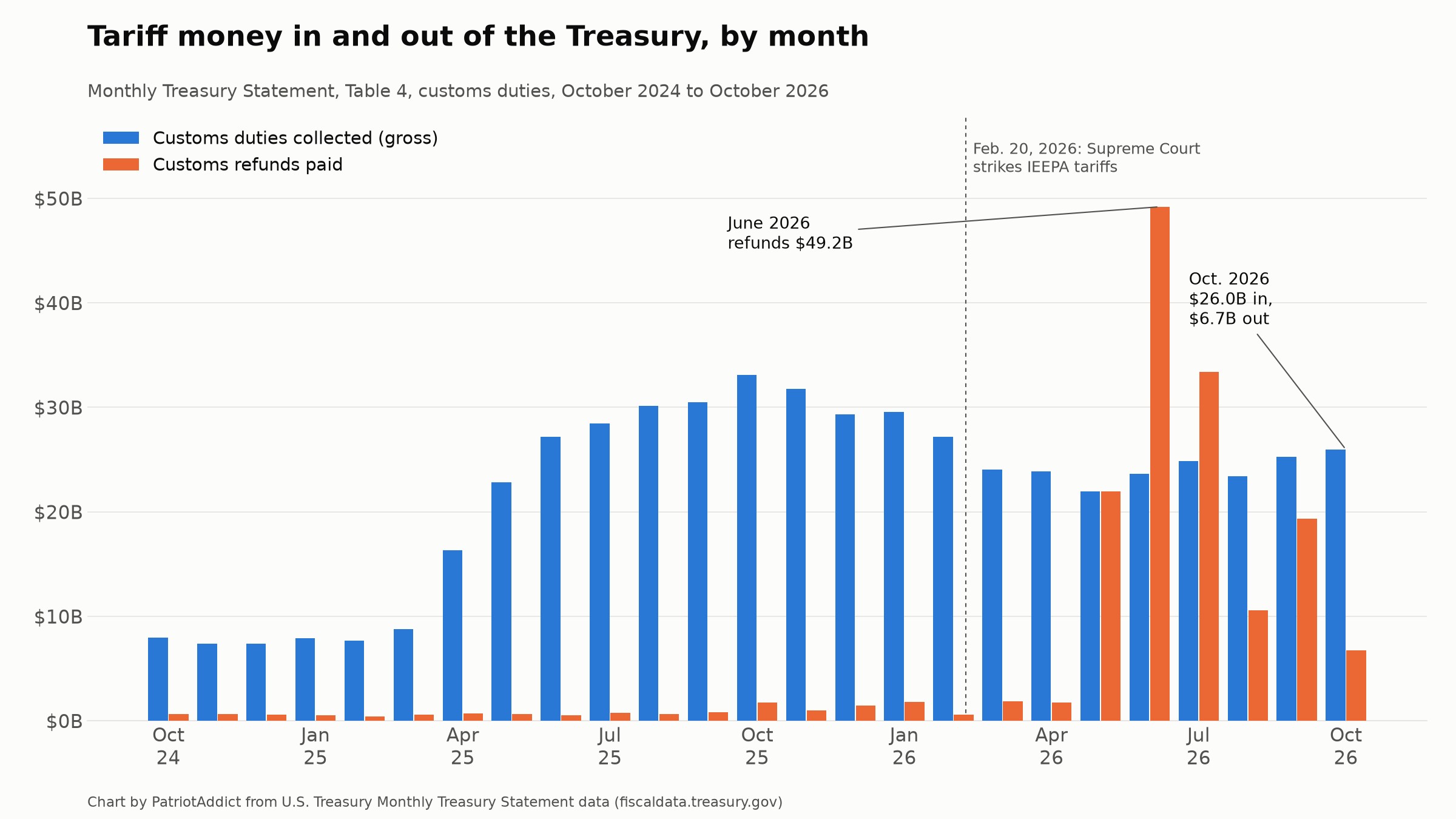
Gross customs duties collected and customs refunds paid each month, October 2024 to October 2026. Chart by PatriotAddict from U.S. Treasury Monthly Treasury Statement data, Table 4.
Those refunds trace back to Learning Resources, Inc. v. Trump, the 6-3 Supreme Court decision of Feb. 20, 2026, holding that the International Emergency Economic Powers Act does not let a president impose tariffs. Customs and Border Protection had sent about $122 billion in refunds, with interest, to the Treasury for payment as of Sept. 11, 24/7 Wall St. reported. Treasury's monthly table does not say how much of October's $6.7 billion was IEEPA money.
The monthly trend is the real news. Refunds hit $49.2 billion in June, when net customs receipts went negative at minus $25.6 billion. They fell to $6.7 billion in October, while gross collections under the tariffs still in force have risen each month since August. One caution cuts the other way: the April 2026 budget behind Table 3 still projects $464.0 billion in customs for all of fiscal 2027. October delivered about 4% of that.
Where did the extra spending go?
Table 9 breaks outlays down by function. Medicare rose to $170.0 billion from $150.6 billion. Social Security rose to $142.7 billion from $134.1 billion. National defense jumped to $128.9 billion from $99.9 billion, and 24/7 Wall St. said part of that reflects a trust fund payment delayed by last year's government shutdown, which began Oct. 1, 2025.
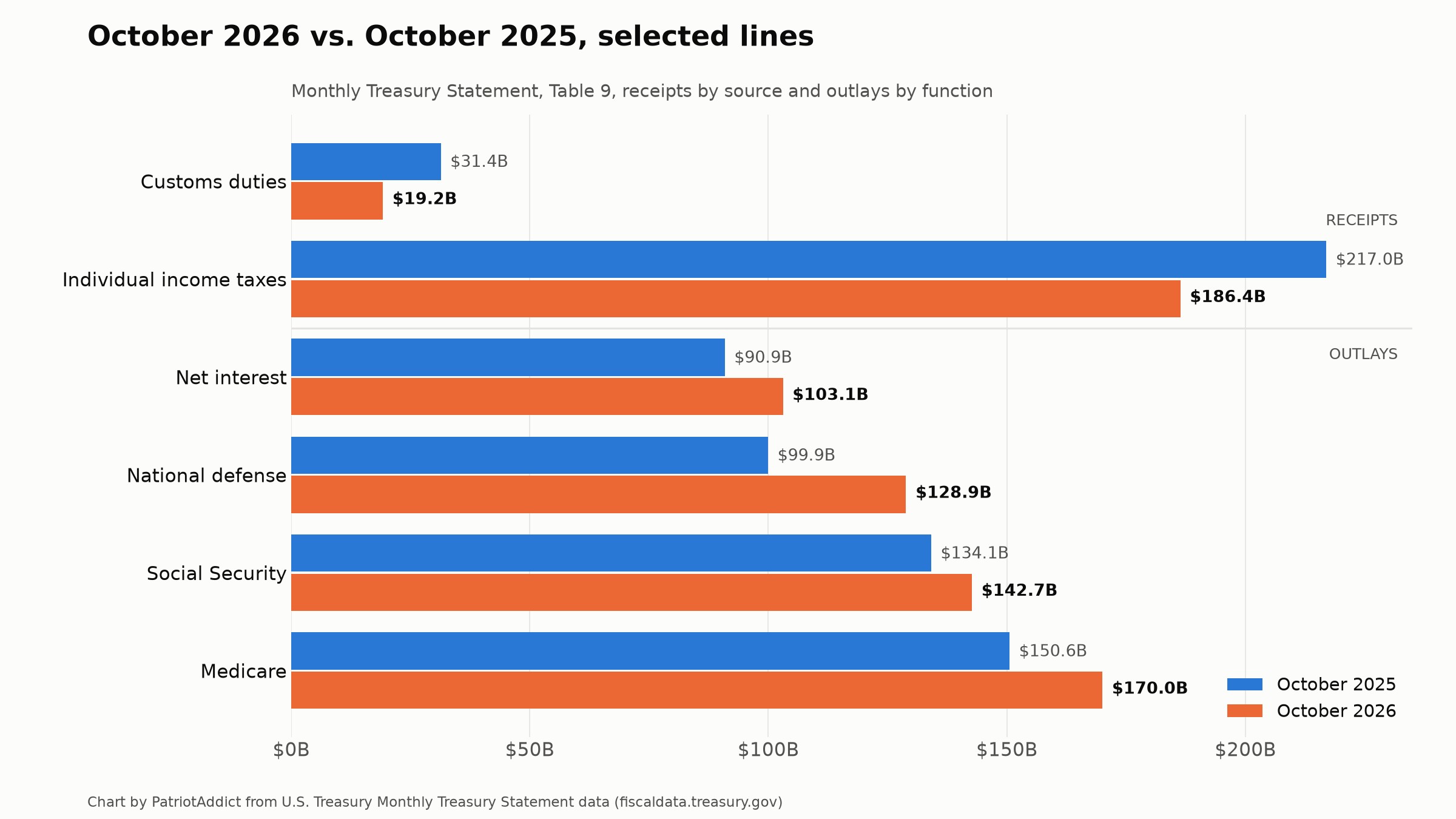
Selected receipt and outlay lines, October 2025 vs. October 2026. Chart by PatriotAddict from U.S. Treasury Monthly Treasury Statement data, Table 9.
On the revenue side, individual income taxes fell to $186.4 billion from $217.0 billion. Paycheck withholding was flat at $156.4 billion. The whole decline sits in non-withheld payments, which dropped to $50.5 billion from $79.5 billion. 24/7 Wall St. attributes that to last year's base, when delayed filing deadlines for Californians hit by the early-2025 wildfires pushed payments into October 2025.
Why should a family care about the interest line?
Net interest on the debt was $103.1 billion in October, up from $90.9 billion, a 13.4% increase. Gross interest on Treasury securities was $115.5 billion. Put the net figure next to receipts and it works out to about 28 cents of every dollar Washington collected last month.
That bill is tied to the same rates households pay. Treasury's daily yield curve put the 10-year note at 5.15% on Nov. 13, against 4.11% on the same date in 2025. Freddie Mac's weekly survey had the 30-year fixed mortgage at 7.11% on Nov. 12, up from 6.24% a year earlier. Borrowing more at higher rates means paying more interest, for the Treasury and for anyone buying a house.
What comes next?
Fiscal 2026 closed with a deficit of $1.99 trillion, per Table 1 of the same statement. A government funding deadline arrives in early December, the Committee for a Responsible Federal Budget noted, and the Federal Reserve meets Dec. 8-9.
The next statement, covering November, should run the other way on the calendar, since the benefit checks that normally go out Nov. 1 were already paid in October. Expect a smaller November deficit and a round of "improvement" headlines. The numbers to watch are the ones that do not move with the calendar: gross tariff collections, the refund line and the interest bill. Right now two of those three are moving in the taxpayer's favor, and the third is not.
Top photo: The Treasury Building in Washington, with the Washington Monument behind it. Photo by MeanieHyaena via Wikimedia Commons, CC BY 4.0.















