Treasury Secretary Scott Bessent told the Federal Reserve on Friday not to "hike too much into an energy supply shock," pointing to falling oil and gasoline prices. The government's own data back him on the pump, where the average gallon of regular slipped under $4 for the first time since July. They are less kind to his diagnosis: the Labor Department's core price index, which strips out energy entirely, has now risen 0.3% three months in a row.
What exactly did Bessent say?
Bessent made his case on CNBC on Friday, Nov. 13, three days after a hot October inflation report sent bond yields climbing. "I think the Fed should understand that this is an energy supply shock," he said, according to Reuters. "So I think that to hike too much into an energy supply shock when it's coming down, these are very noisy numbers." He added that "the Fed's supposed to look into the future, not look in the rearview mirror."
He was careful to stay on the right side of the line between the Treasury and an independent central bank. "I'm not going to tell the Fed what to do. I am going to say they should have an open mind," he said, as quoted by The Standard, which carried the Reuters report. After the Fed cut rates last year, he said, "a reversal in a dramatic way isn't something that I would do if I were on the Fed. But I'm not on the Fed."
Is the energy shock really coming down?
At the pump, yes. The Energy Information Administration's weekly survey put regular gasoline at $3.995 a gallon on Nov. 9, down nearly 16 cents in a week and down from $4.354 on Oct. 5. It is the first reading under $4 since July 13, according to EIA's historical series, and about 50 cents below the year's peak of $4.50 in May.
The relief is real, but it is relative. That same EIA table shows gasoline still 93.9 cents higher than a year ago. Diesel, which moves most of the country's freight, averaged $6.127, down from a September peak of $6.529 but still $2.29 a gallon above last November. The Labor Department's October report lists gasoline up 37.4% over 12 months, one of the few annual figures it could publish after the 2025 shutdown wiped out October 2025 price collection.
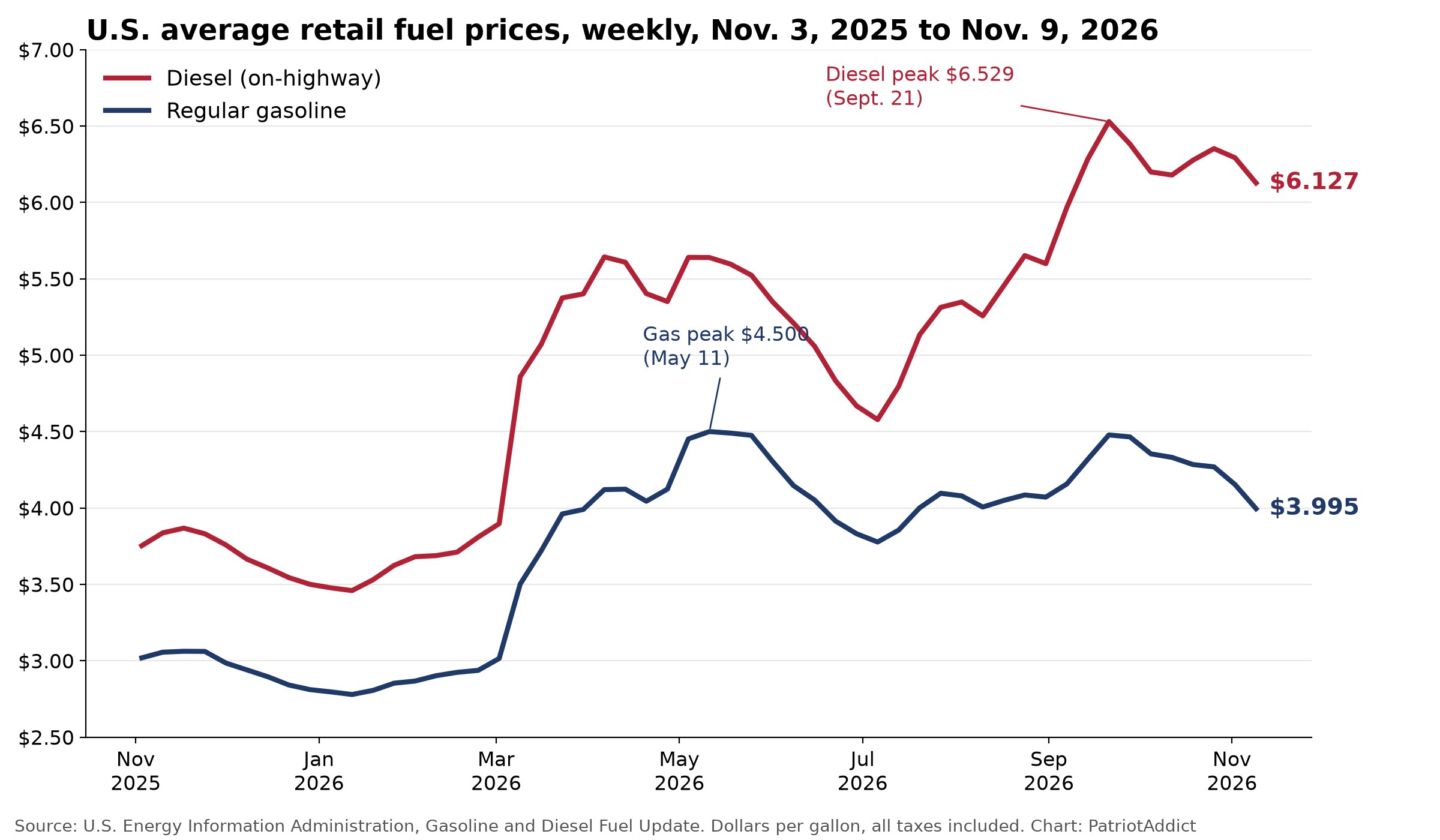
Weekly U.S. average retail prices for regular gasoline and on-highway diesel, Nov. 3, 2025, through Nov. 9, 2026. Chart by PatriotAddict from the U.S. Energy Information Administration's Gasoline and Diesel Fuel Update.
So why is the Fed still talking about hikes?
Because the number the Fed leans on hardest leaves energy out. The Bureau of Labor Statistics' October CPI release says the index for all items less food and energy "rose 0.3 percent in October, as it did in September and August." Three straight months at that pace works out to roughly 3.7% a year, nearly double the Fed's 2% goal. The categories BLS named as rising include medical care, recreation, household furnishings and motor vehicle insurance, which jumped 0.7%. Shelter rose 0.3%.
None of that runs on crude oil, and a Fed official said so on the same network the same day. "Services inflation, which is probably not coming from tariffs or oil, is one of the more troubling aspects of the inflation reports we have been getting," Chicago Fed President Austan Goolsbee told CNBC's Squawk Box, per Reuters. Asked whether the economy is on a path back to 2%, he answered, "My feeling right now is we are not and we've got to deal with that."
Goolsbee conceded part of Bessent's point himself: "The tariff inflation and oil price shock were supposed to have gone away by now and it hasn't." Energy feeds into everything else with a lag, from freight to airfares. The open question is whether falling diesel eventually drags core down, or whether core has a life of its own.
Official record
Federal Open Market Committee statement, Oct. 28, 2026. The Fed held its target range at 3.75% to 4% by a 10 to 2 vote, after raising it a quarter point on Sept. 16. The statement never mentions energy or oil.
"Inflation remains elevated. ... The Committee will deliver price stability." Federal Open Market Committee
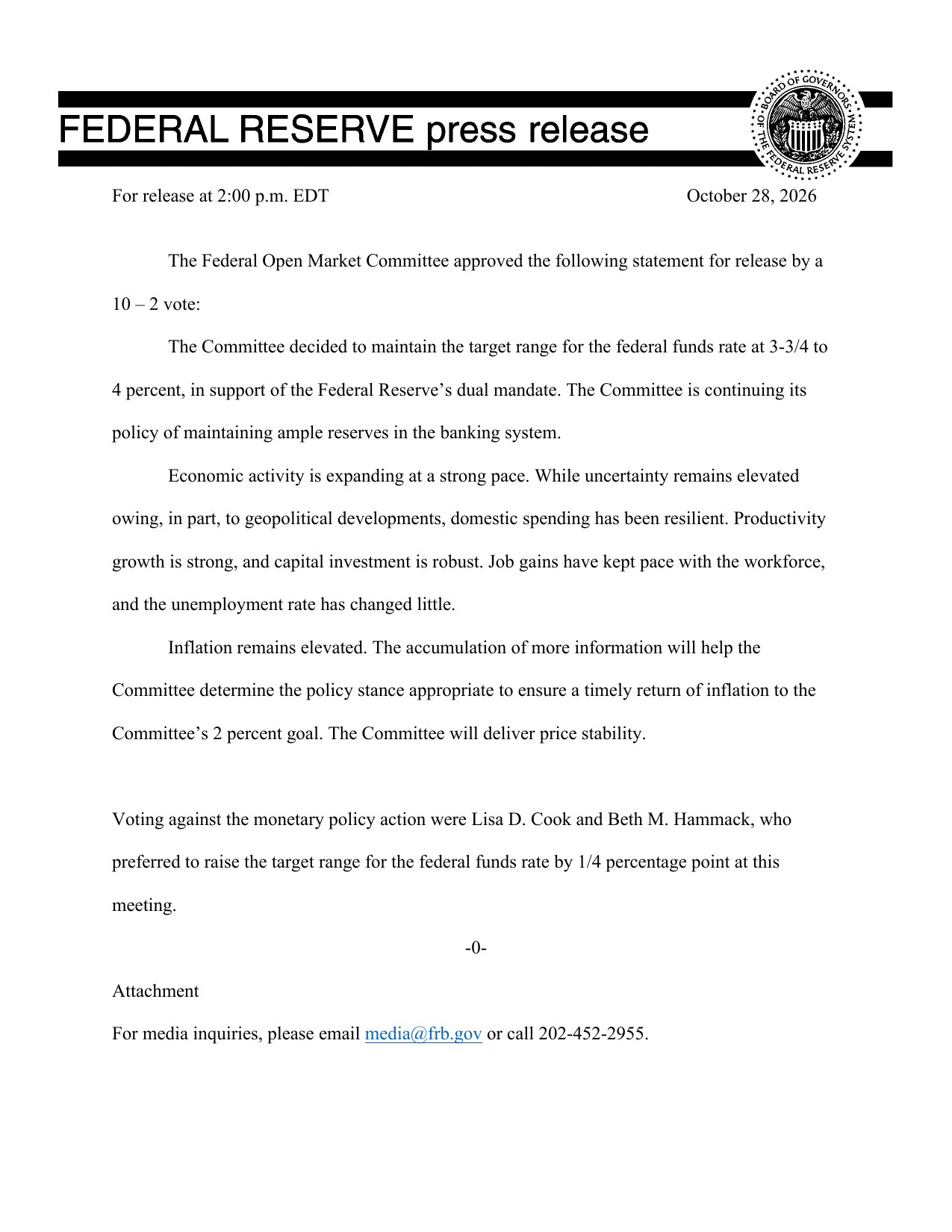
Read or download the full 2-page statement (PDF) or view it on the Federal Reserve's website.
What does the Fed's own record say about the economy?
Here Bessent and the Fed agree more than the headlines suggest. Bessent called the underlying economy very strong. The Fed's October statement opens its assessment with "Economic activity is expanding at a strong pace," and says productivity growth is strong and capital investment is robust. That was the meeting where Fed Governor Lisa Cook and Cleveland Fed President Beth Hammack voted against holding, preferring another quarter-point hike.
A strong economy is exactly what makes a central bank comfortable tightening. Bessent's argument is about the cause of the inflation, not the strength of the economy, and the Fed's own document names no cause at all. It says inflation "remains elevated" and promises to "deliver price stability."
What has the hike talk already cost?
Markets have not waited for the Fed. Treasury's daily yield table shows the 2-year note rising from 4.56% on Nov. 9 to 4.88% on Nov. 13, a jump of about a third of a point in three trading sessions bracketing the Nov. 10 CPI release. The 10-year climbed from 4.88% to 5.15%.
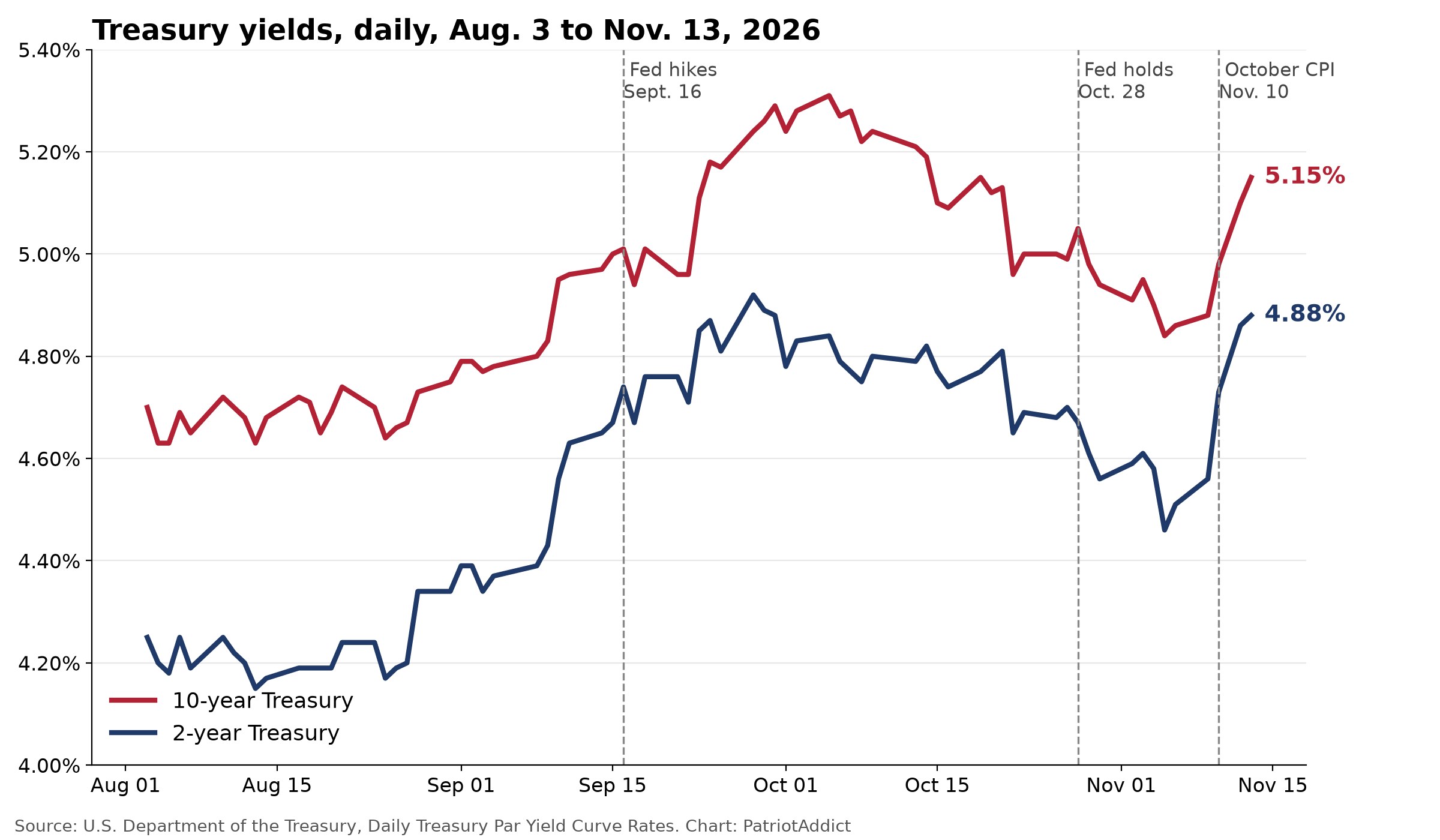
Daily 2-year and 10-year Treasury yields, Aug. 3 to Nov. 13, 2026. Chart by PatriotAddict from the U.S. Treasury's Daily Treasury Par Yield Curve Rates.
The 10-year is the rate that mortgage pricing tracks. Freddie Mac's weekly survey put the average 30-year fixed at 7.11% on Nov. 12, against 6.24% a year earlier. On a $350,000 loan, that gap is roughly $200 a month in principal and interest. Traders were fully pricing quarter-point hikes at the Dec. 8-9 and January meetings as of Friday, Reuters reported, according to 24/7 Wall St.
Who has the better read?
On gasoline, Bessent does. EIA's numbers show the energy spike rolling over, and tightening hard into a falling oil price would mean chasing a problem that is already easing. On the rest of the household budget, Goolsbee has the data. Car insurance rose 0.7% in October alone and shelter 0.3%, and neither has much to do with the Iran war's oil shock.
The next tests arrive before the Dec. 8-9 meeting. EIA updates pump prices Tuesday, and the November CPI lands in December. If core prints another 0.3%, it will be four months running at that pace, and the Fed will be hard pressed to call that noise.