Treasury Secretary Scott Bessent went on national television Sunday and named the Wall Street Journal editor he blames for exposing the house he has now had to leave for a military base under Iranian threats. Nobody has shown that Iran found him through the Journal's photo, but a 2024 FBI complaint shows exactly how Tehran's hired surveillance teams work, and it starts with a target's address and a picture of the front door.
What did Bessent actually say?
On Friday, Bessent told CNBC's "Squawk Box" that he had moved from his home to a military base on the Secret Service's instructions. He also gave Tehran a short, unprintable message. "One of the reasons I've had to move is because the Wall Street Journal printed a photo of my house the day I bought it that has geolocate on it," he said, according to a Raw Story transcript of the segment. "The editor, we pleaded with her not to print the location of my house, but she did anyway." CNBC posted its own excerpts of the interview.
On Sunday he went further. Asked by Larry Kudlow on Fox's "Sunday Morning Futures" whether there had been direct attempts on his life, Bessent said, "We're not going to talk about that," according to yourNEWS, then named Emma Tucker. He said Tucker "authorized a photo of our house" and called it "reckless journalism," Fox News reported. Tucker is the Journal's editor in chief.
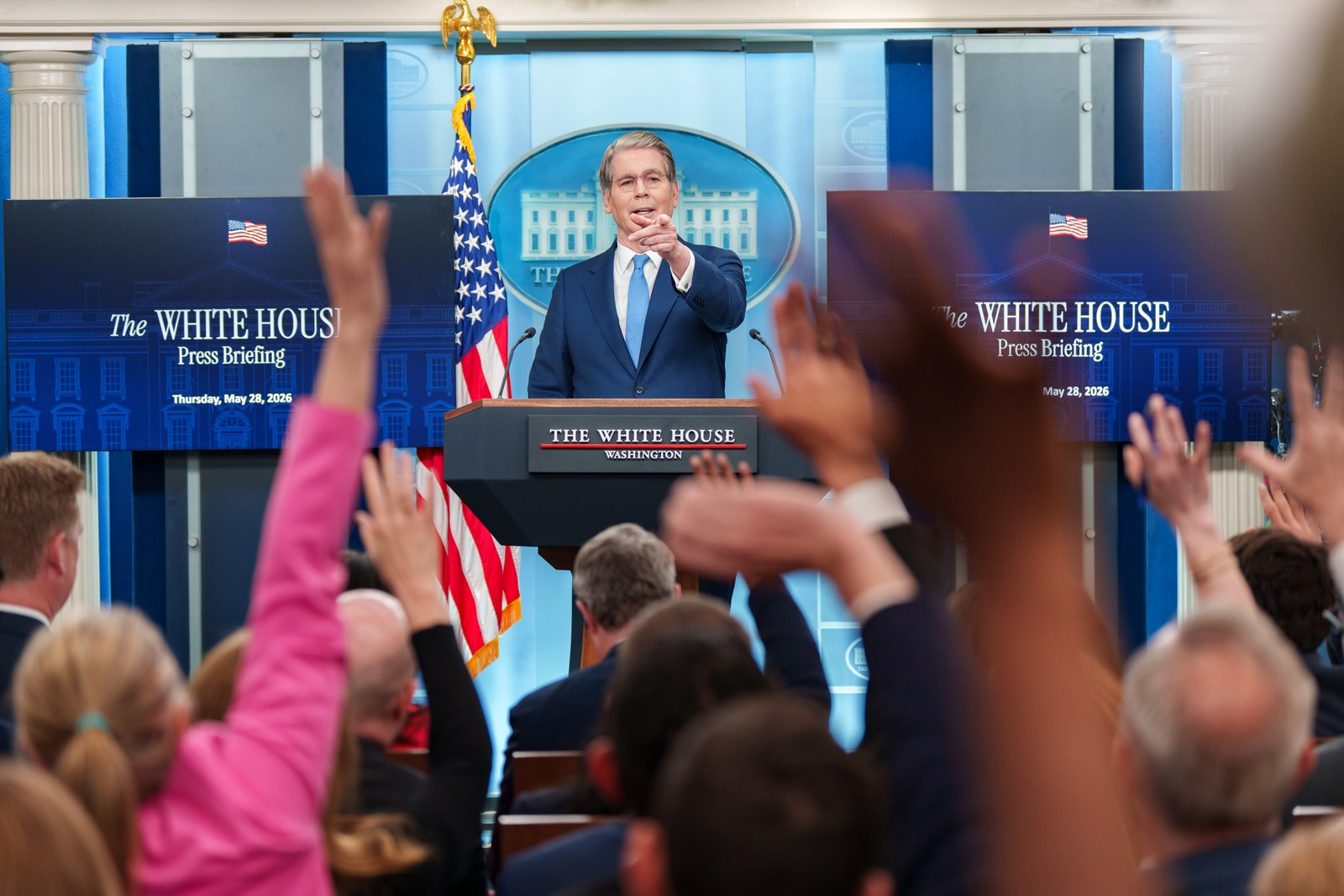
Treasury Secretary Scott Bessent takes questions at a White House press briefing on May 28, 2026. Official White House photo via WhiteHouse.gov (public domain).
What did the Journal publish, and what is still unproven?
The Journal reported in January 2025, days after Bessent's Senate confirmation, that he had paid $12.5 million for a Georgetown mansion. Reuters, citing a person familiar with the matter, said the story ran with an aerial photo that "allowed it to be geolocated," and that the Journal did not respond to a request for comment, as carried by Al-Monitor. The same unnamed source told NBC News that "the news media has an obligation to act responsibly amid growing threats against public officials."
The location did not stay inside one paper. Within days, Charleston's Post and Courier, following the Journal's scoop, described the house as a four-story, 8,000-square-foot home on R Street NW with a saltwater pool. Here is what nobody has put on the record: how Iran actually located Bessent, or what "geolocate" means in this case. Treasury has not described the threats, and we found no public reply from the Journal to Bessent's Sunday charge.
Why would a picture of a house matter to Tehran?
Because that is how the IRGC's contractors work, according to the Justice Department's own filing. In November 2024, federal prosecutors in Manhattan charged Farhad Shakeri, an Afghan national they described as an IRGC asset, along with two New York men, in a murder-for-hire plot. The 26-page sworn complaint says Shakeri's cloud account held an image of an Iranian American journalist's personal data, including possible addresses and her Social Security number, plus a photo of "the front door and porch" of her Brooklyn home.
The two hired men then drove to that house again and again in March 2024, according to the FBI agent's affidavit, with pole-camera footage tracking their car on the block. Shakeri also told agents the IRGC gave him pictures of two Jewish businessmen in New York that "appeared to come from social media," and offered $500,000 to kill each of them.
Official record
United States v. Farhad Shakeri, Carlisle Rivera and Jonathan Loadholt, criminal complaint, U.S. District Court for the Southern District of New York, unsealed Nov. 8, 2024. Original on Justice.gov.
"IRGC Official-1 asked SHAKERI to put aside his other efforts on behalf of the IRGC and focus on surveilling, and, ultimately, assassinating, former President of the United States, Donald J. Trump ("Victim-4")." (FBI agent's sworn complaint, page 25)
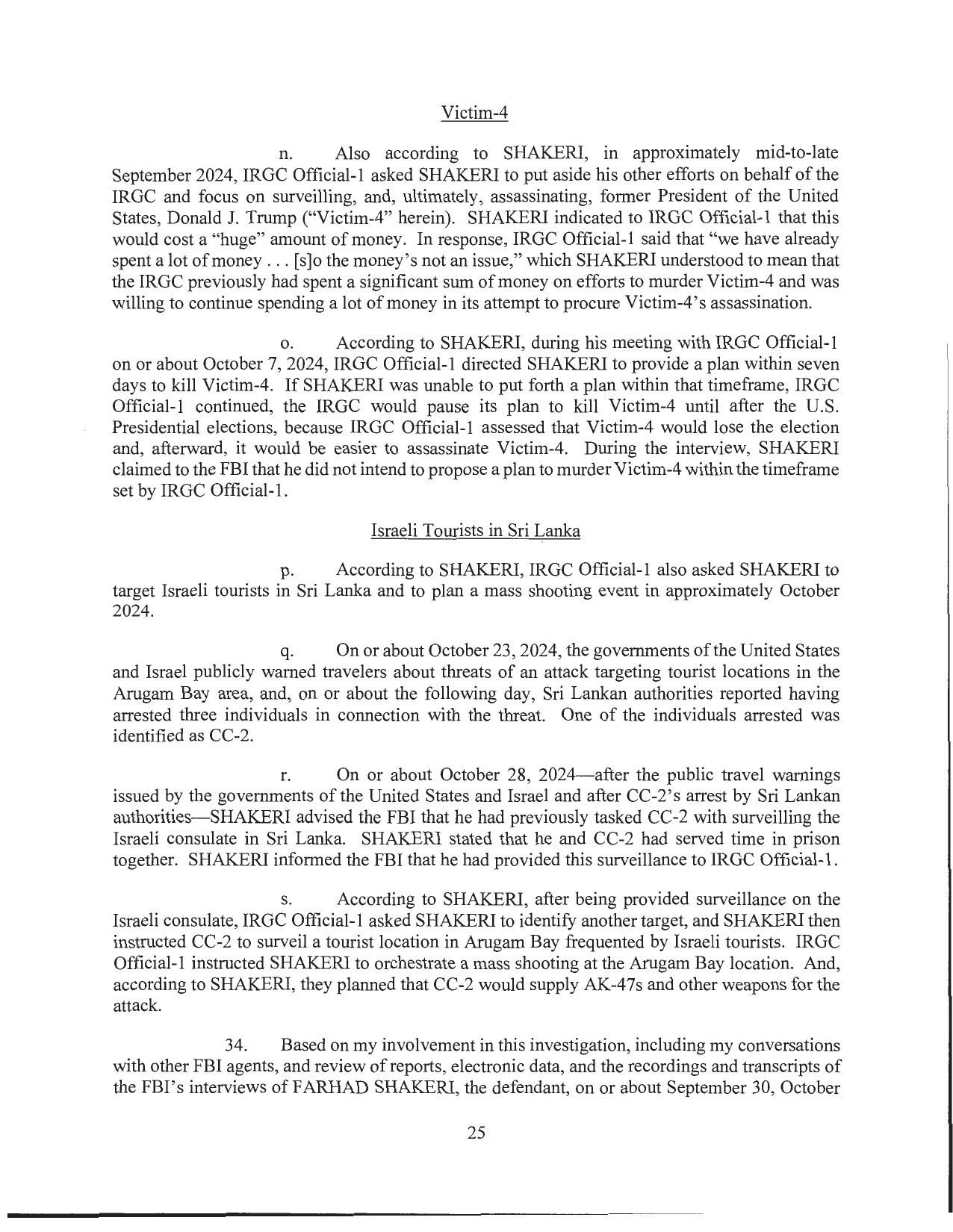
Read or download the full 26-page complaint (PDF).
The same page says the IRGC official told Shakeri "the money's not an issue," demanded a plan to kill Trump within seven days, and said the regime would otherwise wait until after the 2024 election, when it expected Trump to lose and be easier to reach. The complaint is an accusation, and the DOJ release says Shakeri "remains at large and is believed to reside in Iran." It is still the government's sworn account of how the regime goes hunting.
Why Bessent, and why now?
Bessent is the face of the money war. He launched Operation Economic Outcast on Aug. 24, 2026, calling it a campaign to "sever every economic lifeline that sustains this tyrannical regime." Treasury has since sanctioned 27 Iranian airlines in one action, among other designations. At the Heritage Foundation on Friday, Bessent said the flight restrictions were one reason Revolutionary Guard members want him dead, Breitbart reported.
A Treasury spokesperson said the secretary "will not be deterred by the Iranian regime's threats." Reuters reported that a senior intelligence official warned in a memo late last month that Iranian plots against U.S. personnel and citizens had reached an advanced stage.
How many Trump officials now live behind a gate?
Bessent has company. Secretary of State Marco Rubio and Secretary of War Pete Hegseth have been reported to live at Fort McNair, Chief of Staff Stephen Miller moved into military housing, and Attorney General Todd Blanche moved onto a base earlier this year, according to Newsweek's review of the reporting and Fox News Digital. Not every move traces to Iran. Fox reported that some followed concerns about domestic political violence, and Newsweek notes Miller left after his address became public.
The numbers behind the moves are not small. Secret Service Director Sean Curran told 60 Minutes in October that threats against full-time protectees were "up just over 40%" from last year, with 10,000 threat cases since January.
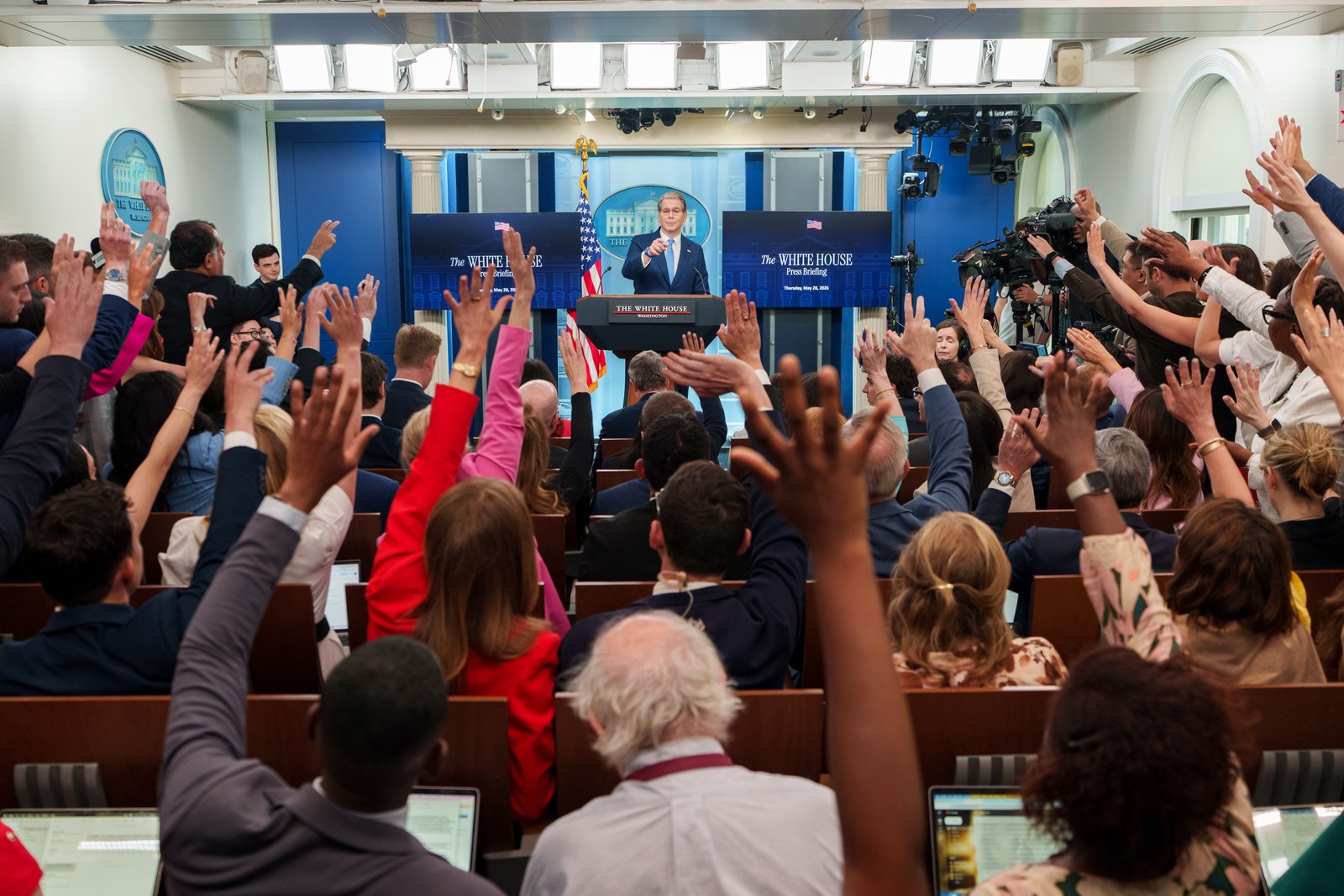
Reporters fill the James S. Brady Press Briefing Room during Bessent's May 28, 2026 briefing. Official White House photo via WhiteHouse.gov (public domain).
Is this about one photo, or a longer fight with the press?
Both. Bessent has a running feud with the financial press. He called the Journal's news operation the "TMZ of financial news" on Friday, per Breitbart, and Raw Story notes that Bloomberg, New York Times and Wall Street Journal reporters were denied credentials to a G20 finance meeting he hosted in Asheville. Bessent has reasons to want the Journal on defense. That does not make the security question go away.
Real estate scoops about the rich are routine. A home photo of the man running an economic siege on a regime that, by the FBI's sworn account, collects porch pictures and pays for stakeouts is a different thing. The Journal can explain its call from January 2025, or it can let Bessent's version stand. Either way, a Cabinet secretary is sleeping on a military base, and the next newsroom weighing an aerial shot of an official's house now knows what the Treasury Department thinks it costs.