A pastor's Christian bookstore in Colorado Springs and Jennifer Sey's XX-XY Athletics ask the 10th Circuit today to block Colorado's pronoun law while their cases go forward. In March, a federal judge refused, saying the bookstore faced no "credible threat" of enforcement. In September, the same judge ruled there is "a very real possibility" the law could be enforced against it.
What is the 10th Circuit hearing today?
Arguments in Born Again Used Books v. Sullivan and XX-XY Athletics v. Sullivan are set for 9 a.m. Mountain time Monday at the Byron White U.S. Courthouse in Denver, according to Alliance Defending Freedom, which represents both businesses. The bookstore's appeal is No. 26-1104. Both are appeals from the denial of a preliminary injunction, so the panel is deciding whether Colorado must stand down while the cases are tried. It is not deciding the final constitutional question.
The target is HB25-1312, passed in May 2025 and signed by Gov. Jared Polis. It rewrote the Colorado Anti-Discrimination Act's definition of "gender expression" to include a person's "chosen name, and how the individual chooses to be addressed." That definition now runs through the state's public accommodations law, which also bars any notice or communication suggesting a customer's presence is "unwelcome, objectionable, unacceptable, or undesirable."
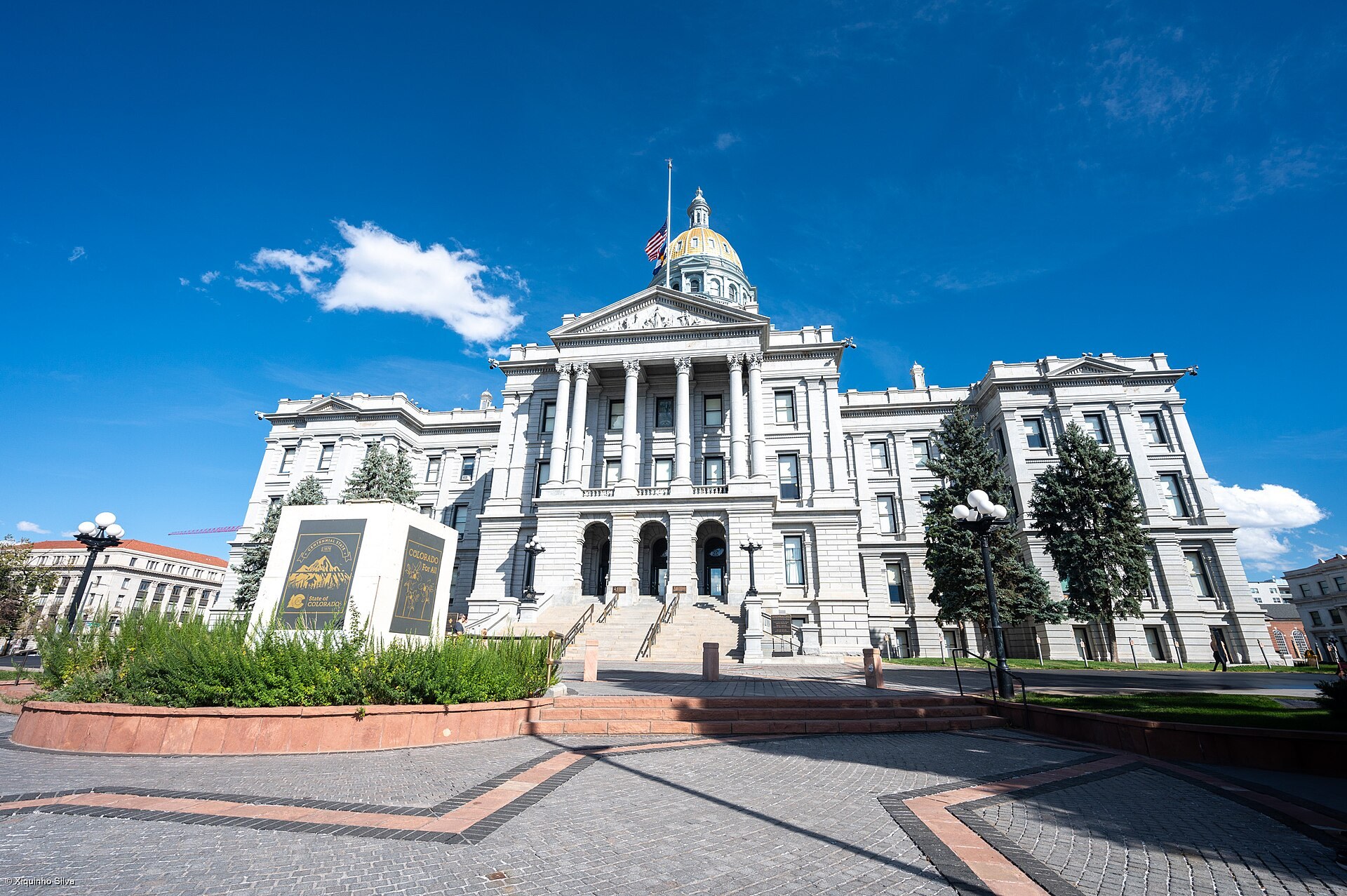
The Colorado State Capitol in Denver, where lawmakers passed HB25-1312 in May 2025. Photo by Xiquinho Silva via Wikimedia Commons (CC BY 2.0).
Who is Born Again Used Books?
Eric and Sara Smith bought the store in 2020, and Eric is a pastor at a local church, according to the bookstore's opening brief. It mostly sells Christian titles and homeschool materials, and its employees often pray with customers. The brief says the store serves everyone, but it "cannot refer to a biological male as 'she' or 'Ms.' or as a 'woman,'" because doing so "would violate the divine commandment not to bear false witness."
The Smiths also want to write the policy down, post it for staff and customers, and explain the reasons on the store's blog. That is where the risk climbs. Under the brief's reading of state law, a court can fine a business $5,000 per public accommodations violation, and a violation of the advertising clauses is a class two misdemeanor carrying up to 120 days in jail and a $750 fine.
Why did the judge say no in March?
U.S. District Judge Regina M. Rodriguez denied the injunctions on March 31, adopting a recommendation from Magistrate Judge Maritza Dominguez Braswell. Her 24-page order reasoned that the law reaches only the denial of "full and equal enjoyment" of goods and services. Since Born Again says it will "happily sell its products to anyone," she wrote, its plan "does not appear on its face to violate CADA or present a credible threat of enforcement."
The same order then undercut that comfort. It said Colorado Civil Rights Commission Rule 81.6(A)(4), on the books since Nov. 30, 2009, already treats "[d]eliberately misusing an individual's preferred name, form of address, or gender-related pronoun" as unlawful harassment. The judge used that rule to find the businesses were asking to "disrupt CADA's decades-long history." So the state's own rule says misgendering can be illegal, and the court leaned on that history to deny relief while also saying the bookstore had nothing to fear.
The state's own witnesses did not settle the question either. Asked under oath whether a single instance of deliberate misgendering could be unlawful harassment, Civil Rights Division Director Aubrey Sullivan said the division "would need to look at the full circumstances of the interaction," according to the bookstore's brief. Dr. Ilan Meyer, the expert Colorado retained, testified that refusing preferred pronouns would make a transgender customer "feel unwelcome," and called that a "reasonable" response. "Unwelcome" is the word the statute bans.
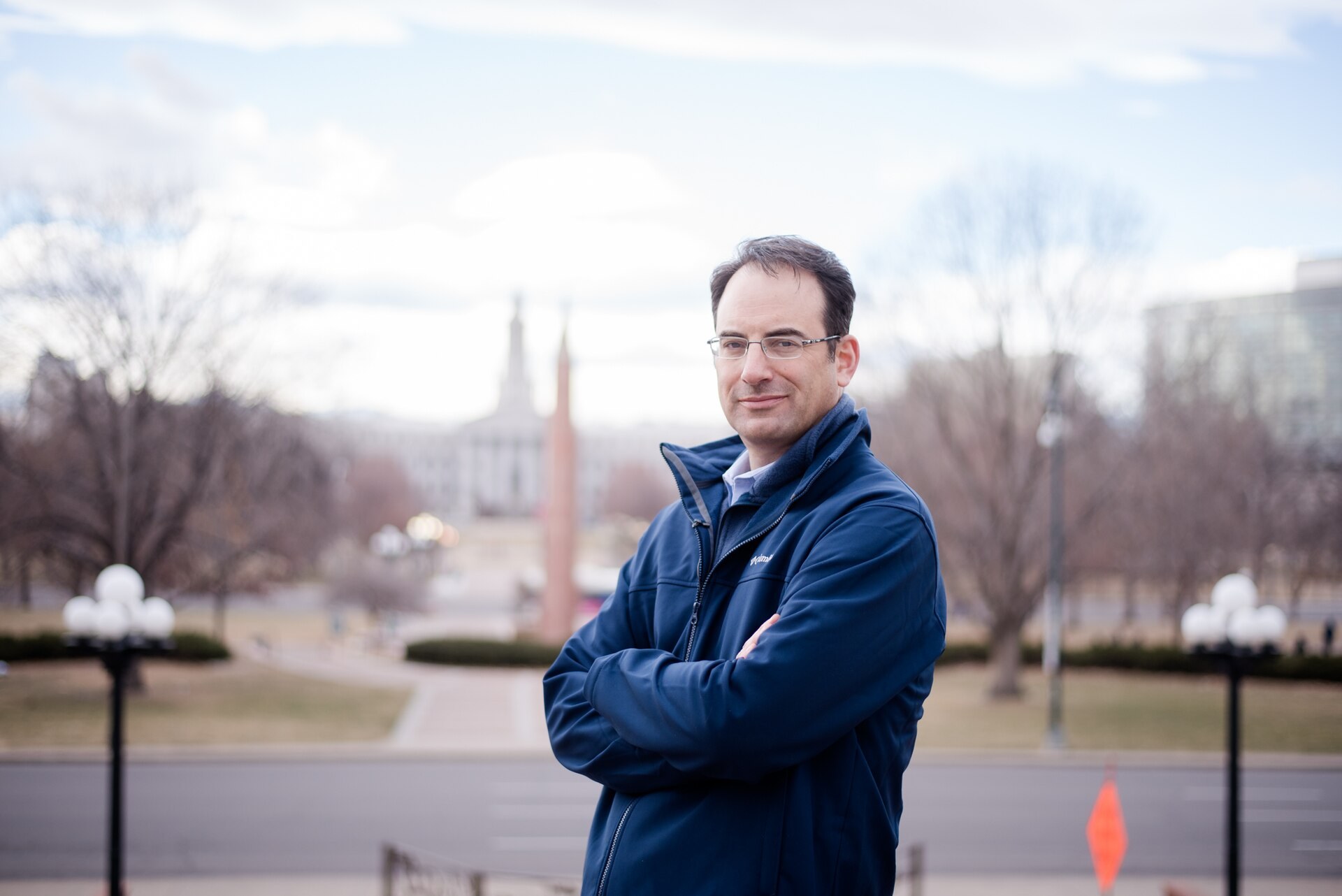
Colorado Attorney General Phil Weiser, a named defendant in both cases. Photo via Wikimedia Commons (public domain).
What changed by September?
On the same day as the March order, the Supreme Court decided Chiles v. Salazar, ruling against another Colorado speech law, this one aimed at counselors. Just the News reported the vote as 8-1. Justice Neil Gorsuch wrote that any law suppressing speech by viewpoint is an "egregious" assault on the First Amendment.
On Sept. 25, Rodriguez ruled on Colorado's motions to dismiss in a 28-page order. This time she found that the bookstore's and XX-XY's intended speech is "arguably proscribed by CADA" and that "there is a very real possibility that CADA could be enforced against them." She explained the shift by the lower bar at the dismissal stage than for a preliminary injunction, and cited Chiles. Their cases stay alive. The claims of three advocacy groups, Defending Education, Colorado Parent Advocacy Network and Protect Kids Colorado, were dismissed without prejudice.
Official record
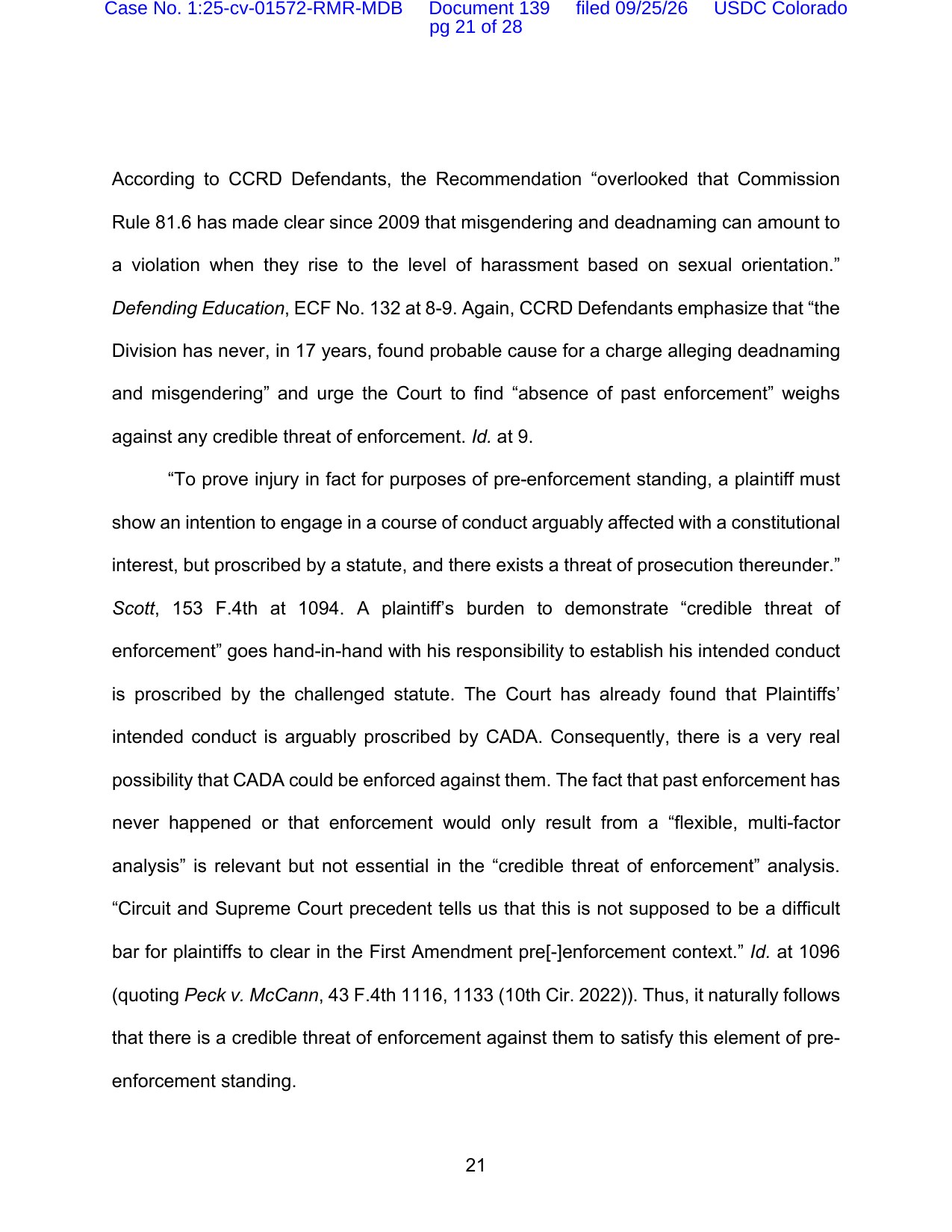
Order Adopting Magistrate Judge Recommendation, Defending Education, et al. v. Sullivan, et al., consolidated with Committee of Five, Inc. (XX-XY Athletics) and Doxa Enterprises, Ltd. (Born Again Used Books), U.S. District Court for the District of Colorado, No. 1:25-cv-01572-RMR-MDB, Document 139, filed Sept. 25, 2026. Page 21 is shown below.
"The Court has already found that Plaintiffs' intended conduct is arguably proscribed by CADA. Consequently, there is a very real possibility that CADA could be enforced against them." Judge Regina M. Rodriguez
Read or download the full 28-page order (PDF), or the March 31 order denying the injunctions.
What does Colorado say now?
The state's position, quoted in the September order, is that the law "only prohibits [misgendering and deadnaming] when it rises to the level of harassment that denies the full and equal enjoyment" of a business's goods and services. Its lawyers also told the court that "the Division has never, in 17 years, found probable cause for a charge alleging deadnaming and misgendering." The judge called that history "relevant but not essential."
That is the heart of today's argument. Colorado says the bookstore is safe because nobody has been charged yet. The bookstore says a law that anyone in the state can trigger with a single complaint, enforced by officials who will only promise to "look at the full circumstances," is exactly what chills a pastor from posting his store's policy online.
Why do outside groups call Colorado a "three-time loser"?
The Independent Women's Law Center, the Manhattan Institute, the Southeastern Legal Foundation and the Center for American Liberty, founded by Assistant Attorney General Harmeet Dhillon, all filed briefs backing the businesses, Just the News reported. The Southeastern Legal Foundation called Colorado a "three-time Supreme Court loser in just the last eight years," counting Jack Phillips of Masterpiece Cakeshop, web designer Lorie Smith of 303 Creative, and counselor Kaley Chiles.
"The government shouldn't be able to censor speech or force people to speak views they disagree with," said ADF Senior Counsel Hal Frampton. Colorado has now lost three free speech and conscience cases at the Supreme Court. The panel in Denver will decide whether a Christian bookstore has to wait for a fourth case, with its own name on it, before a court will protect it.
Top photo: Jennifer Sey, founder of XX-XY Athletics, by Gage Skidmore via Wikimedia Commons (CC BY-SA 2.0).