Aboard Air Force One on Saturday, President Trump told reporters the Gaza war has all but stopped and that Hamas is ready to hand over its guns. "There's not a lot of fighting in Gaza. Hamas is now willing to give up their weapons," he said, a claim confirmed word for word by The Times of Israel, Israel National News and Middle East Eye. It is a real claim about a real ceasefire that brought hostages home after two years of war. It is also, on the specific point about Hamas laying down its weapons, more Trump's own sales pitch than something Hamas itself has agreed to in those terms.
"Nobody Could've Done the Job They Did"
A reporter asked Trump whether he had concerns about Steve Witkoff and Jared Kushner's ability to close out the Gaza deal, a question tied to reports that Trump may hand more of the Russia-Ukraine file to CIA Director John Ratcliffe instead. Trump waved it off. "No, they're doing a great job. Look at Gaza, for example. Look at the fact that we got all of the hostages back," he said, per The Times of Israel.
Israel National News quoted the same exchange with a bit more color: "They've done a great job. Look at Gaza for an example. We got all the hostages back," Trump said, adding that his envoys "done an incredible job. Nobody could've done the job they did," according to Israel National News.

U.S. Special Envoy Steve Witkoff meets with members of the Hostages and Missing Families Forum in Tel Aviv, May 13, 2025. (U.S. Embassy Jerusalem, CC BY 2.0)
What the Ceasefire Has Actually Delivered
The war Trump is talking about began October 7, 2023, when Hamas-led terrorists killed roughly 1,200 people in Israel and took 251 hostage. A US-brokered ceasefire tied to Trump's 20-point plan took effect in October 2025 after indirect talks in Sharm el-Sheikh, Egypt, and led to the release of the remaining hostages in stages, according to CBS News's reporting from those talks. Compared to two years of open warfare, the reduction in intensity is real, and getting hostages' families their people back is a genuine accomplishment nobody on the right should downplay.
But "not a lot of fighting" is a relative description, not zero fighting. More than 1,369 Palestinians have been killed and more than 4,627 wounded since the ceasefire began in October 2025, according to figures cited by Middle East Eye. Israel says its continuing strikes target Hamas operatives rebuilding military capability, while Hamas accuses Israel of violating the deal. Both things can be true at once, and neither erases the other.
Is Hamas Actually "Willing" to Disarm?
Trump and Witkoff have used this exact framing before. At a cabinet meeting on January 30, 2026, Witkoff told reporters Hamas would demilitarize "because they have no choice" and that "they're going to give up the AK-47s," according to The Times of Israel's report at the time. That was more than seven months before this week's comments, which matters: this is a standing talking point the administration returns to, not a fresh breakthrough from this week.
The actual disarmament framework Hamas has been handed is narrower than "give up their weapons." A proposal presented to Hamas in Cairo gives it roughly 90 days to hand over heavy weaponry, rockets, launchers and tunnel maps, with personal weapons collected later through a buy-back program offering jobs and amnesty. Hamas negotiators "expressed willingness... to hand over the terror group's heavy weapons" but "insisted on maintaining lighter weapons, arguing that they are necessary for self-defense," two Arab diplomats told The Times of Israel. That is a narrower, conditional position than "willing to give up their weapons."
Notably, the word "disarmament" does not appear anywhere in Trump's own roadmap. The document uses "decommissioning" instead, a term borrowed in part from Northern Ireland's peace process, according to Chatham House analyst Julie Norman's assessment of the plan. Hamas has specifically rejected Israeli demands that its weapons be destroyed rather than stored, Norman writes, and has "intentionally avoided the language of disarmament or surrender."
Khalil al-Hayya, the Hamas negotiator elected as the group's overall leader in July 2026, has been consistent on where he actually stands. He has "repeatedly said Hamas's weapons are tied to the presence of occupation, and if the occupation ends, these weapons will belong to the state," according to IBTimes UK's reporting. That is a conditional promise pointed at a future Palestinian state, not an unconditional agreement to hand over weapons now. The same report cites Israeli officials saying Hamas has "hardened its position" in recent talks with Aryeh Lightstone, an adviser to Witkoff, with negotiations bogging down over which weapons even count as "heavy" versus "light."
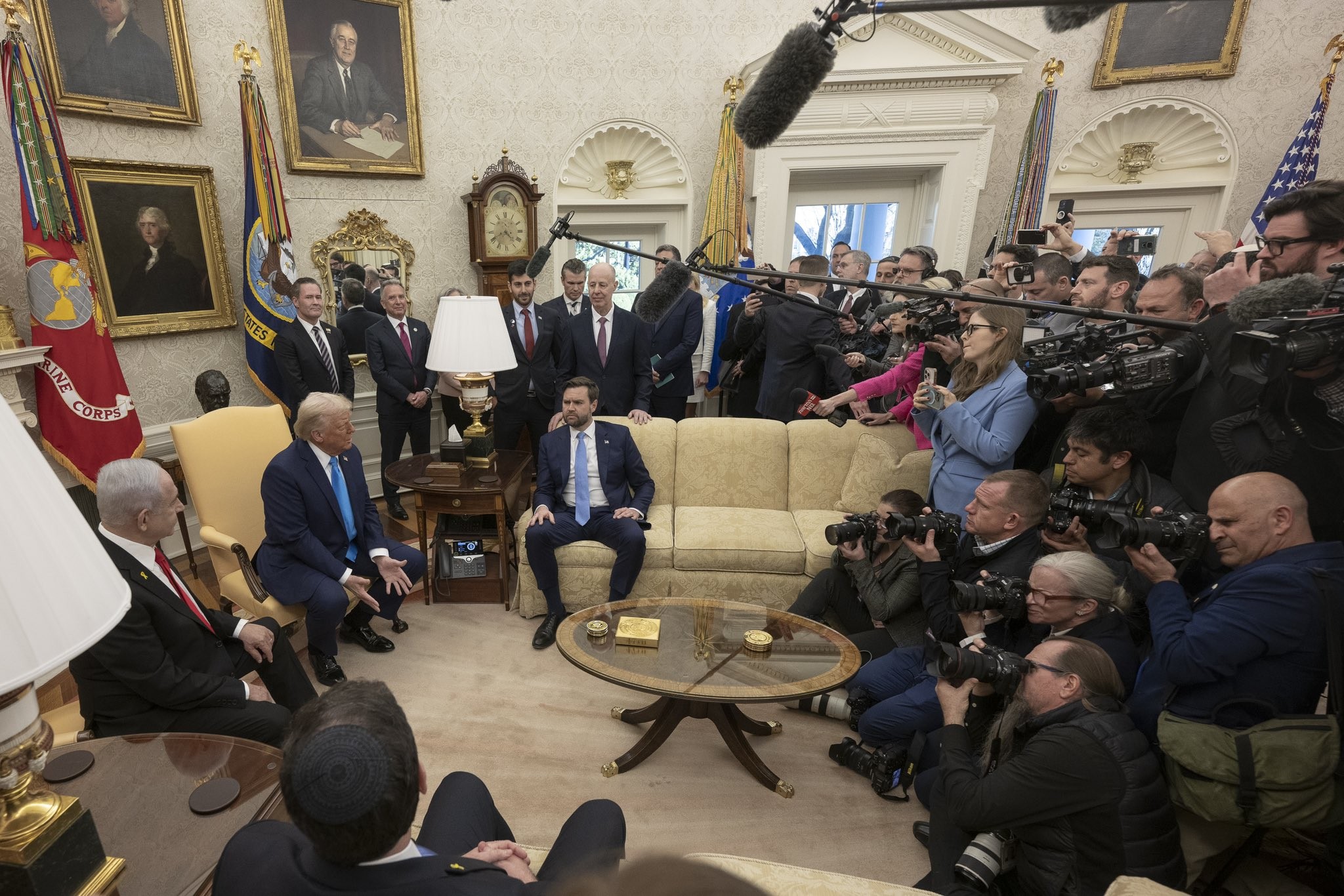
President Trump welcomes Israeli Prime Minister Benjamin Netanyahu to the White House, February 4, 2025. (Official White House Photo / Dan Scavino, public domain)
Trump's Own Team Can't Agree on How the Deal Happened
The disagreement is not only with Hamas. Speaking remotely Sunday to the Yalta European Strategy conference, Kushner said the diplomatic fallout from Israel's September 2025 strike in Doha, Qatar, which targeted Hamas leaders discussing a US ceasefire proposal and killed security personnel without killing its intended targets, gave the US leverage to push a reluctant Israel into the agreement, according to Israel National News. "Today, they're quite happy with it, but at the time, they were uncomfortable with what we were pushing them to do," Kushner said of Israeli officials.
Netanyahu's own Likud party publicly rejected that account a day earlier, insisting it was Israeli ground operations in Gaza City and direct pressure from Trump, not fallout from the botched Doha strike, that actually forced Hamas to the table, according to JNS. When the president's own son-in-law and the Israeli prime minister's political party can't agree on why Hamas folded, a claim about what Hamas will do next deserves at least the same scrutiny.
Kushner has also acknowledged real friction ahead. Israel's own upcoming elections are complicating the next phase, he said last week: "They just have a crazy election and that makes them a little irrational in certain regards but we're very determined and we're working through these things," per Israel National News.
The Territory Tells Its Own Story
If Hamas were actually disarming on the timeline Trump describes, Israel would be preparing to withdraw. It is doing the opposite. Israeli control of Gaza has grown since the ceasefire started, from roughly 53 percent of the territory in October 2025 to nearly 70 percent by this August, according to Chatham House's tracking of the deal. Israeli officials have said they will not pull back without what they call "genuine disarmament" by Hamas, and have raised serious security concerns about the plan directly with the White House. Both sides are, in Norman's phrase, more likely to tell mediators "at least some semblance of what it wants to hear" than to take the first real step.
A Real Win, With the Hard Part Still Ahead
None of this means Trump has nothing to show. Hostages are home. The war is smaller than it was. An American administration got Israel and Hamas to sign onto a 20-point framework at all, something two years of prior diplomacy never managed. That is a legitimate foreign-policy accomplishment, and Witkoff and Kushner earned real credit for the hostage releases specifically.
But "Hamas is now willing to give up their weapons" describes a hope, not a fact on the ground. Hamas's own leadership has offered a conditional, partial version of that promise, tied to ending the occupation and limited mostly to heavy weapons so far. The buy-back program for personal firearms has not been built. Israeli officials remain openly skeptical that a group that carried out October 7 will actually disarm at all. Trump is entitled to say the deal is working. Whether Hamas actually gives up its weapons, on any timeline, is the test that hasn't been passed yet.