The Supreme Court told the Trump administration late Monday night that its new mail-ballot verification rule cannot take effect for this November's midterms, denying an emergency stay request in an order that leaves the current mail-voting system in place through Election Day. The 7-2 ruling in United States Postal Service v. California, No. 26A305, caps a six-month fight over whether the Postal Service can require states to hand over voter lists and use barcoded envelopes before it will deliver a ballot. The strangest part of the order is that Justice Brett Kavanaugh, a Trump appointee, agreed the rule is probably legal and voted against the administration anyway.
What did the Court actually say Monday night?
The order itself is four sentences. "The application for stay presented to Justice Jackson and by her referred to the Court is denied," the unsigned per curiam opinion reads. "The Government is unlikely to succeed on the merits of its challenge to the District Court's preliminary injunction. And the equitable factors applicable for obtaining emergency relief from this Court do not favor a stay."
That leaves in place a nationwide injunction from U.S. District Judge Indira Talwani in Boston, who ruled in June that core parts of Trump's ballot-mail order were unconstitutional and blocked them again in September after the Postal Service published its final version. The practical effect, as Votebeat's Dion Nissenbaum reported, is that mail voting in 2026 will work the same way it has in every recent election.
Official record
United States Postal Service, et al. v. California, et al., No. 26A305, Supreme Court of the United States, decided September 14, 2026.
"The Government is unlikely to succeed on the merits of its challenge to the District Court's preliminary injunction." — per curiam order
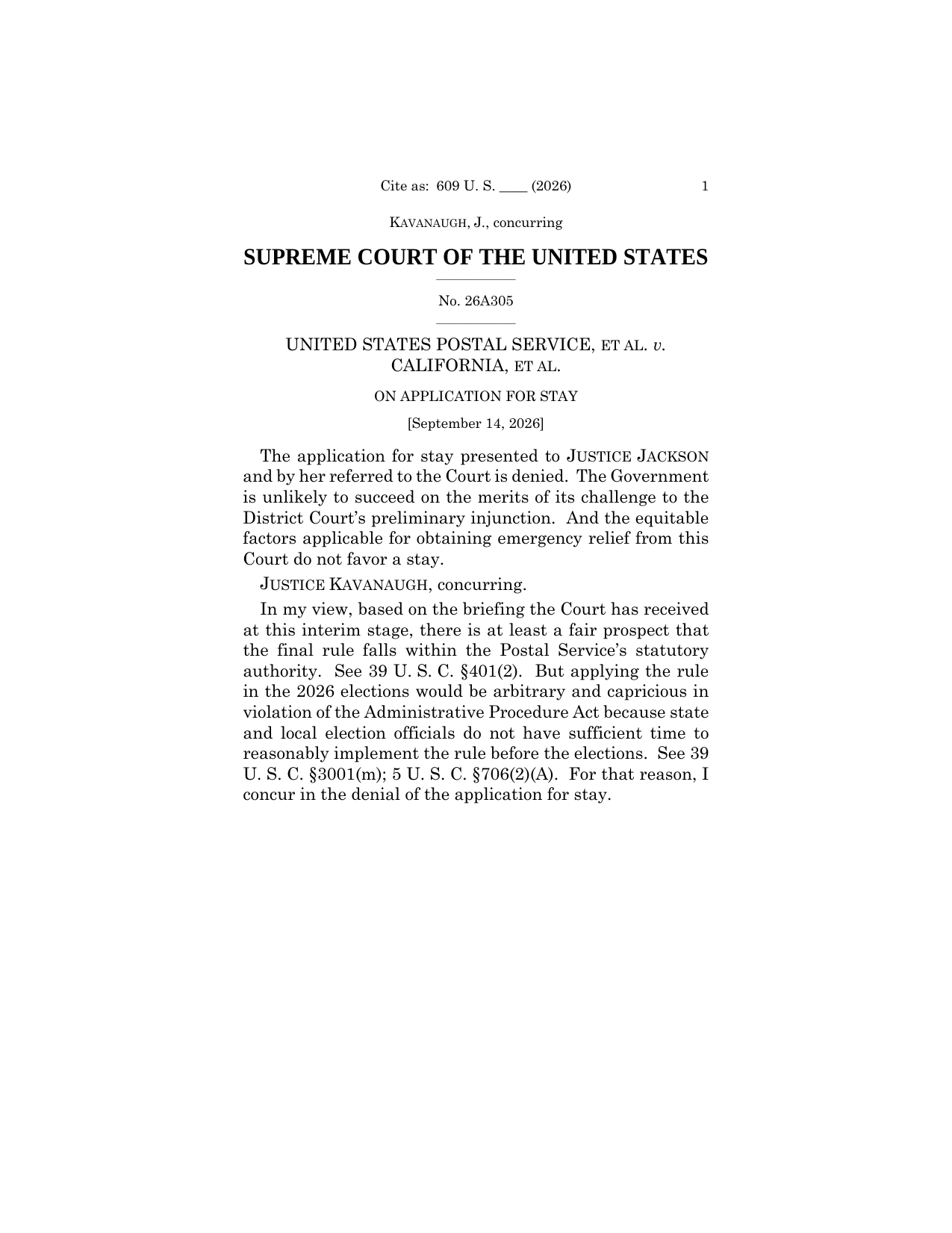
Read the full order (PDF) on the Supreme Court's website.
Why would a Trump appointee side against the administration?
Kavanaugh wrote separately to explain his vote, and his reasoning matters more than the bottom line. "There is at least a fair prospect that the final rule falls within the Postal Service's statutory authority," he wrote in his concurrence. His problem was timing, not substance: applying the rule "in the 2026 elections would be arbitrary and capricious in violation of the Administrative Procedure Act because state and local election officials do not have sufficient time to reasonably implement the rule before the elections."
In plain terms, Kavanaugh is saying the Postal Service was probably within its rights to write this rule. He just would not force county clerks to comply with it a few weeks before ballots go out. That is a narrow, procedural loss for Trump, not a ruling that the underlying policy is illegitimate.
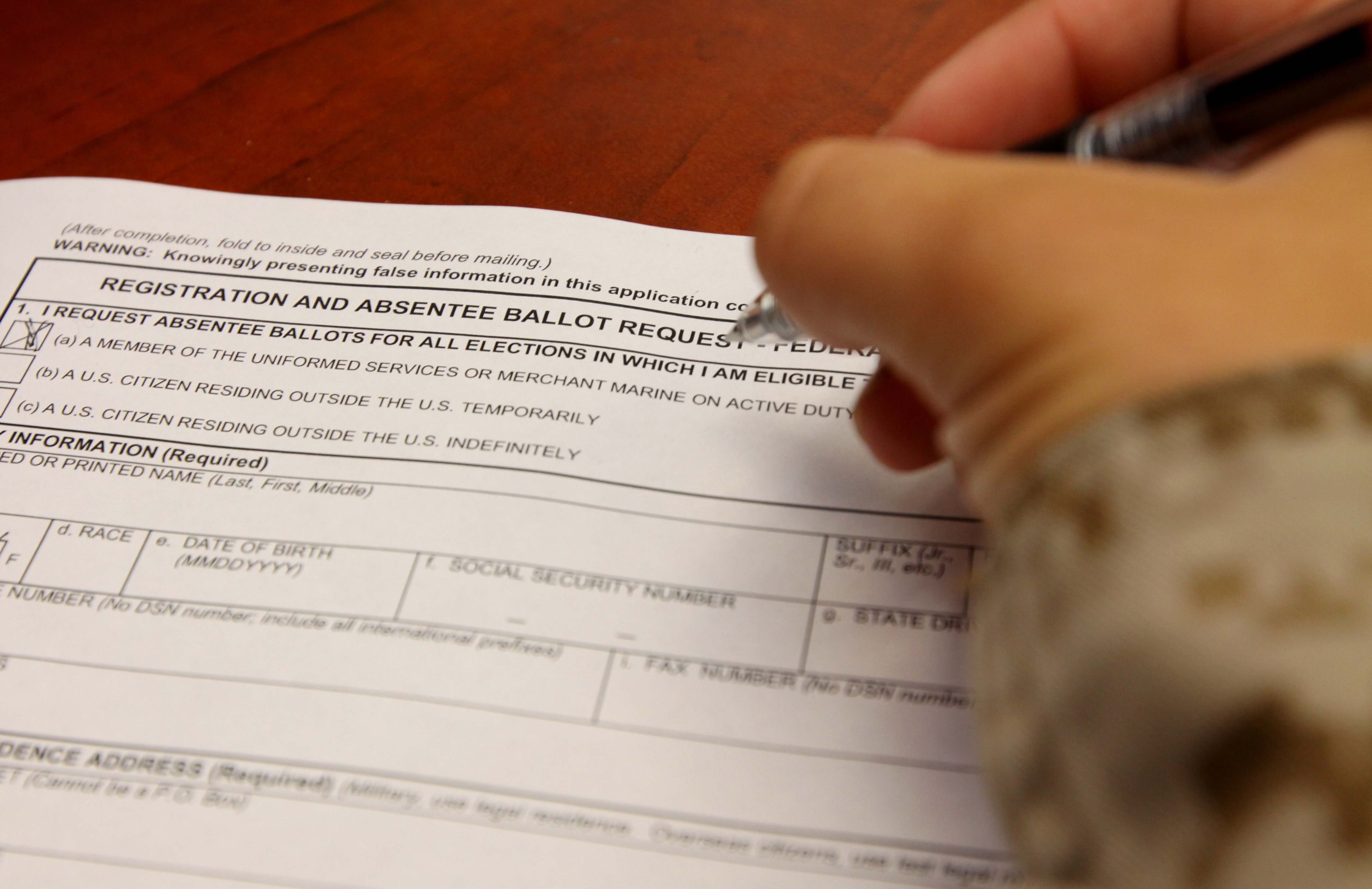
A service member completes a federal absentee ballot request form. U.S. Marine Corps photo, public domain, via Wikimedia Commons.
What was the ballot-mail rule actually built to do?
Trump signed the underlying executive order in March, directing USPS to build a system that could screen ballot envelopes before delivering them. The final rule, published August 26, required states to upload voter information to a new federal portal, use envelopes with a unique intelligent-mail barcode for each voter, and get envelope designs pre-approved by the Postal Service. Ballots that failed the check would be bounced back to the state instead of delivered.
The government's stated goal was straightforward. Justice Samuel Alito, writing in dissent, noted the rule would "enhance the visibility of Federal Ballot Mail" to better detect election fraud, quoting the Federal Register notice directly. Twenty-three Democrat-led states and a coalition of voting-rights groups sued within days of the March order, arguing the president has no authority to dictate how ballots move through the mail.
Who does Alito say actually killed this rule?
Here is what most coverage of Monday's order skipped over. Alito's dissent, joined only by Justice Clarence Thomas, does not just fault the district court. He points a finger at the Supreme Court's own calendar.
Alito writes that after the Court stayed an earlier version of Talwani's injunction on jurisdictional grounds, it "spent from late July to the end of August drafting nearly 40 pages of opinions, including two dissents," before issuing that ruling, "despite the Government's public notice that it would not publish a final rule while subject to the injunctions" and its stated need to issue the rule in "early-to mid-August to allow time to implement it." In other words, Alito is arguing the justices themselves ate up the very weeks the Postal Service needed, then used the resulting time crunch as a reason to deny relief. "The plaintiff States cannot claim the timing of the rule tilts the equities in their favor," he wrote, "when they, and courts hearing their claims, are responsible for so much of the delay."
It is an unusual accusation for one justice to level at his own court in a published dissent, and it did not show up in the wire coverage of the ruling. Read alongside the timeline, the order looks less like a verdict on Trump's election-security agenda and more like the product of a legal process that could not move fast enough to test it before voters started casting ballots.
What did a Postal Service whistleblower warn about?
The rule had internal critics before the Supreme Court ever weighed in. Two weeks before the ruling, an anonymous USPS whistleblower described the rollout to Votebeat as "secretive, rushed, chaotic, and fundamentally flawed." The core worry was technical: if the Postal Service's barcode scanner flagged a single ballot in a batch as noncompliant, the system as designed would reject the entire batch and mail it back to the state, potentially stranding thousands of legitimate ballots over one clerical mismatch.
That is a real design risk worth taking seriously, and it is also exactly the kind of problem a rule can fix with more testing time. The whistleblower's account was about execution, not about whether ballot verification itself is a legitimate goal.
What happens to election security enforcement now?
Monday's order does not end the underlying case. It only decides who wins while the lawsuit continues, and the district court still has to rule on whether the Postal Service ever had the legal authority to write this rule at all. Homeland Security Secretary Markwayne Mullin, who has taken on a larger role in the administration's election-integrity push since July, has called election security "national security," and DHS's broader voter-verification efforts, including its multistate fraud investigations, continue independent of this specific rule.
For November, the practical result is simple: mail ballots will move through the postal system this year exactly as they did in 2022 and 2024, with no federal barcode requirement and no new portal. Twelve states told the district court they supported the rule and were ready to comply on schedule, which means the "impossible timeline" argument that carried the day was not universal, just the majority's read of a mixed record.
The real stakes go past this November
A 7-2 vote with a Trump-appointed justice writing separately to say the policy is probably lawful is not a repudiation of ballot-security rules. It is a ruling that this particular rule, on this particular calendar, could not be forced onto county election offices in time. The distinction matters because it means the fight over whether Washington can set uniform verification standards for ballot mail is still live, headed for a full merits ruling that will land only after the votes this fall are already counted. Whoever controls the House and Senate in January will decide whether Congress moves to settle that question by statute, or leaves it to the next election cycle's version of this same last-minute scramble.