Federal law lets a licensed gun dealer sell a rifle or a shotgun directly to an out-of-state customer who walks in the door, passes a background check, and walks out with it the same day. The same dealer cannot sell that customer a handgun. The pistol or revolver has to be shipped to a federally licensed dealer back in the buyer's home state first, at extra cost and extra delay, before the buyer can ever touch it. A Texas gun store, two traveling competitive shooters, and the Firearms Policy Coalition sued over that gap in January 2025, and on September 2 a three-judge panel of the Fifth Circuit Court of Appeals in New Orleans heard oral argument on whether it survives the Second Amendment.
A rifle can cross the counter. A handgun cannot.
The case is Elite Precision Customs LLC v. Bureau of Alcohol, Tobacco, Firearms and Explosives, No. 25-11206 in the Fifth Circuit, on appeal from the Northern District of Texas. The law being challenged is a set of provisions inside 18 U.S.C. section 922 that the district court's opinion simply calls the "Sale Restrictions." Subsection (a)(3) makes it a federal crime for anyone other than a licensed dealer to bring a firearm bought out of state back into the state where they live. Subsection (b)(3) bars a licensed dealer from selling or delivering a firearm to a customer the dealer knows lives in another state.
Both provisions carry a carve-out, and the carve-out is the whole story here. A licensed dealer can sell a rifle or a shotgun to an out-of-state resident face to face, on the spot, as long as the sale complies with both states' laws. Handguns got no such exception when Congress wrote the Gun Control Act of 1968. A buyer from another state has to arrange for the pistol to be shipped to a dealer in his own state, pay that second dealer's transfer fee, and wait for it to arrive before he can legally take possession.
Who actually eats that cost
Elite Precision Customs is a small manufacturer and federally licensed dealer of custom firearms in Mansfield, Texas. Its complaint says that when an out-of-state customer wants to buy a handgun in the shop, staff have to turn him away from the counter and route the sale through a dealer in his home state instead.
Tim Herron, a Grand Master shooter in the United States Practical Shooting Association who lives in New Mexico, travels the country for competitions and buys a handgun from an out-of-state dealer once or twice a year. Per the district court's own account of the record, routing each purchase through a New Mexico dealer adds $30 to $40 and means he cannot take the gun home the day he buys it. Freddie Blish, a retired Marine Corps lieutenant colonel from Arizona who teaches handgun safety courses on the road, says he has passed on buying from dealers he visits, including Elite Precision itself, purely because of the extra step. Firearms Policy Coalition, a Nevada-based gun rights group all three belong to, joined as a plaintiff on their behalf.
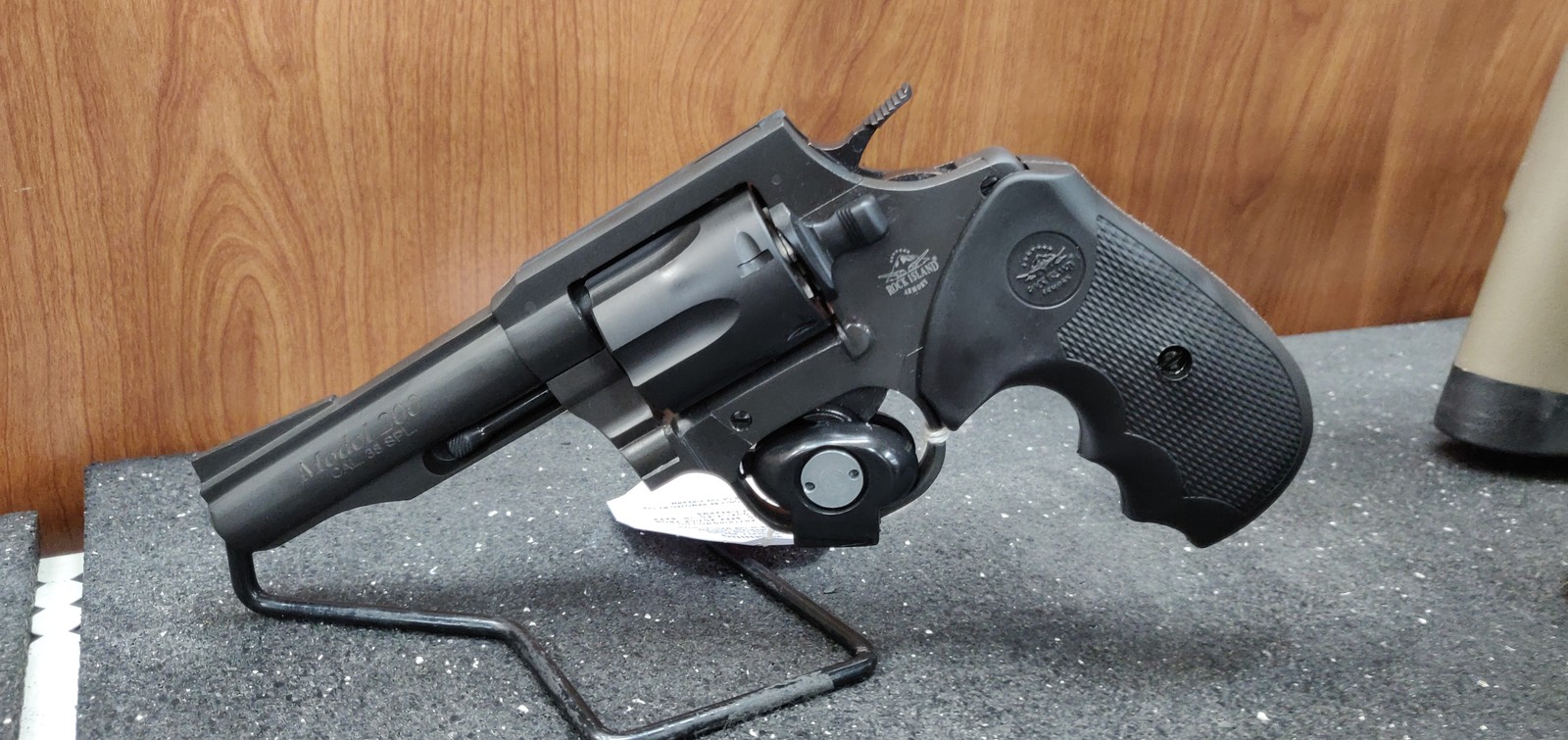
A modern double-action revolver. The restrictions Elite Precision Customs is challenging apply specifically to handguns, not rifles or shotguns, which already carry a face-to-face interstate sale exception under the same statute. (Photo by Wikimedia Commons contributor Somers-all-the-time, CC BY-SA 4.0)
What the judge actually ruled
U.S. District Judge Mark T. Pittman, a Trump appointee sitting in Fort Worth, sided with the government on September 30, 2025. His reasoning did not reach the historical test that has decided most Second Amendment cases since the Supreme Court's 2022 Bruen ruling. He stopped a step earlier, ruling that the handgun transfer rules do not touch the "plain text" of the Second Amendment at all, because they regulate how a sale is completed rather than banning any category of gun or any class of buyer.
Pittman leaned on his own circuit's 2024 ruling in McRorey v. Garland, which upheld a ten-day waiting period tied to expanded background checks, and distinguished the Fifth Circuit's 2025 ruling in Reese v. ATF, which struck down a total federal ban on dealers selling handguns to adults under 21. The difference, in his framing, is that Reese involved an outright ban on an entire class of buyers ever completing a purchase, while Elite Precision's customers can still buy the gun, they just have to route it through a second dealer first.
Official record
Elite Precision Customs LLC, et al. v. Bureau of Alcohol, Tobacco, Firearms and Explosives, et al., No. 4:25-cv-00044-P (N.D. Tex.), Opinion and Order, filed September 30, 2025.
"The Sale Restrictions do not regulate the right to keep and bear arms, only the ability to purchase them in specific and narrow circumstances, and thus ultimately the manner in which they can be acquired." — Judge Mark T. Pittman
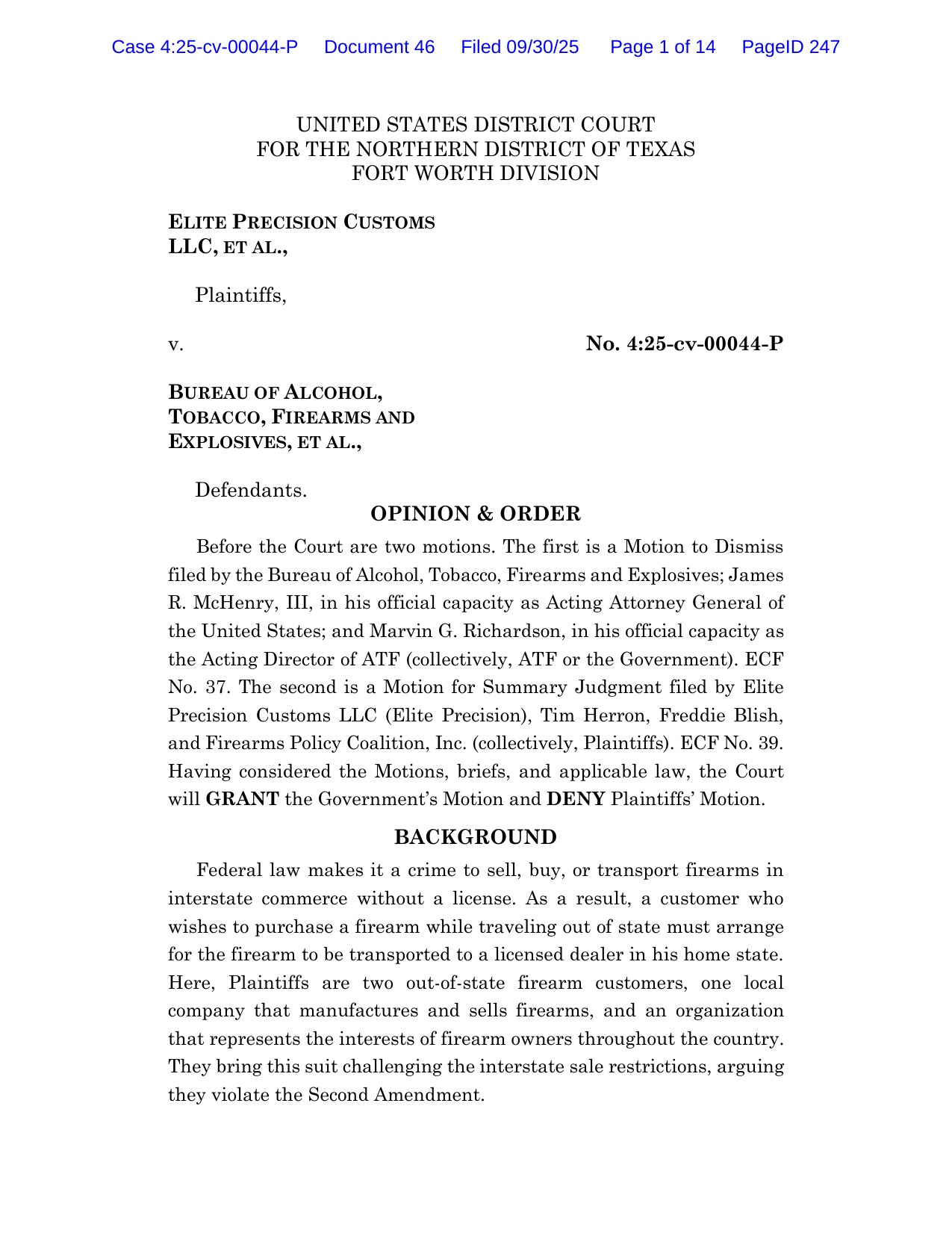
Read or download the full 14-page opinion (PDF) · view the full docket on CourtListener
The history fight FPC says the government got wrong
FPC's opening brief, filed February 4, argues Pittman never should have gotten off the ground on step one. Acquiring a gun, the brief says, is "fairly implied" by the right to keep and bear one, and the district court read a nonexistent carve-out into the word "infringed" to avoid that conclusion.
That pushes the fight to the historical record, where the government's answering brief leans hard on colonial-era trade laws: a 1642 Connecticut ban on residents selling guns outside the colony, a 1670s Virginia law restricting arms sales to the colony's own "loyal subjects," a 1719 South Carolina export ban, and a 1652 New Netherland ordinance against private gunpowder and firearm trade. The government's brief also cites the Second Circuit's 2025 ruling in United States v. Vereen, which found a "Founding-era historical tradition of restricting arms transactions across borders."
FPC's reply brief, filed May 27, takes those laws apart one at a time. The 1642 and 1650 Connecticut statutes, the brief argues, were aimed at keeping guns from reaching Native American tribes the colony was at war with, not at fellow English colonists. The Virginia law, adopted one year after Bacon's Rebellion burned Jamestown to the ground in 1676, is read by FPC as a law about disloyal subjects, not out-of-towners. The 1652 New Netherland ordinance survives only by title; the underlying text, FPC notes, is lost entirely, which the brief says makes it useless as a founding-era analogue under the Ninth Circuit's own reasoning in a similar case. None of it, FPC argues, resembles a law that lets a sale happen but requires it to be completed through a second dealer.
Where the case stands now
Oral argument happened September 2 before Judges Jerry E. Smith, Catharina Haynes, and Kurt D. Engelhardt, all three appointed by Republican presidents, in the Fifth Circuit's West Courtroom in New Orleans. The Second Amendment Foundation's Grassroots Judicial Report confirmed the panel and framed the question the same way FPC does: whether a residency-based transfer restriction can survive Bruen when the government cannot point to a founding-era law that did the same thing, in the same way, for the same reason. No ruling has issued yet.
The Fifth Circuit already reversed one Second Amendment win on this exact statute once before. Judge Reed O'Connor struck down the same Sale Restrictions under strict scrutiny in 2015's Mance v. Holder, only to be reversed by the Fifth Circuit itself in 2018 and denied certiorari by the Supreme Court in 2020. That reversal came under the old means-end scrutiny standard the Supreme Court later discarded in Bruen. FPC is asking the same circuit to reach the opposite result now that a different test governs, and the panel drawn for this case includes none of the three judges who decided Mance.
What actually changes if Elite Precision wins
A win here would not touch background checks. Nothing in FPC's briefs asks the court to eliminate the federal instant background check or the paperwork a dealer already fills out on every sale. What would change is the requirement that a handgun sale to an out-of-state buyer get relayed through a second dealer in the buyer's home state before the buyer can take possession. Dealers like Elite Precision could sell a handgun to an out-of-state customer the same way they can already sell that customer a rifle: face to face, on the spot, once the buyer clears the background check and the sale complies with both states' laws.
For gun owners, the practical stakes sit closer to Herron's $30-to-$40 transfer fee than to any sweeping change in who can buy a gun. But the legal stakes are bigger than that dollar figure suggests. A ruling for Elite Precision would mean the Fifth Circuit has extended Bruen's text-and-history test to reach a federal commercial regulation that has stood since 1968 and survived one earlier constitutional challenge already. A ruling for the government keeps the current two-dealer system in place and hands other circuits a fresh post-Bruen precedent to lean on the next time this fight comes up somewhere else. Either way, the panel that heard this case on September 2 is the one that decides which version of the law gun buyers live under next.