President Trump said for the first time on Sunday that he backs Flock Safety's automated license plate cameras, telling reporters aboard Air Force One "I sort of like them" because of what they do for law enforcement. It is the clearest answer he has given since the cameras became a live fight inside his own party, one that pits back-the-badge Republicans against a growing bloc of GOP lawmakers who call the technology a warrantless surveillance dragnet.
What Trump actually said
Trump made the comment Sunday flying home from Ireland, when a reporter asked him directly: "Flock cameras, you haven't talked a lot about these Flock cameras. A lot of law enforcement say they really help them, would you be willing to back that?" Trump answered, "I sort of like 'em because of that, because of law enforcement," then added, "But some people don't. They think it's an infringement." When the same reporter interjected that the cameras "help catch a lot of criminals," Trump said, "But I like them." Mediaite and Forbes both recorded the exchange the same way.
That is a real shift from where Trump stood four weeks earlier. Asked about Flock in the Oval Office on August 17, he said only that the cameras were "being studied" and that he would reveal his position in the coming weeks, according to the Washington Examiner. He has now made that call, and he made it in the most casual setting possible, answering a shouted question on a plane rather than in a prepared statement.
The case law enforcement makes
Flock's pitch is simple. Its cameras photograph every passing license plate, tag the vehicle's make, model and color, and instantly check the plate against databases for stolen cars, Amber Alerts and missing persons. Flock CEO Garrett Langley told Fox News host Kayleigh McEnany the company has assisted more than a million criminal investigations and played a role in roughly 10,000 missing person cases, per Mediaite's account of that interview. Florida police departments have credited the cameras with locating a suspect in a killing in Volusia County and finding a 13-year-old girl who was the subject of an Amber Alert, according to Fox 13 Tampa Bay.
There is also an immigration enforcement angle that matters directly to this audience. An Associated Press investigation found federal agencies have used the Flock network to help identify drivers they consider suspicious, including for immigration purposes, and a Virginia Center for Investigative Journalism review found federal agencies queried one Virginia locality's Flock data thousands of times before a state law restricted that access in mid-2025 (both cited by WHRO). That is exactly the use case the White House wants to expand, and exactly the one that worries the Republicans described below.
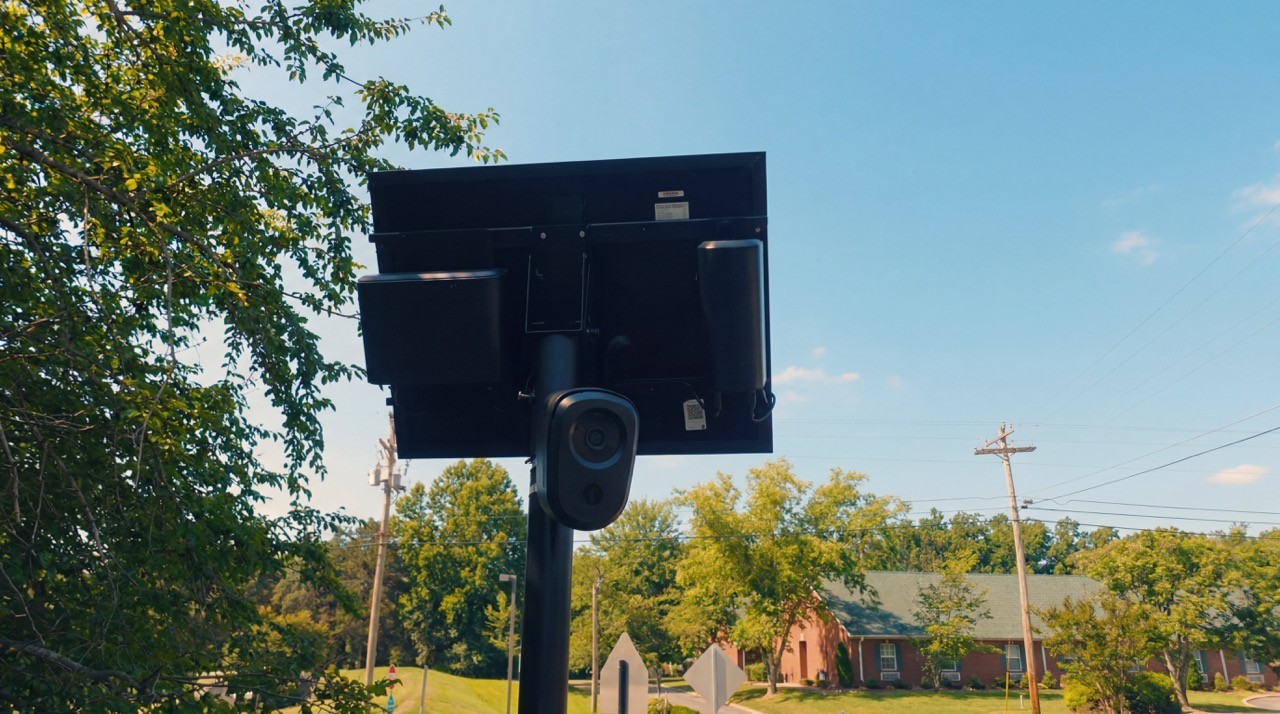
A Flock Safety camera and solar panel unit, the kind now installed in more than 5,000 cities. (Julian Focareta/Flock Safety, Wikimedia Commons, CC BY-SA 4.0)
The Republicans who say no
The opposition is not coming from the usual civil-liberties suspects alone. Rep. Tim Burchett of Tennessee introduced the Protection Against Mass Surveillance Act to bar federal agencies from buying, operating or accessing systems like Flock, and to block federal money from funding local deployments. Rep. Thomas Massie of Kentucky is pushing a bill to cut off federal funding for any jurisdiction that runs Flock cameras, and previously teamed with Rep. Lauren Boebert of Colorado on a bill targeting license plate readers and facial recognition together. Reps. Keith Self of Texas, Eli Crane of Arizona and Andrew Clyde of Georgia have signed onto the PRIVACY Act, which would require a warrant before any federal agency can search Flock-style data. Rep. Scott Perry of Pennsylvania tried to attach a restriction in committee, telling constituents that "Flock and Flock-like cameras track where law-abiding people go, who they visit, and how they live, all without a warrant," and calling on people to "STOP THE FLOCK" (Newsweek).
Florida Gov. Ron DeSantis went further than writing a bill. His transportation department ordered every automated license plate reader removed from state highway rights-of-way within 30 days. "I think it's out of control," DeSantis said, adding he did not want Florida to become a "surveillance state," per Fox 13 Tampa Bay. He is not opposed to the underlying crime-fighting use. He says the Legislature needs to write the rules first, an argument Congress has yet to have.
What Hawley's investigation actually found
The most detailed case against Flock comes from Sen. Josh Hawley of Missouri, who chairs the Senate Judiciary Subcommittee on Crime and Counterterrorism. In an August 26 letter demanding records from Flock CEO Garrett Langley, Hawley wrote that the company "boasts more than 120,000 cameras across 49 states and more than 20 billion vehicle scans every month," and that "the overwhelming majority of the Americans captured in those records did nothing wrong." The letter names specifics: a Milwaukee officer charged with searching his girlfriend's plate 124 times and her ex-boyfriend's 55 times, the St. Charles County, Missouri police department, which dropped Flock after a civilian employee ran personal searches, and a Florida woman jailed 13 days on eight felony counts, including three counts of vehicular homicide, after Flock misidentified her car. Prosecutors dropped every charge seven months later when the real suspect was found. One California department's alerts were wrong 71 percent of the time. (Read Hawley's letter.)
Hawley is explicit that he is not calling for a ban. "I want law enforcement to have tools to catch offenders and keep the public safe," he wrote. "But Americans do not surrender their privacy rights when they drive to work, drop their kids off at school, or go to church." That is close to the exact line Trump drew in his own comment, minus the conclusion. Hawley wants Congress to write rules before the network gets bigger. Trump, for now, has just said he likes it.
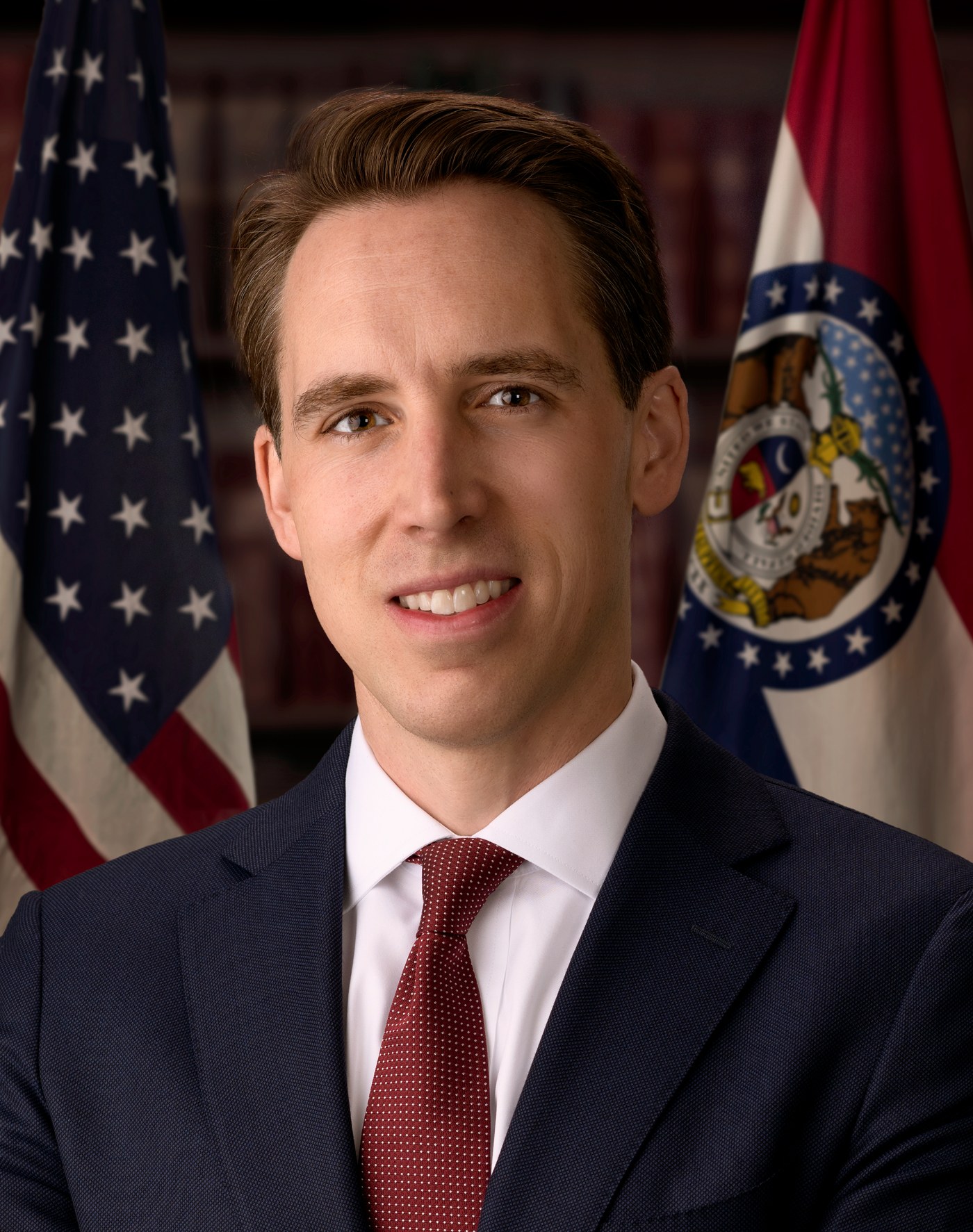
Sen. Josh Hawley (R-Mo.), whose Judiciary subcommittee is investigating Flock's data practices. (Official Senate portrait, public domain)
The lawsuit: Schmidt v. City of Norfolk
The sharpest constitutional test is playing out in Virginia. Norfolk residents Lee Schmidt, a retired 22-year Navy veteran, and Crystal Arrington, a home-healthcare worker, sued the city in October 2024 over its network of Flock cameras, arguing that logging every car's movement without a warrant violates the Fourth Amendment. They are represented by the Institute for Justice, which calls it the first case in its Plate Privacy Project. Norfolk's own records showed Schmidt's car was photographed 475 times and Arrington's 325 times in roughly four and a half months, according to WHRO's review of the original complaint. Neither had been charged with anything.
Schmidt and Arrington are appealing to the U.S. Court of Appeals for the Fourth Circuit, with briefing that ran through the summer. "Although I'm of course disappointed by the court's decision, I remain committed to fighting against this dragnet warrantless surveillance," Schmidt said after the ruling, according to WHRO. Whichever way the Fourth Circuit rules will matter well beyond Norfolk, since it puts a federal appeals court on record over whether a modern Flock network amounts to a Fourth Amendment search.
Cities are already voting with their feet
Local governments are not waiting on Congress or the courts. At least 56 municipalities nationwide canceled, deactivated or rejected Flock contracts in 2026 alone, according to The Guardian, which also reported that civil liberties groups say under 1 percent of scanned vehicles nationwide are ever connected to a crime. Pflugerville, Texas shows why. A resident's public records request found that between February and August 2026, outside agencies ran nearly 1.6 million searches of the city's cameras versus roughly 5,000 by Pflugerville's own police, a 315-to-1 ratio the city had not disclosed to residents. The city manager ordered the camera lenses covered before the council even voted, and the vote to kill the $87,500 contract was unanimous. The police chief declined to recommend renewal, saying he lacked clarity on how the data was protected. (Hoodline.)
The White House wants them anyway
Here is the friction Trump's Sunday comment sits on top of. Documents reviewed by The Atlantic show the administration's priority list for U.S. Park Police includes 450 new officers, $12.8 million in equipment, and Flock license plate readers listed as nonnegotiable, according to Yahoo News's report on those documents. That request landed the same month 56 cities pulled the plug on the same company, and while Trump flew home from Ireland saying he liked the cameras, members of his own party in the House were writing bills to strip federal money from exactly this kind of purchase.
Where this actually leaves things
Trump did not announce a policy on Sunday. He answered a question honestly, said he understands the objection, and sided with law enforcement anyway. That is the first time he has picked a side after a month of saying the issue was under review, and it puts him closer to the White House's own budget request than to Burchett, Massie, Perry, Self, Crane, Clyde or DeSantis. None of that resolves the legal question sitting in front of the Fourth Circuit, and none of it answers Hawley's letter, which is still waiting on Flock's response.
What Trump's comment does settle is which argument he finds more persuasive: catching criminals beats warrant paperwork. Republicans who spent the last two years running against government overreach are going to keep making the opposite case, in Congress, in state legislatures and in federal court. This fight is not sorting itself along party lines, and it is not going away because the president said he likes the cameras.