America's trade deficit hit $105.6 billion in August, the widest since March 2025, and it has now doubled since April. Read past the headline in Tuesday's Commerce Department release and two things stand out: the year-to-date "improvement" comes almost entirely from early 2025's tariff stockpiling, and Vietnam's goods deficit with the U.S. has now passed both China's and Mexico's for the year.
What Did Tuesday's Report Actually Say?
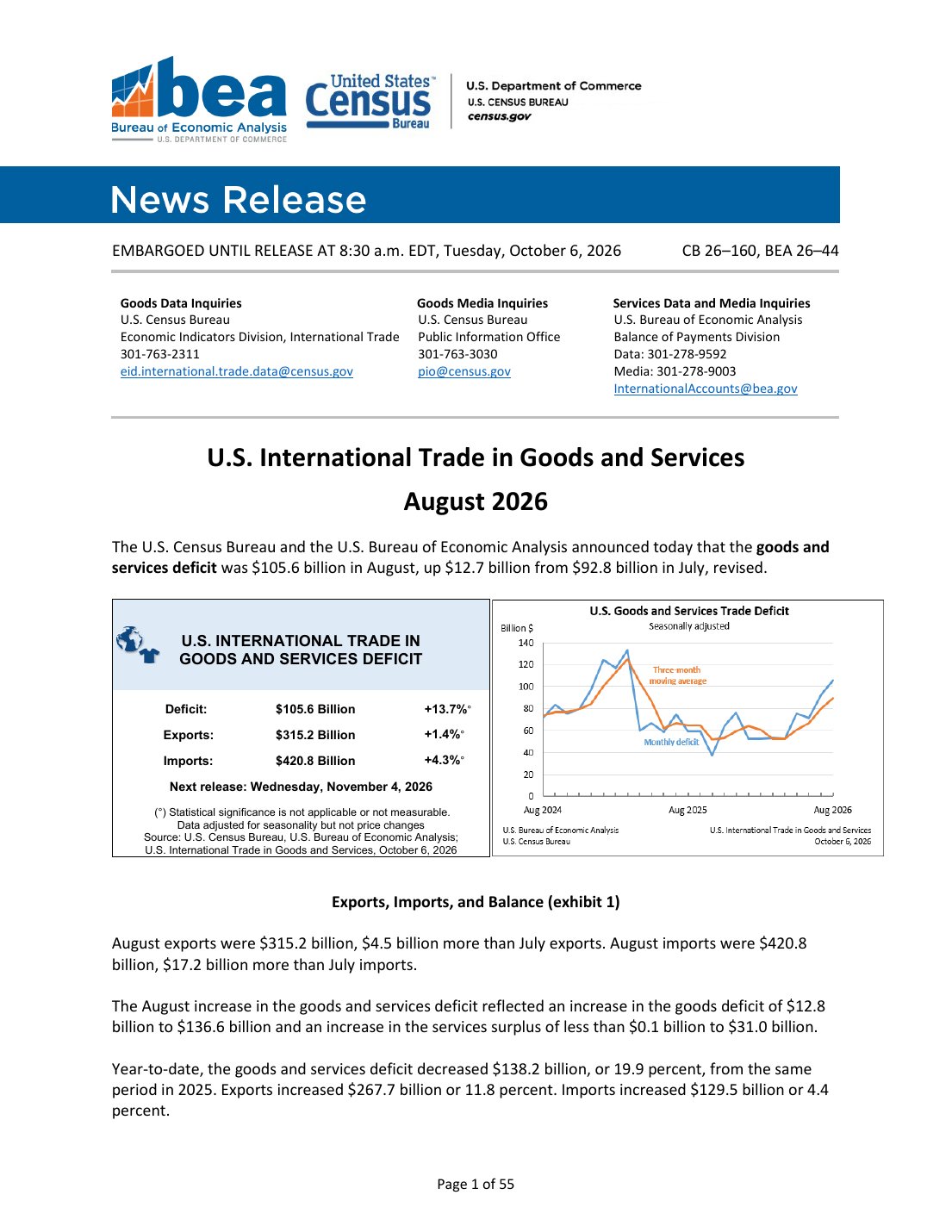
The Census Bureau and the Bureau of Economic Analysis reported Tuesday that the goods and services deficit rose from $92.8 billion in July to $105.6 billion in August. Imports climbed $17.2 billion to $420.8 billion, an all-time high. Exports rose only $4.5 billion, to $315.2 billion.
Economists polled by Reuters had expected about $102 billion, according to the wire service. Reuters also noted the deficit stood at $79.8 billion in November 2024, the month President Trump won a second term. CNBC's headline called it the widest gap "since just before Trump tariffs enacted last year."
What drove August is right there in the release. Crude oil imports rose $3.3 billion, nonmonetary gold $3.1 billion and semiconductors $2.4 billion. Capital goods imports hit a record $146.4 billion, which Reuters tied to business spending on AI equipment.
The Deficit Has Doubled in Four Months
The monthly series in the release's first table shows how fast this turned. In April 2026 the deficit was $52.9 billion. In May it was $75.8 billion, then $71.2 billion in June, $92.8 billion in July (revised up from $88.6 billion) and $105.6 billion in August. That is a doubling in four months.
Inflation explains only part of it. The release says the goods deficit adjusted for prices rose 8.2 percent in August, against an 11.1 percent jump in dollar terms on the same Census basis. Oil is part of that gap. Census's own petroleum table puts the average imported barrel of crude at $76.94 in August, up from $64.20 a year earlier.

TSMC's Fab 21 under construction in Phoenix, Arizona, in November 2023. Semiconductor imports rose $2.4 billion in August as AI spending pulled in chips from Taiwan. (Photo: Hunter Trick, CC BY-SA 4.0, via Wikimedia Commons)
Is the Year Really Down 19.9 Percent?
The release also contains the number tariff supporters will reach for. "Year-to-date, the goods and services deficit decreased $138.2 billion, or 19.9 percent, from the same period in 2025," it says. That sentence is accurate. It is also mostly about January, February and March of last year.
In the first quarter of 2025, importers rushed to beat the April tariffs. The deficit ran $124.7 billion in January, $117.1 billion in February and $133.0 billion in March, the all-time record. Those three months add up to $374.8 billion. The first quarter of 2026 came in at $158.8 billion. That one stretch of $215.9 billion is bigger than the entire year-to-date decline.
So we lined up the months after the tariffs took hold. From April through August 2025, the deficit totaled $320.5 billion. From April through August 2026, it totaled $398.2 billion. By our arithmetic from the release's own table, that is about $77.7 billion worse, or roughly 24 percent, comparing tariff-era months to tariff-era months.
Official record
U.S. Census Bureau and U.S. Bureau of Economic Analysis, "U.S. International Trade in Goods and Services, August 2026," release CB 26-160, BEA 26-44, October 6, 2026 (55 pages), from bea.gov.
"The U.S. Census Bureau and the U.S. Bureau of Economic Analysis announced today that the goods and services deficit was $105.6 billion in August, up $12.7 billion from $92.8 billion in July, revised."
Release, page 1
Read or download the full 55-page release (PDF) · BEA's trade data page
China Shrank. Vietnam and Taiwan Took Its Place.
The country table, Exhibit 19, is where the tariff story gets interesting. On a year-to-date basis through August, the goods deficit with China fell from $151.3 billion in 2025 to $113.3 billion this year. That is a $38.0 billion drop, about 25 percent, and imports from China fell by about $37 billion. On China, the tariffs are doing what Trump said they would.
The money did not stay home, though. Over the same eight months, the deficit with Taiwan jumped from $84.6 billion to $149.8 billion, up 77 percent. Vietnam's rose from $113.5 billion to $163.3 billion, up 44 percent. Together those two countries now run up $313.1 billion in deficits with the U.S. this year, about 2.8 times China's total.
In April, Diego Marroquín Bitar of CSIS wrote that the deficit "did not shrink" but "moved to Vietnam and Taiwan," and warned Vietnam "could soon surpass both Mexico and Canada." The August numbers say it already has on a year-to-date basis. Vietnam's $163.3 billion now tops Mexico's $156.5 billion. Mexico still had the bigger gap for August alone, $27.7 billion to Vietnam's $24.0 billion, and Reuters reported record monthly goods deficits with Mexico, Vietnam and Malaysia.
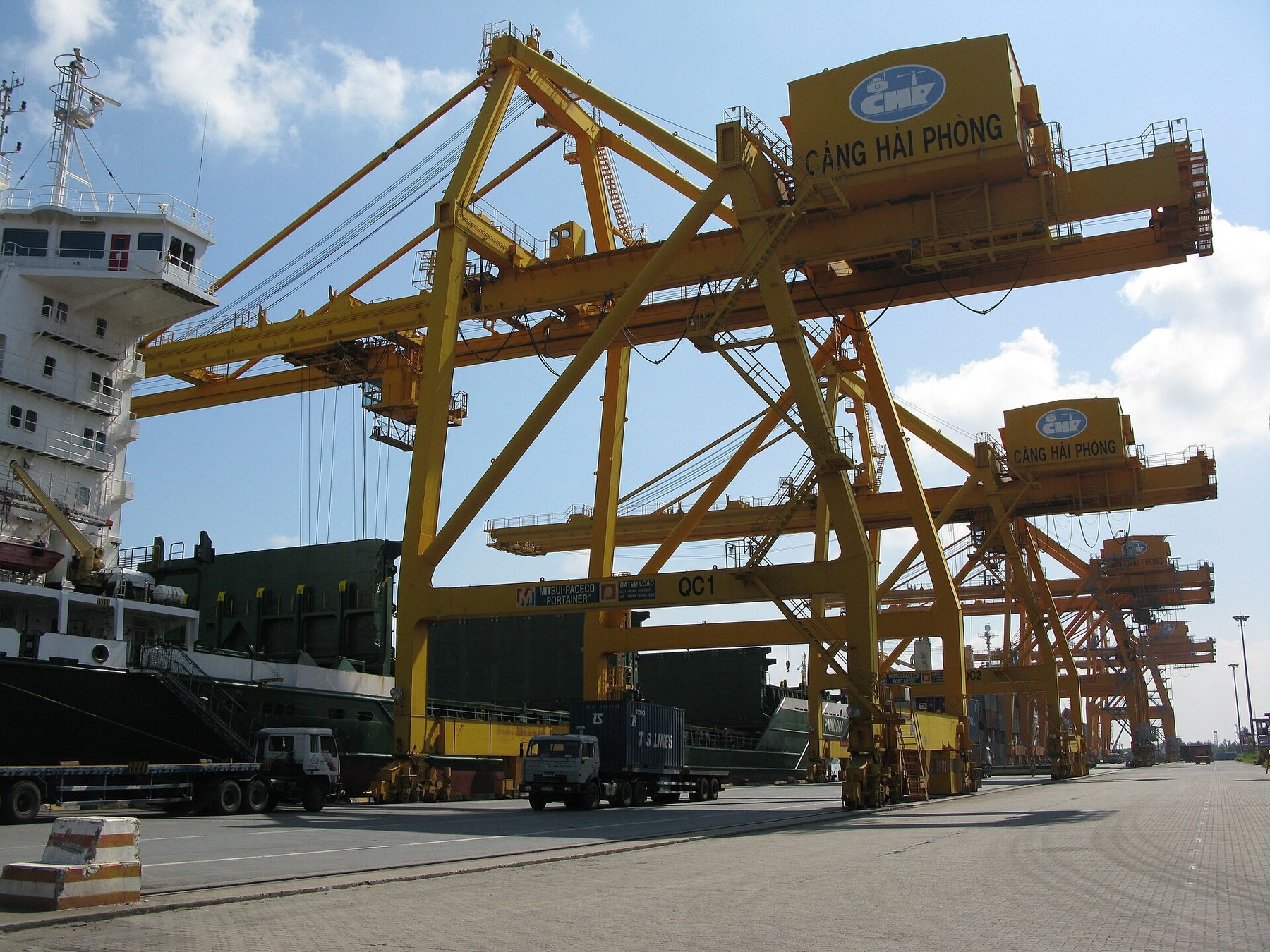
Container cranes at the Chùa Vẽ terminal in the Port of Hải Phòng, Vietnam. Vietnam's goods deficit with the U.S. reached $163.3 billion through August. (Photo: Phó Nháy, public domain, via Wikimedia Commons)
Where the Tariffs Clearly Worked
The same table has real wins in it, and they deserve more than a footnote. The goods deficit with the European Union fell from $170.1 billion in the first eight months of 2025 to $66.0 billion this year, a drop of about $104 billion. Imports from the EU fell by roughly $70 billion while U.S. exports there rose by about $34 billion.
Switzerland flipped from a $55.8 billion deficit to an $18.6 billion surplus. That one comes with an asterisk. Much of the Swiss trade is gold bullion moving back and forth, and the release says BEA swaps nonmonetary gold out when it calculates GDP. U.S. gold exports year-to-date have more than doubled, from $40.1 billion to $86.6 billion.
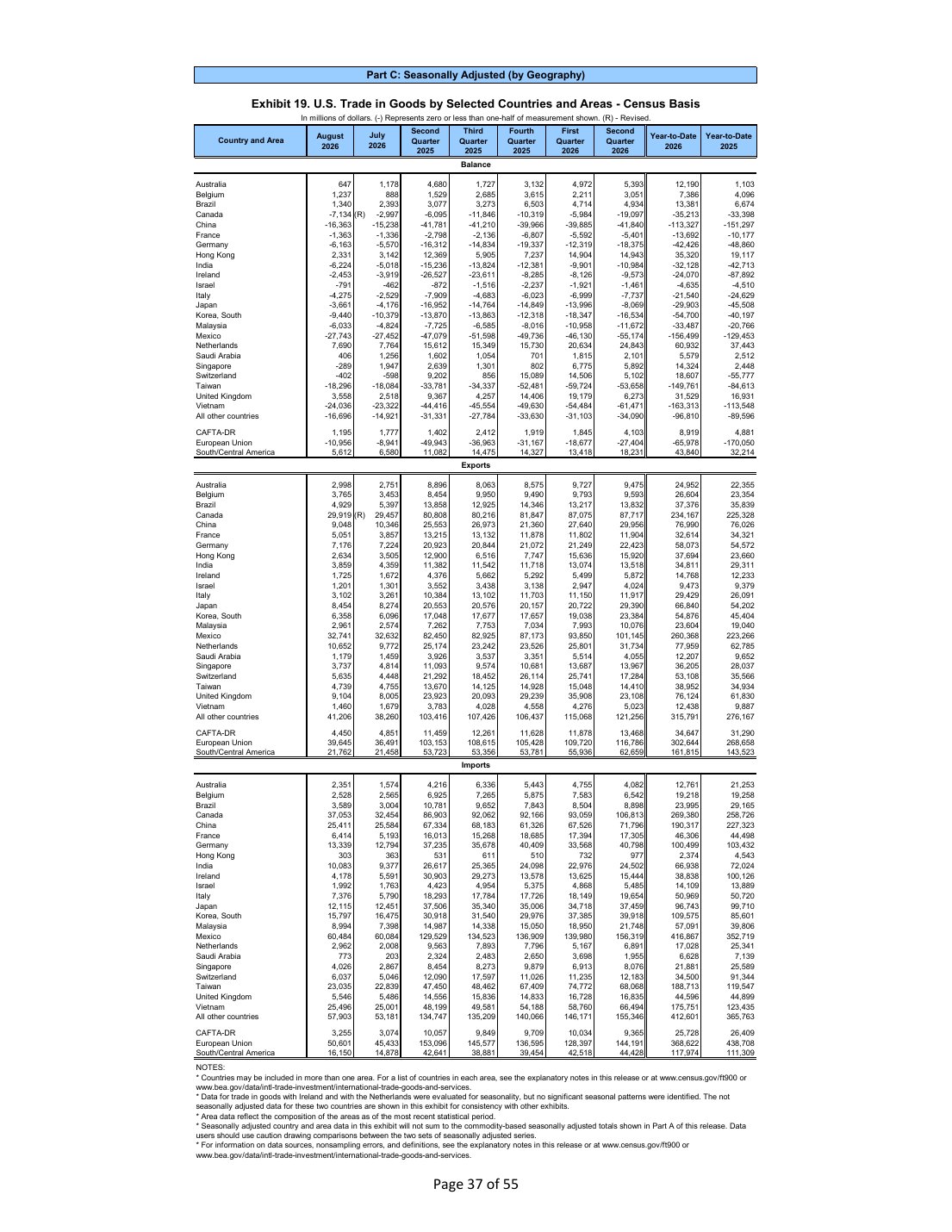
Exhibit 19 of Tuesday's release, page 37: goods balances by country. The right-hand columns compare January through August of 2026 with the same months of 2025. (U.S. Census Bureau and BEA, public domain)
America Is Selling More Fuel Abroad Than Ever
One line in the release cuts the other way from the headline. Through August, the U.S. ran an $85.2 billion surplus in petroleum trade, up from $33.4 billion in the same months of 2025. Crude oil exports are worth $95.6 billion so far this year, compared with $66.1 billion a year ago.
Part of that is price. With the Iran war rattling oil markets, the average exported barrel of crude has fetched $88.18 this year, up from $70.90. Volume is up too. Census counts 2.43 billion barrels of energy-related petroleum products exported through August, up 17 percent, while imports fell to 1.76 billion barrels.
Fuel oil exports deserve a look of their own. They reached $44.0 billion through August, up $14.5 billion, or 49 percent, from last year. That happened while the national average for diesel topped $6 a gallon for the first time ever in September, as CNBC reported via TheStreet. Strong world prices pull American fuel overseas, and that is the same pressure the White House is trying to ease at home with its red-dyed diesel order.
What Comes Next for Trump's Trade Fight?
Trade has subtracted from GDP for three straight quarters, Reuters reported, and economists estimate it could cut as much as 2.5 percentage points from third-quarter growth. Christopher Rupkey, chief economist at FWDBONDS, told Reuters the tariffs "have done nothing to reduce America's reliance on the import of foreign-produced goods."
That goes too far. The release shows the China deficit down a quarter and the EU deficit down more than half, and the U.S. is booking record energy surpluses. But it also shows the overall gap running about 24 percent wider than in the same post-tariff months a year ago, with Taiwan and Vietnam absorbing what China lost. A deficit that moves from Beijing to Hanoi and Taipei is a smaller China problem. It has not yet turned into more made-in-America goods.
September's numbers come out November 4, the day after Election Day. If the monthly gap keeps climbing, the year-to-date cushion from last year's stockpiling will keep shrinking with it.
Top photo: Containers lifted off a ship by quay cranes at the Port of Savannah, Georgia, July 29, 2021. (U.S. Customs and Border Protection photo by Jerry Glaser, public domain, via Wikimedia Commons)