A former senior CIA official pleaded guilty Tuesday to stealing about $194 million from taxpayers by inventing classified programs to pay for gold bars and Florida real estate. Buried in the court papers is a second confession: he gave a foreign government official information about a secret U.S. intelligence source. His plea deal bars the two prosecuting offices from charging him for anything in those papers, the source disclosure included.
What David Rush Admitted in an Alexandria Courtroom
David J. Rush, 49, of Ashburn, Virginia, pleaded guilty on October 6 to a single count of wire fraud, according to the Justice Department. The court's minute entry shows the hearing before U.S. District Judge Michael S. Nachmanoff ran 33 minutes, from 1:18 to 1:51 p.m. Rush was remanded to custody, and sentencing is set for January 28, 2027.
The court filings never name his employer. They call it "Government Agency 1." CIA Director John Ratcliffe settled that in the DOJ release, saying the agency found the problem in an internal investigation and "immediately referred this matter to the FBI." Rush faces up to 20 years in prison.
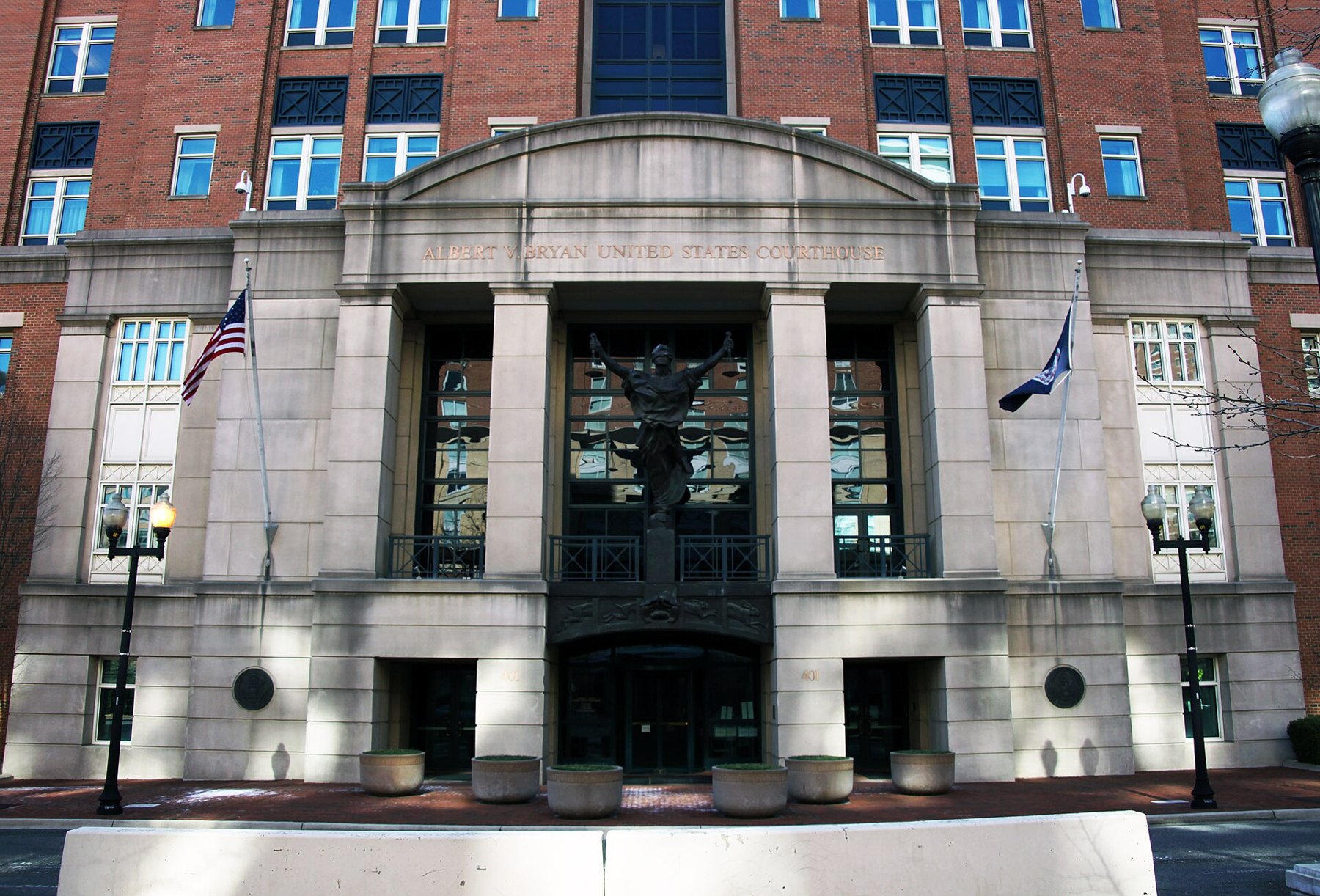
The Albert V. Bryan U.S. Courthouse in Alexandria, Virginia, where Rush entered his guilty plea. (Photo: dctim1, CC BY-SA 2.0, via Wikimedia Commons)
He Invented a Secret Program and Approved His Own Spending
The 15-page statement of facts, which Rush signed as "true and accurate," lays out how he did it. In the fall of 2025 he told contractors that a Special Access Program, the government's most tightly guarded category of classified work, needed to buy real estate in South Florida. That program, labeled "SAP #1" in the filing, "was not a legitimate government program."
Rush then pretended to "read in" contractor employees to the fake program and had at least one of them sign a nondisclosure agreement. He told them it could not be discussed with anyone outside the program. Prosecutors say this let him serve "as his own approving official for the expenditures." When a contracting official at the agency questioned the spending, Rush told the official he or she did not have a "need to know."
That one detail should alarm every taxpayer. Someone inside the system asked the right question, and a classification stamp shut it down.
Palm Beach Mansions and 298 Gold Bars
Between November 2025 and March 2026, a government contractor wired about $145 million to a shell company that a subcontractor set up at Rush's direction. The shell company invoiced the contractor for "Consulting." The filing lists what it bought: a $21.9 million Palm Beach home, a $13.65 million Palm Beach lot, a $27 million Palm Beach home and a $40 million parcel in Hobe Sound. That is $102.55 million in real estate. Rush discussed buying $40,000 in kitchen appliances for one house and told the subcontractor he would not sell another for less than $15 million net.
The gold came from a second invented mission. Rush told a subcontractor's executive that a sensitive assignment allowed payment in "gold, diamonds, or cryptocurrency," then picked gold. That company bought 298 bars at a cost to the agency of about $46,361,721 and delivered them in Pelican cases to a safe in Rush's Loudoun County office. In March 2026 Rush claimed the gold had reached its recipients, and he relayed that one of them "wanted to know whether the gold bars could be traced." It could. The serial numbers on the 298 bars the FBI seized from his home on May 19 matched the executive's records.
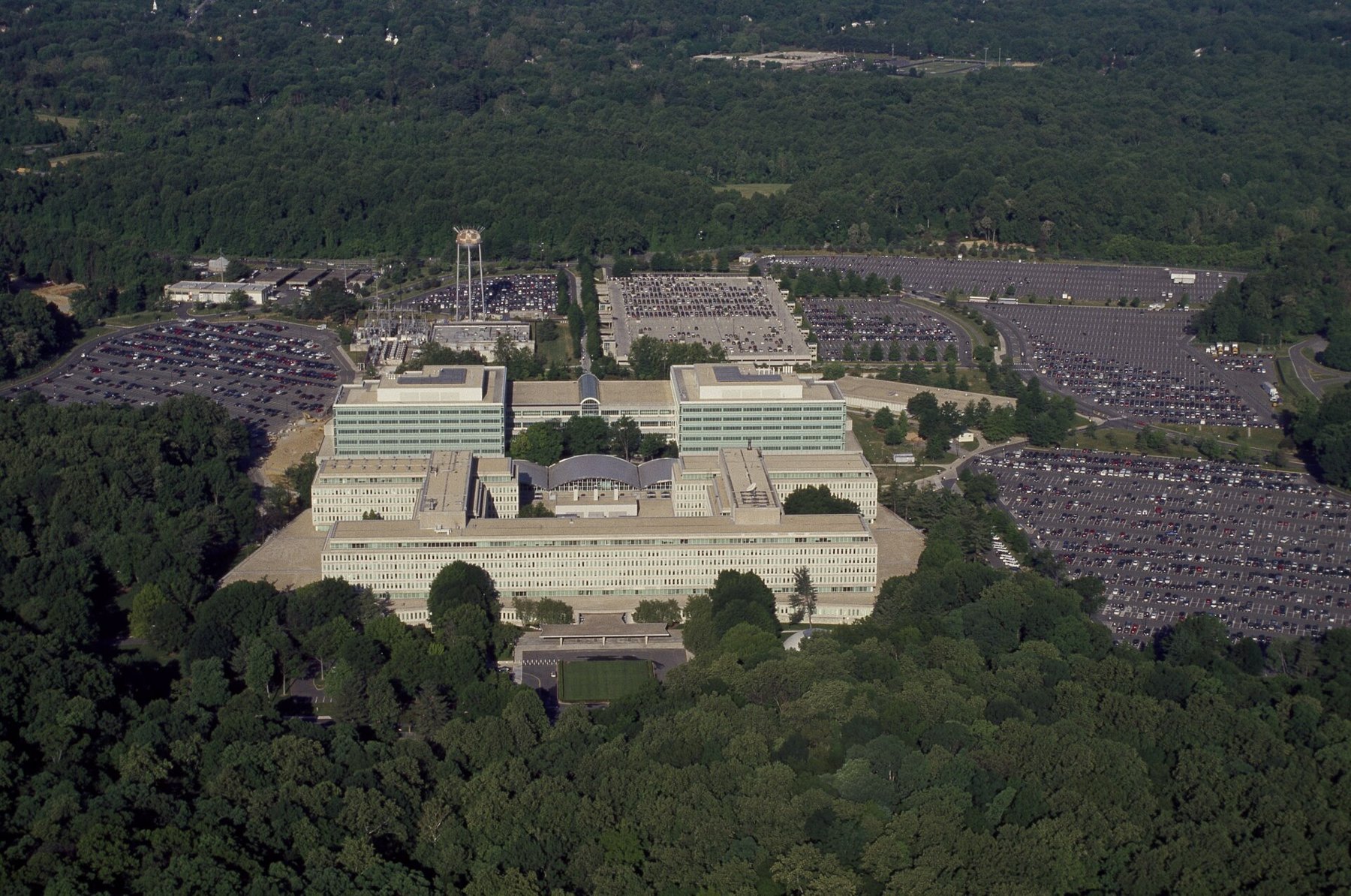
CIA headquarters in Langley, Virginia. Court filings refer to Rush's employer only as "Government Agency 1," and CIA Director John Ratcliffe confirmed the agency referred the case to the FBI. (Photo: Carol M. Highsmith, Library of Congress, public domain, via Wikimedia Commons)
The Secret Source the Press Release Left Out
The Justice Department's announcement talks about gold bars and Rolexes. It says nothing about paragraphs 71 and 72 of the statement of facts. There, Rush admits that "in and around late 2025" he gave Top Secret national defense information to "a foreign government official who was not authorized to receive it." He "revealed to a foreign government official the existence and certain descriptive information of a U.S. government clandestine human source."
Official record
United States v. David J. Rush, No. 1:26-cr-00185 (E.D. Va.), Statement of Facts, Document 41, filed October 6, 2026 (15 pages), via CourtListener.
"The disclosure of such information could endanger the safety and life of the human source and the U.S. government officers working with the source and jeopardize the U.S. government's ability to recruit human sources, who rely on the U.S. government's assurance of absolute secrecy."
Statement of Facts, paragraph 71, page 13
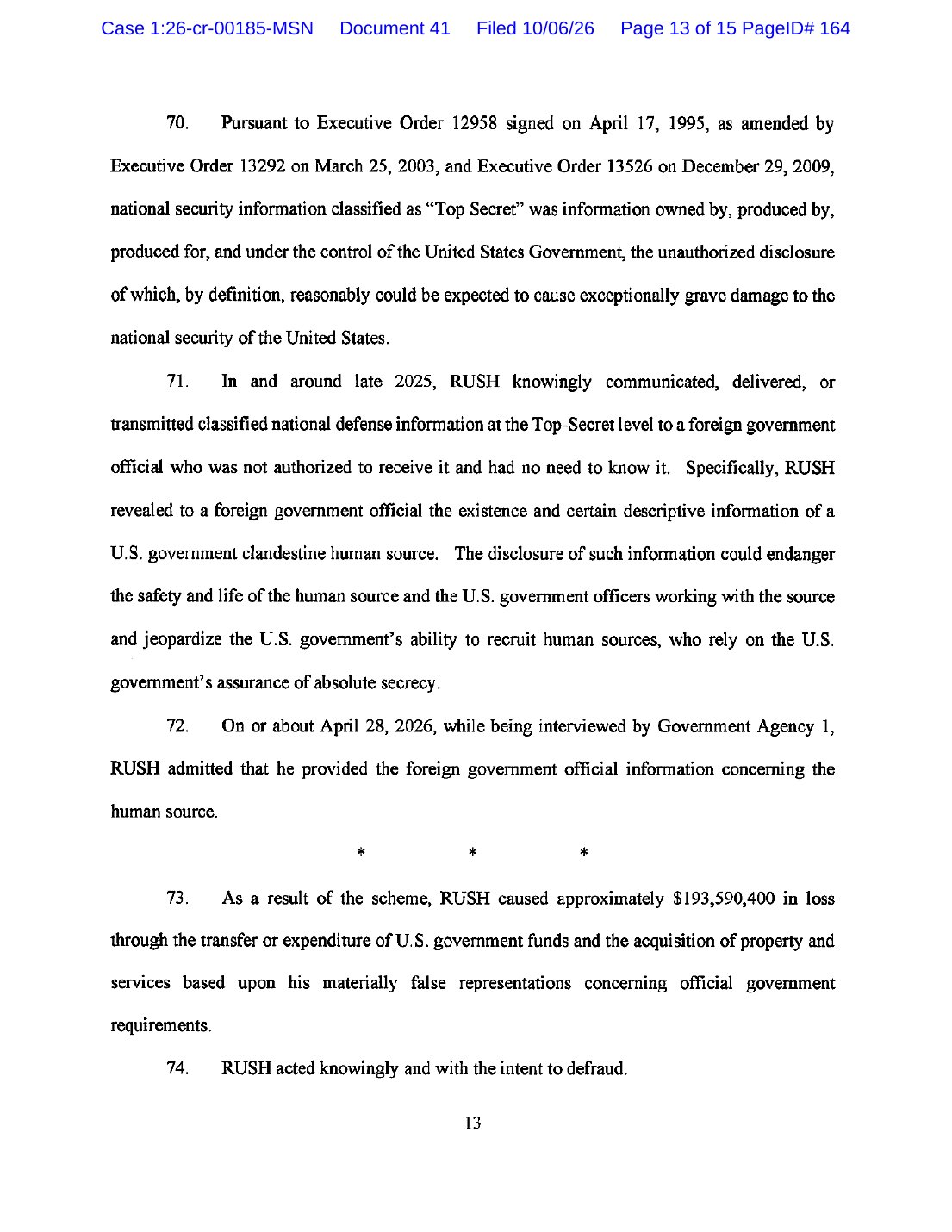
Read or download the full 15-page statement of facts (PDF) · the 19-page plea agreement · the criminal information
The filing says Rush admitted this to agency interviewers on April 28, 2026, three weeks before the FBI raid. It does not name the foreign government, and it does not say whether he was paid. Loudoun Now reported that he "does not appear to have been charged" for it.
Read Paragraph 7 of the Plea Deal
The plea agreement explains why. Under the heading "Immunity from Further Prosecution in This District," the government promises it "will not further criminally prosecute the defendant in the Eastern District of Virginia for the specific conduct described in the Information or Statement of Facts." The source disclosure is in the statement of facts. The deal binds the Eastern District of Virginia U.S. Attorney's Office and the National Security Division's counterintelligence section, the two offices that brought the case.
It is not a blanket pardon. The same paragraph says it gives no protection from "any component" of the Justice Department other than those two offices, or from state prosecutors. DOJ also says its investigation "is continuing," and the Director of National Intelligence has asked the intelligence community's inspector general to investigate. As things stand, though, the man who exposed an American source is set to be sentenced for one count of fraud.
The deal does tie him down in other ways. Any money he makes from a book or movie goes to the government, and he needs FBI permission before any contact with a foreign government. He also gave up the right to seek more classified discovery and waived most of his appeal rights.
The Taxpayer Bill Is Bigger Than the Headline
The statement of facts also says the government paid for "dozens of privately chartered flights" Rush authorized, mostly to Palm Beach, at a total of about $1,818,487. On one trip he flew with a family member and no one else, at an estimated $95,000 round trip. The agency says he had no official reason to go to Palm Beach.
Look at the dates. The charter flights run from September 10, 2024, to May 14, 2026, more than a year before the October 2025 start date the filing gives for the fraud scheme. The plea's restitution figure, $195,408,888.24, is $1,818,487.55 more than the $193,590,400.69 forfeiture judgment. That gap matches the charter-flight total to the dollar, though the filings do not explain it. Rush also admits he lied about being a military pilot and about degrees he never earned, and he billed about 392 hours of military leave from 2021 on, though he left the Navy Reserve in 2015.
Why His Sentence Could Be Lighter Than You Expect
Both sides agreed on the sentencing guideline adjustments, and one footnote matters. The loss calculation is "guided by the November 1, 2026 amendment to the Loss Table." The U.S. Sentencing Commission adjusted those tables for inflation this year for the first time since 2015, and the change takes effect before his January sentencing. Under the current table, a loss over $150 million adds 26 levels. The plea instead applies the new bracket of more than $90 million and less than $200 million, which adds 24.
Those two levels add up. By our math from the plea's own table, Rush's stipulated offense level is 37 before credit for pleading guilty. That already includes a two-level "zero-point offender" break for having no prior record. With the standard three-level reduction and no criminal history, the advisory range would be 151 to 188 months, roughly 12.5 to 15.7 years. Under the old loss table it would have been 188 to 235 months. The guidelines are advisory, and Judge Nachmanoff can go up to the 20-year maximum.
What Happens Next
The plea lists $38.65 million seized from the shell company's bank account. Rush is forfeiting that money along with the four properties, two 2026 BMW Alpina XB7s, the gold, more than $2.1 million in cash, €104,795 and 35 watches. Whether taxpayers are made whole depends on what those houses sell for.
The bigger question is about the source. Rush admits he exposed a clandestine American source to a foreign official, and the offices that prosecuted him have agreed not to charge it. Attorney General Todd Blanche said in the DOJ release that the administration is "rooting out waste, fraud, and abuse." Americans deserve to know which foreign government got that information, and why the betrayal of a human source ended up as a paragraph in a fraud plea.
Top photo: Gold bars and cash seized from David Rush's Ashburn, Virginia, home, as released by the Justice Department. (U.S. Department of Justice, from U.S. v. David J. Rush, 1:26-cr-00185, public domain)