President Trump stood on a rally stage in Grand Island, Nebraska, Monday night and signed an order letting any driver put tax-free red-dyed diesel in a highway truck through the end of the year. He called it "tax-free." The order's own text calls it a deferral, says Treasury must set "the date by which postponed taxes must be paid," and makes the whole thing depend on a legal finding Treasury hasn't made yet.
What Trump Promised in Grand Island
Trump signed the order onstage at the Nebraska State Fairgrounds, four weeks before the midterms. Turning to Sen. Pete Ricketts and Gov. Jim Pillen, both on the ballot, he said: "Pete and Jim, this should absolutely ensure your election, I guarantee you that," according to the Associated Press. "The typical trucker will save more than $100 every time they fill up."
The pitch was simple. Farm and construction equipment runs on dyed diesel, which is the same fuel sold without the federal highway tax. "Tonight, I am going to sign a historic Executive Order to officially waive the off-road requirement and allow anyone to purchase tax-free red dye diesel for any reason," Trump said, in remarks the White House posted Monday night.

President Trump tours the Mack Trucks plant in Macungie, Pennsylvania, with Mack Trucks president Stephen Roy on June 23, 2026. (Official White House photo by Molly Riley, public domain, via Wikimedia Commons)
The White House puts the federal diesel tax at 24.4 cents a gallon, or "about $60 on a 250-gallon fill." The $100 figure only holds "where states match this federal action," since state fuel taxes are a separate bill the President can't waive.
The Order Says "Defer," Not "Waive"
The signed text, titled "Emergency Tax Relief on Diesel Fuel," is more careful than the rally speech. Section 2 tells the Treasury Secretary to "defer payment" of the highway diesel tax under 26 U.S.C. 4041 for fuel used from October 5 through December 31, 2026. That deferral comes "without any penalties, interest, additional amount, or addition to the tax."
Deferred money is still owed. Section 3 makes that plain: Treasury's guidance must spell out "the date by which postponed taxes must be paid." Section 4 then asks the Secretary to "explore avenues, including legislation, to eliminate the obligation to pay the amounts deferred." In other words, actually forgiving the tax may take an act of Congress.
The White House fact sheet uses the same careful wording: defer "for the remainder of the year without interest or penalties, and to explore pathways to eliminate the obligation to pay the deferred taxes." That's a promise to try, not a done deal.
Everything Hinges on a Five-Day Treasury Call
This is the part almost nobody reported. The deferral isn't automatic. Section 2(a) says that within five days, the Treasury Secretary, "in consultation with the Secretary of War, as appropriate, shall determine whether relief is authorized under 26 U.S.C. 7508A, including whether a qualifying event has occurred and which taxpayers have been affected by that event."
Section 7508A is the disaster-relief statute the IRS uses to push back deadlines after hurricanes and wildfires. It covers a federally declared disaster, a significant fire, or "a terroristic or military action," a term the tax code defines in section 692(c)(2) as military action involving U.S. forces "resulting from violence or aggression against the United States or any of its allies (or threat thereof)."
Bringing in the Secretary of War points to the third path. Our reading: Treasury would have to treat the Iran conflict, which the AP ties to the diesel spike, as a qualifying military action, and then name which taxpayers it "affected." The order doesn't say that outright, and Treasury hasn't announced a finding.
Official record
26 U.S.C. 7508A, "Authority to postpone certain deadlines by reason of Federally declared disaster, significant fire, or terroristic or military actions," from the official 2024 edition of the U.S. Code published by the Government Publishing Office.
"...the Secretary may specify a period of up to 1 year that may be disregarded in determining, under the internal revenue laws, in respect of any tax liability of such taxpayer..."
26 U.S.C. 7508A(a)
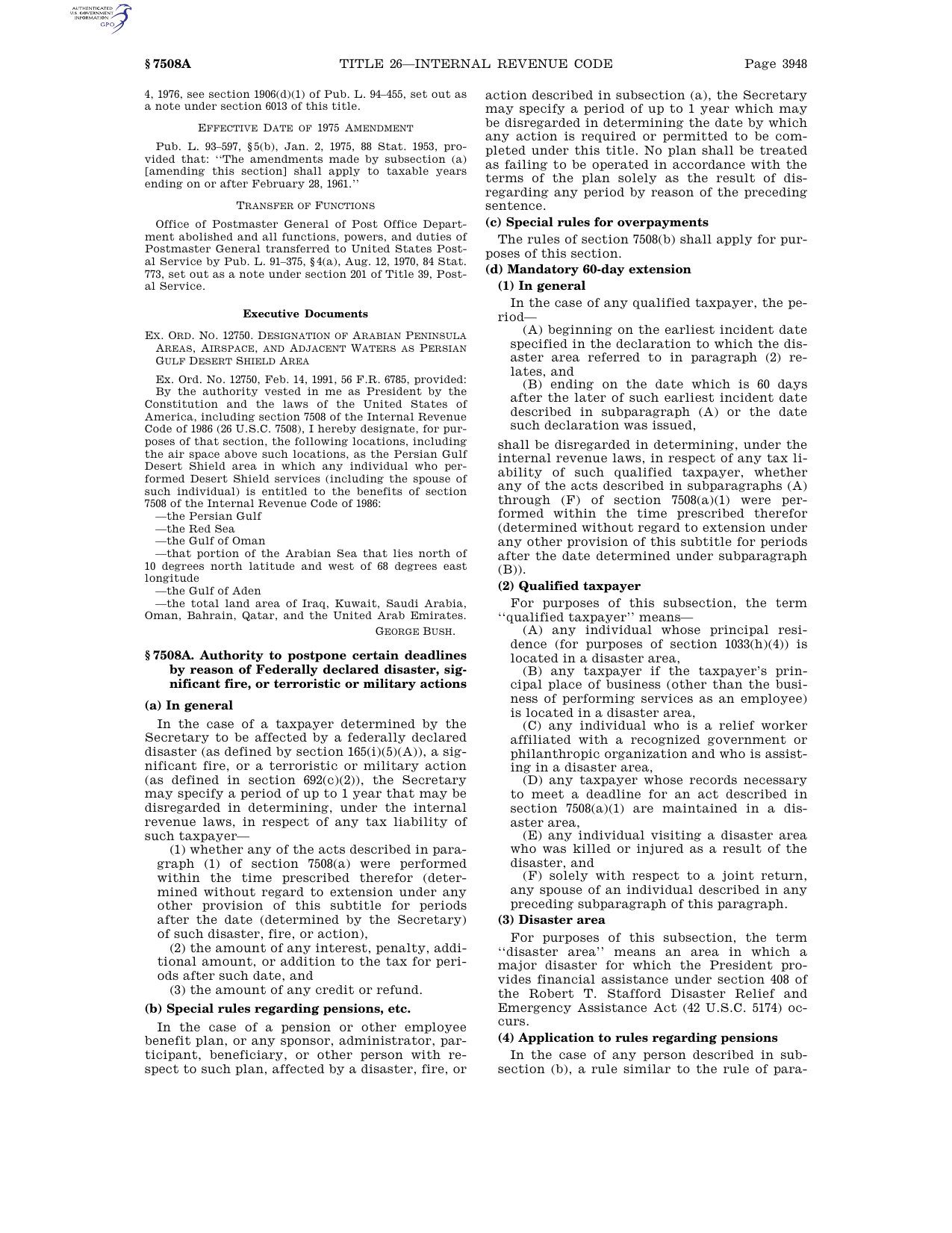
Read or download the full 4-page excerpt (PDF). The section text begins at the bottom of the left column.
The statute caps any postponement at one year. So if Treasury signs off, a trucker who burns dyed fuel in November could see the tax come due well into 2027, unless Congress wipes it out first.
The $10-a-Gallon Penalty Is the Real Prize
For truckers, the bigger threat was never the 24.4 cents. It's the fine. Under 26 U.S.C. 6715, anyone caught using dyed fuel on the highway pays "the greater of $1,000, or $10 for each gallon," on top of the tax. Each prior penalty raises the minimum again.
Run the White House's own 250-gallon fill through that formula and a driver pulled for a tank sample faces a $2,500 penalty to save about $61 in tax. Section 2(c) of the order addresses that directly. It tells Treasury to have the IRS announce, within five days, that it won't impose the 6715(a)(1) or (a)(2) penalties on dyed diesel "sold for use or used on the highway" from October 5 through December 31.

Combine harvesters in Beatrice, Nebraska. Farm equipment like this already runs on tax-free dyed diesel. (Photo by Katrina Wiese, CC BY-SA 2.0, via Wikimedia Commons)
Past Waivers Made Drivers Pay the Tax Anyway
The IRS has waived the dyed-diesel penalty before, during supply emergencies. In May 2021, after the Colonial Pipeline shutdown, it dropped the penalty in 12 states and Washington, D.C., for two weeks. There was a catch: relief applied "only if the operator or the person selling such fuel pays the tax of 24.4 cents per gallon."
That was about getting fuel to stations, not cutting prices. Trump's order goes further than any of those waivers by pairing the penalty relief with a deferral of the tax itself, nationwide, for almost three months. That's a real break for cash-strapped owner-operators right now, even if the IRS sends a bill later.
Who Actually Saves Money?
Farmers mostly don't, at least not directly. They already buy dyed diesel tax-free for field equipment. "Taxes aren't the problem, supply is," Patrick De Haan of GasBuddy wrote on X last week, as quoted by the AP. The order seems to know that. Section 7 tells the Agriculture Secretary to make sure co-ops and rural distributors have enough dyed diesel "in high-demand areas," so a rush of truckers doesn't drain the farm supply.
Truckers are the winners, if they can find the fuel at the right pump. Section 6 asks the Federal Motor Carrier Safety Administration to coordinate with states, industry, and labor groups on access.
Roadside Checks Don't Stop Everywhere
The fact sheet says the administration and governors "can exercise their enforcement discretion to halt inspections." The order is narrower. Section 5 only asks Treasury to "assess" how the IRS should handle fuel-tank inspections and sampling during the relief period, then announce it. Section 6(b) tells FMCSA to "continue all compliance enforcement measures, including audits, inspections, and monitoring programs."
State law is its own problem. The order can't touch state fuel taxes or state dyed-fuel rules, so Section 8 sends the White House Office of Intergovernmental Affairs out to "encourage States to adopt policies that correspond." Until a driver's home state and every state on his route says yes, red fuel in a semi could still draw a state ticket.
What to Watch This Week
The five-day clock in Sections 2(a) and 2(c) runs out on Saturday, October 10. By then Treasury should say whether a qualifying event under 7508A has occurred, and the IRS should publish its penalty announcement. The guidance has to name the covered taxpayers and the payback date.
Trump moved fast on a cost that has hit rural voters hard, and the penalty relief alone takes real risk off the table for drivers. But "tax-free" is a promise the order hands to Treasury and Congress to keep. Truckers should read the IRS notice before they fill up red.