A full 14-judge Third Circuit ruled Tuesday that Edward Williams, a Pennsylvania man disarmed for life over a 2005 drunk-driving conviction, may keep his guns. The Justice Department's best fallback was that Williams could just apply to Washington for his rights back. The court called that process "a slow trickle of relief available only upon invitation."
Who Is Edward Williams, and What Did the Court Decide?
Williams had two drunk-driving convictions in the early 2000s. The second, in 2005, was a high-BAC offense that carried a possible five-year sentence because it was a repeat. That possible term is what brought him under 18 U.S.C. § 922(g)(1), the federal law barring anyone convicted of a crime "punishable by imprisonment for a term exceeding one year" from owning a gun. His actual sentence was ninety days to two years, served in home confinement.
According to the court's opinion in Williams v. Attorney General, No. 24-1091, he did not know the conviction cost him his gun rights. He bought a gun after his sentence, worked at a gun store, and answered "no" on a federal purchase form when asked about crimes carrying more than a year. In 2015 his lawyer told him the truth. Williams sold off his firearms and sued in 2017.
Judge Paul Matey, a Trump appointee, wrote for seven judges: "Williams is presently a peaceable citizen, capable of bearing arms consistent with the design of the Second Amendment." The court affirmed a district judge who had already ruled for Williams, as Fox News reported.
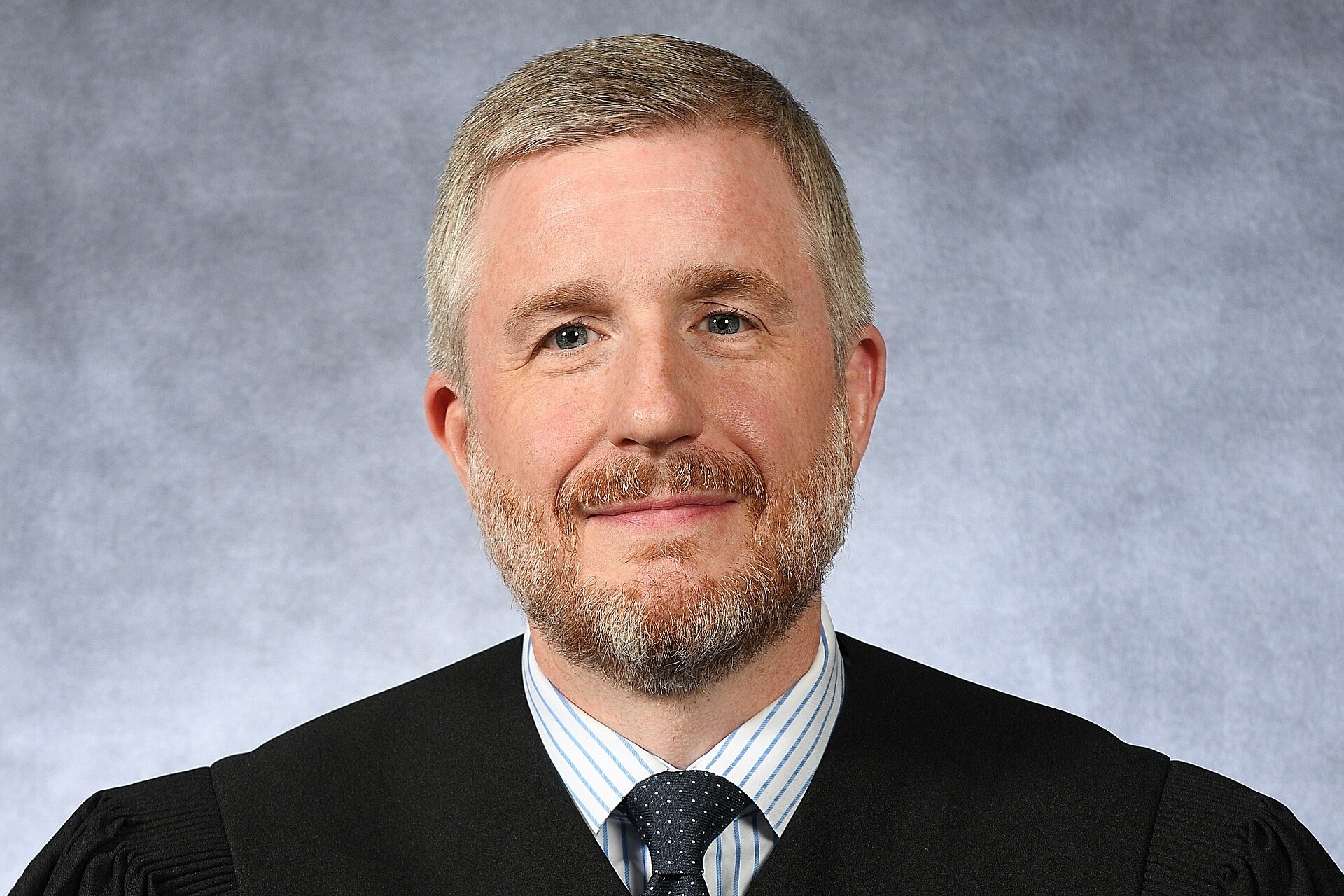
Judge Paul Matey, who wrote the court's opinion. (Photo by ToddRothsteinphoto via Wikimedia Commons, CC BY-SA 4.0)
Why Did the Government's "Habitual Drunkard" History Fail?
The Justice Department argued that early American laws aimed at "common drunkards" and "habitual drunkards" justify disarming Williams. Matey took the argument apart on its own terms. Those laws, he wrote, sent habitual drunkards to jails or inebriate asylums or put them under guardianship. DOJ "offers no evidence to establish" that disarming people was their aim.
The opinion also notes that DOJ itself conceded it may keep Williams disarmed only if he "presently poses a physical danger if armed." Nothing in the record showed that. His DUI conviction involved no threat, no property damage and no injury to anyone, the court said, and he had a lifetime of gun ownership without incident.
That fits the court's larger rule. The majority wrote that history supports disarming "the violently dangerous," not "felons writ large," and that the Second Amendment cannot be limited to people "responsible" as defined by "the whim of the sovereign or the will of the majority." The same day, the same court went the other way in United States v. Bost, upholding the charge against a man convicted of terroristic threats. Judge Stephanos Bibas opened that opinion with "The right to keep and bear arms has limits, and this is one."

The lobby of the James A. Byrne U.S. Courthouse in Philadelphia, April 2010. (Photo by Carol M. Highsmith, Library of Congress, public domain)
Can't Americans Just Apply to Get Their Rights Back?
This is where the ruling reaches well past one man. DOJ told the court that 18 U.S.C. § 925(c), which lets the Attorney General restore firearm rights to applicants unlikely to be dangerous, turns a permanent ban into a temporary one. The court did not buy it.
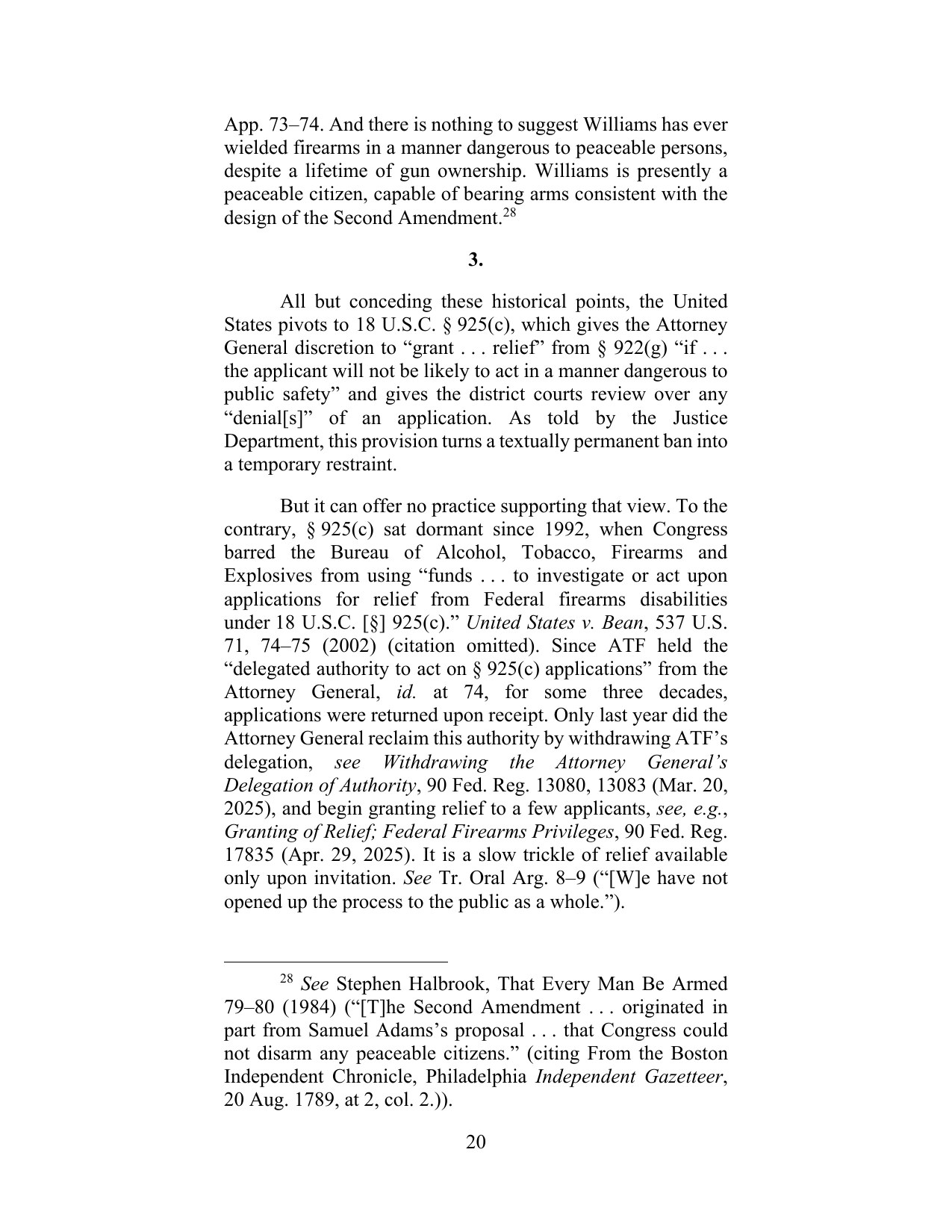
The opinion says that provision "sat dormant since 1992," when Congress barred ATF from spending money on applications. Only last year did the Attorney General pull the authority back from ATF and start granting relief to "a few applicants." Matey quoted DOJ's own lawyer at oral argument: "[W]e have not opened up the process to the public as a whole." Then he dismissed the final rule DOJ now points to: "Our duty is to decide the case based on present facts, not future promises."
Official record
Williams v. Attorney General, No. 24-1091 (3d Cir. en banc, Oct. 13, 2026), opinion of the court, page 20.
"Williams is presently a peaceable citizen, capable of bearing arms consistent with the design of the Second Amendment."
Slip op. at 20
Read or download the full opinion (PDF) · Third Circuit's official copy
The final rule is real. The opinion says the Attorney General signed it Aug. 13, 2026, and it appeared in the Federal Register on Aug. 20. Until it is in operation and tested, the court refused to treat it as proof that ordinary Americans have a working path back to their rights.
What Did the Three Judges Who Wanted a Different Route Say?
The ruling was not unanimous on that point. Chief Judge Michael Chagares, joined in part by Judges Cheryl Krause and Arianna Freeman, agreed Williams should win but wrote that people seeking restoration "must first pursue their claims through the revitalized administrative process outlined in 18 U.S.C. § 925(c)." He would excuse Williams only because of "the unusual circumstances of this lawsuit and its protracted timeline."
That concurrence is the roadmap DOJ will use next. The majority said no such step is required, but with three judges on record for exhaustion and Judge Freeman writing separately that drunk driving can show a credible threat to public safety, the question will not stay settled in the Third Circuit.
What Happens at the Supreme Court?
The justices are already deep in this area. On Oct. 13 the Court denied review in 13 firearms cases, eight of them federal felon-in-possession challenges, according to the Duke Center for Firearms Law. Its same post lists seven new petitions on that statute in the past week.
For gun owners, the stakes are practical. The Third Circuit has now said twice in one day that the lifetime ban has limits. The open fight is who decides where those limits fall, and how fast. Williams waited nine years, through a district court win, an appeal and an en banc rehearing to be told what the court called obvious. Anyone who plans to wait on a Justice Department application form should read that timeline first.