The Justice Department says the arrest of an OpenAI engineer for hiding a recorder in an executive conference room is "a matter of national security." The charge is a single federal wiretap count with a five-year maximum, and nothing in the department's release says a foreign government sent him. Both things can be true, and the gap between them is the story.
What Did Prosecutors Actually Charge?
Abdulrahman Alfozan, 35, a Saudi national who joined OpenAI as an engineer in July 2025, was arrested Oct. 9 and made his first federal court appearance Tuesday, according to the Justice Department's Oct. 13 press release. He is charged with using or endeavoring to use a device to intercept oral communications. If convicted he faces up to five years and a $250,000 fine.
The release does not name the statute, but that penalty matches the federal Wiretap Act. Section 2511 punishes anyone who "intentionally intercepts, endeavors to intercept" an oral communication, with a maximum of "not more than five years." It is the same law that covers a boss who bugs a break room.
Here is what the complaint alleges. On Sept. 30, OpenAI staff found a recorder plugged into a USB port behind a television in an executive conference room in San Francisco. It was wrapped in toilet paper, had been installed around Sept. 28, and its contents were encrypted. Closed-circuit video allegedly puts Alfozan near the room on multiple dates, though he had no authority to attend meetings there. On Oct. 5 he allegedly entered the room and looked behind the television. The same day, security found a second, similar recorder in a bag he had left unattended.
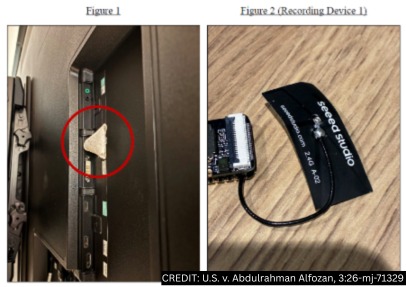
Figures 1 and 2 from the complaint in U.S. v. Abdulrahman Alfozan, No. 3:26-mj-71329 (N.D. Cal.): the spot behind the television, and Recording Device 1. (U.S. Department of Justice, public domain)
Why Does the Complaint Lean So Hard on Chatbot Prompts?
The most unusual evidence is digital. Before Sept. 28, Alfozan allegedly used a workplace "productivity tool" to ask about OpenAI's building addresses, meeting rooms, room capacities and calendars, and where "leadership and exec" would be. Then, from Sept. 24 to Sept. 30, a chatbot account tied to his spouse, which shared "multiple identifiers and attributes" with his own, allegedly asked about "build[ing] a continuous audio recorder" and "encrypt[ing] the SD card." It also asked about the specific device later found, including its MAC address.
Court documents identify the hardware as a Seeed XIAO ESP32-S3 Sense, The San Francisco Standard reported, a thumb-sized development board sold online for $23.99. OpenAI told reporters its own models helped staff identify the device. Whether that made the chat logs easy to collect, and what legal process covered the spouse's account, the release does not say. The spouse is not charged. Those are fair questions for a movement that watches how much of private life now sits in a tech company's database.
Official record
U.S. Department of Justice, Office of Public Affairs, Press Release 26-1173, Oct. 13, 2026. Quoted from the first page of the release.
"According to the complaint, Alfozan had been employed as an engineer by OpenAI since July 2025. On or about Sept. 30, OpenAI personnel discovered a surreptitious audio recording device (Recording Device 1) inserted into a USB port on the back of a television in an executive conference room inside one of their buildings in San Francisco."
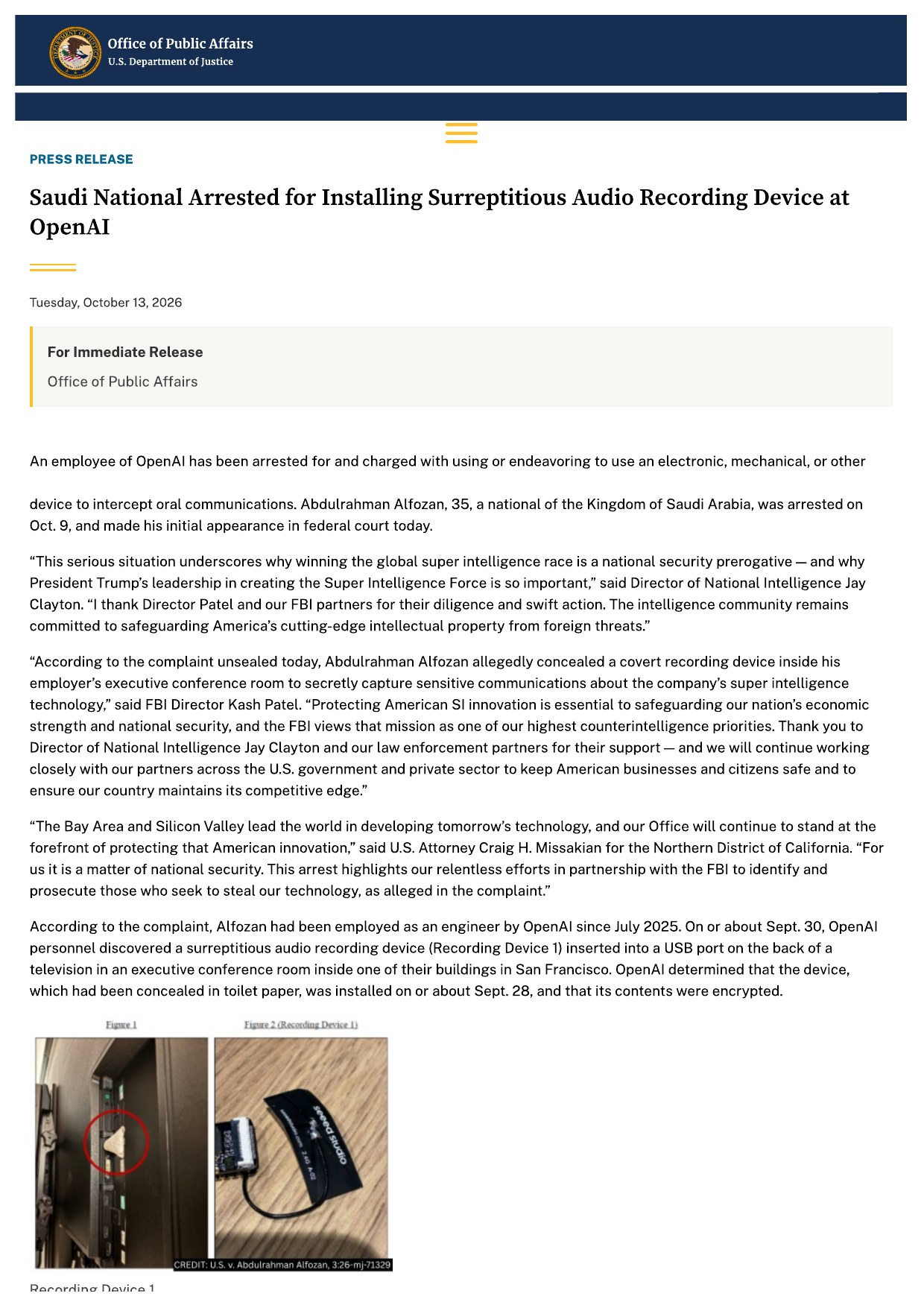
Read or download the full release (PDF) · original on justice.gov
Where Is the Foreign-Government Link?
It is not in the release. The department notes Alfozan is "a national of the Kingdom of Saudi Arabia," and Director of National Intelligence Jay Clayton says the intelligence community will keep "safeguarding America's cutting-edge intellectual property from foreign threats." But no sentence alleges that Riyadh, or anyone else, directed or paid him. The Associated Press reported that the complaint does not say what he meant to do with any recordings. OpenAI says it has no indication he accessed model weights, source code or customer data.
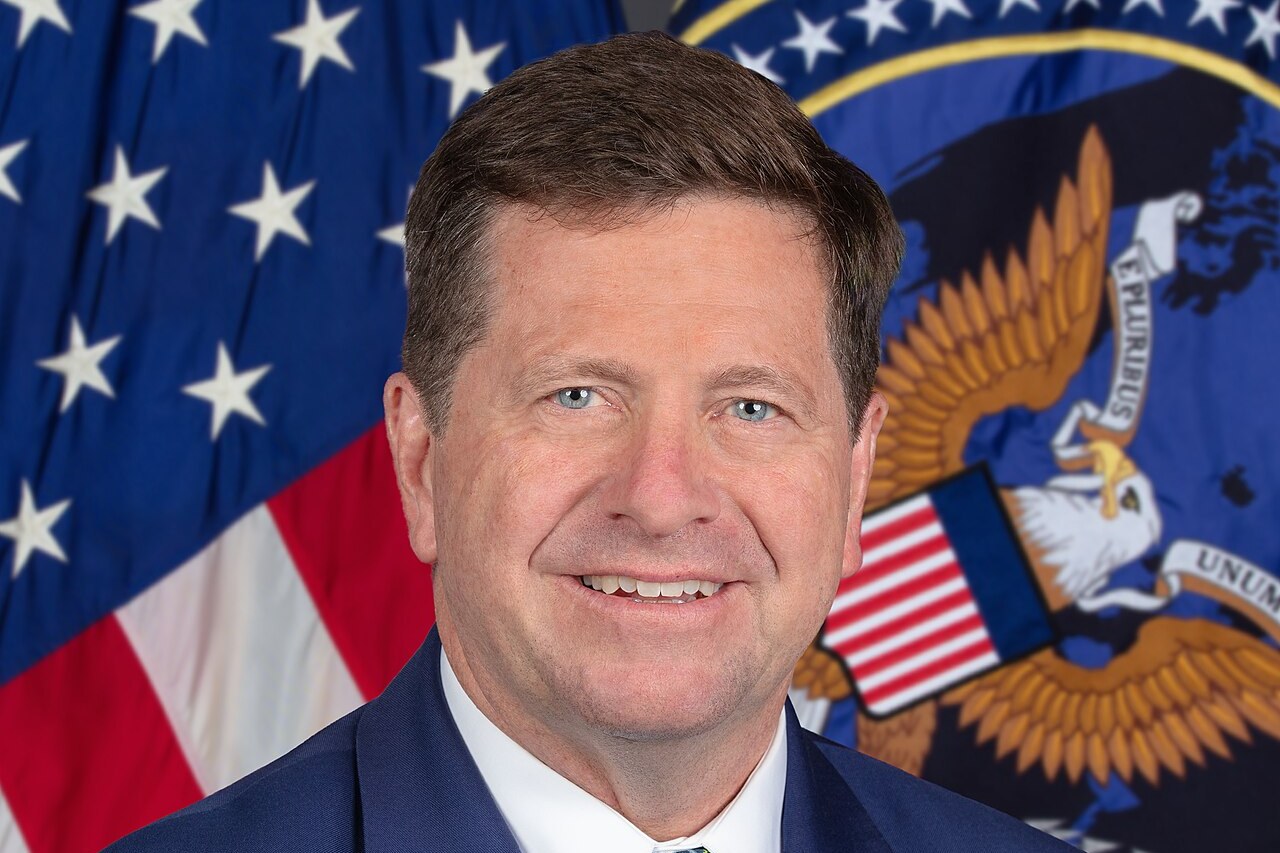
Director of National Intelligence Jay Clayton, whose statement opens the Justice Department release. (Official portrait, Office of the Director of National Intelligence, public domain, via Wikimedia Commons)
There is also a legal line between the two. The economic espionage statute, 18 U.S.C. § 1831, applies to offenses committed "intending or knowing that the offense will benefit any foreign government." Prosecutors have not charged it. They may never need to, or may lack the evidence. The release does list a Counterintelligence and Export Control Section trial attorney from the National Security Division on the case, so Washington is treating it as more than a workplace dispute.
Why Is the Administration Selling It This Way?
The release ties the case to the White House's push on advanced AI. Clayton calls the case a reminder that winning the "global super intelligence race is a national security prerogative" and credits "President Trump's leadership in creating the Super Intelligence Force." FBI Director Kash Patel calls protecting American "SI innovation" one of the bureau's "highest counterintelligence priorities." The prosecution, the release says, supports National Security Presidential Memorandum 11. In the last days of September Trump signed an order creating that task force, with Clayton among its four named leaders.
Protecting the country's lead in AI from China and other rivals is a legitimate job, and a hidden microphone in an executive suite is a serious allegation. Alfozan is presumed innocent, and his lawyer has urged the public not to jump to conclusions this early. A detention hearing is set for Oct. 19 before Magistrate Judge Alex Tse.
What to watch is whether the national security language gets evidence behind it. If a superseding indictment names a foreign beneficiary, this becomes an espionage case. If it never does, Americans will have been told a five-year wiretap count was a threat to the nation, and the next time the government raises that alarm, the public will remember the difference.