Christa Pike tortured and killed 19-year-old Colleen Slemmer in 1995, and Wednesday night Tennessee still couldn't carry out her death sentence. The Supreme Court cleared the way, the state gave two doses of pentobarbital, and Pike left the prison by ambulance alive. Tennessee's own filings show the day's last-minute stay was built on one sympathetic sentence a state lawyer said in August.
Thirty-One Years, and Tennessee Still Couldn't Finish the Job
Pike was set to die at 10:00 a.m. Central on September 30 at Riverbend Maximum Security Institution in Nashville. She would have been the first woman executed in Tennessee in at least 200 years, according to the Associated Press. The morning came and went with a stay in place. By evening, the U.S. Supreme Court had lifted it.
AP's media witnesses said officials appeared to give Pike two doses of pentobarbital. At 7:46 p.m. the curtain to the media room closed. When it went back up, Pike could be heard loudly snoring, and she was still audible behind the curtain until the microphone was cut around 8:53 p.m. Emergency vehicles came and went from the prison.
Pike was taken to an off-site medical facility, WSMV and WVLT reported. Her lawyers filed emergency motions in the Supreme Court, the Sixth Circuit and the district court, arguing she was in "unnecessary agony" and asking the state to begin lifesaving measures.
What Pike Did to Colleen Slemmer
The facts of this crime are not in dispute, and Pike herself does not deny them. Tennessee's application to the Supreme Court, quoting the Tennessee Supreme Court's 1998 opinion, says Pike killed Slemmer on January 12, 1995, because she "just felt mean that day." Pike cut Slemmer's throat six times, struck her in the back with a meat cleaver and crushed her skull with a piece of asphalt.
Both women were students at a Job Corps center in Knoxville. A pentagram was carved into Slemmer's chest, and the attackers took a piece of her skull as a souvenir, WSMV reported. Pike's boyfriend, Tadaryl Shipp, was 17 and got life with the possibility of parole. Pike, 18 at the time, was the only one sentenced to death.
Slemmer's mother, May Martinez, traveled from Florida to watch. "Every time I think about it, I think about Colleen feeling that pain and trying to get up and run," she told the AP days before. Tennessee's lawyers quoted her in their filing: "Thirty-one years is long enough to wait."
The Stay Nobody Asked For
Here is the part most coverage skipped. The Sixth Circuit's stay came at 8:17 a.m. Central, less than two hours before the execution. According to the state's filing, Pike "did not even request" it. A divided panel granted a "short stay of execution in order to properly analyze the parties' fully briefed arguments," the state wrote, without finding that Pike was likely to win.
The paperwork behind that stay was filed the day before. On September 29 the Supreme Court denied Pike's earlier stay application and cert petition. Later that same day, hours before the execution, Pike filed a motion under Federal Rule of Civil Procedure 60(b) to reopen her long-finished federal habeas case. The district court ruled the same day that it was really a second habeas petition and sent it to the Sixth Circuit. That transfer is what the panel stopped the clock to study.
Official record
Nelsen v. Pike, No. 26A428, Supreme Court of the United States, order and dissent of September 30, 2026 (3 pages). The order vacates the Sixth Circuit's stay in In re Pike, No. 26-5864. View on supremecourt.gov.
"The application to vacate stay of execution of sentence of death presented to JUSTICE KAVANAUGH and by him referred to the Court is granted."
Order of the Court, page 1
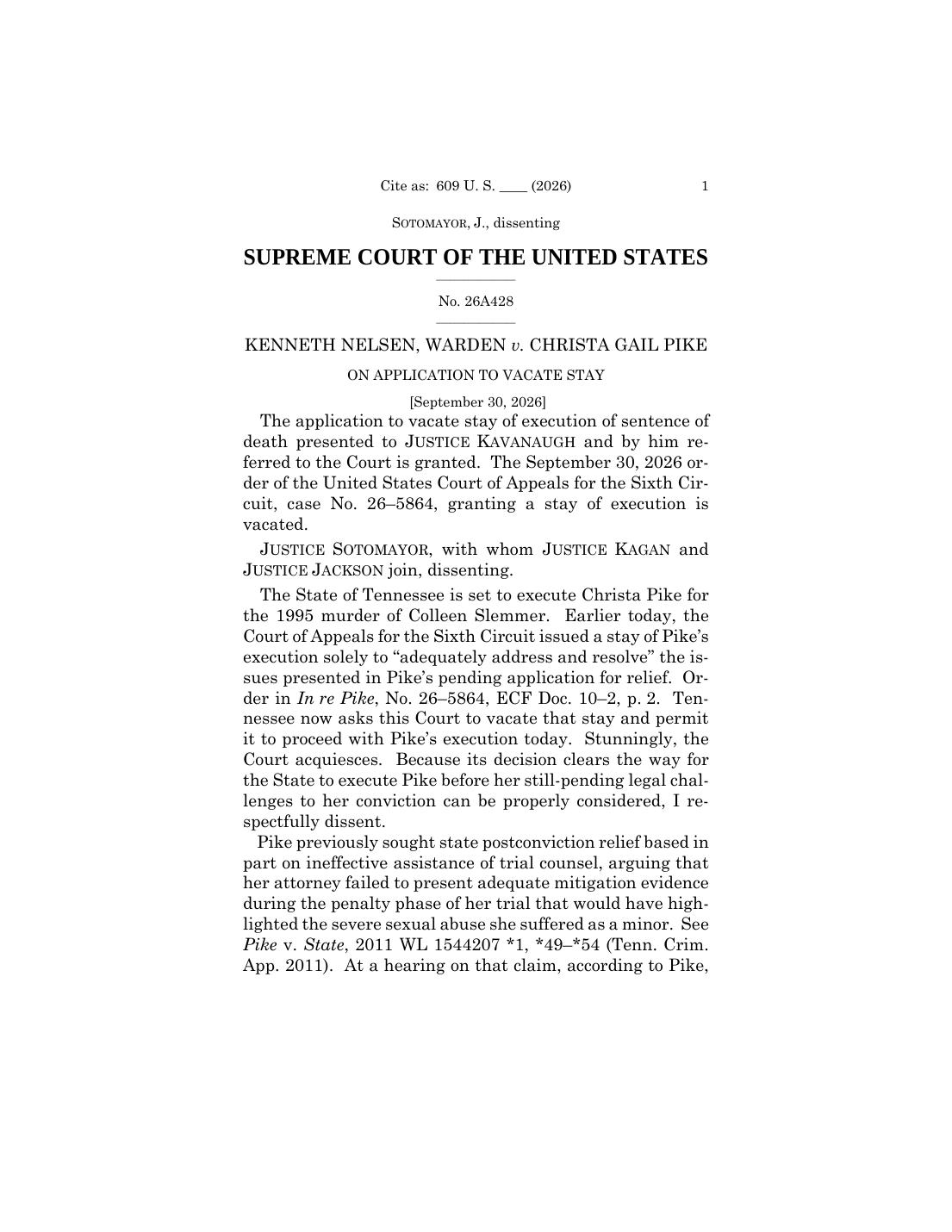
Read or download the full 3-page order and dissent (PDF) · Tennessee's 15-page application to vacate the stay
One Kind Sentence Became a "Concession"
So what was the new evidence? It was a single act of courtesy from the state's own lawyer. At an August 13 hearing on Pike's mental health claims, the state's attorney said, as quoted in Tennessee's filing: "The State does not dispute the terrible things that Ms. Pike suffered. I think everybody in this courtroom wishes that those things had never happened to Ms. Pike."
Pike's lawyers treated that as an admission. Her motion argued that the state had once attacked her credibility about childhood sexual abuse during her 2007-2008 post-conviction hearings. If the state now "does not dispute" the abuse, they said, the earlier proceedings were "tainted" by "gamesmanship." Justice Sonia Sotomayor's dissent recounts that argument, describing Pike's claim that the state's remark "effectively concedes" the point.

Justice Sonia Sotomayor, who wrote the dissent joined by Justices Kagan and Jackson. (Collection of the Supreme Court of the United States, Steve Petteway, public domain, via Wikimedia Commons)
Tennessee's answer is the strongest point in the record. The state says the courts never turned Pike down because they doubted her. The post-conviction court ruled that "[e]ven assuming that all the evidence" about her childhood "had been presented to the jury," the verdict would not have changed, given "the strength of the aggravating factors." The Sixth Circuit said the same in 2019 in Pike v. Gross, calling the new evidence "mostly cumulative and insufficient to overcome the heinous nature of her crime." In plain English, the courts assumed she was telling the truth and still upheld the sentence.
Forty-Seven Days of Waiting
Look at the calendar. The state lawyer's remark was made August 13. Pike filed her Rule 60(b) motion September 29. That is 47 days, and the state's application makes the point directly: she "waited until the very last possible moment to seek relief." It bought her most of a day.
The Supreme Court has warned about this exact tactic. In Bucklew v. Precythe (2019), the Court said last-minute claims that "could have been brought earlier" can be grounds to deny a stay. Sixth Circuit Judge Richard Griffin dissented from the panel's stay along the same lines. As the state's filing quotes him, Pike's "claim is that the State's recent remarks undermine the state court's prejudice determinations," and that was "the whole merits decision" she already lost.
Sotomayor, joined by Justices Elena Kagan and Ketanji Brown Jackson, wrote that "[s]tunningly, the Court acquiesces," and argued the Sixth Circuit only wanted time to "adequately address and resolve" a novel issue. The six-justice majority gave no explanation, which is normal for emergency orders.
Governor Lee Halts Executions for the Rest of 2026
Overnight, Gov. Bill Lee ordered "a comprehensive, third-party review to determine exactly what occurred" and called off the one other execution scheduled this year, WSMV reported. "Carrying out a lawfully imposed sentence is among the State's most serious responsibilities," Lee said, "and the people of Tennessee expect it to be done in a manner that is not only legal and constitutional, but is effective."

Tennessee Gov. Bill Lee, who ordered an outside review after the failed execution. (Photo: Maryland GovPics, CC BY 2.0, via Wikimedia Commons)
The Tennessee Department of Correction said it followed every step of the "lawful, established execution protocol approved by the Attorney General's Office." The department added that the drug "has consistently been effective" and the protocol "does not allow for additional procedures beyond what was carried out this evening."
This is the second failure this year. In May the state called off Tony Carruthers' execution after staff spent more than an hour failing to set an IV, AP reported. Carruthers was convicted of kidnapping and killing three people in 1994. Tennessee did carry out an execution in August, putting Anthony Darrell Hines to death for a 1985 murder. Lee also paused executions in 2022 for an independent review of the state's lethal-injection process.
Who Pays for the Failure
Pike's lawyers will now argue that a second attempt would be cruel and unusual. That fight is coming, and the state has not said what it plans next. Tennessee's own filing already names the people paying the price. The state wrote that the stay "traumatized" Slemmer's family, and that "the surviving victims' right to closure" demanded the execution go forward.
The courts did their part. The Supreme Court rejected the last-minute theory, and the sentence has been upheld at every level for three decades. What failed Wednesday night was the state's own execution process, for the second time in five months. Gov. Lee's review needs to explain how, and May Martinez deserves that answer before another year goes by.
Top photo: The Tennessee Supreme Court Building in Nashville, which set Pike's September 30 execution date. (Photo: Antony-22, CC BY-SA 4.0, via Wikimedia Commons)