Generac, the Wisconsin generator maker, has settled with the EEOC after federal investigators found it broke the Civil Rights Act by refusing a Christian team lead's religious accommodation over transgender coworkers' pronouns. Sixteen months ago the company called the same charge "frivolous" and promised to fight it. The original charge shows that Spencer Wimmer never asked to call anyone by the wrong pronoun. He asked to use no names or pronouns at all, and Generac still said no.
The EEOC Says Generac Broke Federal Law
On September 30 the U.S. Equal Employment Opportunity Commission announced that Generac Power Systems agreed to "monetary and injunctive relief" to resolve a religious accommodation charge. According to the agency's reasonable cause finding, Generac violated Title VII when it "did not fully engage in the reasonable accommodation interactive process" before denying the request.
The agreement requires Generac to update its religious accommodation policies and train its people on handling those requests. The dollar figure was not disclosed. The EEOC's release does not name the employee, but his lawyers at the Wisconsin Institute for Law and Liberty confirmed the same day that the settlement closes the charge they filed for their client, Spencer Wimmer.

EEOC Chair Andrea Lucas, whose agency found reasonable cause against Generac. (U.S. Equal Employment Opportunity Commission, public domain, via Wikimedia Commons)
"Title VII requires employers to engage with religious accommodation requests, and that obligation does not disappear when the request involves a religious employee's sincerely held belief in the binary nature of sex," EEOC Chair Andrea Lucas said. She added that, consistent with President Trump's Executive Order 14168, the agency "will continue to prioritize for enforcement" charges like this one. The release says the EEOC has taken more than 40 public actions to defend workers' religious liberty since January 2025.
Generac Called It "Frivolous" Last Year
That is a long way from where Generac started. When WILL filed the charge in May 2025, the company told BizTimes Milwaukee: "We strongly disagree with the claims by this former employee, and we will defend against this frivolous claim." It also said, "we've never had a policy on gender pronoun usage."
This week a Generac spokesperson struck a different tone, saying the company appreciates "the EEOC's engagement throughout this process and the opportunity to resolve this matter." A settlement is not an admission in court, and Generac has not conceded any wrongdoing in public. Still, the frivolous claim drew a federal cause finding and ended with the company paying the man it fired.
What Wimmer Actually Asked For
Most coverage, starting with the EEOC's own release, describes the request as a bid "to use biological sex-based pronouns." The 20-page charge WILL filed on May 20, 2025 describes something narrower. Wimmer, a self-described "devout Christian Baptist" who led a team of 11 to 13 customer service agents at Generac's Jefferson, Wisconsin office, asked to "avoid all pro[noun] and proper nouns" with transgender coworkers "so that [he] may continue to be respectful and professional to them."
On Generac's own accommodation form, he also confirmed he would not use those coworkers' former names. In other words, he offered to stop using any name or pronoun for those coworkers rather than pick the wrong ones. The charge says he had already been doing that quietly, and that no employee ever complained. One former direct report who identifies as transgender had "openly begged" leadership to keep Wimmer as supervisor during a restructuring.
The EEOC's investigative file is not public, so it is possible the agency's record frames the request differently. But on the only public version of the facts, this was about as modest an accommodation request as a pronoun case gets.
Official record
Title VII Charge of Discrimination, Spencer Wimmer v. Generac Power Systems, filed by the Wisconsin Institute for Law and Liberty with the EEOC Milwaukee Area Office, May 20, 2025 (20 pages), as published by WILL. The page below quotes Generac's March 20, 2025 denial letter.
"Please understand that misgendering by either 1) using other than the individual's preferred pronouns or 2) using other than the individual's preferred name will be considered violations of Generac's No Harassment policy and the Wisconsin Fair Employment Act and will result in discipline up to and including termination."
Generac denial letter, as quoted in the charge, page 12
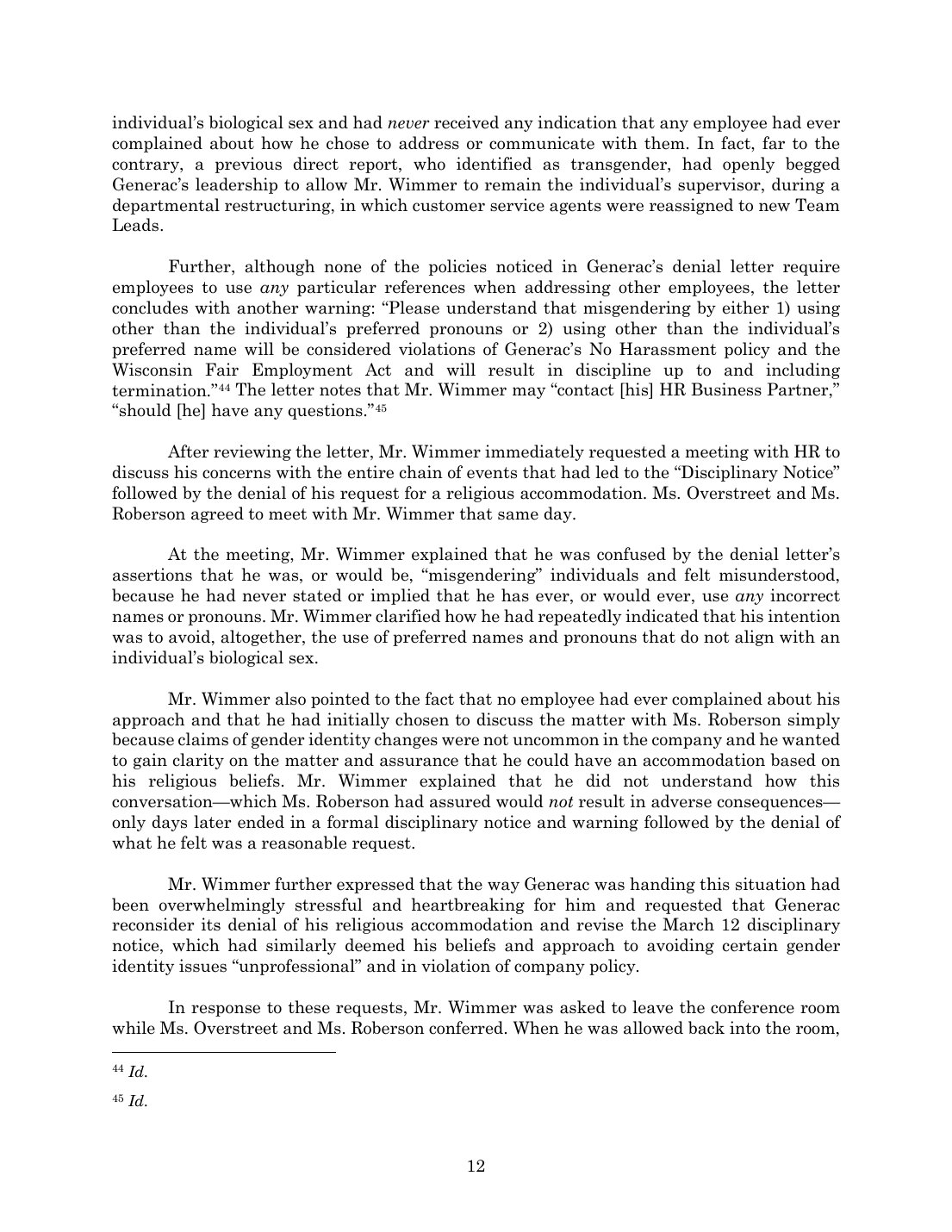
Read or download the full 20-page charge (PDF) · EEOC press release, Sept. 30, 2026
Eighteen Days From Warning to Denial
The charge lays out a fast timeline. Around March 3, 2025, Wimmer told his manager that his faith kept him from using a newly transitioned report's preferred name and pronouns. On March 12 he received a written "Verbal Warning" calling his approach "unprofessional" and a "violation of the company's Code of Business Conduct and No Harassment Policy." The charge says the HR generalist in that meeting argued his beliefs made no sense, comparing preferred names to her own nickname.
He filed a formal accommodation request on March 13. HR asked for a letter from a religious leader, and on March 20 his pastor at Westside Baptist Church in Janesville sent one, citing Genesis 1:27. Generac denied the request the same day. The denial, as quoted in the charge, said Generac had reviewed "all the required information" and called the belief "gender harassment" under Wisconsin law.
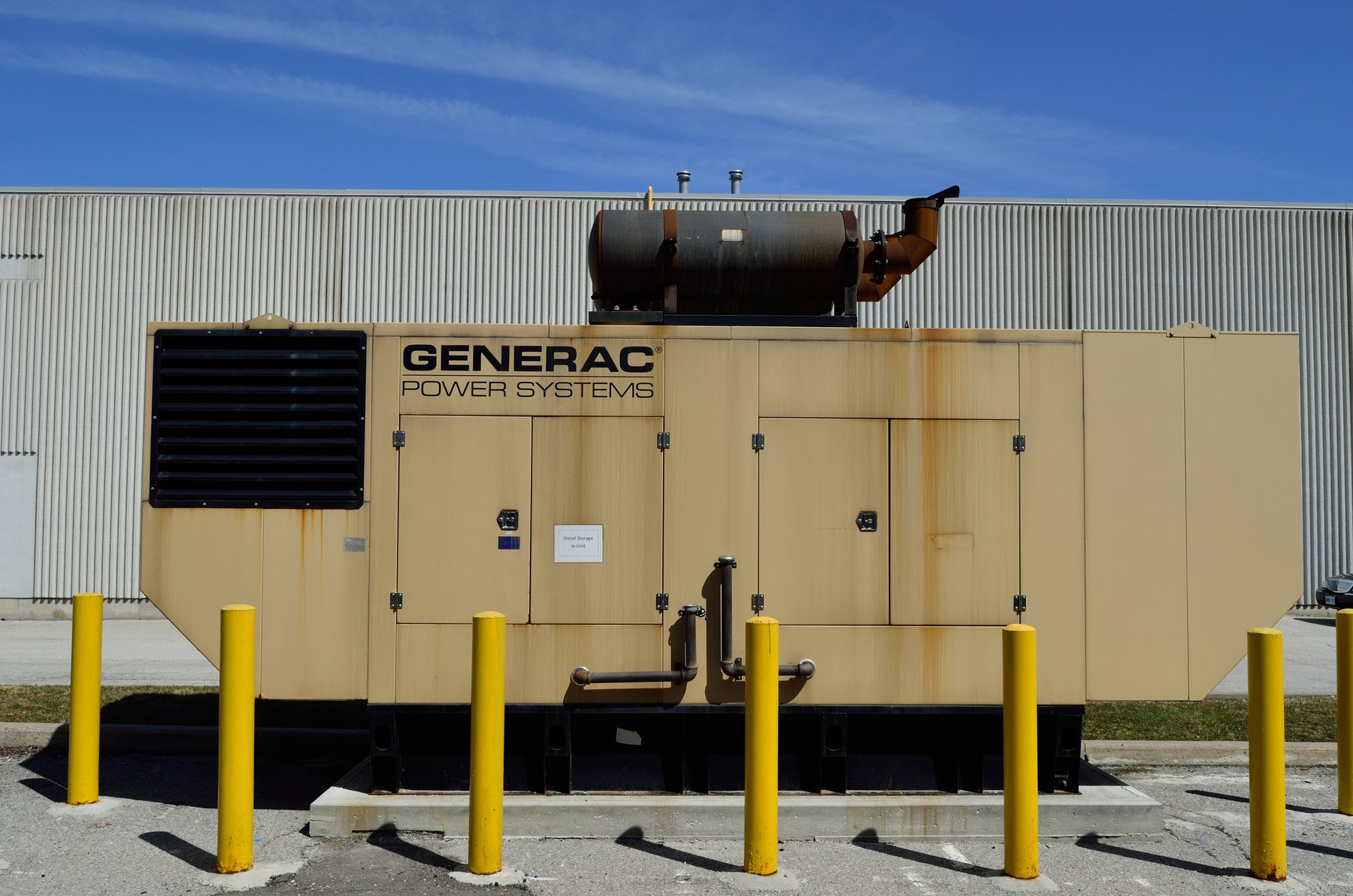
A Generac Power Systems industrial generator. The company reported 9,239 employees at the end of 2024, according to its annual report cited in the charge. (Raysonho, CC0, via Wikimedia Commons)
That is the heart of the EEOC's "interactive process" finding. An employer is supposed to talk through a request and look for something workable. Here, by the charge's account, the only answer offered was the one Wimmer said he could not give in good conscience.
Resigned or Fired? The Two Accounts Differ
The EEOC says Generac's failures "resulted in the religious employee's resignation." The charge tells a sharper story. Wimmer gave two weeks' notice on March 31, 2025, then emailed on April 2 to take it back after learning he might have legal protection. Hours later, the charge says, HR told him the company would not accept the rescission and that he was "terminated, effective immediately." His manager walked him out of the building.
The charge also alleges that his personal items were shipped back damaged, including a new Bible from his pastor that arrived with a water ring and puncture marks, and a Chi Rho mug that was badly scratched. Those are WILL's allegations, and nobody has tested them. The settlement resolves the charge without any public finding on them.
Why the Law Shifted Under Generac's Feet
Generac denied the request in March 2025, when Biden-era EEOC guidance still listed repeated, intentional "misgendering" as possible harassment. Two months later, Judge Matthew Kacsmaryk vacated those parts of the guidance in a suit brought by Texas and the Heritage Foundation, finding the agency had exceeded its authority.
The Supreme Court had already raised the bar for employers in its 2023 Groff v. DeJoy decision. Refusing a religious accommodation now takes a burden that is "substantial in the overall context" of the business, not just a minor cost. Then, in August 2025, the Seventh Circuit, whose rulings bind federal courts in Wisconsin, revived Indiana teacher John Kluge's claim over a last-names-only accommodation. The court held that his school had not proven an undue hardship as a matter of law.
Wimmer's proposal was even less than Kluge's. Generac employs more than 9,000 people and reported over $4 billion in revenue, by the charge's count from its own SEC filing. A team lead who skips pronouns for a few coworkers is a hard sell as a "substantial" burden on a company that size.
What This Means for Workers of Faith
A conciliation agreement is not a court precedent, and the full terms are private. But the message from Lucas is plain: the EEOC will treat a refusal even to discuss a pronoun accommodation as a Title VII problem, and it will say so in public. For a Christian employee who wants to keep both his job and his convictions, that is a real change from a year and a half ago, when his company's HR department told him his beliefs were harassment.
"We are proud to have represented Spencer and stand ready to defend religious liberty anywhere it is threatened," WILL Deputy Counsel Luke Berg said. Wimmer's own statement was shorter: "I am deeply grateful for WILL's effort defending my rights in the workplace."