

Coverage of Secretary of State Marco Rubio's Monday meeting with Venezuela's new foreign minister says Washington is pushing toward elections there, and opposition leader María Corina Machado says it means a presidential vote in 2027. The State Department's own readout is about 70 words long and gives no date, no year and no deadline.
What does the State Department readout actually say?
It has four sentences. The Office of the Spokesman readout says Rubio met Foreign Minister Oliver Blanco at the department on Nov. 2, reaffirmed "the President's three-phase plan for Venezuela," and discussed "progress in the Venezuelan-led reconciliation talks." It also says Rubio "urged the continued release of the remaining political prisoners."
I could only read the page through a fetch tool that paraphrases long passages, so the quotes below are the short fragments it returned, checked against a second keyword pass. The readout contains the word "elections" once. It does not contain "2027," Machado's name, Delcy Rodríguez's name or the word oil.
Official record
U.S. Department of State, Office of the Spokesman, readout of Secretary Rubio's meeting with Venezuelan Foreign Minister Blanco, Nov. 2, 2026.
"...the President's three-phase plan for Venezuela: stabilization, economic recovery and political reconciliation, and democratic transition."
"...institutional reforms that lay the groundwork for free, fair, and credible elections."
Where does "2027" come from?
From Machado, not from the government. Al Jazeera quotes her saying Rubio "has set out a sequence of events" that "makes clear the holding of presidential elections in 2027." Reuters, in a dispatch republished by Yahoo, puts it more loosely: Machado says Washington has suggested elections next year.
Both accounts attribute the timing to her. Reuters reports no specific election date, and Al Jazeera says Rodríguez has promised elections "with the world as witness" without naming one. A year is a reasonable thing for an opposition leader to take from private talks. It is not something a reader can find in the document.
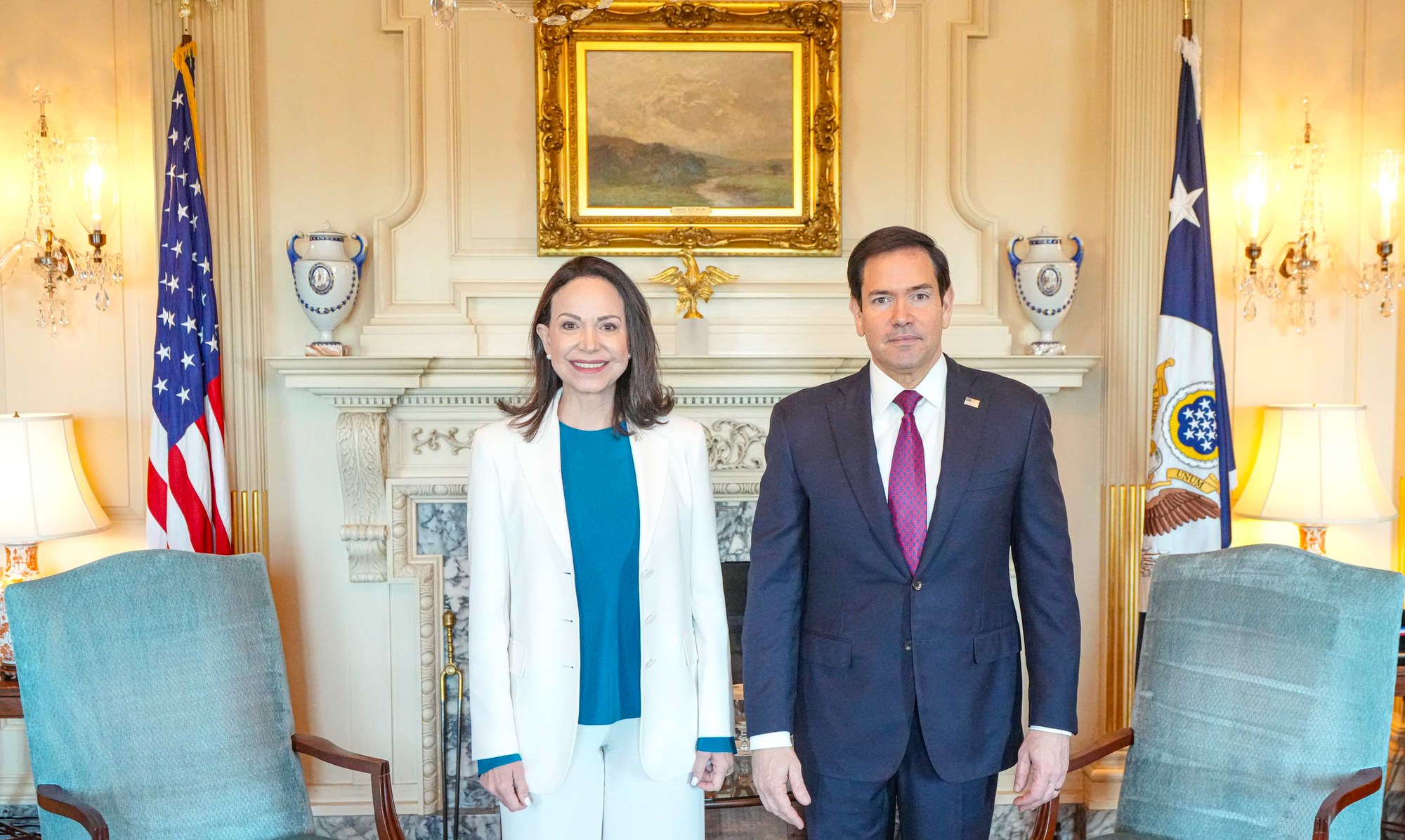
Rubio with opposition leader María Corina Machado at the State Department on March 31, 2026, seven months before Monday's meeting with the foreign minister. Official State Department photo by Freddie Everett, via Flickr (public domain).
Is the three-phase plan new?
No. Rubio laid it out on Jan. 7 after briefing Congress, as Fox News reported. Stabilization came first, tied to U.S. control of Venezuelan oil exports. Recovery meant opening oil markets to American and other Western firms, releasing political prisoners and letting exiles return. On the third phase Rubio said only: "In the end, it will be up to the Venezuelan people to transform their country."
Fox reports that Rubio gave no election timeline that day, and that lawmakers who attended the briefings said the administration shared none. The Nov. 2 readout adds progress on "reconciliation talks" to that frame. It adds no calendar.
What else was on the table Monday?
Blanco, named to his post last week and making his first U.S. visit in the job, according to Gulf News, also met Treasury Secretary Scott Bessent. Treasury posted a readout of that meeting. I could not open it, so I am relying on Reuters, which says Treasury described a discussion of boosting energy production and attracting investment.
That matters because the State Department readout says nothing about oil. Al Jazeera notes that a September deal gives a joint venture, North American Blue Energy Partners, 100-year rights over 17 oilfields, with the Pentagon holding a 35% stake and the U.S. entitled to buy 20% of output at cost. Those terms are Al Jazeera's account, which I did not check against the deal text. Machado told the outlet the agreement "does not reflect the levels of transparency that Venezuelan society wants."
What about the political prisoners?
The readout asks for "continued" releases of the "remaining" prisoners, which concedes that some have already been freed. Gulf News cites the watchdog Foro Penal counting 344 political prisoners as of Sept. 18, and says a landmark amnesty law led to many releases while hundreds remain jailed. The readout gives no number and no deadline here either.
What the readout does and does not settle
It settles that the administration still describes its Venezuela policy as phased, that Rubio and Blanco discussed institutional reforms ahead of a vote, and that prisoners are still on the U.S. list. It does not settle when Venezuelans vote, who may run, or what the oil arrangement means for that vote. Reuters adds that Rubio said last week the electoral system was built to rig elections and must be replaced quickly, and that the talks leave out Machado's party, Vente Venezuela. Those are Reuters' reports, and I did not find the underlying remarks.
Until a date appears in a State Department or Venezuelan government document, "2027" is Machado's reading of what she was told.
Header photo: Secretary of State Marco Rubio meets Venezuelan Foreign Minister Oliver Blanco at the Department of State, Washington, D.C., Nov. 2, 2026. Official State Department photo by Freddie Everett, via Flickr, public domain (U.S. government work). Cropped and resized.















