A pro se petition now pending at the Supreme Court asks whether a Colorado magistrate could order a father to give up his guns after he went to church to see his son, with no finding that he threatened anyone. The filing is real and its legal question is sharp, but every fact in it comes from the father, and no Colorado court has ruled on the merits.
What is the petition and where does it stand?
The case is Robinson v. Freeman, No. 26-538, filed by Samuel Collin Robinson of Grand Junction, who is representing himself. The docket shows the Colorado Supreme Court's decision as March 4, 2026, the case docketed Oct. 22, and a response due Nov. 23. The respondent, his former wife, has not answered yet. Duke's Center for Firearms Law listed the case in its Nov. 2 SCOTUS Gun Watch among pending petitions, with no conference date.
That timing matters. The justices meet Friday on 24 other firearms petitions, mostly felon-in-possession challenges, and hear the AR-15 case, Viramontes v. Cook County, on Dec. 2. Robinson's case is not part of that group. It is a new filing that can sit for weeks before anyone votes on it.
Official record
Petition for a writ of certiorari, Robinson v. Freeman, No. 26-538 (filed by Robinson without a lawyer). Quotations are from the petition itself.
"When a parent went alone, and unarmed, to church, to see their child, making no threat of any kind while there, may a magistrate order, as a consequence, per the wishes of the other parent, that the first must relinquish the firearms they had owned for decades?"
"The district court did not 'find' a credible threat to physical safety. Therefore, the Rahimi decision does not apply to, and does not control disposition of, this case."
What does the petition say happened?
According to Robinson, he had gone to church alone and unarmed for about five years to see his children, who attended with their mother. After she moved across town in July 2025, the family changed congregations. On July 30, 2025, she filed for a civil protection order, and the petition says a magistrate issued a temporary order, including a firearms relinquishment requirement, later the same afternoon. He says he learned of it that evening by email and was served the next day with 48 hours to comply.
Robinson says the mother's motion included false claims of domestic violence, some from more than 14 years ago. I have no way to check that. The petition calls the church facts "undisputed," but no response from her side is in the record I could see, and her lawyer is listed in the petition only by name.
What does the Rahimi argument actually claim?
Robinson leans on United States v. Rahimi (2024), which upheld disarming someone a court has found to be a credible threat to another person's physical safety. He quotes the Court's own limit: "Our analysis starts and stops with Section 922(g)(8)(C)(i)," and it did not decide whether the federal statute's second prong, (C)(ii), is also constitutional. His argument is that a Colorado order with no threat finding falls in that gap.
He also points to forms. He says the motion checked boxes for "Domestic Abuse," "Domestic Violence" and "Stalking" but not for a physical threat, and that the temporary order did not check the box saying the act involved the threat or use of physical force. I could not read those scanned pages in the filing's appendix, so that is his description, not something I confirmed. His claim does track Colorado law as excerpted online: C.R.S. 13-14-105.5 ties the gun requirement to an on-the-record finding of a qualifying act of domestic violence involving physical force, and 13-14-104.5(4) says the temporary-order hearing "may be ex parte." I read both through a web excerpt, not the official code.
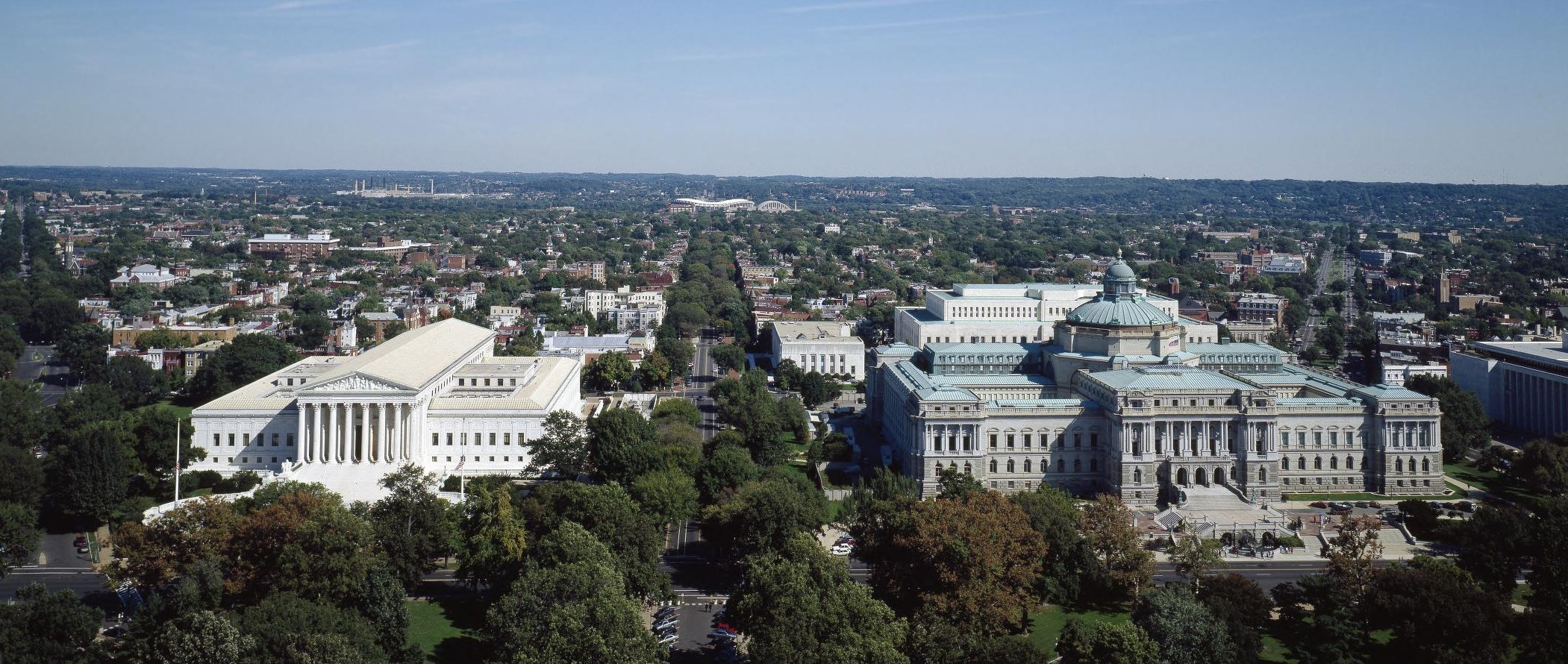
The Supreme Court building (left) and the Library of Congress Thomas Jefferson Building, seen from the Capitol dome. Photo by Carol M. Highsmith, via the Library of Congress (no known restrictions on publication).
Did any Colorado court rule on the merits?
No. That is the main weakness. The Colorado Court of Appeals issued an order to show cause on Oct. 30, 2025, saying "it appears that this appeal may be moot." Its order recounts that on Aug. 12, 2025, the magistrate held a hearing, vacated the temporary order and issued a permanent protection order. Robinson says the court then dismissed the appeal without explanation, and the Colorado Supreme Court denied his petition on March 4, 2026 in a short order that gives no reasons.
So the constitutional question was raised at each level, but the courts below never answered it. The Supreme Court usually wants a lower-court ruling to review. In my read, a mootness dismissal and a skipped-hearing claim that rests on what the court file does not contain make this a harder vehicle than the felon-ban cases lined up this week. That is my assessment, not a prediction of what the justices will do.
What should 2A voters take from it?
The part worth watching is the due process point, which does not depend on whose account of the church visits is right. Colorado's statute lets a temporary order issue after a hearing that may be ex parte, and Robinson's gun surrender clock started before he knew a case existed. Whether disarmament can follow a protection order with no violence finding and no chance to respond is a question Rahimi left open, which is why a filing like this gets read.
What the filing cannot do is prove the facts. It is one side's account, written by a litigant without counsel, about a family dispute. Look for the response due Nov. 23, which will show whether Colorado disputes the story, or just argues the case is moot.
Header photo: the west front of the U.S. Supreme Court building, Washington, D.C. Photo by Carol M. Highsmith, via the Library of Congress (no known restrictions on publication). Cropped and resized.