

The National Shooting Sports Foundation called the Justice Department's new Firearm Handler Check rule a "tremendous victory" and said it lets "all" gun dealers run background checks on current and prospective employees. The 17-page Federal Register text published Oct. 27 is narrower than that: it limits the checks to people with access to firearms, ammunition or manufacturing tools, and it says in so many words that it disagrees with NSSF's argument for going wider.
What the rule does
The rule, 91 FR 67460, amends 28 CFR part 25 so a federal firearms licensee can send a consenting employee's name through the FBI's NICS system. It takes effect Nov. 27. The FFL gets back one of three answers, "Pass," "Pending" or "Did Not Pass," plus a transaction number. It does not get the underlying records.
The rule implements a provision Congress wrote into the 2022 Bipartisan Safer Communities Act, 34 U.S.C. 40901(b)(2). The Department's own summary says the use is voluntary for the dealer, requires the employee's written consent, and carries no FBI fee. A dealer who skips it breaks no rule.
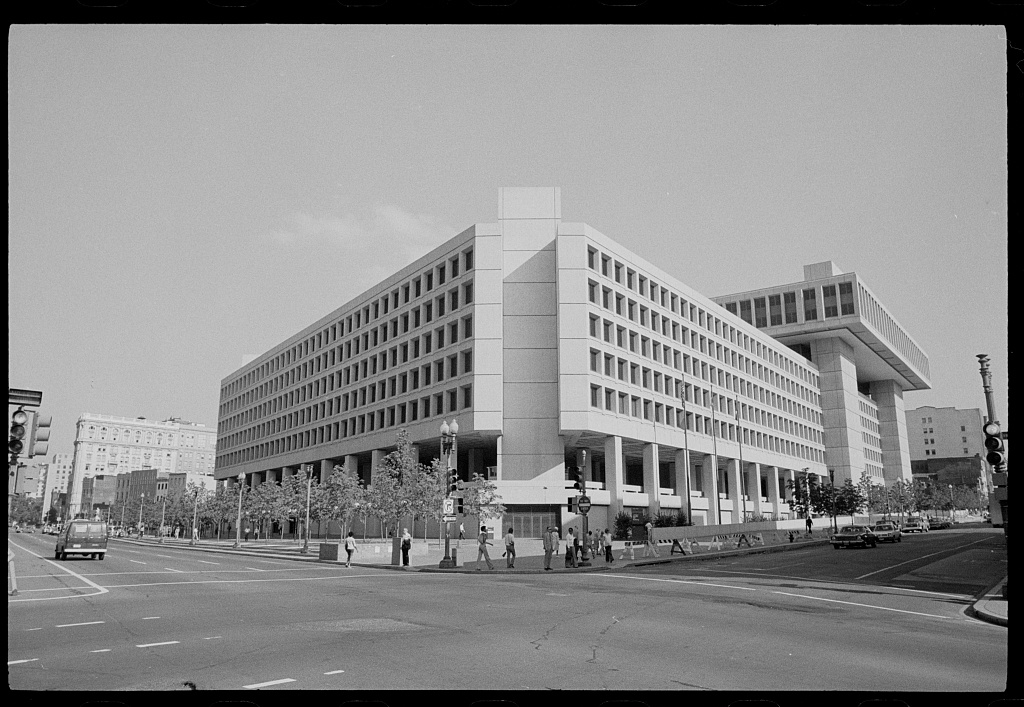
The FBI's J. Edgar Hoover Building in Washington, 1977. The Bureau runs NICS from its CJIS Division in Clarksburg, West Virginia. Photo: Thomas J. O'Halloran, Library of Congress (U.S. News and World Report collection), no known restrictions on publication.
"All dealers" versus "eligible employees"
NSSF's Oct. 26 announcement says the rule lets FFLs run checks on "current and prospective employees." In the part I could read, it does not mention any limit on which employees.
The rule text does. It defines an "eligible employee" as someone who handles or can reach firearms or ammunition, certain manufacturing workers, and, new in the final version, independent contractors or agents who work at the premises and can reach firearms, ammunition or parts. A bookkeeper with no access to the inventory is outside the definition.
That limit is the exact point NSSF fought. Its comment on the 2024 proposal, quoted in the final rule, called the restriction "ultra vires" and said Congress "required by statute that FHCs be available for all current or prospective employees without limitation."
The Department's answer to NSSF
The Department "respectfully disagrees." Its stated reasons are workload and statutory purpose. It estimates about 80,000 licensees, with 50,000 already sending purchase checks to the FBI. If 65,000 to 70,000 of them submitted just 10 employee checks a month, it says, NICS would take in 7.8 to 8.4 million employee checks on top of its normal volume of roughly 10 million a year handled directly by the FBI. It cites a one-time appropriation that has not been annualized.
It also rejected NSSF's headcount. NSSF put direct firearms-industry employment at 154,611. The Department says big-box stores licensed to sell guns employ roughly 793,000 people by its estimate, and that NSSF's figures ignore prospective hires entirely.
Then comes the line gun owners will notice. The Department wrote that Everytown and Giffords, which "advocate for more firearm-related background checks (e.g., 'universal' background checks)," did not share NSSF's position on this point. Both groups, the rule says, called the proposal sensible and faithful to Congress's intent. Everytown said it should be "promptly finalized."
Official record
Final rule, "Bipartisan Safer Communities Act of 2022: Criteria for National Instant Criminal Background Check System (NICS) Background Checks of Firearm Handlers," 91 Fed. Reg. 67460 (Oct. 27, 2026), Docket No. FBI-159. This is page 67466, where the Department answers NSSF's "ultra vires" argument.
"The Department respectfully disagrees with NSSF's arguments that FHCs must be available to persons outside of 'eligible employees.'" — 91 FR 67466
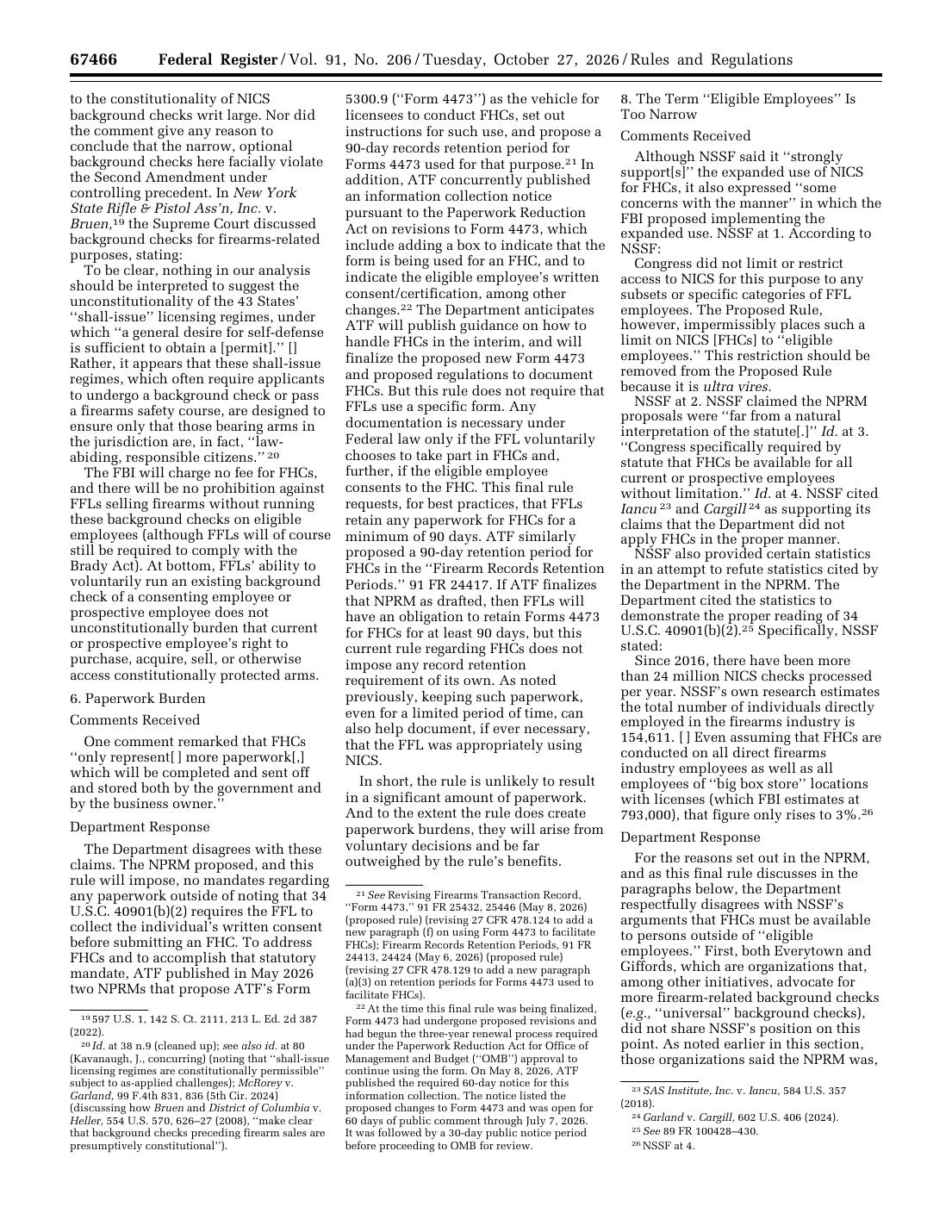
Read or download the 17-page Federal Register PDF · view the rule on FederalRegister.gov
Whose rule is it?
Shooting News Weekly's headline said the "Trump DOJ" has "finally" enabled the checks and noted the prior administration did not complete them. The rule's own history is more mixed. The notice of proposed rulemaking, 89 FR 100424, was published Dec. 12, 2024, and the final rule says it is being finalized "as proposed" apart from a few changes. The public comment period closed in January 2025 with 25 comments, about 80 percent neutral or supportive by the Department's count.
The changes are small. ATF dropped its planned Form 5300.47 and, in two May 2026 proposals, would use a revised Form 4473 instead, with a proposed 90-day retention period. Contractors were added to the eligible group. The Department also labels the rule "deregulatory" under Executive Order 14192, on the theory that it lets dealers use NICS for another purpose. OMB still reviewed it as a "significant regulatory action."
What gun owners should read in it
For a dealer, the practical upside is real: a free federal check on a hire who will stand near the inventory, instead of the third-party screens one commenter said were slow. The rule also says "Did Not Pass" does not bar a dealer from employing someone in a job that never touches guns or ammunition, and it gives the employee the same appeal path as a denied buyer, including a civil action under 18 U.S.C. 925A.
The Department also answered a commenter who said the rule violates the Second Amendment. It cited the Bruen footnote approving shall-issue background checks and called the checks "narrow" and "optional." Whether anyone litigates that is unknown. Nothing I found shows a challenge.
I could not confirm NSSF's account of its role in the 2022 statute from an independent source, and I did not read the full text of NSSF's release.















