

Trump said Oct. 23 that he will "veto everything" if Democrats win Congress. Treasury's own tables show a nearer clock: the $41.1 trillion debt limit had $1.125 trillion of room left on Sept. 30, and the cushion has been shrinking by about $200 billion a month.
What did Trump actually say about vetoes?
Roll Call reported that on Friday, Oct. 23, as he left the White House for a Florida rally, Trump said: "What happens is I veto everything, and then the Democrats come and they want to make a deal." On Sunday in Port Huron, Michigan, the same report says he told a crowd that if Democrats win, "it's you, you will only have yourselves to blame." I could not open video or a transcript of either appearance, so both quotes come through Roll Call.
Roll Call also quoted Democratic strategist Jim Manley, who said Monday that Trump needs a debt-ceiling increase and a government that stays open. That is the part of the story the veto line skips. A veto is a power over bills Congress sends him. Two bills are coming that he will want to sign, and one of them has a hard date.
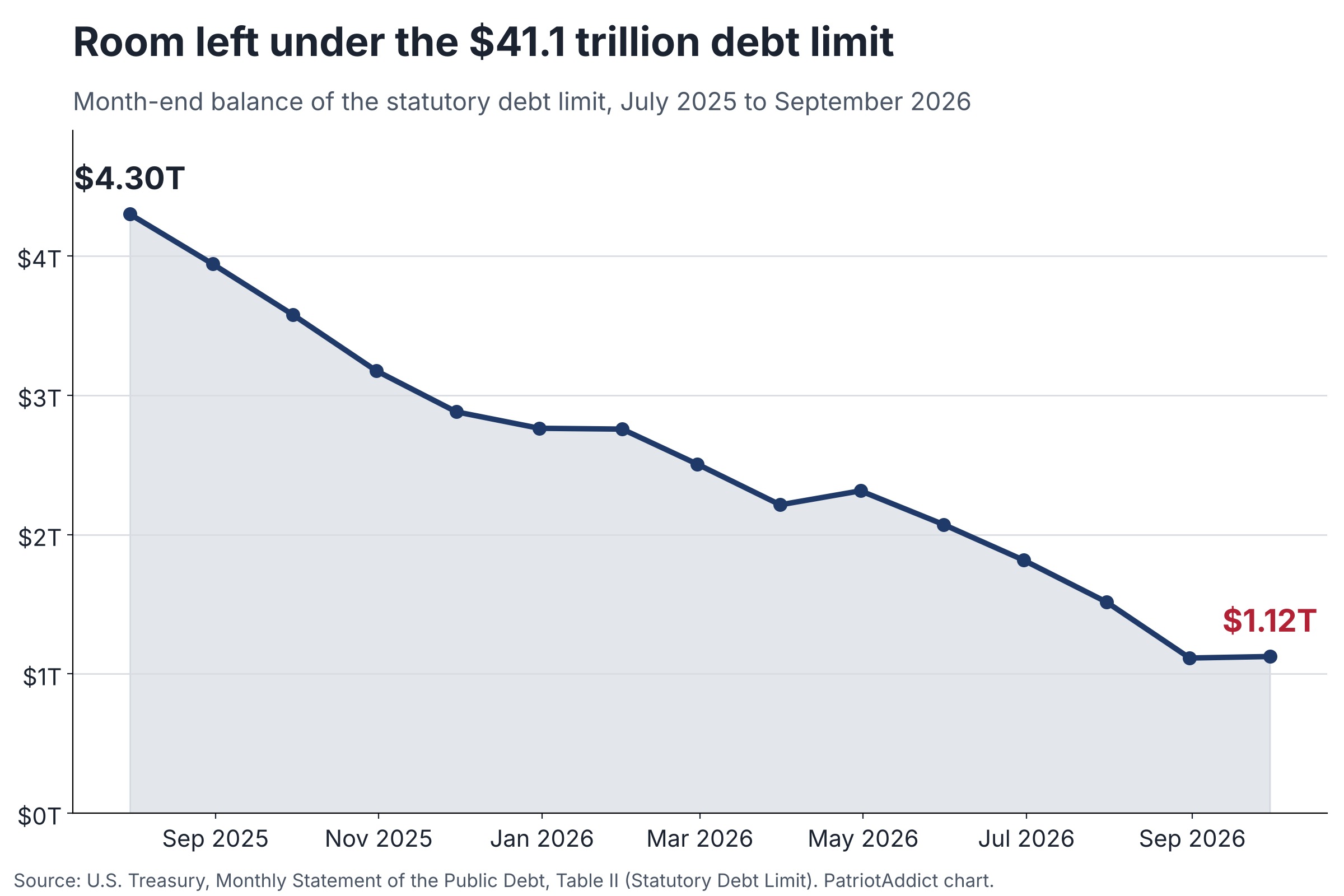
Month-end balance of the statutory debt limit, from Treasury's Monthly Statement of the Public Debt, Table II. Chart by PatriotAddict from Treasury's data, a U.S. government work.
How much room does the debt limit have left?
Table II of Treasury's Monthly Statement of the Public Debt lists debt subject to limit at $39.979 trillion on Sept. 30, against a statutory limit of $41.104 trillion. The balance is $1.125 trillion. On Sept. 30, 2025 it was $3.578 trillion. That is $2.45 trillion used up in twelve months, an average of about $204 billion a month.
Treasury's Debt to the Penny table puts total public debt at $40.463 trillion on Oct. 23, up $291 billion since Sept. 30. The limit counts a little less than that total, because unamortized discount and a few small items are excluded (a $193 billion gap on Sept. 30). Applying the same gap, I estimate about $830 billion of room left now. That figure is my arithmetic, not a Treasury number.
At $204 billion a month, $830 billion lasts about four months, which points to late February or early March. That matches what Lou Crandall of Wrightson ICAP told Roll Call in September, a self-described "very much off-the-cuff" guess of February or March. Tax receipts in April slow the climb, and the timing is uncertain by weeks.
Why do some stories say the money lasts until late 2027?
Those dates are for the x-date, not the limit. Roll Call's Oct. 22 report says Treasury would run out of cash and emergency accounting measures by late 2027 or early 2028. Hitting the cap is the earlier event. After that, Treasury can suspend certain trust fund investments and similar steps to keep paying bills for several more months.
The Congressional Research Service says the same thing in its Sept. 21 In Focus: outside projections from June 2026 had the debt reaching the limit "in early to mid-2027," with extraordinary measures delaying a binding limit "by another several months." One caution on that page. It says debt subject to limit was $40.0 trillion "as of August 31, 2025." Treasury's table shows $39.99 trillion and a $1.114 trillion balance on Aug. 31, 2026, so I read the year as a typo.
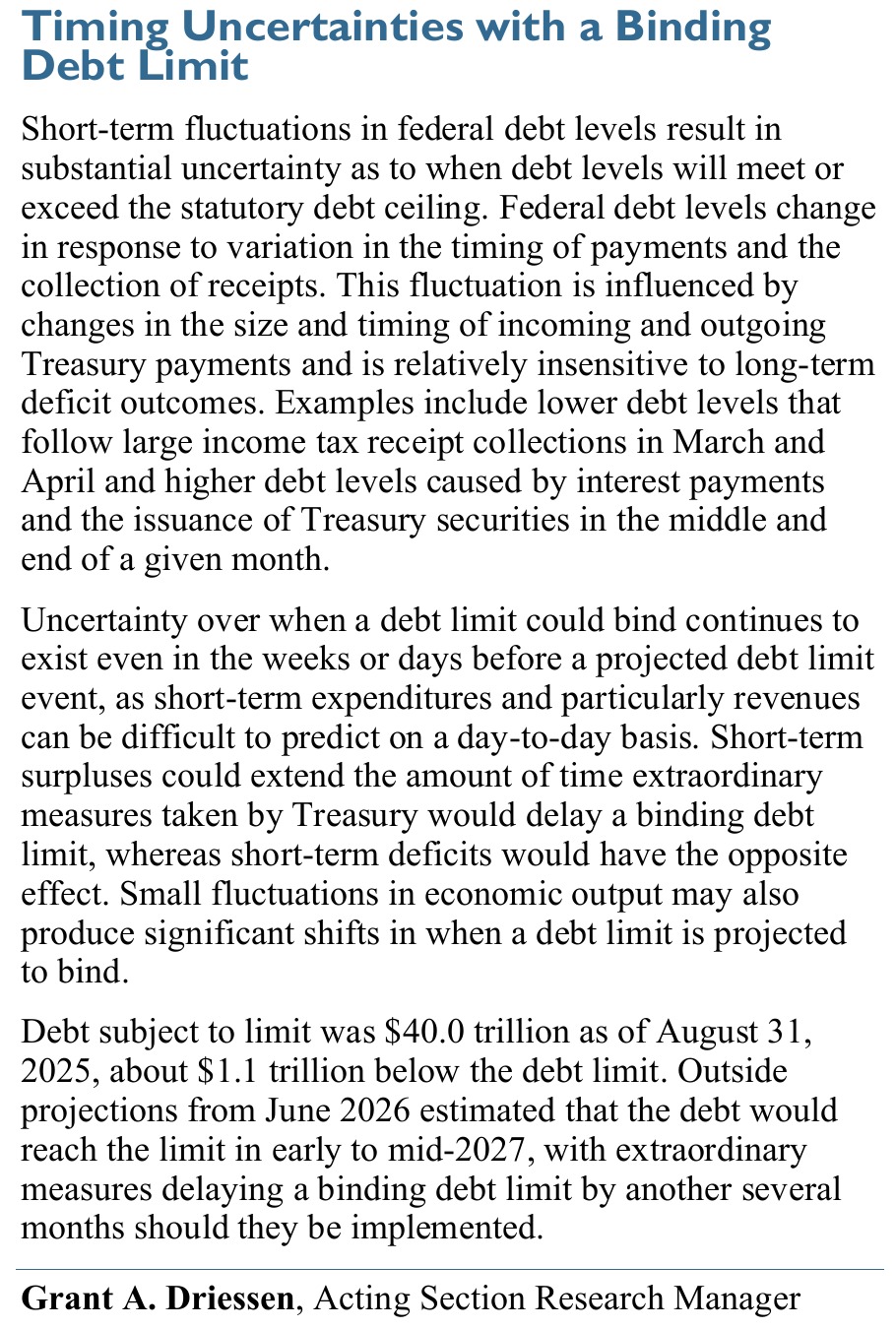
Page 2 of CRS In Focus IF10292, "The Debt Limit," updated Sept. 21, 2026. A U.S. government work. Read the full report (PDF).
What can Republicans do before Jan. 3?
The calendar is tight. The White House says Trump signed H.R. 6500 on Sept. 2, funding agencies through Dec. 11. Axios reported that Speaker Mike Johnson sent the House home for a seven-week recess that runs past the Nov. 3 election. Whoever wins, the lame-duck session has a month to deal with the Dec. 11 deadline.
In August, Just the News reported, citing The Hill, that Trump was pressing Sen. John Thune and Johnson to raise the limit by another $5 trillion through the end of his term, using a third party-line reconciliation bill. Roll Call says Republicans dropped that package before the midterms. Sen. Kevin Cramer, R-N.D., said Oct. 22: "We have to do debt limit. I don't care how we do it, necessarily." He would back a partisan bill if Democrats refuse to deal.
Not every Republican wants it. Per the same Just the News report, Sen. Thom Tillis, R-N.C., told The Hill that raising the limit through the end of Trump's term would give both parties room to ignore the debt problem. Roll Call adds that if Republicans lose either chamber, the lame duck is their last chance at a filibuster-proof reconciliation bill.
My read: a veto threat is leverage over a Democratic Congress in 2027, and the debt limit is a decision that costs less to make before then, with 51 votes and a Republican Congress. The Treasury table says the cap bites in the first few months of that new Congress. Republicans can raise it now, or negotiate it later across the table from the people Trump says he will veto.
Header photo: President Donald J. Trump speaks with reporters on the tarmac, official White House photo P20261025JB-0139, from the White House gallery for Oct. 25, 2026. Official federal photo, public domain. Cropped.















