

Fortune ran the headline on Monday: the Pentagon "orders bases to plan for 90 days without the grid." The Daily Wire went with "ordering every military base to get off the grid." The public record is thinner than that. Hegseth's FORTRESS America speech promised bases that make their own power and never said "90 days," and the 90-day figure traces to documents Fox News Digital reviewed but did not name.
Where the 90 days comes from
Fox News Digital reported on Oct. 25 that every major continental U.S. installation would be expected to run essential operations, including power, water, fuel and communications, for at least 90 days without outside support. The story cites "documents reviewed by Fox News Digital" and does not say what they are. The only official it quotes by name is Pentagon spokesman Sean Parnell, and his lines are about the principle: relying on civilian infrastructure is "an intolerable risk," and "power is combat now." None of the quotes I could find in the Fox piece states a number of days.
Fortune then wrapped the Fox report in a bigger headline. Read down, its own article says the requirement is still being developed and rests on internal planning documents, not a published directive. The Washington Times followed on Tuesday with the headline "Pentagon says every base should be fully self-sufficient for at least 90 days." That is how a "reported requirement" became an "order" and then a Pentagon statement in two days.

Fort Drum, N.Y., at night before an energy resiliency exercise on May 9, 2023, a base the Army picked on Aug. 26, 2026 to host a Janus microreactor. The photo predates FORTRESS. (U.S. Army photo by Mike Strasser, Fort Drum Garrison Public Affairs, via Army.mil, public domain)
What Hegseth actually said at Quantico
The program was announced Sept. 30 in Hegseth's "State of the Force" address at Marine Corps Base Quantico. In the transcript posted by Rev, the FORTRESS passages are about power and survivability. He says "we are launching FORTRESS America, a national insurance policy for the American homeland," that the name stands for "federal operations for resilience, troop resources, energy, supply and survivability," and that "every major military installation in America is going to generate its own power, independent of the civilian grid."
The phrase "90 days" does not appear anywhere in that transcript. The nearest number is "120 days," in an unrelated passage about a separate review called Project Meridian. I read the Rev transcript, not the Department of War's own as-delivered text, because war.gov refused my requests.
Official record
Secretary of War Pete Hegseth, "State of the Force Address (As Delivered)," Marine Corps Base Quantico, Sept. 30, 2026. Department of War text · Rev transcript used for the quotes
"Every major military installation in America is going to generate its own power, independent of the civilian grid." — Hegseth, as transcribed by Rev
What the Pentagon has put on the record since
Two things, both short of a 90-day order. A memo dated Oct. 6 from Under Secretary Michael Duffey, obtained by DefenseScoop, names Richard "Matt" O'Malley interim director of the FORTRESS America Program Office and tells him to serve as "principal integrator among all stakeholders." It lists five pillars: space and spectrum resilience, installation hardening and cyber resilience, energy independence, supply chain and industrial base resilience, and a strategic defense reserve. DefenseScoop says O'Malley has been nominated for a Senate-confirmed post and has not been confirmed. The memo that created the program on Sept. 30 is posted on media.defense.gov, linked from DefenseScoop. I could not open it, so I am not quoting it.
Then, on Oct. 20, a senior defense official told a Defense Writers Group roundtable that about 500 continental bases are being assessed. Air and Space Forces Magazine reported the official's line on cost: "The assessment timeline that we're in right now is trying to determine what is this going to cost." The magazine's own guess is "scores of billions of dollars, if not hundreds of billions," and it says the work could take decades. Its article does not mention 90 days, a deadline or a funding line.
Old problem, new number
Base power resilience is not new. The Air Force's 2021 Installation Energy Strategic Plan warned of outages lasting 30 days or more, per Air and Space Forces. A 2024 infrastructure plan set a fiscal 2030 goal for microgrids at 14 Air Force bases and two Space Force bases.
The Army has the most concrete program. Its Aug. 26 release says it is awarding "up to a combined $2.2 billion" with the Defense Innovation Unit to own, build and operate nuclear microreactors at five installations: Fort Bragg, Fort Campbell, Fort Hood, Fort Benning and Fort Drum. It expects "more than 20" microreactors across Department of War installations once private funding is counted. Look at the wording of what they are for. At Fort Benning, the post's own announcement says three Radiant microreactors will give "resilient, independent power to selected mission-critical facilities in the event of a commercial grid outage." Selected facilities, not the whole base. The latest step, on Oct. 16, was a first planning visit, not a reactor.
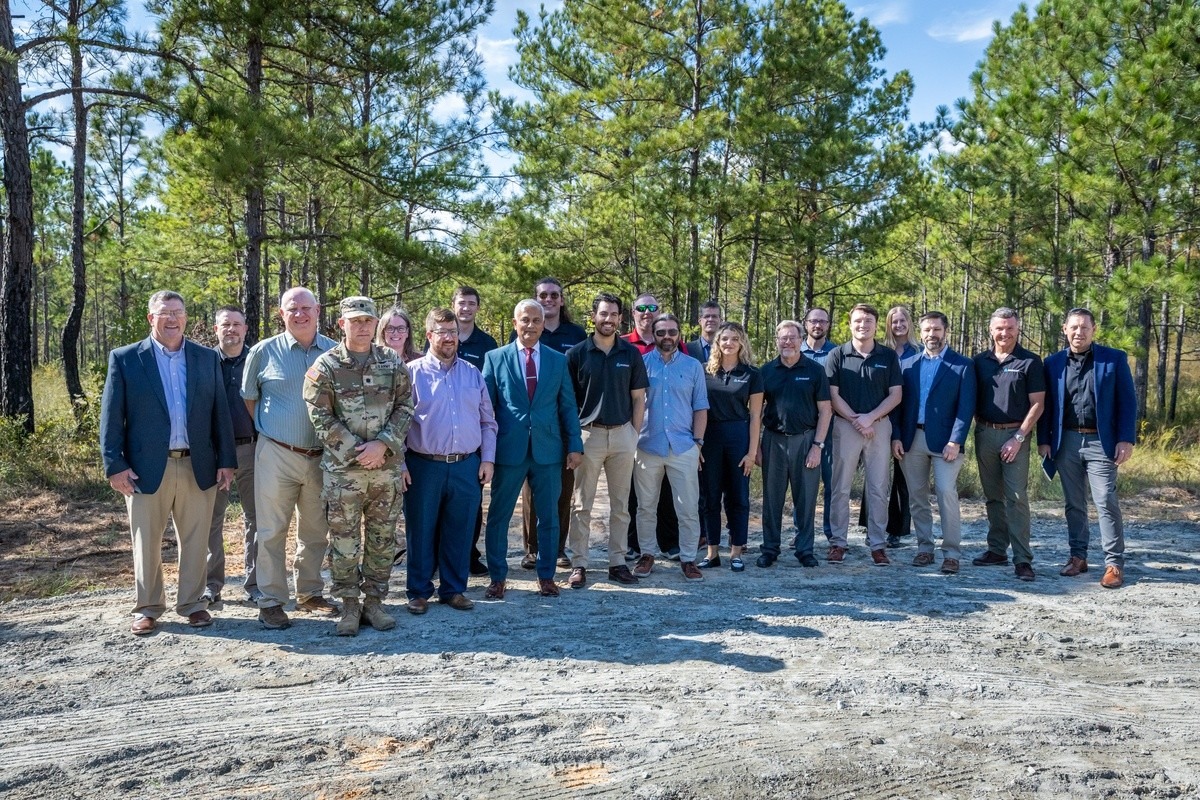
Fort Benning leaders, Army energy officials and Radiant Industries staff at the Oct. 16, 2026 Janus Program site visit, where three microreactors are planned. (U.S. Army photo via Army.mil, public domain)
So the real story is a gap between a goal and a budget. Hegseth has made a promise anyone can check against the speech. The 90-day standard is a reported number, no one on the record has confirmed it, and no cost estimate or deadline has been published for it. If the number is real, the Pentagon can say so in a memo and show Congress the price. If it is not, a headline saying "orders" will have set a bar the department never set.
The British angle is a separate campaign
Fortune paired the Pentagon item with the UK's "Be Ready" household campaign, launched Oct. 22. By Fortune's own account the two efforts are not known to be coordinated, British household guidance dates to May 2024, and neither government has said a war is imminent.
What I could not verify
I could not open the Fox article's underlying documents, the Sept. 30 establishment memo, or the Oct. 6 Duffey memo itself, and I did not confirm the 90-day standard with the Department of War. I read the news articles through a fetch tool's summaries, not the full pages, so check exact wording at the links below.
Sources: Fox News Digital, Oct. 25; Fortune, Oct. 26; DefenseScoop, Oct. 7; Air and Space Forces Magazine, Oct. 20; Army release on Janus awards, Aug. 26; Army, Fort Benning site visit; The War Zone, Oct. 26; IBTimes UK, Oct. 25.















