

The Supreme Court's one-paragraph order on Thursday lets New Hampshire enforce its student ID rule at the polls on November 3, and the headlines are calling it a ban. The order's own text and the state's filing describe a narrower fight. The law behind the ban was never blocked. What a federal judge had ordered fixed was a Secretary of State directive that went further than the statute.
What did the Supreme Court actually order?
The order in Scanlan v. Coalition for Open Democracy, No. 26A512, is unsigned and runs one paragraph. It grants New Hampshire's stay request and puts two lower-court orders on hold, dated October 2 and October 5, while the First Circuit appeal and any petition for review play out. If the Court later denies review, the stay ends on its own.
The Court gave one reason. Lower federal courts "should ordinarily not alter the election rules on the eve of an election," it wrote, quoting its 2020 ruling in Republican National Committee v. Democratic National Committee, and "the District Court did not point to anything that would justify deviating from that principle." It did not rule on whether the law is constitutional.
Official record
Supreme Court of the United States, Scanlan v. Coalition for Open Democracy, No. 26A512, order on application for stay, October 22, 2026.
"Accordingly, the application for stay presented to JUSTICE JACKSON and by her referred to the Court is granted." — Supreme Court of the United States
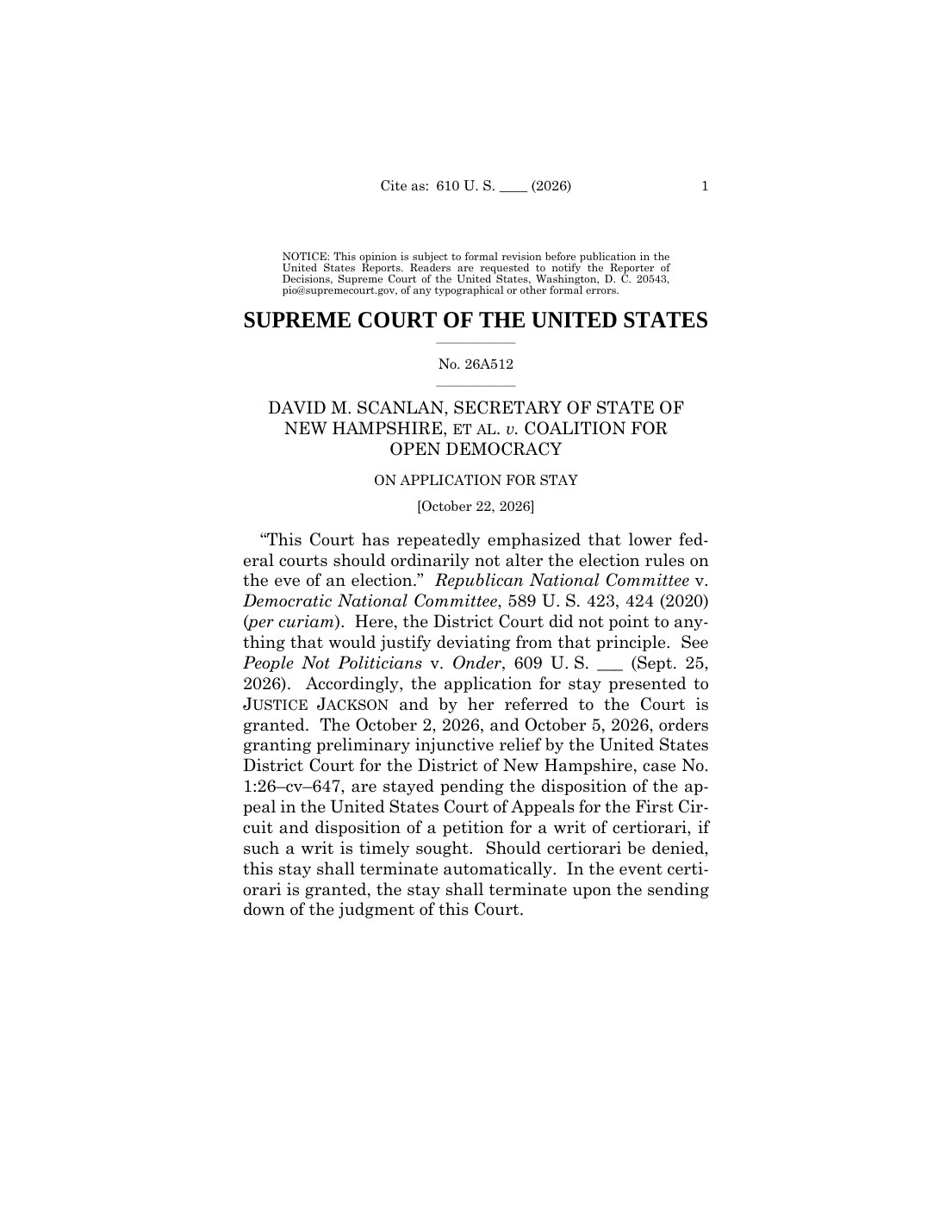
Read or download the full 3-page order and dissent (PDF) · view it on SupremeCourt.gov. Supreme Court orders are public records.
Was the student ID law ever blocked?
No. Gov. Kelly Ayotte signed HB 323 on April 3, and it took effect June 2, according to the state's stay application. It removed school-issued student IDs from the list of cards that prove identity when getting a ballot, so only government-issued ID counts automatically. Before that, the district court's first order says, student IDs had worked for identity since the state's voter ID law was enacted in 2012.
The Coalition for Open Democracy sued on August 11. In that first order, the court refused to touch the law before the September 8 primary, citing the same election-timing doctrine the Supreme Court used on Thursday. In October, the application says, the court again "did not enjoin enforcement of HB 323 itself."
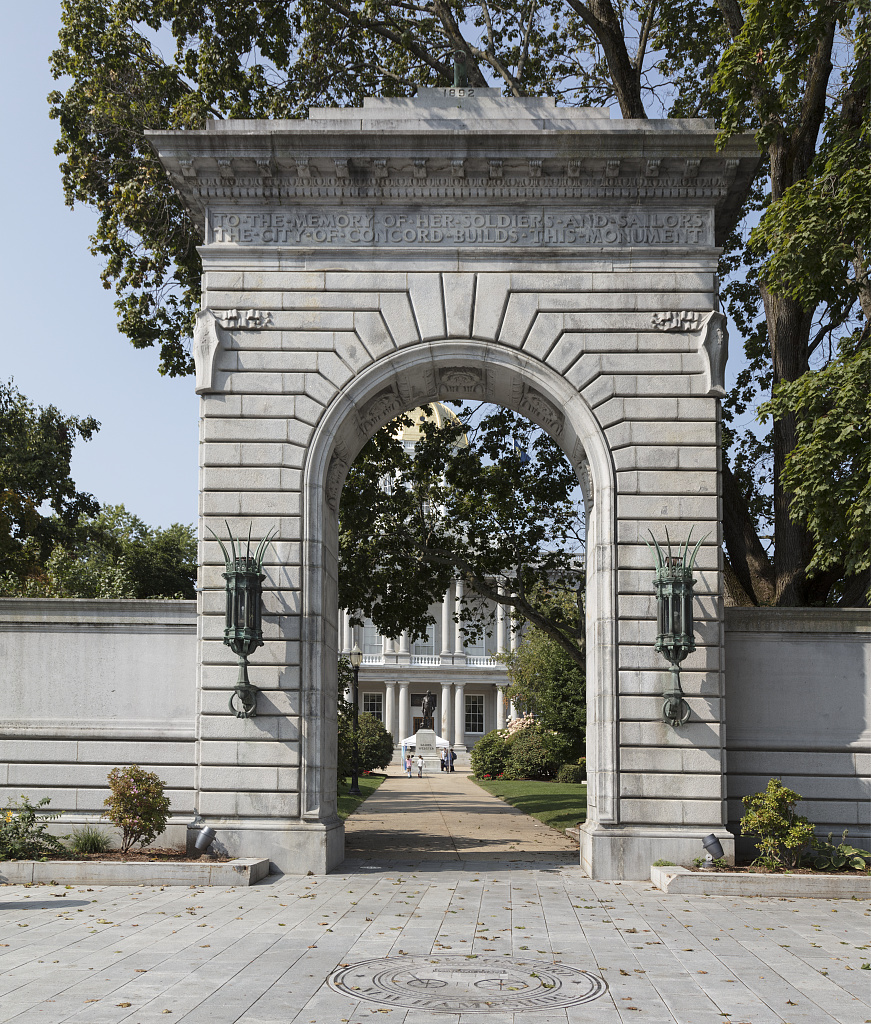
The 1892 Soldiers and Sailors Memorial Arch on the grounds of the New Hampshire State House in Concord, where HB 323 was passed. The State House is visible through the arch. Photo: Carol M. Highsmith via the Library of Congress, no known restrictions on publication. File photo.
So what did the judge order?
Secretary of State David Scanlan's April directive went past the statute, U.S. District Judge Joseph Laplante found. As described by the Granite Post, the directive said student IDs could not be used to register or get a ballot at all. The judge said state law has a "safety valve" that lets an election official weigh other evidence of identity when a voter lacks a listed ID, and the directive shut that off for student IDs. "The State has offered no independent justification for that broader prohibition," Laplante wrote.
His order did not put student IDs back on the list. It required Scanlan to tell officials that student IDs are "no longer expressly valid" but that they "may consider them, along with other available evidence," a line the state quotes in its filing. The stay puts that instruction on hold.
Why did the Court side with the state?
New Hampshire's argument was timing. The judge ruled 32 days before the election, the state says, after five months of clerk training, new polling place posters and radio ads built around its reading of the law. It also noted that the plaintiff filed suit 130 days after the governor signed the bill.
Justice Ketanji Brown Jackson, the only justice to note a dissent, called the order "targeted." Her point was that the injunction "left the state election rule untouched" and only required a state official to match his public statements to the written law. Under those circumstances, she wrote, the relief "actually promoted the interests Purcell sought to protect."
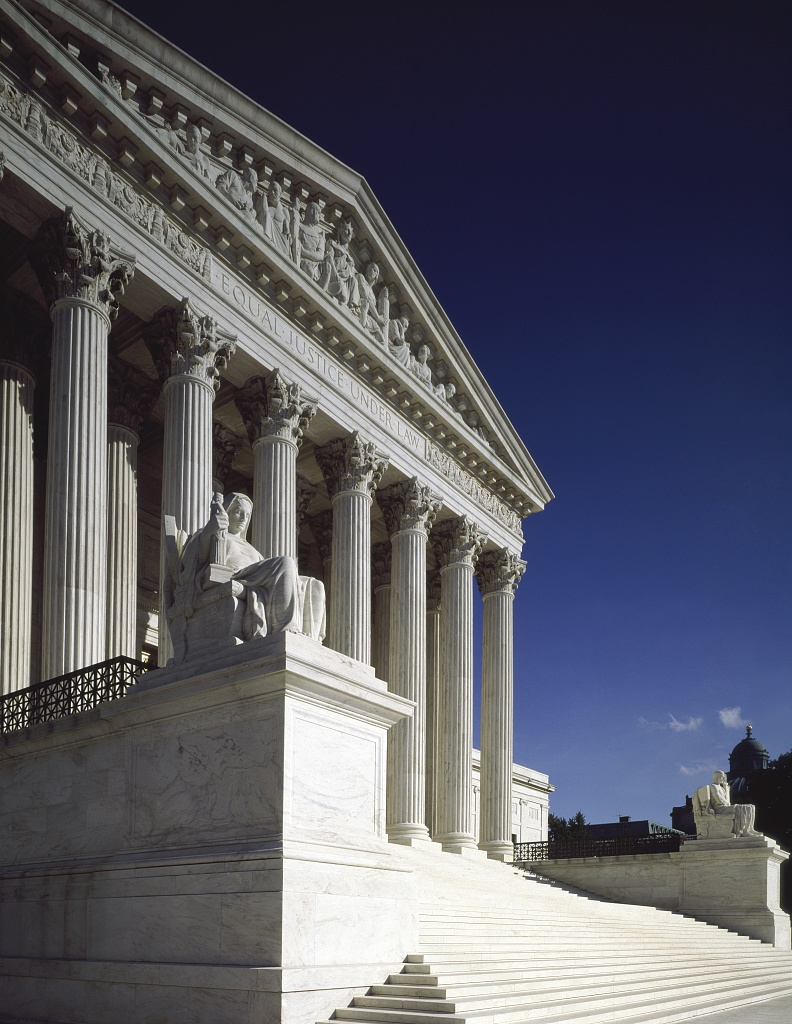
The U.S. Supreme Court building and its front steps in Washington, D.C. Photo: Carol M. Highsmith via the Library of Congress, no known restrictions on publication. File photo.
What does a New Hampshire student need on November 3?
A government-issued photo ID, such as a driver's license or passport, per the Granite Post. The state's own filing warns that voters could "show up at the polls with only their student IDs in-hand," and says that "even under the district court's interpretation, that is not the law."
The law's backers have a case on the merits. Co-sponsor Rep. Berry said student IDs have no address check, citizenship check or security features, the district court's first order records. The same order notes that opponents testified no fraud involving student IDs had ever been documented, and that a 2022 state committee found no evidence of widespread voter fraud. The First Circuit appeal continues. Until it ends, a student should carry a driver's license or passport and not count on a campus card.
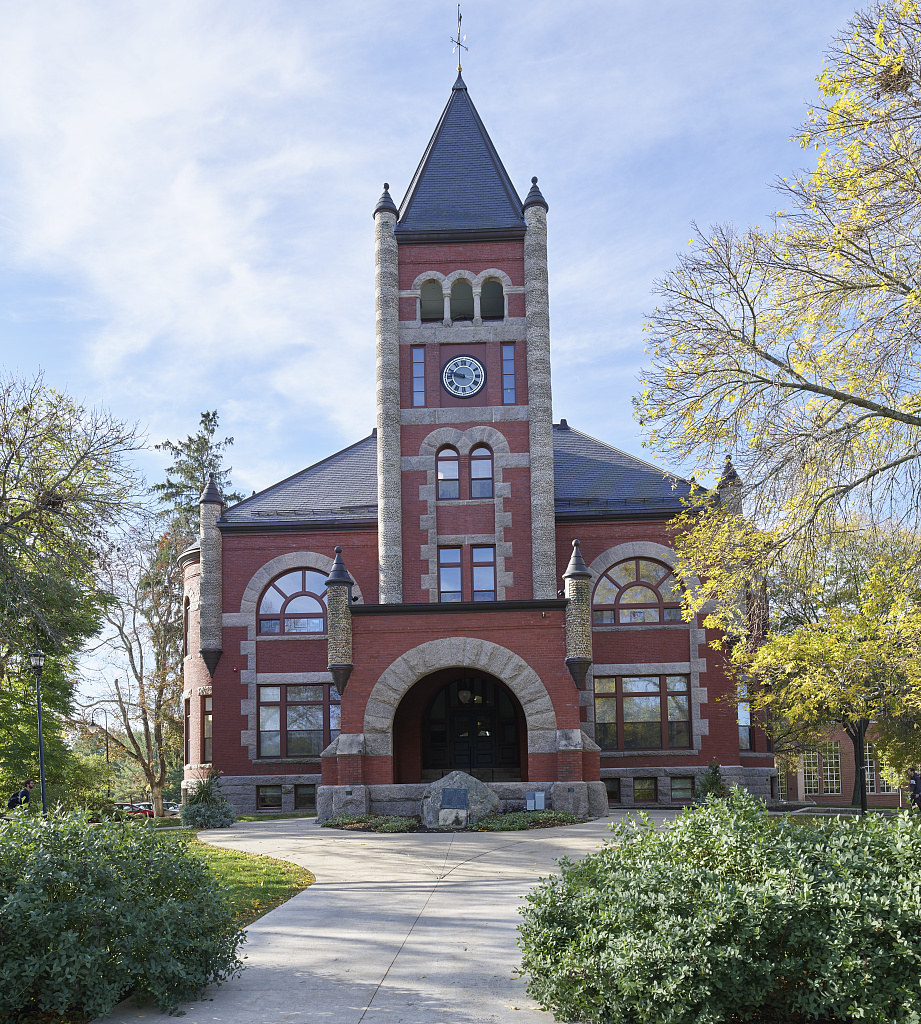
Thompson Hall, known locally as "T-hall," a central building on the University of New Hampshire campus in Durham. Photo: Carol M. Highsmith via the Library of Congress, no known restrictions on publication. File photo.
Header photo: the U.S. Supreme Court building, Washington, D.C. Photo: Carol M. Highsmith via the Library of Congress, no known restrictions on publication.















