The Justice Department asked the Supreme Court on Wednesday to restart about 340 miles of border wall and road construction in West Texas, and the order it wants lifted turns on three words in a 1996 law. U.S. District Judge Kathleen Cardone wrote that "high illegal entry" must at least mean "not the lowest rate of illegal entry," and she found Big Bend has the lowest on the border.
What is DHS asking the Supreme Court to do?
Solicitor General D. John Sauer filed the emergency application in Mullin v. Friends of the Ruidosa Church, No. 26A560, on October 21. It asks the justices to stay Cardone's injunction, and also to treat the filing as a petition for certiorari and "summarily reverse." Justice Alito asked for a response by 4 p.m. Eastern on October 29, according to the Court's docket. The government's application calls the injunction "baseless."
The plaintiffs are Friends of the Ruidosa Church, the Center for Biological Diversity and river guide Danny William Miller Jr. Cardone's October 2 order was a single paragraph. It barred DHS from building "border barrier or related infrastructure" or doing ground-disturbing work in the Big Bend Sector until DHS complies with all applicable laws, despite three waivers that set those laws aside. Her written reasoning did not arrive until October 14, 12 days later, which the government says violates the federal rule that every injunction "state the reasons why it issued."
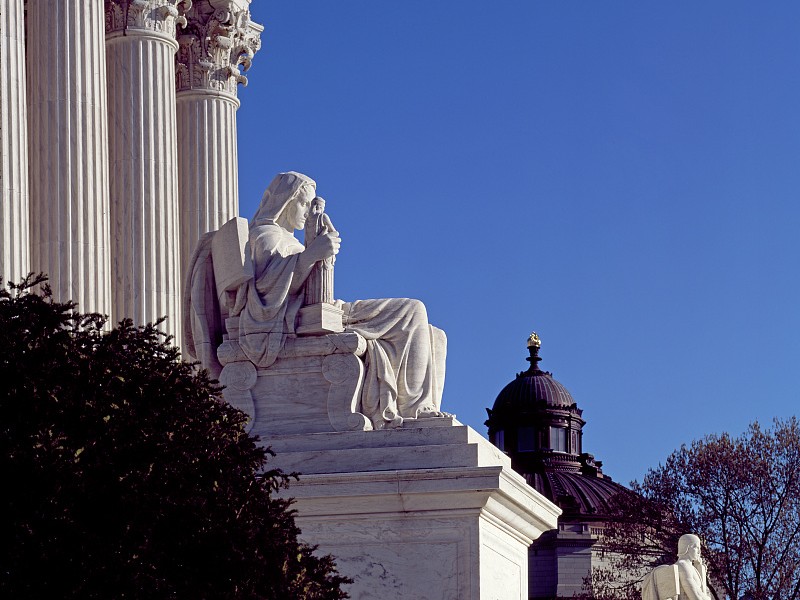
A statue by sculptor James Earle Fraser outside the U.S. Supreme Court building in Washington. Photo: Carol M. Highsmith, Library of Congress, no known restrictions on publication. File photo.
What does the judge's opinion actually say?
The 1996 law lets the DHS secretary build barriers "in areas of high illegal entry" and waive "all legal requirements" he considers necessary to build them fast. Each of the three Big Bend waivers declares the sector an area of high illegal entry, citing more than 89,000 apprehensions between 2021 and 2025. Cardone accepted that number. Her opinion says the total was "undisputed" at the hearing.
Then she put it next to the other six southern sectors. Big Bend sits in what testimony called "extraordinarily distant last place," with the fewest apprehensions in total and per mile of border. The sector is more than 25 percent of the border, she wrote, yet over 30 years its annual apprehensions ran between 0.3 and 2.2 percent of the border-wide total.
Official record
Friends of the Ruidosa Church v. Mullin, No. 3:26-cv-01099 (W.D. Tex.), Memorandum Opinion, Doc. 75, filed October 14, 2026, reproduced at page 214a of the government's appendix.
"For 'high illegal entry' to impose any limit, it must at least mean, 'not the lowest rate of illegal entry.' And the evidence shows that the Big Bend Sector has the lowest rate of illegal entry along the entire U.S.-Mexico border." Judge Kathleen Cardone, Oct. 14, 2026
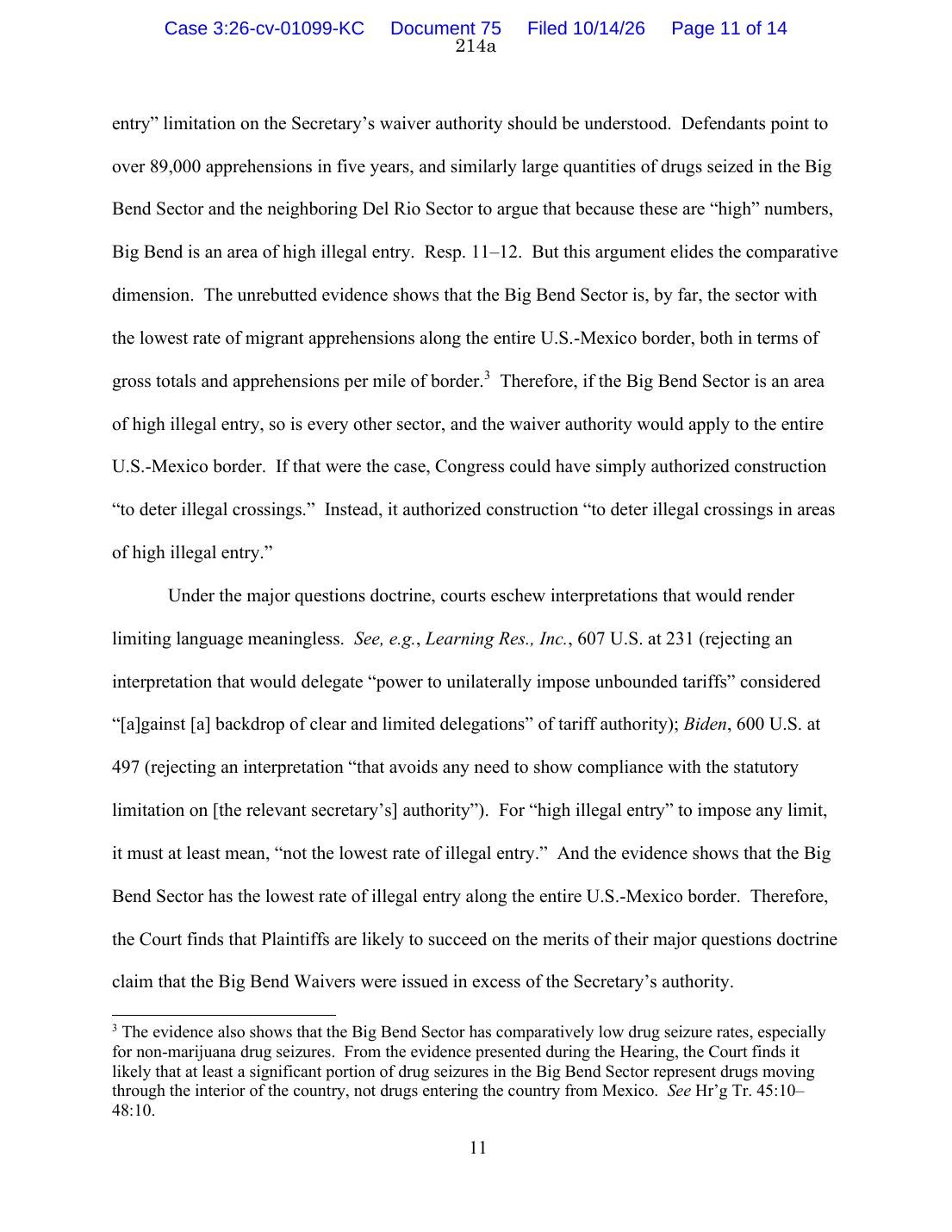
Read or download the full 14-page opinion (PDF) · view the Supreme Court docket. Federal court filings are public records.
What does the government's own record show?
The application has real numbers of its own. It says Big Bend encounters spiked to more than 30,000 a year in fiscal 2021 and 2022, and that drug seizures in fiscal 2026 already top each of the three prior full years. The waivers cite 87,574 pounds of marijuana and 94 pounds of fentanyl seized in the sector from 2021 to 2025. The filing also describes a May 2026 case of an armed man who crossed on foot in Big Bend and later tried to enter a Texas school.
Cardone's footnote 3 cuts the other way on drugs. She found it likely that a significant share of seizures in the sector are drugs moving through the interior, since Big Bend has several highway checkpoints. Her opinion records testimony that the sector accounts for 1 percent of non-marijuana seizures and 15 percent of all seizures.
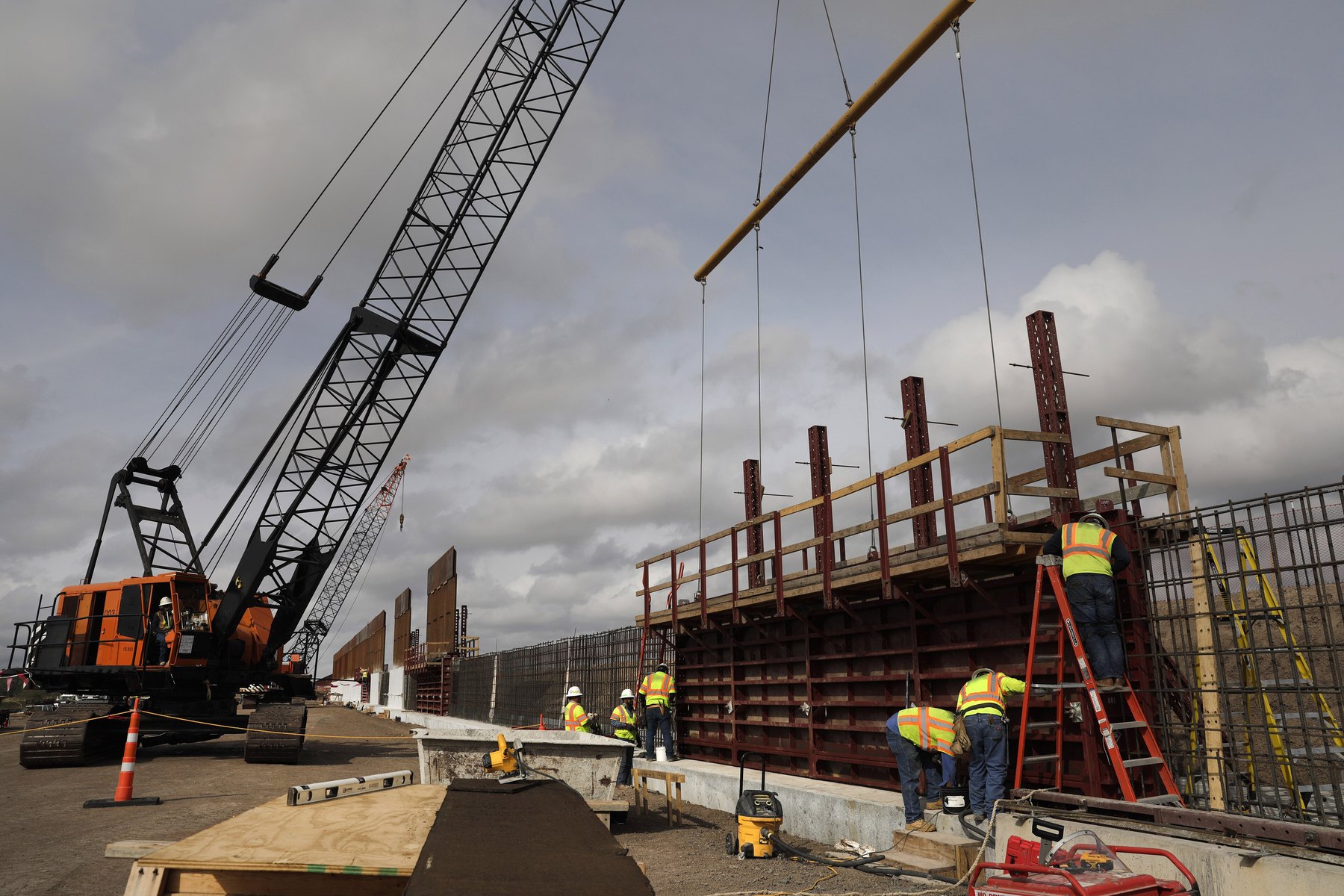
Crews build a border wall system near Weslaco, Texas, in the Rio Grande Valley Sector, a different part of the border than Big Bend. Photo: U.S. Customs and Border Protection via Wikimedia Commons, public domain. File photo.
The government's answer is that Congress wrote "high," not "higher than the next sector." It quotes a 2019 Ninth Circuit ruling that the law "does not dictate that 'high illegal entry' is a comparative determination," and says a gap in Big Bend would become a "funnel point" for smugglers.
Is a wall going through Big Bend National Park?
Not as described in the government's own filing. It says the only barrier planned inside the national park is a 17-mile, non-contiguous vehicle barrier, and none is planned in Big Bend Ranch State Park. A 30-foot pedestrian barrier is planned elsewhere in the sector. The application quotes CBP Commissioner Rodney Scott's August 13 statement: "We are NOT building a 30-foot wall or stadium lighting through Big Bend National Park, Big Bend Ranch State Park or the Black Gap Wildlife Management Area."
The injunction is much wider than the park, though. It covers the whole sector, and Marfa Public Radio reports that private land in the area is slated for 30-foot steel bollard wall.
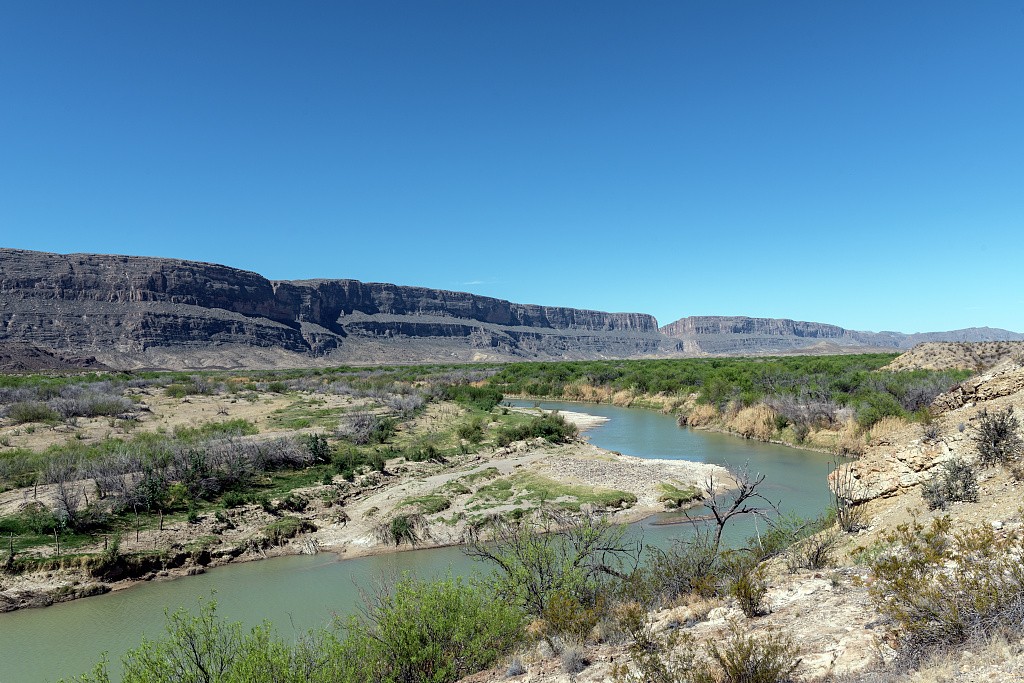
The Rio Grande in Big Bend National Park, with Mexico on the left and the United States on the right. Photo: Carol M. Highsmith, Library of Congress, no known restrictions on publication.
Why does the Supreme Court get this one directly?
Congress wrote it that way. Under section 102(c) of the 1996 law, waiver challenges can only allege constitutional violations, and an injunction "may be reviewed only upon petition for a writ of certiorari," so there is no stop at the Fifth Circuit. The government's main argument is that the major-questions doctrine, which Cardone used, is a rule about statutes and not the Constitution, so she lacked jurisdiction. She ruled it is a constitutional clear-statement rule. She leaned on the same doctrine the Court applied in Learning Resources v. Trump to reject IEEPA tariffs.
The government says no court has ever sustained a challenge to the substance of one of these waivers, and that CBP counts more than 60 since 2005. Meanwhile it puts suspension costs above $460,000 a day on five contracts, with about three-quarters of a mile of barrier already built. Those costs run at least until the Court rules on the stay.
Header photo: canoeists on the Rio Grande in Santa Elena Canyon, Big Bend National Park, Texas. Photo: Carol M. Highsmith, Library of Congress, via Wikimedia Commons, public domain.