

The NRA, the National Shooting Sports Foundation and the Second Amendment Foundation sued New Mexico's attorney general on Monday, October 19, because the state says a federal court order killed its seven-day gun waiting period for exactly two people. The complaint says everyone else, including gun stores, can still be prosecuted for skipping the wait.
What did the gun groups file?
The suit, National Shooting Sports Foundation et al. v. Torrez, was filed in the U.S. District Court for the District of New Mexico as Case No. 1:26-cv-03514. Nine plaintiffs sign on: the three national groups, the New Mexico Firearms Industry Association, the New Mexico Shooting Sports Association, three Albuquerque gun dealers and a retired Albuquerque police officer named Peter Hackett. The defendant is Attorney General Raúl Torrez, sued in his official capacity.
The law at issue is House Bill 129, now N.M. Stat. §30-7-7.3. It bars a firearm from changing hands until seven calendar days have passed, and the complaint says the clock includes the time of the federal background check. A buyer who clears the check in minutes still waits a week. Handing over the gun early is a misdemeanor for both buyer and seller, per the complaint. Bearing Arms covered the filing on Tuesday.

New Mexico Attorney General Raúl Torrez, the defendant in the new suit. File photo by LandofEnchantment Pics, via Wikimedia Commons, CC0 public domain.
Why would New Mexico still enforce a law a federal appeals court blocked?
Because of who sued the first time. In August 2025 the Tenth Circuit ruled in Ortega v. Lujan Grisham that the waiting period burdens Second Amendment rights and sent the case back for an injunction. The plaintiffs in that case were two individuals, Samuel Ortega and Rebecca Scott. After the remand, the district court entered final judgment for them in late August 2026.
The governor's office read that judgment narrowly. SourceNM reported that the order bars the state from making the two named plaintiffs wait. "The law remains in effect otherwise," communications director Michael Coleman said. He defended the statute as protecting "space between the decision to buy the gun and the moment of impulse."
The complaint says the state's lawyers repeated that position directly to plaintiffs' counsel: New Mexico "can and will enforce HB129 against everyone but Samuel Ortega or Rebecca Scott." That is the plaintiffs' account of a private exchange. The state has not, in anything I could find, confirmed those words publicly.
Official record
Complaint for Declaratory and Injunctive Relief, NSSF v. Torrez, No. 1:26-cv-03514 (D.N.M. filed Oct. 19, 2026), paragraph 6.
"Both in public and in private, state officials have said in no uncertain terms that buyers and sellers who fail to comply with New Mexico's unconstitutional law should be prepared to face criminal charges in state court." — Plaintiffs' complaint, an allegation not yet tested in court
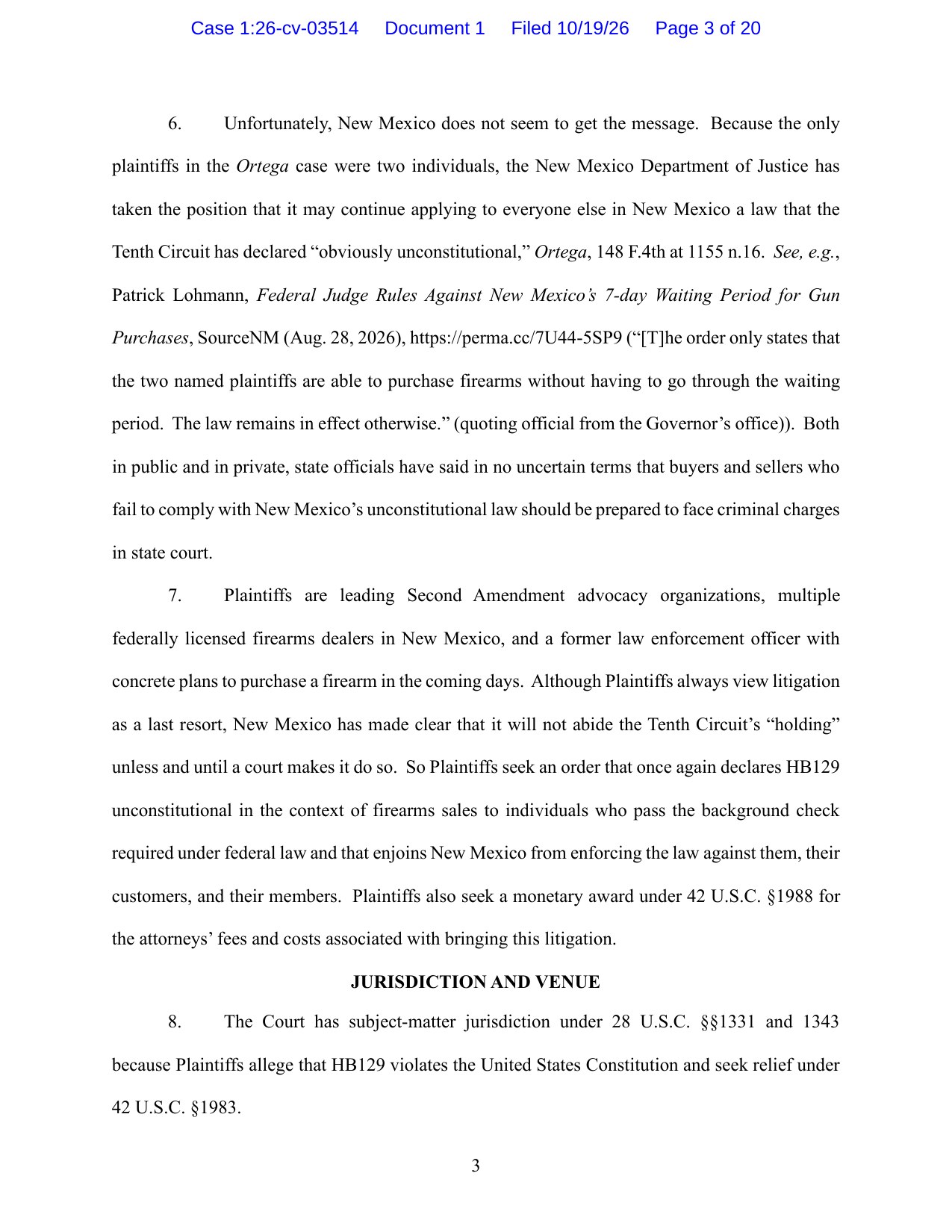
Read or download the full 20-page complaint (PDF) · page 3 shown
What did the Tenth Circuit actually say about scope?
This is the part the headlines skip. The state is not inventing its two-person reading from nothing. The appeals court itself told the district judge to sort out the scope of relief, citing the Supreme Court's 2025 Trump v. CASA ruling. In the opinion's words, courts "are without authority to issue remedies beyond what provides complete relief to the plaintiffs actually involved in the suit."
The panel also wrote that the plaintiffs asked to have the whole law enjoined except as applied to buyers whose background checks are not cleared within three days. For those buyers, the court said, the law is "not obviously unconstitutional in the way it is when applied to the Plaintiffs." That footnote is where the phrase "obviously unconstitutional" comes from, and the new complaint leans on it.
Official record
Ortega v. Lujan Grisham, No. 24-2121 (10th Cir. Aug. 19, 2025), published opinion, page 37 with footnote 16.
"So the Waiting Period Act's application to those individuals is not obviously unconstitutional in the way it is when applied to the Plaintiffs." — Tenth Circuit, footnote 16
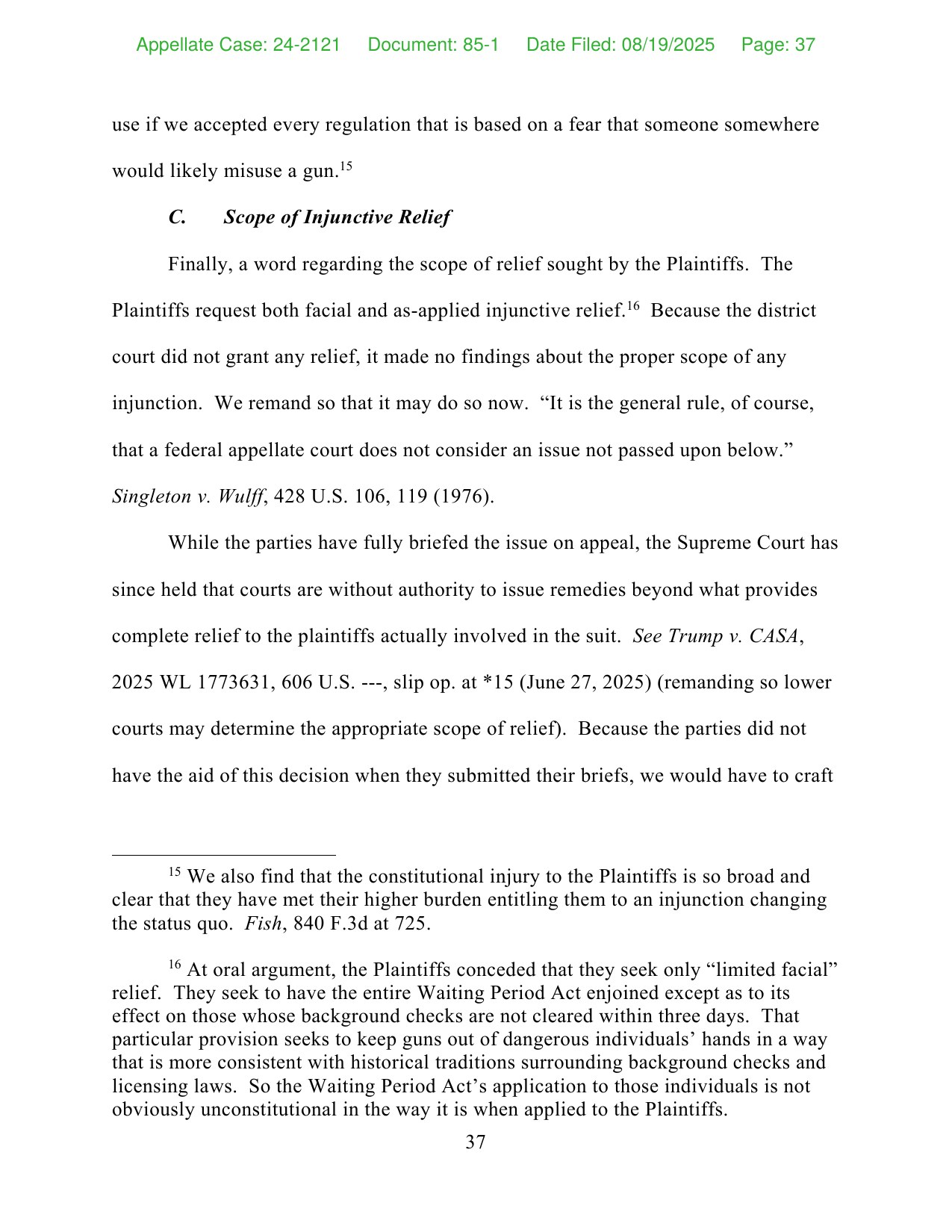
Read or download the full opinion (PDF) · original on ca10.uscourts.gov
Who is the test buyer, and what do the plaintiffs want?
Hackett is the human face of the case. The complaint says he served more than 20 years with the Albuquerque Police Department, holds a federal Q clearance and is cleared to own firearms. He plans to buy a Glock 21 Gen 5 MOS from plaintiff Right to Bear Arms on or about October 24 and, because of HB129, would wait seven days to take it home.
The plaintiffs want a declaration that HB129 violates the Second Amendment for law-abiding buyers who clear a background check in under 72 hours, plus a preliminary and permanent injunction covering the plaintiffs, their customers and their members. They also ask for attorney fees. The complaint cites a Justice Department report that over 90 percent of background checks finish "within seconds to minutes," and says an offer of judgment filed in a June 2026 Florida case, Dunn v. Glass, conceded that Florida's three-day wait violates the Second Amendment.

The Byron White United States Courthouse in Denver, home of the Tenth Circuit, September 2014. Photo by Nan Palmero via Wikimedia Commons, CC BY 2.0. File photo.
What happens next?
The complaint says Torrez has appealed the Ortega judgment to the Tenth Circuit, so the same panel-level question is coming back up. Meanwhile a district judge in Albuquerque now has to decide whether to grant the preliminary injunction the plaintiffs want. No hearing date was posted in anything I found.
The fight is bigger than one state. If gun owners must file a fresh suit every time a state reads an appeals court win as a two-plaintiff win, the right becomes a lawsuit-by-lawsuit privilege. The Justice Department, Bearing Arms notes, treated the NFA registration rulings in the Jensen and Silencer Shop cases differently, declining to appeal and stopping enforcement beyond the plaintiffs. New Mexico chose the opposite path, and Albuquerque's federal court will now say whether that is allowed to stand.
Header photo: the east entrance of the New Mexico State Capitol in Santa Fe, August 2010. Photo by N. Salazar via Wikimedia Commons, public domain. File photo.















