The Supreme Court on Monday refused to revive the 2024 plea deals that would have taken the death penalty off the table for accused 9/11 mastermind Khalid Sheikh Mohammed and two co-defendants. The order gave no reasons. The filings behind it show how narrow the fight was: the lower courts spent months arguing over whether defense lawyers started "performing" the deals by not questioning a witness for two days.
What did the Supreme Court actually do?
It denied the petition in Khalid Shaikh Mohammad v. United States, No. 26-13, on October 19, according to the Court's docket. Justice Brett Kavanaugh took no part. The docket for co-defendant Walid bin 'Atash (No. 25-1335) shows a denial the same day. Court filings spell the name "Mohammad"; news coverage usually uses "Mohammed."
A denial is not a ruling on the merits. It leaves in place a July 2025 D.C. Circuit decision that voided the deals, and Axios reported that the death penalty stays available. The same report puts the tentative military trial date at June 5, 2028.
How does a signed deal die in two days?
The government's own brief opposing Supreme Court review, signed by Solicitor General D. John Sauer, lays out the timeline. On July 31, 2024, retired Army Brig. Gen. Susan Escallier, the Convening Authority for the case, accepted the defendants' offers and signed the agreements. Each defendant had offered to plead guilty to all charges and attached signed stipulations confessing to involvement in the attacks.
On August 2, then-Defense Secretary Lloyd Austin announced he was taking the decision back. The AP reported his position that a death penalty decision in an attack that grave "should only be made by the defense secretary." Five of the charges against the defendants carry the death penalty, per the same government brief.
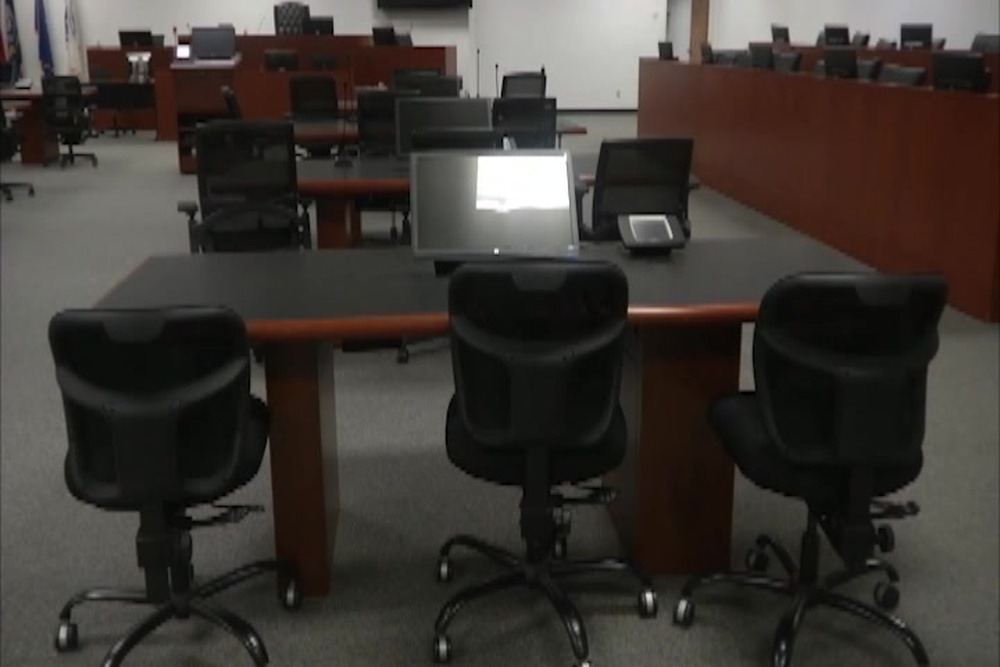
The defense table in Court Room 2 of the Expeditionary Legal Complex at Guantanamo Bay, the military commissions courthouse. Still from a 2017 video by the Department of Defense, via DVIDS, public domain.
Why did a witness nobody questioned matter?
Military commission rules let the convening authority withdraw from a deal "at any time before the accused begins performance of promises contained in the agreement," as the government brief quotes the rule. So the whole case turned on one question: had the defendants started performing?
The military judge said yes. He pointed to the signed stipulations and to something that happened on August 1 and 2. Defense counsel did not question a witness at the suppression hearing of a fourth co-defendant who had no deal. The judge told them they could question the witness later if the pleas were not accepted. The Court of Military Commission Review, according to the brief, relied solely on that silence.
The D.C. Circuit panel disagreed. Judges Millett and Rao wrote that a commitment not to question witnesses "appears nowhere in the agreements' text," so it was not a promise "contained in the agreement." The opinion issued writs blocking the guilty pleas. Judge Wilkins dissented in part and called the majority's reasoning a "hyper-literal reading" of the agreements. He was the only judge to vote for rehearing en banc, per the government brief.
Official record
Brief for the United States in Opposition, Mohammad v. United States, No. 26-13 (U.S., filed August 26, 2026), page 4 of the brief. This is the government's own account of the two days between signing and withdrawal.
"Over the next two days, August 1 and 2, 2024, petitioners' counsel refrained from questioning a witness at the suppression hearing of a fourth co-defendant who had not entered a pretrial agreement."
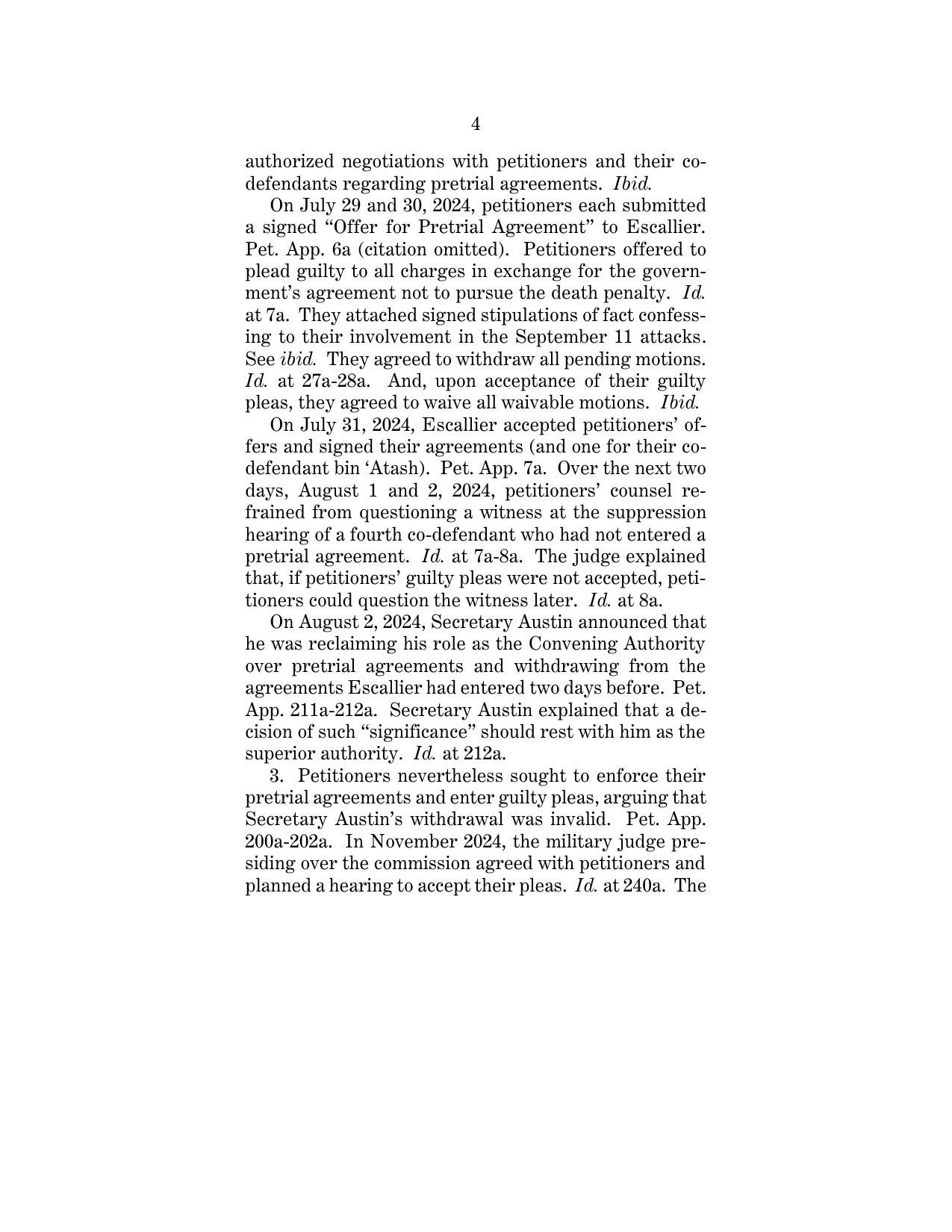
Read or download the full brief (PDF) · View it on the Supreme Court docket
Did the Trump administration change the government's position?
No. The mandamus petition that voided the deals was filed by the prior administration's lawyers; the D.C. Circuit's opinion lists Matthew Olsen as Assistant Attorney General for National Security "at the time the petition was filed." The brief urging the Supreme Court to stay out is signed by Trump's Solicitor General. Both administrations defended Austin's authority to pull the deals.
The D.C. Circuit also framed the stakes plainly. Whether the defendants face execution is a "grave" question, the court wrote, that "requires political accountability," and it said the prosecutions involve "a national interest of the highest degree." Voters answer for the Secretary of Defense. They do not answer for a convening authority's signature.

A balloon left at the National 9/11 Pentagon Memorial before an anniversary ceremony, September 11, 2015. DoD photo by Mass Communication Specialist 2nd Class Dominique A. Pineiro, via DVIDS, public domain.
Where does that leave the families?
Divided, as they have been since 2024. The AP reported that some relatives saw a trial as the best path to justice, while others saw the deal as the best hope of ending the case. September Eleventh Families for Peaceful Tomorrows and 53 individual relatives filed an amicus brief in the D.C. Circuit supporting the defendants, according to the opinion's listing of counsel. Axios reported that the original deals drew outrage from some victims' families.
The deal on the table would have meant guilty pleas and life without parole, the AP reported. The denial means a trial, with 2,976 deaths to account for and the death penalty still in play. The defendants have been held at Guantanamo since 2006, and the tentative trial date is two years out.
Header photo: the U.S. Supreme Court Building, Washington, D.C. Photo: Architect of the Capitol, public domain (cropped).