A federal judge in Greensboro refused Monday to block North Carolina's new absentee ballot rules, and the headlines call them mail-in restrictions. The judge's 72-page order shows what the rules actually do. The signature test asks whether the name on the envelope is the name of the voter who got the ballot, and the 2024 rule it replaced already asked for a signature "made by the voter." The real change is about sealing the inner envelope.
What did the judge actually decide?
U.S. District Judge Thomas Schroeder denied a preliminary injunction in North Carolina Alliance for Retired Americans v. State Board of Elections, No. 1:26cv965, according to the order filed October 19. The Republican National Committee and the state Republican Party intervened on the state's side. Schroeder wrote, quoting another court, that "the election is not merely upcoming; it has already started," and that courts "should ordinarily not alter the election rules on the eve of an election."
He also faulted the plaintiffs for timing. They sued 18 days after the State Board issued its September 4 guidance and asked for an injunction the day before county boards began counting absentee ballots. A footnote calls it "a preliminary determination that is not an ultimate determination of the merits."
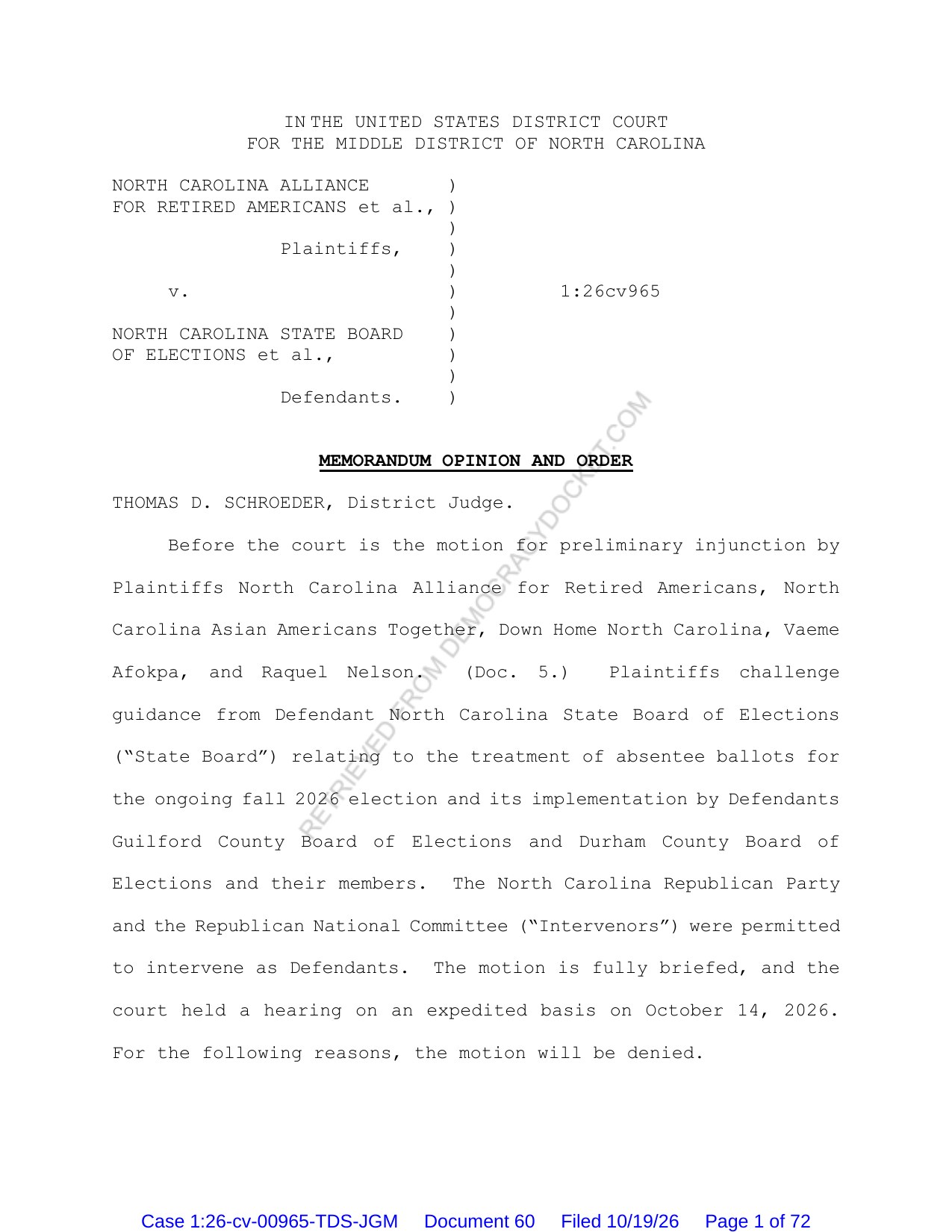
Page 1 of Judge Schroeder's order, No. 1:26cv965 (M.D.N.C.). Source: U.S. District Court, Middle District of North Carolina, public court record, copy via Democracy Docket.
Is it really a signature match?
Not in the handwriting sense. The order quotes the 2026 guidance: if the signature "appears to be the name of the voter assigned the application number on the container-return envelope, and not some other person, then that is not a deficiency even if the signature is illegible." Absent "clear evidence to the contrary," the county board presumes the signature is the voter's.
The 2024 guidance, which the Board replaced, said nearly the same thing and told counties to accept a signature "if it appears to be made by the voter." It also made a ballot non-curable if "the witness or assistant signed in place of the voter's signature." The 2026 guidance did delete a line saying the envelope signature "shall not be compared" with the voter's registration record. The opinion does not describe any registration-record comparison being required in its place.
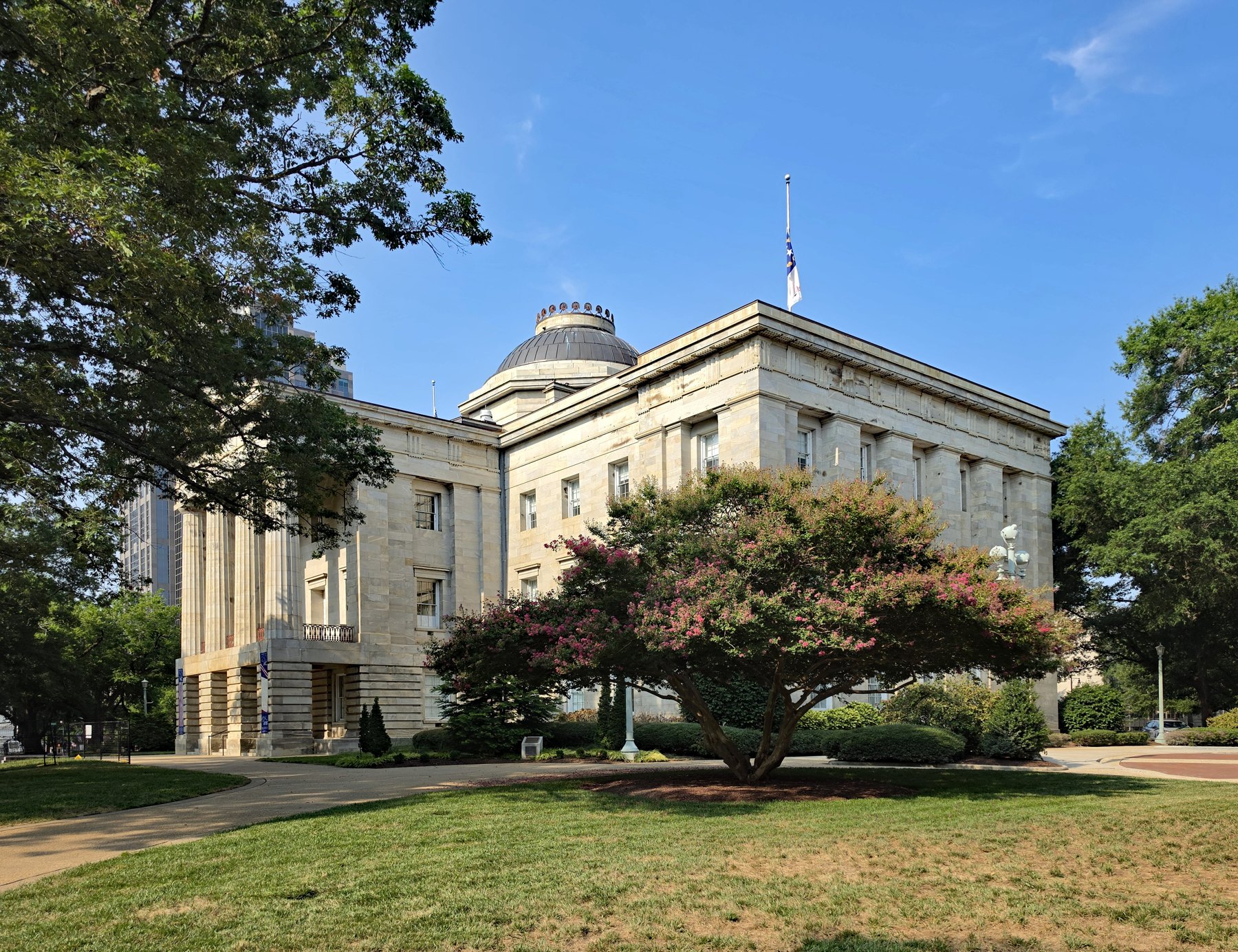
The North Carolina State Capitol in Raleigh. The General Assembly has not met to approve the Board's new absentee rules, and the Board told the court it will not before the election. Photo: P. Hughes via Wikimedia Commons, CC BY 4.0.
What changed on the sealed envelope?
Here the two memos differ. Under the 2024 guidance, a ballot was spoiled only when both the outer envelope and the inner "container-return" envelope arrived unsealed or looked resealed. If either one was sealed, the ballot counted.
Under the 2026 guidance, the inner envelope has to be sealed. If it arrives unsealed, or the ballot comes in with no inner envelope at all, the ballot is spoiled and reissued. The Board relied on N.C. Gen. Stat. 163-230.1(d), which says the ballots must be "sealed in the container-return envelope." The Board's February ruling said an unsealed inner envelope raises "the same chain of custody concerns" as an unsealed outer one. That ruling followed a consent judgment in a suit the Republican Party and RNC brought.
A resealed inner envelope with a properly sealed outer one can be cured with an attestation. Per the order, a spoiled ballot comes with notice: reissue by mail if caught by the Friday before Election Day, and a same-day call afterward telling the voter to vote in person.
How many voters does this touch?
Nobody knows yet. The order says about 123,828 absentee ballots had been requested as of October 8, and the State Board told the judge 31,582 had been cast. The plaintiffs say the two provisions "will disenfranchise hundreds, if not thousands, of voters." The opinion records that claim as a prediction, and Schroeder found they had not shown a likely win on the merits.
His sharpest line concerned the remedy. The plaintiffs' proposal, he wrote, "eliminates any verification of the signature, permitting a voter to sign anyone's name to the certification, even 'Mickey Mouse.'" The order says both requirements are printed on the ballot materials and calls neither "burdensome, much less unduly so."
Official record
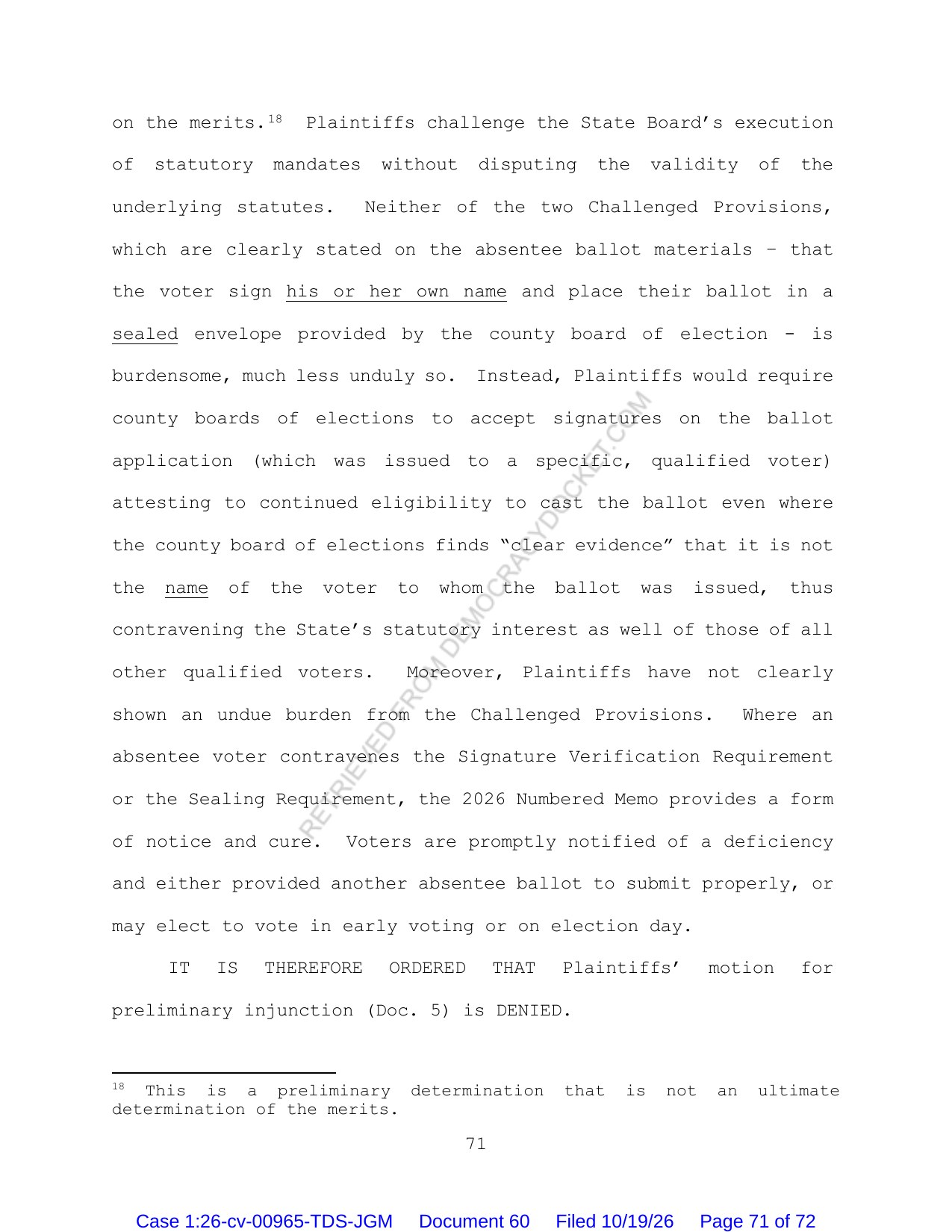
Memorandum Opinion and Order, North Carolina Alliance for Retired Americans et al. v. North Carolina State Board of Elections et al., No. 1:26-cv-00965 (M.D.N.C. Oct. 19, 2026), Doc. 60, page 71 of 72 (the closing paragraphs and the order). Copy retrieved through Democracy Docket.
"Neither of the two Challenged Provisions, which are clearly stated on the absentee ballot materials – that the voter sign his or her own name and place their ballot in a sealed envelope provided by the county board of election – is burdensome, much less unduly so." — Judge Thomas D. Schroeder
Read or download the full 72-page order (PDF) · Source copy at Democracy Docket
Who wrote these rules, and what comes next?
The Board adopted the guidance September 4 by a party-line vote, NC Newsline reported. The plaintiffs told the court the Board acted "after only 30 minutes of discussion," Carolina Journal reported. Board executive director Sam Hayes posted on X that the Board was "pleased with yesterday's decision."
One wrinkle the order spells out: the Rules Review Commission approved the underlying rules August 27, but enough objections came in to require legislative approval. The Board told the court the General Assembly will not meet until after the election, so the September memo is what counties are using.
Neither report says whether the plaintiffs will appeal. If they do, the Purcell problem gets harder every day, because every ballot cast under the 2026 memo is one more a court would have to revisit. For voters the order's own summary is the checklist: sign your own name and seal the inner envelope.
Header photo: the L. Richardson Preyer Federal Building and Courthouse in Greensboro, North Carolina, one of the federal courthouses of the Middle District of North Carolina. Photo: Warren LeMay via Wikimedia Commons, CC0.