

President Trump announced an $8 billion Harvest Fuel Relief program for farmers on Monday, but the Agriculture Department has not published a single payment rate. USDA says rates for the big commodity crops come "in November," the same month as the midterms, and farmers who grow anything else are being told to email in their fuel bills.
What did USDA actually announce?
Trump unveiled the program at a Kansas campaign event, saying it would provide "$8 billion in support to offset diesel costs," according to reporting carried by KSL. The money is one-time payments, authorized under the Commodity Credit Corporation Charter Act and run through the Farm Service Agency.
It is not a fuel rebate. Payments follow a uniform formula meant to cover "a portion" of modeled 2026 crop-year losses, built on a national average from planted acres, Economic Research Service cost estimates and USDA's yield and price forecasts, per Newsweek's summary of the release. A farmer's actual diesel receipts do not set the check.
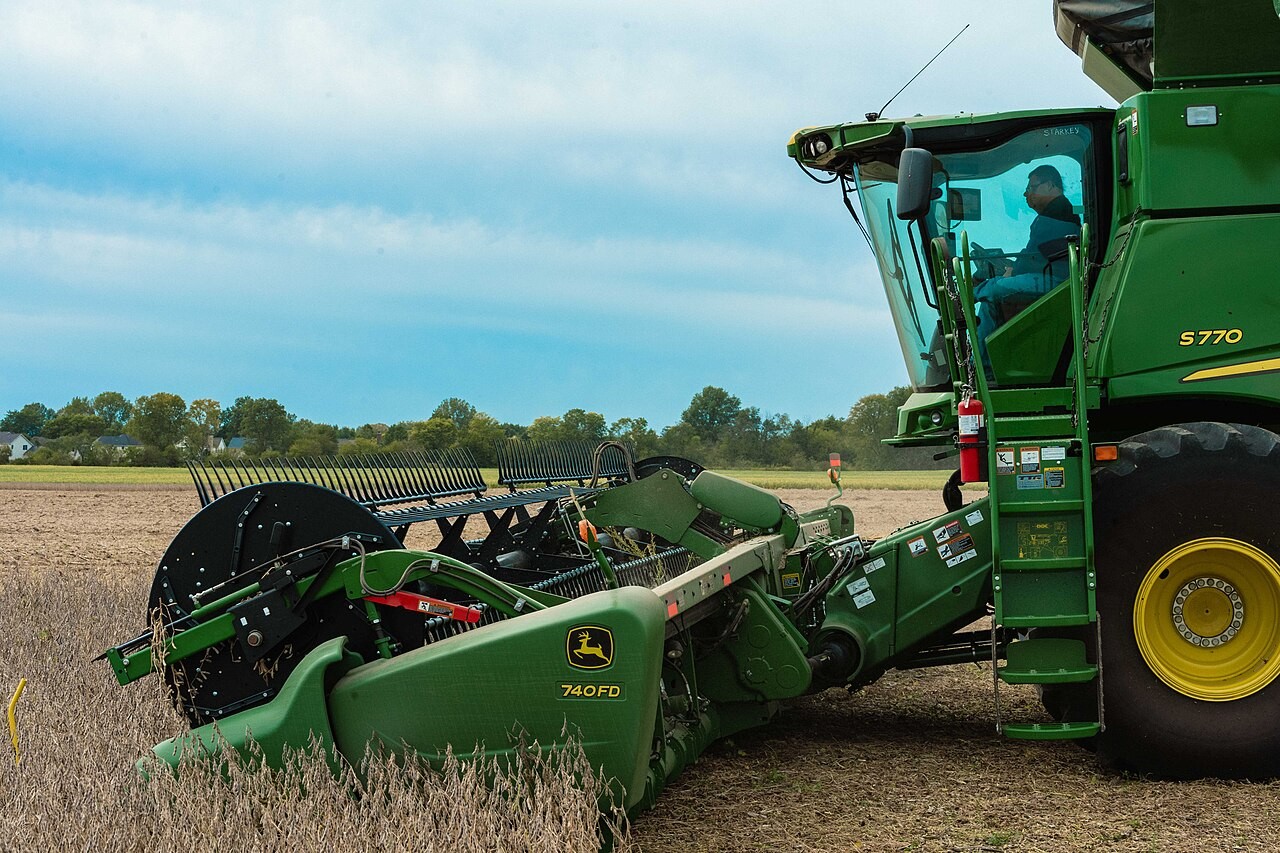
A combine harvests soybeans on a 135-acre field in Brownsburg, Indiana, in September 2022. Photo: NRCS/USDA (Brandon O'Connor), via Wikimedia Commons, public domain. File photo, not from this week's announcement.
What is the diesel bill the program is chasing?
The Energy Information Administration's weekly survey put U.S. on-highway diesel at $6.179 a gallon on October 12, up $2.514 from a year earlier. That is roughly a 69 percent jump. AAA's national average was $6.3187 on Monday, OilPrice.com reported, and KSL's report ties the fuel spike to the U.S.-Israeli war on Iran.
Compare that to the earlier fix. Earlier this month Trump signed an order to widen access to tax-exempt diesel, KSL's report notes. But the federal diesel tax is 24.4 cents a gallon, per OilPrice. Even a full waiver covers about a tenth of a $2.51 increase. That is my arithmetic, and it is why the tax tweak was never going to be enough.
Official record
USDA press release, Trump Administration Announces $8 Billion Harvest Fuel Relief Program, October 19, 2026.
"President Trump is the most pro-farmer president of my lifetime and he is continuing to put Farmers First every day." — Agriculture Secretary Brooke Rollins, as quoted in coverage of the release
When does anyone get paid?
Not yet, and not on a stated date. Title I commodity rates are due in November. Methods for other eligible crops will be announced later. Application timelines and regional guidance are expected "in the coming weeks," per Ohio's Country Journal. Election Day is November 3.
Growers outside Title I, including specialty crop farmers and commercial fishermen, are asked to send fuel expense data to HarvestFuel@usda.gov so USDA can calculate their rates. Everyone is told to set up a Login.gov account before the application opens. Crop insurance is not required, which is good news for small operators.
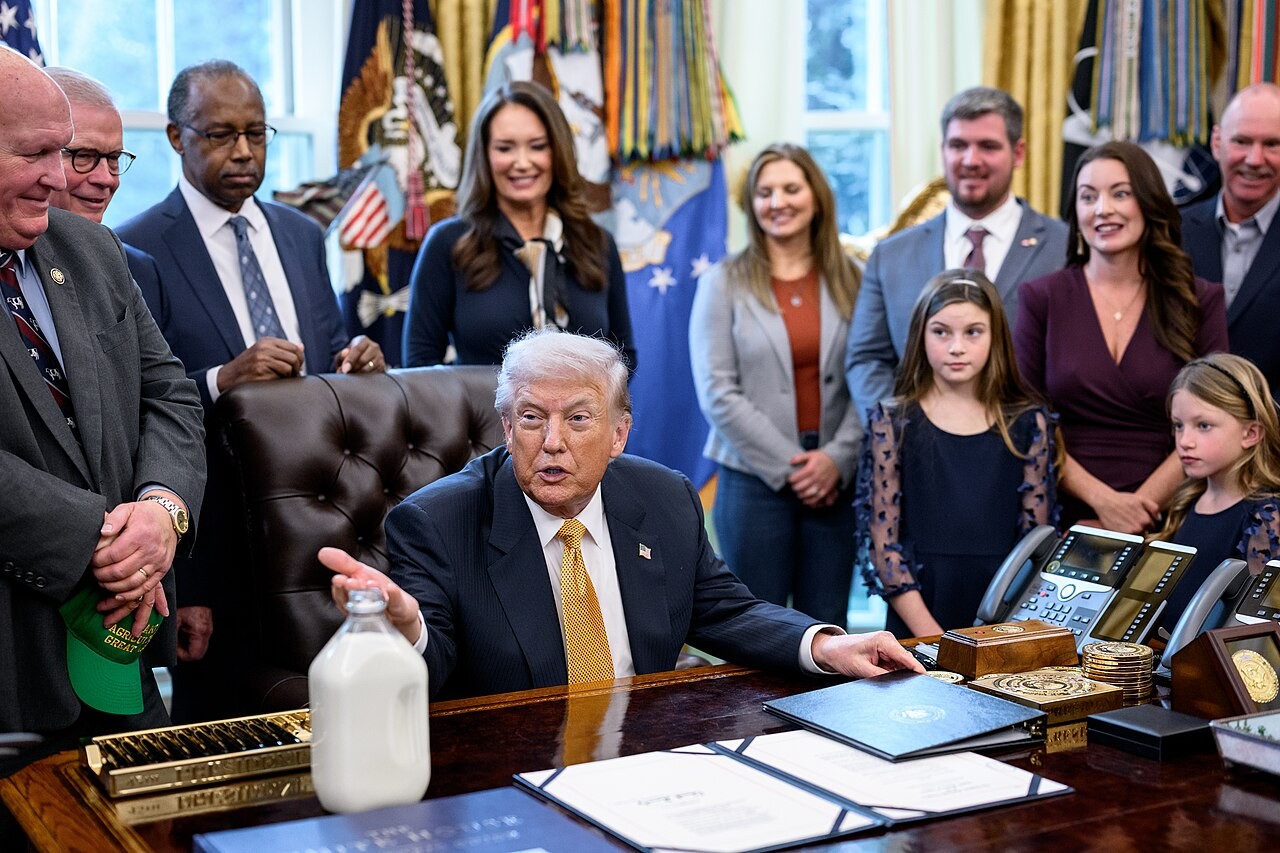
Trump in the Oval Office on January 14, 2026, signing the Whole Milk for Healthy Kids Act with dairy farmers, Agriculture Secretary Brooke Rollins and HHS Secretary Robert F. Kennedy Jr. Official White House photo by Joyce N. Boghosian, via Wikimedia Commons, public domain.
How does it compare with the last round of farm aid?
USDA says the earlier Farmer Bridge Assistance program paid $12 billion to more than 560,000 farmers, and that nearly $14 billion in Agriculture Risk Coverage and Price Loss Coverage payments went out about two weeks ago, OCJ reports. Harvest Fuel Relief copies the bridge program's formula approach.
For scale only: $12 billion across 560,000 farms is about $21,400 each, and $8 billion across the same number would be about $14,300. USDA has published no such figure and payments will track acres, so treat that as a ruler, not a forecast.
Is it enough, and is the timing fair to ask about?
Farmers need the help. Diesel is up $2.51 in a year at the exact moment they run combines and grain trucks around the clock. John Boyd of the National Black Farmers Association told Newsweek farmers "just can't survive" these fuel prices.
It is also fair to note who announced it and where. The pitch came at a Kansas campaign event for Sen. Roger Marshall, per Newsweek, and KSL's report lists it alongside a $90 Medicare payment and a floated $5,000 check plan from earlier this month. KSL's report says Trump's approval has sagged on the cost of living and the GOP is defending farm-state Senate seats. Relief that lands before harvest ends is relief. Relief with no rate by Election Day is a headline. Farmers should watch the November rate notice, because the per-acre number is the only one that pays a fuel bill.
Header photo: a combine throws dust harvesting soybeans in Brownsburg, Indiana, September 23, 2022. NRCS/USDA photo by Brandon O'Connor, via Wikimedia Commons, public domain. File photo.















