Missouri Attorney General Catherine Hanaway sued the ATF on September 8, asking a federal judge to declare that the government can no longer force law-abiding gun owners to register suppressors and short-barreled rifles now that Congress zeroed out the tax that used to justify the paperwork. Her co-plaintiff is Dave Marshak, and the 34-page complaint filed under his name describes him only as a private citizen, a gun owner and a Second Amendment supporter. It never mentions that Marshak has spent the last nine years as the elected sheriff of Jefferson County, a county of more than 220,000 people just south of St. Louis.
What Is Missouri Actually Asking a Judge to Do?
The suit, filed in the U.S. District Court for the Eastern District of Missouri as State of Missouri ex rel. Hanaway and Marshak v. Bureau of Alcohol, Tobacco, Firearms and Explosives, names the ATF, the Department of Justice, Attorney General Todd Blanche and ATF Director Robert Cekada as defendants. It asks the court for two separate declarations: that the National Firearms Act's registration scheme for untaxed firearms exceeds what Congress can regulate under its taxing power, and separately, that the same scheme violates the Second Amendment as applied to suppressors and short-barreled rifles.
Either finding alone would let the court permanently block ATF and DOJ from enforcing suppressor and short-barreled-rifle registration against Missouri and its residents. The case landed with Chief Judge Stephen R. Clark, nominated by President Trump in 2019 and confirmed by the Senate 53-45. No hearing date has been set as of publication.
The Tax That Justified All of This Doesn't Exist Anymore
In 1934, Congress built the NFA around a $200 tax on making or transferring suppressors, short-barreled rifles and a handful of other firearm categories, and the Supreme Court upheld it that same decade as a straightforward revenue measure in Sonzinsky v. United States. That framing held for almost ninety years. Then, on July 4, 2025, President Trump signed the One Big Beautiful Bill Act, and Section 70436 reset the making and transfer tax on suppressors, short-barreled rifles, short-barreled shotguns and "any other weapons" to zero dollars, effective January 1, 2026. Machine guns and destructive devices still carry the old $200 tax. Everything else does not.
Missouri's complaint leans on a 1935 case, United States v. Constantine, for a simple proposition: a provision that generates no revenue cannot be justified as a tax. With the dollar figure at zero, the state argues, the fingerprints, photographs, home addresses and months-long waits that come with an ATF Form 4 are regulations with no constitutional foundation left holding them up.
Didn't a Texas Judge Already Settle This?
Missouri's argument is not new. It borrows heavily from a ruling Judge James Wesley Hendrix issued August 5 in Silencer Shop Foundation v. ATF, a consolidated case out of the Northern District of Texas. Hendrix held that once Congress zeroed the tax, the registration requirements for suppressors, short-barreled rifles and short-barreled shotguns could no longer stand on the taxing power, and the Justice Department let its own seven-day emergency stay of that ruling lapse on August 13 rather than appeal to the Fifth Circuit.
Here is the part most coverage of Missouri's lawsuit skipped. The Texas injunction only protects the plaintiffs in that case, plus their members and customers going forward. Per the NRA's own legal explainer, that list runs to fifteen states, Alaska, Georgia, Idaho, Indiana, Kansas, Louisiana, Montana, North Dakota, Oklahoma, South Carolina, South Dakota, Texas, Utah, West Virginia and Wyoming, along with groups like Gun Owners of America, the Texas State Rifle Association and Silencer Shop's own dealer network. Missouri is not on that list. Missouri's own complaint says as much: ATF "continue[s] to enforce the NFA nationwide," even though the agency is "permanently enjoined from enforcing" it "as to certain individuals, States, businesses and members of certain associations." Every Missourian who is not a member of one of those associations is still fully exposed. That gap is the entire reason this second lawsuit exists.
Who Is Dave Marshak, and Why Doesn't the Lawsuit Say So?

Dave Marshak, elected Sheriff of Jefferson County, Missouri since 2017, is Catherine Hanaway's co-plaintiff. The complaint filed under his name calls him only "a natural person." (Jefferson County Sheriff's Office)
Marshak has run the Jefferson County Sheriff's Office, a department serving more than 220,000 residents, since he was sworn in during January 2017. His official biography lists a law enforcement career going back to 1991, a stint as SWAT team commander, and the Governor's Medal of Valor. None of that appears anywhere in the complaint, which introduces him in paragraph 13 as simply "a natural person and a citizen of the United States and a citizen of Festus, Missouri."
It is not only Missouri's own pleading that left this out. Breitbart, Bearing Arms, Ammoland and USA Carry all covered the filing in the days afterward and every one referred to him only as "plaintiff Dave Marshak," with no mention of the badge. Marshak has said he joined the case as a private citizen rather than in his official capacity, and per the Post-Dispatch's reporting on his comments, he argues that criminal penalties for illegal possession, not a federal registry, do the actual work of deterring misuse. Coming from a sitting sheriff, that argument carries more weight than the same line from an advocacy group's press release.
How Many of These Guns Are Actually Out There?
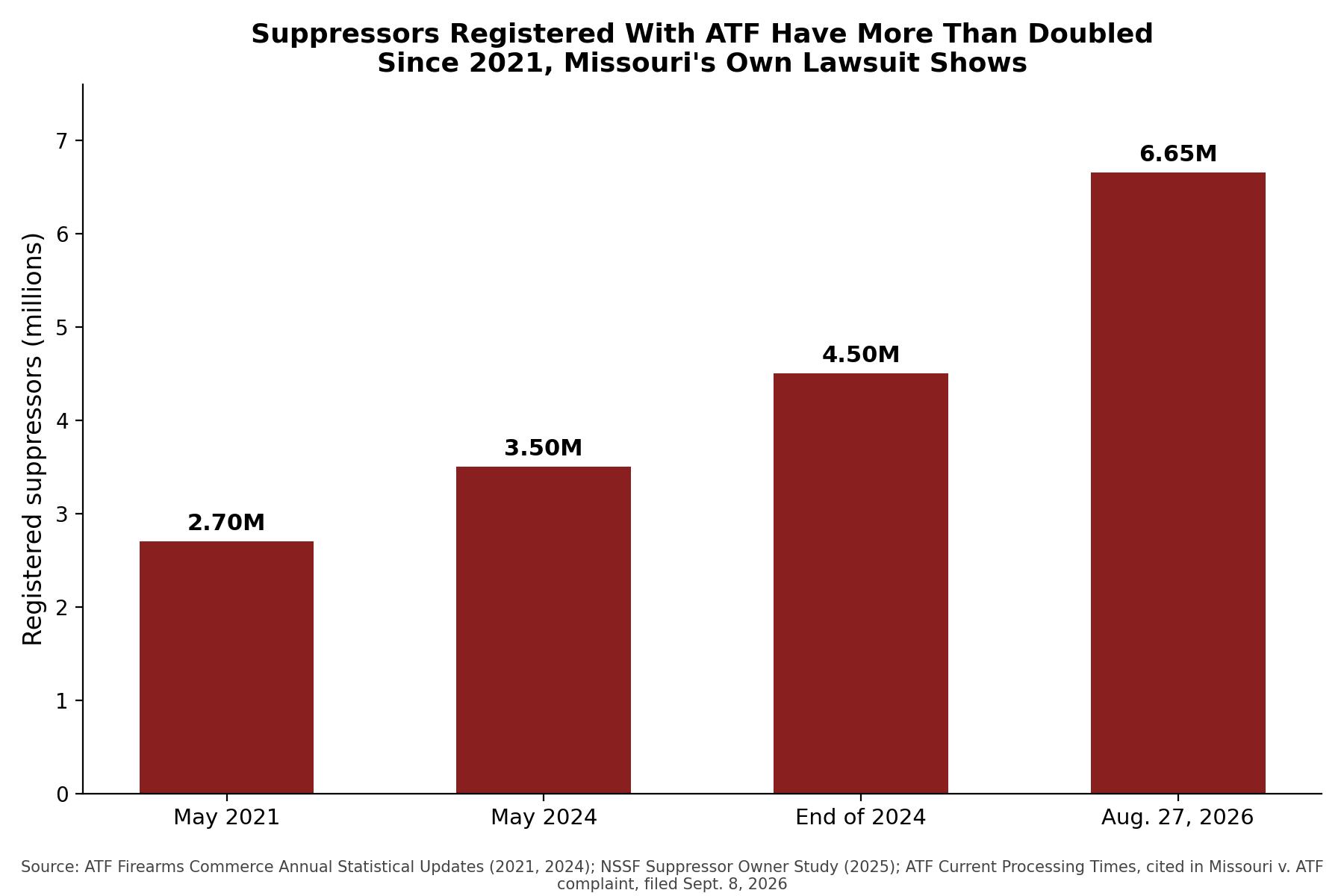
Registered-suppressor totals cited in Missouri's own complaint, drawn from ATF's Firearms Commerce annual statistical updates, a 2025 NSSF ownership study, and ATF's live processing-times page. (PatriotAddict analysis)
The complaint's own footnotes make the "common use" argument for it. ATF's Firearms Commerce reports put registered suppressors at roughly 2.7 million in May 2021 and 3.5 million by May 2024. The National Shooting Sports Foundation's 2025 ownership study put the figure near 4.5 million by the end of 2024. ATF's own live processing-times page, cited directly in Missouri's complaint, showed 6,654,209 registered suppressors as of August 27, 2026. Registered short-barreled rifles climbed from 532,725 in May 2021 to 1,227,044 as of late August this year.
Under Heller and Bruen, the government can only ban or heavily restrict a class of arms if it is both dangerous and unusual. Missouri's lawyers use these numbers to argue the "unusual" half of that test cannot be met for an item millions of Americans already legally own. The numbers cut a second way too. Registrations kept climbing every single year the $200 tax and the paperwork were both still in force, which undercuts any argument that the fee itself was the thing standing between ordinary buyers and these firearms. What it bought was months of waiting and a fingerprint card, not fewer owners.
What Happens Next
Nothing changes for Missourians while the case is pending. Possessing an unregistered suppressor or short-barreled rifle remains a federal felony under 26 U.S.C. Section 5861, punishable by up to ten years in prison and a $250,000 fine, and Missouri's own state agencies still have to register and transfer these firearms the old way in the meantime. Missouri is also not alone in scrambling to catch up with a law Congress rewrote faster than the states around it. Pennsylvania lawmakers introduced a bill in August to reconcile state statutes that still criminalize suppressors based on federal NFA compliance, the same disconnect Missouri's suit is trying to close from the other direction.
The headline version of this story is "a state sues a federal agency," which happens often enough that it barely registers. The actual story is that the state's chief legal officer and the elected sheriff of a 220,000-person county both told a federal judge, in a signed filing, that the paperwork their own government still makes gun owners fill out doesn't make Jefferson County or anywhere else safer. Whatever a court eventually decides about the tax power, that is a harder argument for Washington to wave off than the usual press release from an advocacy group.