Ella Pool is old enough to carry a concealed handgun in Louisiana without a permit. She is too young to be issued one. The Firearms Policy Coalition asked a federal judge on September 1 to end that contradiction, and its filing spells out what the gap costs the 18-to-20-year-old adults stuck in it.
Louisiana dropped the carry age to 18 and left the permit age at 21
In 2024, Louisiana passed Act 1 of its Second Extraordinary Session, the permitless carry law Gov. Jeff Landry signed as Senate Bill 1. Buried in the text is one edit that did all the work: the bill reached into R.S. 14:95(M), struck the words "twenty-one years of age" and wrote in "eighteen." As of July 4, 2024, an 18-year-old in Louisiana who is not otherwise prohibited may carry a concealed handgun with no license whatsoever.
What SB 1 never touched was the state's permit statute. La. R.S. 40:1379.3(C)(4) still reads, in full: "Be twenty-one years of age or older." Louisiana kept running its concealed handgun permit program through the State Police, and those permits still unlock things permitless carry does not.
Official record
Pool v. Besson, No. 6:26-cv-02650-DCJ-DJA (W.D. La.), Document 18-1, Memorandum in Support of Plaintiffs' Motion for Preliminary Injunction, filed September 1, 2026. Every filing is posted on FPC's case page and on the public docket.
"SB 1, however, does not deliver on its broad promise in light of the State's pre-existing regulatory framework for concealed carry."
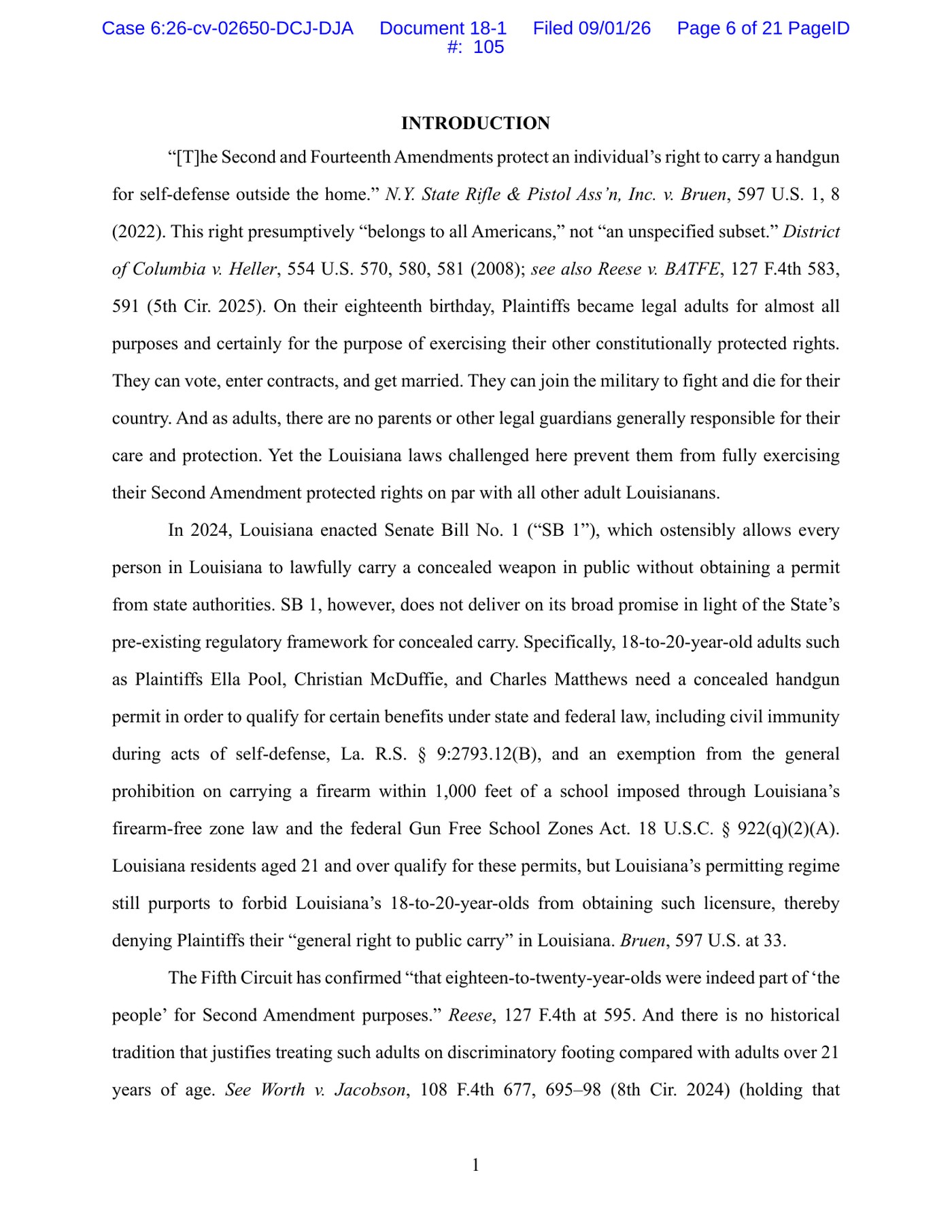
Read or download the full 21-page memorandum (PDF), or view the official docket.
The 1,000-foot rule is what turns a paperwork gap into a felony exposure
Federal law makes it a crime to knowingly possess a firearm in a school zone, which 18 U.S.C. § 921(a)(26) defines as anywhere within 1,000 feet of school grounds. The penalty under § 924(a)(4) runs up to five years in prison. The escape hatch is narrow: § 922(q)(2)(B)(ii) exempts anyone "licensed to do so by the State in which the school zone is located."
Louisiana refuses to license Pool. So the exemption Congress wrote for permit holders is one she is legally barred from reaching, and Louisiana's own permit statute compounds it. Paragraph (M) of the same section voids any carry, permitted or not, in any "facility, building, location, zone, or area in which firearms are banned by state or federal law."
The Fifth Circuit already put its finger on the seam. In United States v. Allam, 140 F.4th 289 (2025), the court upheld the school-zone law against an as-applied challenge, noting that the statute "is not a categorical prohibition" precisely because it excludes license holders. FPC's motion takes the court at its word: for an 18-to-20-year-old Louisianan, it is categorical, and the reason is the state's own age cutoff.
The scale is not theoretical. The Louisiana Department of Education's February 1, 2026 enrollment report lists 1,336 public school sites. None of the 1,000-foot rings around them are marked, and merely walking or driving through one is enough. Pool, Christian McDuffie of Youngsville and Charles Matthews of Baton Rouge have each stopped carrying in public entirely rather than guess where the rings fall.
Louisiana had the fix in hand in April 2025 and passed half of it
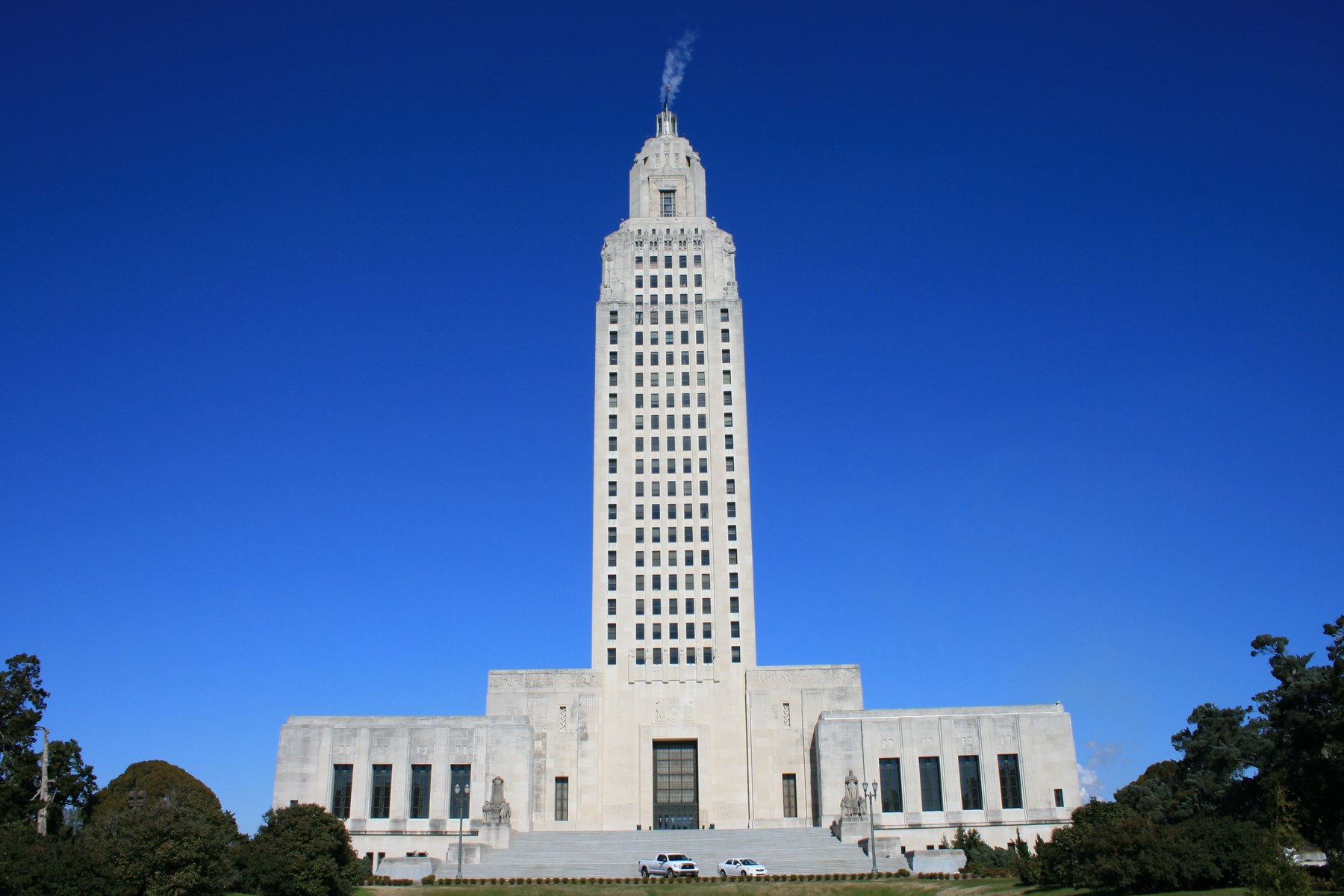
The Louisiana State Capitol in Baton Rouge. The 2025 legislature rewrote the concealed handgun permit statute and left the 21-year-old requirement untouched. (Photo by Jim Plylar, Wikimedia Commons, CC BY-SA 3.0)
According to FPC's account, its counsel warned Louisiana Solicitor General Ben Aguiñaga in April 2025, during separate litigation over the state's ban on nonresident permits, that the age limit was unconstitutional too. FPC says it handed the state draft language fixing both problems at once.
Then look at what the legislature actually did. Act 273 of 2025, House Bill 407 by Rep. Lauren Ventrella, went through § 40:1379.3 line by line, crossed out "Louisiana resident" and wrote in "person," and repealed the residency paragraph outright. The official statute page still shows the scar: "(3) Repealed by Acts 2025, No. 273." The very next line, paragraph (4), still says twenty-one.
"Louisiana had ample notice, a perfect solution, and two legislative sessions to act. They refused. That's on the State," FPC President Brandon Combs said in the group's September 1 announcement. He added that FPC had offered a consent decree and the state turned it down.
Two days earlier, a Trump appointee upheld Hawaii's version of the same rule
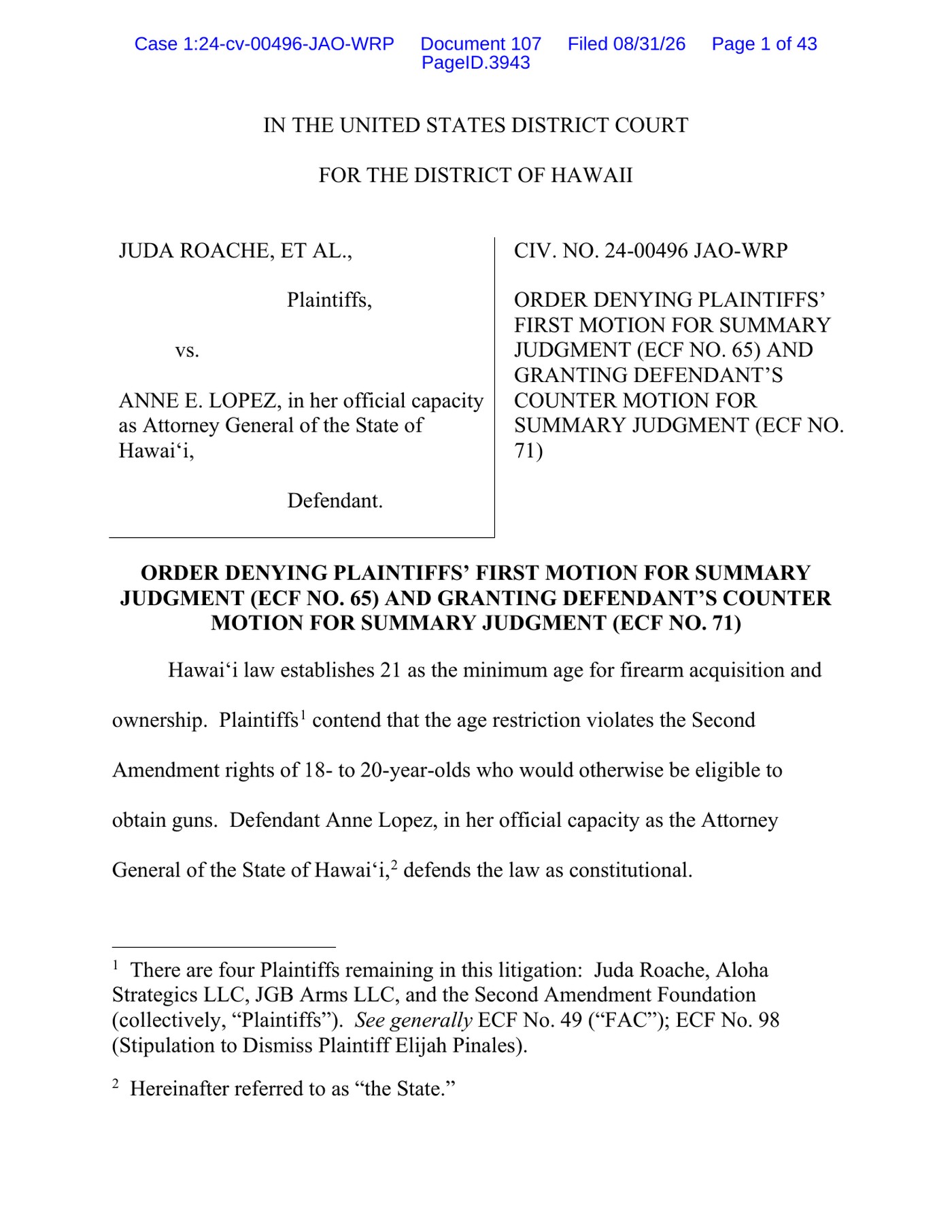
Page one of the 43-page summary judgment order in Roache v. Lopez, D. Haw. No. 1:24-cv-00496, entered August 31, 2026. (U.S. District Court for the District of Hawaii, via CourtListener)
On August 31, U.S. District Judge Jill Otake in Honolulu granted summary judgment to Hawaii Attorney General Anne Lopez against the Second Amendment Foundation, two licensed dealers and 18-year-old plaintiff Juda Roache, upholding the state's rule that nobody under 21 may acquire a firearm. Otake was nominated by President Trump in December 2017.
She did not dispute that 18-to-20-year-olds are part of "the people." She ruled that Hawaii's cutoff survives anyway: "the Court finds solid evidence in Founding era common law that society restricted the practical ability of people under 21 from acquiring goods, including firearms, because of concerns about their judgment and maturity." The full order is on the public docket.
That is the opposite of where the Fifth Circuit landed in Reese v. BATFE, 127 F.4th 583 (2025), which struck down the federal ban on selling handguns to that age group. Hawaii sits in the Ninth Circuit. Louisiana sits in the Fifth, where Reese is binding, which is why FPC keeps quoting it.
What Judge Joseph has to decide
The case is assigned to Judge David C. Joseph, another Trump appointee. The defendant is Col. Frank J. Besson, substituted as Louisiana State Police superintendent under Rule 25(d) after Col. Robert Hodges left the post.
Joseph has already narrowed the question. In an August 21 ruling the court said it can "assume, without deciding, that § 922(q) is constitutional" and confine itself to whether Louisiana's age cutoff passes muster. That framing favors FPC: it strips out the hardest federal question and leaves one state statute holding up the structure.
Louisiana Republicans spent two sessions telling gun owners they had delivered constitutional carry. What Pool and her co-plaintiffs got is a right they cannot carry to work without mapping every school in the parish first. The fix is a two-word amendment to paragraph (4) of a single statute, and the state has now handed that job to a federal judge instead.
Stand with the Americans who refuse to apologize for the Second Amendment. Shop the PatriotAddict collection.