HUD and DOJ rescinded the answer to Question 59 in a 2013 Fair Housing Act guidance document, restoring the one-year deadline for accessibility complaints. The rescission took effect August 13, and on August 31 HUD's fair housing chief ordered his enforcement staff to start applying it immediately. Fox News called it an Obama-era mandate getting slashed. What actually got slashed is one paragraph, and the dollar figures on both sides are worth running yourself.
HUD struck one answer out of a 31-page document
Open the HUD and Justice Department joint statement on accessibility requirements for covered multifamily dwellings and all 31 pages now carry a red banner: "Effective August 13, 2026, the agencies rescind the answer to Question 59." Question 59 asked at what point the filing clock starts running. Its answer is struck through with a line. The rest of the document stands.
That detail matters more than the headlines suggest. Question 58, sitting directly above it and untouched, already told readers a complaint goes to HUD "within one year" and to federal court "within two years." The deadlines themselves were never the fight. Question 59 was the part that told builders and later owners those clocks might never start at all.
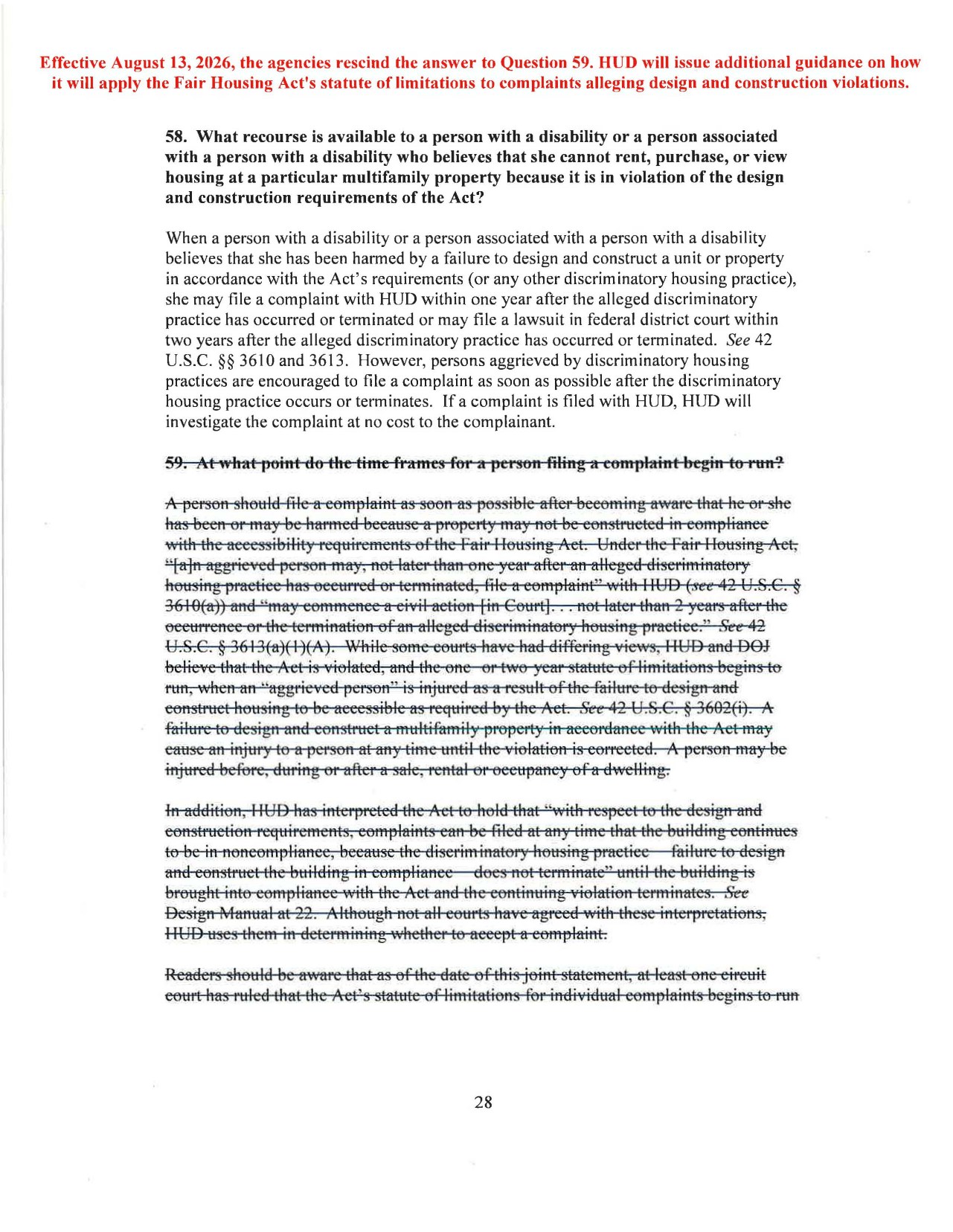
Page 28 of the 2013 HUD and DOJ joint statement as it is posted today. The answer to Question 59 is struck through; Question 58 above it is not. (U.S. Department of Justice, Civil Rights Division, public domain government work.)
Congress wrote the deadline into the statute in 1988
The design and construction requirements come from the Fair Housing Amendments Act of 1988, which added disability as a protected characteristic and required multifamily buildings completed after March 13, 1991 to include accessible features under 42 U.S.C. 3604(f)(3)(C). The same 1988 law set the clocks. Section 3610(a)(1)(A)(i) gives an aggrieved person one year to file with the Secretary. Section 3613(a)(1)(A) gives two years for a private suit.
Both clocks run from when the practice "occurred or terminated." The 2013 answer read that to mean a builder's failure never terminates until the building is fixed, turning a one-year deadline into no deadline. Assistant Secretary Craig Trainor's memorandum says that reading left Congress's judgment "inoperative or superfluous, void or insignificant," a phrase he borrows from the Supreme Court's 2009 ruling in Corley v. United States.
Official record
Memorandum from Craig W. Trainor, Assistant Secretary for Fair Housing and Equal Opportunity, "The Statute of Limitations Under the Fair Housing Act as Applied to Design and Construction Cases," dated August 31, 2026 (7 pages).
"As a result, effective immediately, the U.S. Department of Housing and Urban Development (HUD or the Department) will treat an alleged violation of 42 U.S.C. § 3604(f)(3)(C) as a distinct discriminatory housing practice that ends when the design and construction of a covered multifamily dwelling is completed."
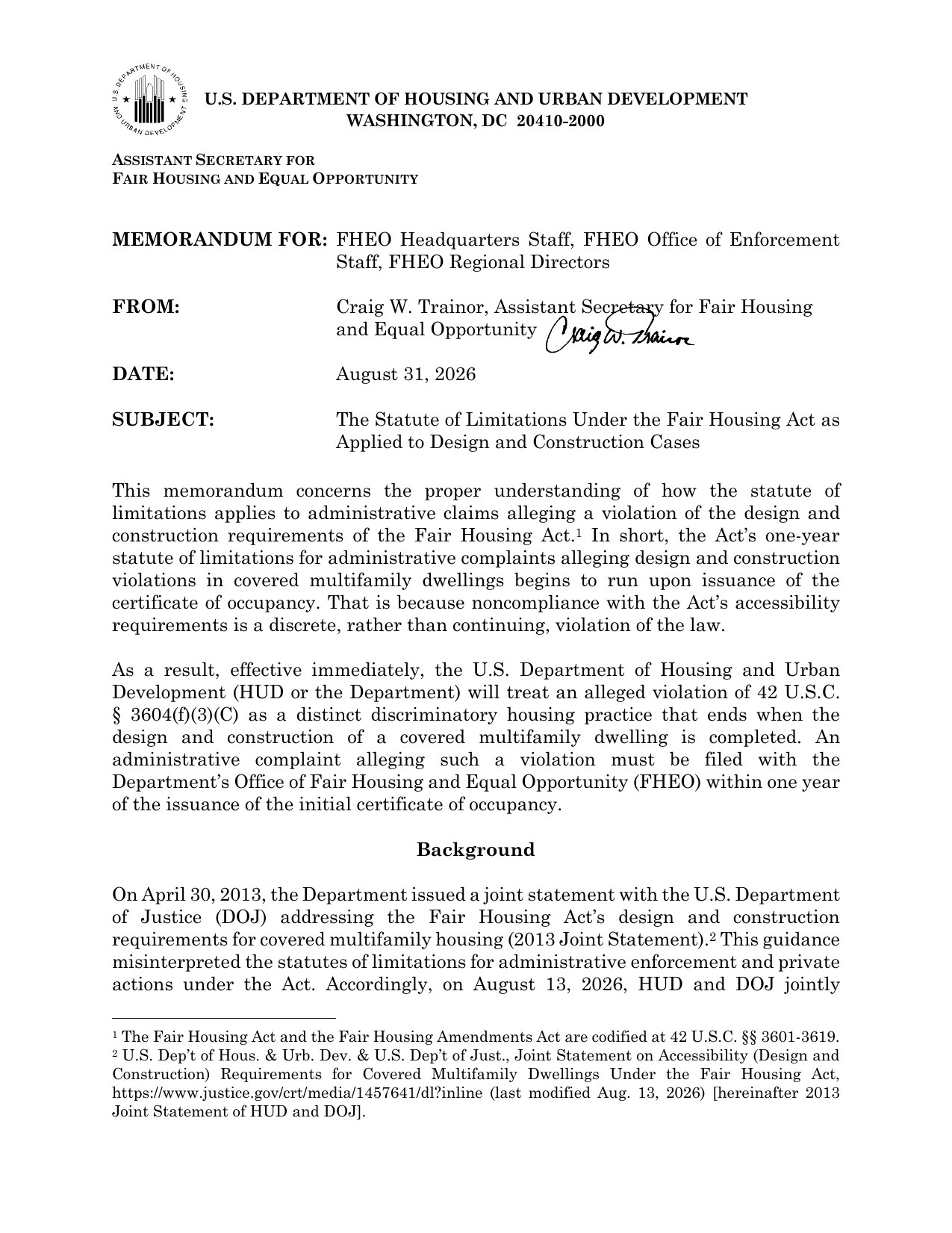
Read or download the full 7-page memorandum (PDF) at HUD.gov, or read HUD's September 1 announcement, HUD No. 26-063.
The Ninth Circuit said this in 2008, sitting en banc
HUD is not breaking new legal ground here. In Garcia v. Brockway, 526 F.3d 456, the Ninth Circuit held en banc in May 2008 that the practice barred by the statute is designing and constructing an inaccessible building, and that the practice terminates when construction is finished, evidenced by the certificate of occupancy. The 2013 joint statement acknowledged that ruling in the very answer it has now lost, then declined to explain why the court was wrong.
Trainor's memorandum makes a point worth noticing. Only two federal appellate courts have ever addressed the question, and both rejected HUD's continuing-violation theory. The Sixth Circuit put accrual at the sale or rental of the unit instead of the certificate of occupancy, so those courts split on the trigger date, not on whether a deadline exists at all. The memo leans on the Supreme Court's 2024 decision in Loper Bright Enterprises v. Raimondo for the rule that courts, not agencies, decide what a statute means.
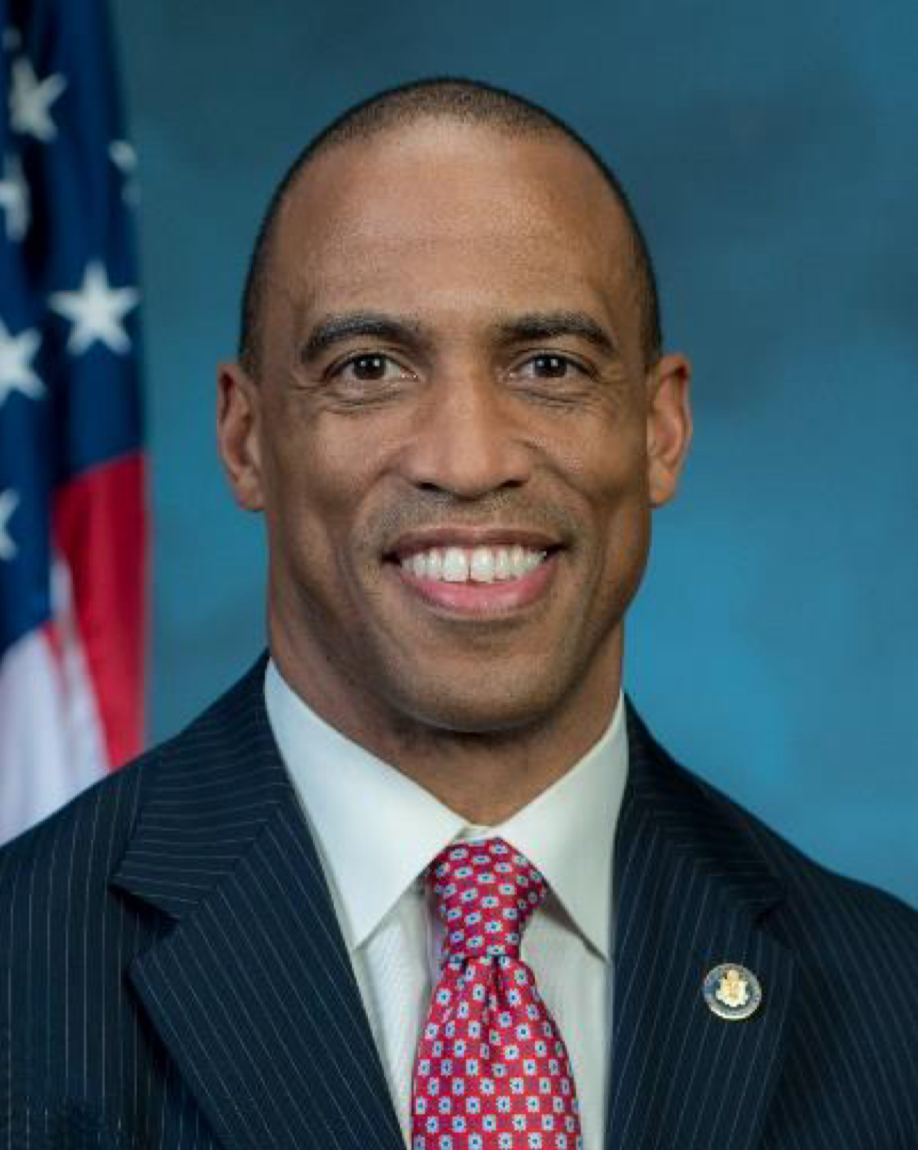
HUD Secretary Scott Turner, who said the action "rescinds unnecessary and expensive liability created by legal theories that have no basis in law." (Official HUD portrait, 2025, public domain government work.)
Now run the numbers on that $110 million
HUD's press release says the old guidance imposed "over $110 million in onerous repair costs" on building owners over five years. That is $22 million a year. The Census Bureau counted 484,000 multifamily units completed in 2025 across about 17,000 buildings. Spread $22 million over a single year of that output and you get about $45 per unit. Charge the entire five-year total against one year's 484,000 units and it still comes to roughly $227 per unit.
| Figure | Source | What it actually covers |
|---|---|---|
| $110 million over 5 years | HUD, Sept. 1 release | Retrofit costs on owners nationwide under the 2013 reading |
| Nearly $49 million across almost 500 refinance deals since 2019 | HUD internal data, via Fox News | Findings of a single third-party inspection firm |
| More than $1 billion over 4 years | HUD internal data, via Fox News | Lost HUD-insured multifamily loan volume at one lender |
| $131,734 per new single-family home | NAHB, June 2026 | All federal, state and local regulation combined |
| $40,288 per new home | NAHB, June 2026 | Building code changes over the past 10 years alone |
Compare that to the number builders themselves cite. The National Association of Home Builders reported in June that regulation adds $131,734 to the average new single-family home, 26.4 percent of a $499,500 average sales price. The components check out. Take $84,939 during construction plus $46,795 during land development and you land exactly on $131,734, which divided by $499,500 is 26.37 percent. Now divide HUD's whole five-year retrofit bill by that per-house figure: $110 million buys about 835 houses' worth of regulatory load.
One more figure deserves a squint. Fox reported that one inspection firm found "nearly $49 million" in fixes across "almost 500" refinance deals, "averaging over $100,000 in deficiencies per property." Divide $49 million by 500 and you get $98,000. For the average to clear $100,000 the deal count has to fall under 490.
What the memorandum leaves standing
Question 60 was not touched. It still says a builder who violates the requirements at multiple properties over time may answer for all of them as a pattern or practice, so the continuing-violation idea survives in exactly the repeat-offender cases. The memo's last sentence confirms it "neither addresses nor alters" the Attorney General's authority to sue builders under 42 U.S.C. 3614(a). Tenants keep their separate rights to reasonable modifications and accommodations at any time.
The two-year private deadline is softer than the coverage implies. HUD says it "supports a clear, predictable, and reasonable limitations period" of two years from the certificate of occupancy, then concedes in a footnote that "courts will interpret the statute of limitations for themselves." HUD is setting its own administrative practice. It is not binding a federal judge.
Housing is expensive. It is not currently skyrocketing.
Turner's quote blames "the skyrocketing cost of building, buying, and renting a home." The current data reads differently. The Cotality Case-Shiller national index rose 1.5 percent over the year through June, below inflation for the thirteenth straight month. Shelter in the July CPI was up 3.2 percent, rent of primary residence 2.9 percent. The median new house sold in July went for $393,800, which Census reports as down 0.9 percent from a year earlier and not statistically significant. Prices got high and stayed high. They are not climbing fast right now.
The legal case for this memo is the strong part. An appellate court said the same thing 18 years ago, no appellate court has ever endorsed HUD's old reading, and a one-year deadline that never begins is not a deadline. The affordability case is thinner than the press release, and the biggest regulatory line item builders name, $40,288 per house in code changes, is untouched. There is also a structural catch. This is a guidance memorandum, effective immediately, with no Federal Register notice and no comment period, which is the same footing the 2013 guidance stood on. That is exactly why one memo could undo it. Making the deadline permanent is a job for Congress, not for the next assistant secretary.
Header photo: Robert C. Weaver Federal Building, HUD headquarters in Washington, D.C., by Carol M. Highsmith, Library of Congress, public domain.