The White House says nearly 70% of people ICE arrests have a U.S. criminal conviction or charge. ICE's own July arrest records say 48.7%. We pulled the government file the newspaper stories were built on and ran the split ourselves, and the administration's number turns out to be real but badly out of date. The last month ICE arrests actually cleared 70% on that measure was May 2025.
What the White House put on the table
Fox News Digital reported that Lauren Bis, a special assistant to the president, hit back at the Washington Post and the New York Times over their reporting on ICE arrests of people with no criminal record.
Her framing: though "nearly 70% of illegal aliens arrested by ICE have been convicted or charged with a crime in the United States," the "actual arrests of public safety threats and criminals is much higher." She asked why the press keeps peddling "false narratives protecting criminal illegal aliens."
That is a specific number attached to a specific population, so we checked it against the government's own records.
The file both sides are arguing over
The Post and Times stories run off a dataset the Deportation Data Project released on August 21, covering every ICE arrest, book-in and removal from October 1, 2022 through August 6, 2026. The records came out of ICE under a FOIA lawsuit brought by the project's co-director, David Hausman. This is ICE's paperwork, not an outside estimate.
The arrest table carries a field ICE fills in itself, apprehension_criminality, with three permitted values: convicted criminal, pending criminal charges, and other immigration violator. We downloaded it, dropped the rows the project flags as duplicates in its codebook, and counted July.
ICE's own July numbers
| ICE arrests, July 2026 | Count | Share |
|---|---|---|
| Convicted of a U.S. crime | 11,731 | 23.9% |
| Pending U.S. charge, no conviction | 12,179 | 24.8% |
| Immigration violation only | 25,181 | 51.3% |
| Conviction or pending charge | 23,910 | 48.7% |
| Total | 49,091 | 100% |
That 48.7% already uses the most generous definition DHS applies to itself, counting anyone with an open charge as criminal even though a charge is not a finding of guilt. The White House said nearly 70%.
A sanity check on the arithmetic: 49,091 arrests over 31 days is 1,584 a day, and 25,181 immigration-only arrests is 812 a day. CBS News, working the same file, reported more than 1,580 arrests a day in July and more than 800 a day involving people without criminal records. Our count and theirs land in the same place.
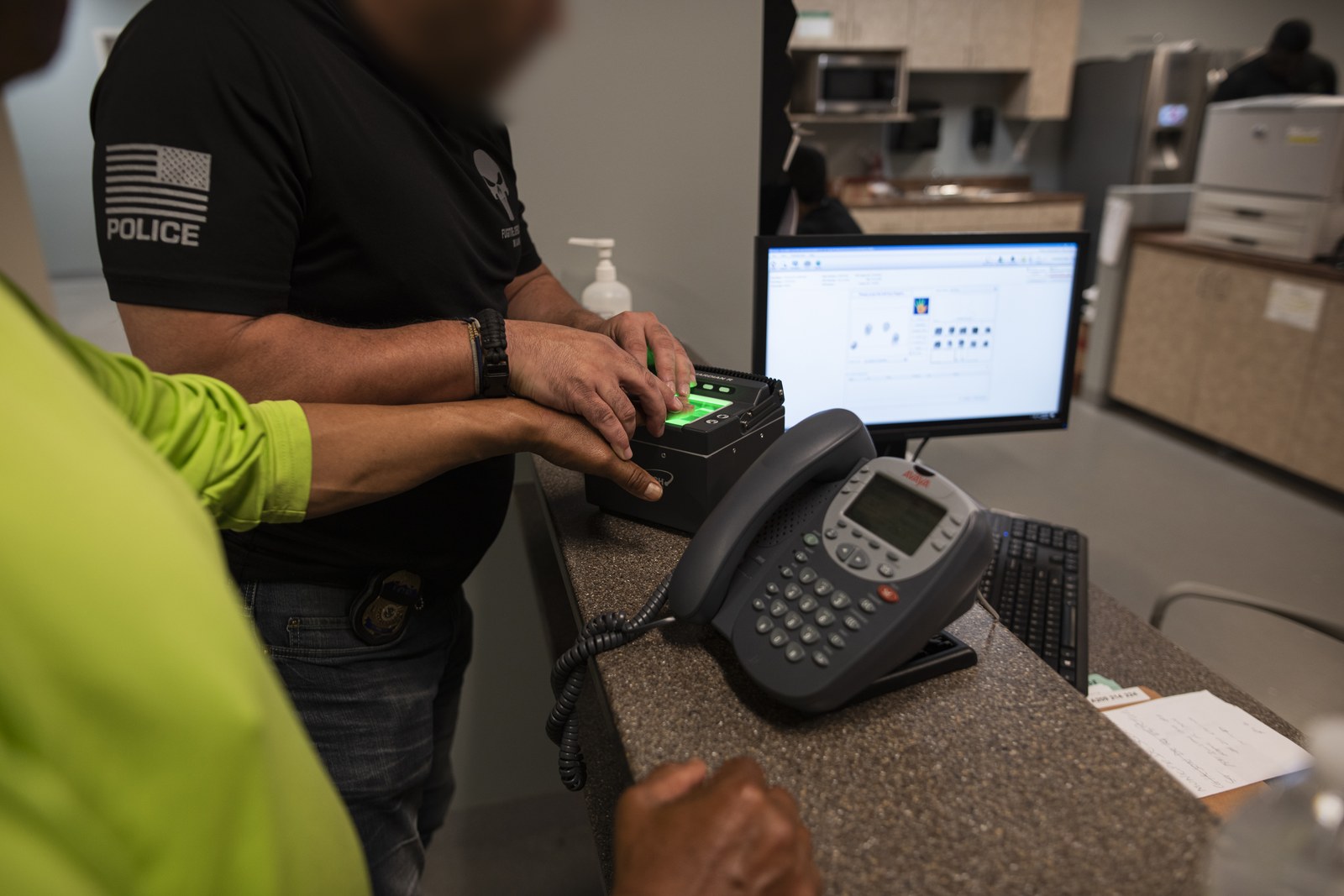
An ICE Enforcement and Removal Operations officer takes an arrestee's fingerprints during a Fort Myers, Florida field office operation. The criminality code in ICE's arrest file is generated from checks like this one, and it reads U.S. records. (U.S. Immigration and Customs Enforcement, public domain, via Wikimedia Commons)
The 70% figure is real. It describes last year.
Run the same ICE field month by month and the number has an expiration date on it. In October 2024, the last full month before Trump took office again, 83.9% of ICE arrests involved a conviction or a pending charge. May 2025 was the final month above 70%, at 73.2%. July 2025 came in at 65.0%, December 2025 at 52.9%, and the first six days of August 2026 at 44.9%.
Cumulative averages treat the administration more kindly, which is likely where the 70% came from. Across the entire second term through August 6, 2026, the figure is 60.6% of 571,539 arrests. Narrow the window to January 20 through October 15 of 2025 and it rises to 67.7%, close to the 66% PolitiFact calculated for that same stretch back in January. Neither window describes what ICE did this summer.
Where the White House has a real point
Bis's substantive argument is not about the percentage at all. It is that the field is blind in one direction. She named Salvadoran national Josue Saul Garcia-Lopez, arrested in May on an international warrant identifying him as an active MS-13 member; Honduran national Fredy Alexander Lopez Lara, wanted for homicide at home; and Antonio Israel Lazo-Quintanilla, an 18th Street Gang member on El Salvador's most-wanted list whose only U.S. offense, DHS said, was driving without a license.
She is right that every one of them lands in the "other immigration violator" column, which records U.S. criminal history only. A foreign conviction, a foreign warrant or an INTERPOL notice does not show up in it. Any story that reads that column as proof of harmlessness is reading more into it than the data supports.
The trouble is that DHS has never published a count. "Much higher" is not a figure, and no public file exists to test it against.

An ICE officer uses a handheld biometric identification device on a man arrested during an Enforcement and Removal Operations surge in Collier and Lee counties, Florida. (U.S. Immigration and Customs Enforcement, public domain, via Wikimedia Commons)
ICE's threat-level column is where it could settle this
The agency does grade the seriousness of its own arrests, in the same dataset. ICE assigns a threat level of 1 through 3 to people it books as convicted criminals, with Level 1 the most serious. Of the 49,091 arrests in July, 3,578 carried a Level 1 rating. That is 7.3%.
All but two of them sit in the convicted-criminal column. ICE recorded no threat level whatsoever for any of the 25,181 immigration-only arrests, which is precisely the blank the White House is asking the public to fill in with MS-13.
The number neither side printed
On the detention side, the trend has actually been moving the administration's way, and nobody covering this fight said so. ICE's twice-monthly detention management file, which Congress requires it to publish, shows that of the 58,231 people in ICE custody from ICE arrests as of the July 11 data pull, 18,043 had convictions and 18,513 had pending charges. That works out to 62.8%, up from 56.3% in late January.
The reason is statutory rather than rhetorical. Andrew Arthur of the Center for Immigration Studies notes that people removable on criminal grounds face mandatory custody, while people held on immigration grounds alone can petition an immigration judge for release under 8 C.F.R. 1003.19 and often win it. Separately, 16,588 of July's arrests, one in three, involved someone who already held a final order of removal, which triggers mandatory custody under section 241(a) of the Immigration and Nationality Act.
Official record
Deportation Data Project, "ICE data release: Oct. 2022 - Early Aug. 2026," published August 24, 2026. Obtained from ICE under FOIA litigation in Hausman v. ICE and released under CC0. Read the release notice or go straight to the arrest and detention tables.
"The update includes every ICE encounter, detainer request, arrest, book-in to detention, and removal between October 1, 2022 and August 6, 2026. This adds almost five months of data to the previous release, which ran through March 10, 2026." Deportation Data Project, August 24, 2026
ICE's own aggregate detention statistics, cited above, come from the agency's detention management page; the parsed spreadsheet series is mirrored here.
What this comes down to
The Post and the Times reported the arrest numbers correctly, and we got the same answers off the same file. The White House is on solid ground insisting that "no U.S. criminal record" and "no criminal record" are different claims, and on the individual cases it named it is plainly right. Reporters who treat that column as a character reference are cutting a corner.
What the administration cannot do is answer a July 2026 arrest statistic with a 2025 running average and call the gap a false narrative. If the foreign-record blind spot is as big as Bis says, DHS could end this argument in an afternoon by publishing the count, the way Congress already makes it publish the detention tables. Until it does, the only figure anyone outside the building can audit is ICE's own, and ICE's own says 48.7%.