The Supreme Court will decide whether a Kentucky town can stop Catholic priests from building a small shrine to the Virgin Mary next to their own church. Kentucky's highest court called the loss "a mere inconvenience" because the priests could build a smaller shrine somewhere else on the lot. The Court's Oct. 1 order shows something most coverage left out: the justices agreed to hear only one of the two questions the church asked, and they set aside the argument about golf courses and country clubs getting better treatment than churches.
A 16-by-39-Foot Grotto Went All the Way to the Supreme Court
Our Lady of Lourdes church sits on Amsterdam Road in Park Hills, a small city in Kenton County just across the Ohio River from Cincinnati. The church was built in 1930, before the town adopted zoning, so it is allowed to stay in a residential zone as a grandfathered "nonconforming use." It is owned by the Missionaries of Saint John the Baptist, a nonprofit founded by Roman Catholic priests.
The priests wanted to dig a grotto into the hillside on a neighboring lot. The cert petition describes a shrine to the Virgin Mary with a plaza, a walking path and a retaining wall, 16 feet by 39 feet, "about the size of a backyard swimming pool." The location is not random. The petition points to the 1858 apparitions at Lourdes, France, where Mary reportedly asked St. Bernadette to "tell the Priests that a chapel must be built" next to the grotto.
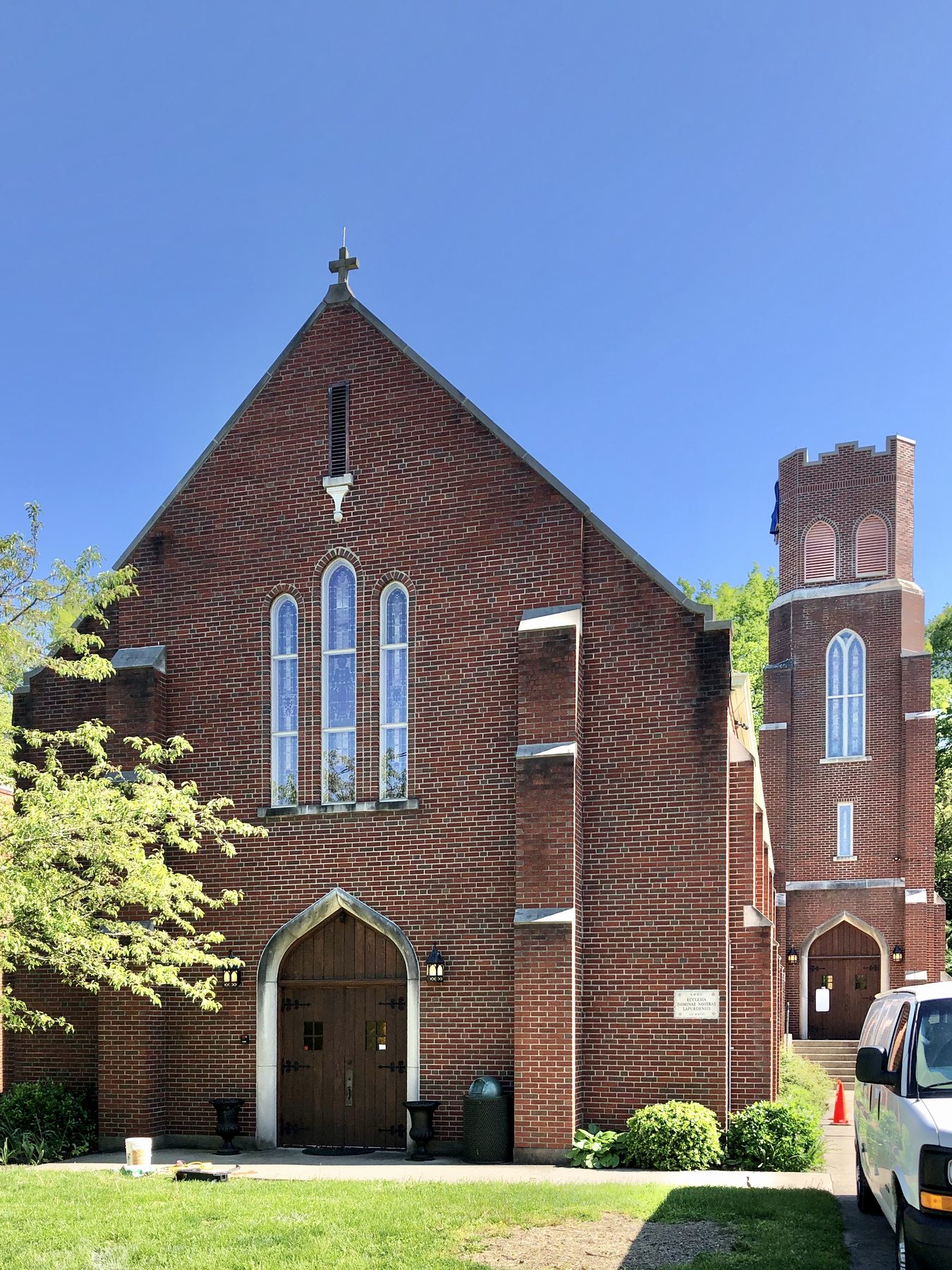
The front of Our Lady of Lourdes church on Amsterdam Road in Park Hills, Kentucky. (Photo: w_lemay, CC0 public domain dedication, via Wikimedia Commons)
The Town Said Yes. Two Neighbors Sued.
In April 2021 the Park Hills Board of Adjustment voted 4-1 to grant a conditional-use permit and setback variances, according to the Kentucky Supreme Court's opinion. The board found the grotto would "contribute to the general well being of the neighborhood or the community." The one no vote said the church was not on an "arterial street," which the town's ordinance requires for church-related permits in a residential zone.
Joel and Elizabeth Frederic, who live across the street, sued. Their main complaint at the hearing was traffic and parking. A Kenton County judge sided with the church. The Kentucky Court of Appeals reversed, and on Dec. 18, 2025 the Kentucky Supreme Court affirmed, vacating the permit for good.
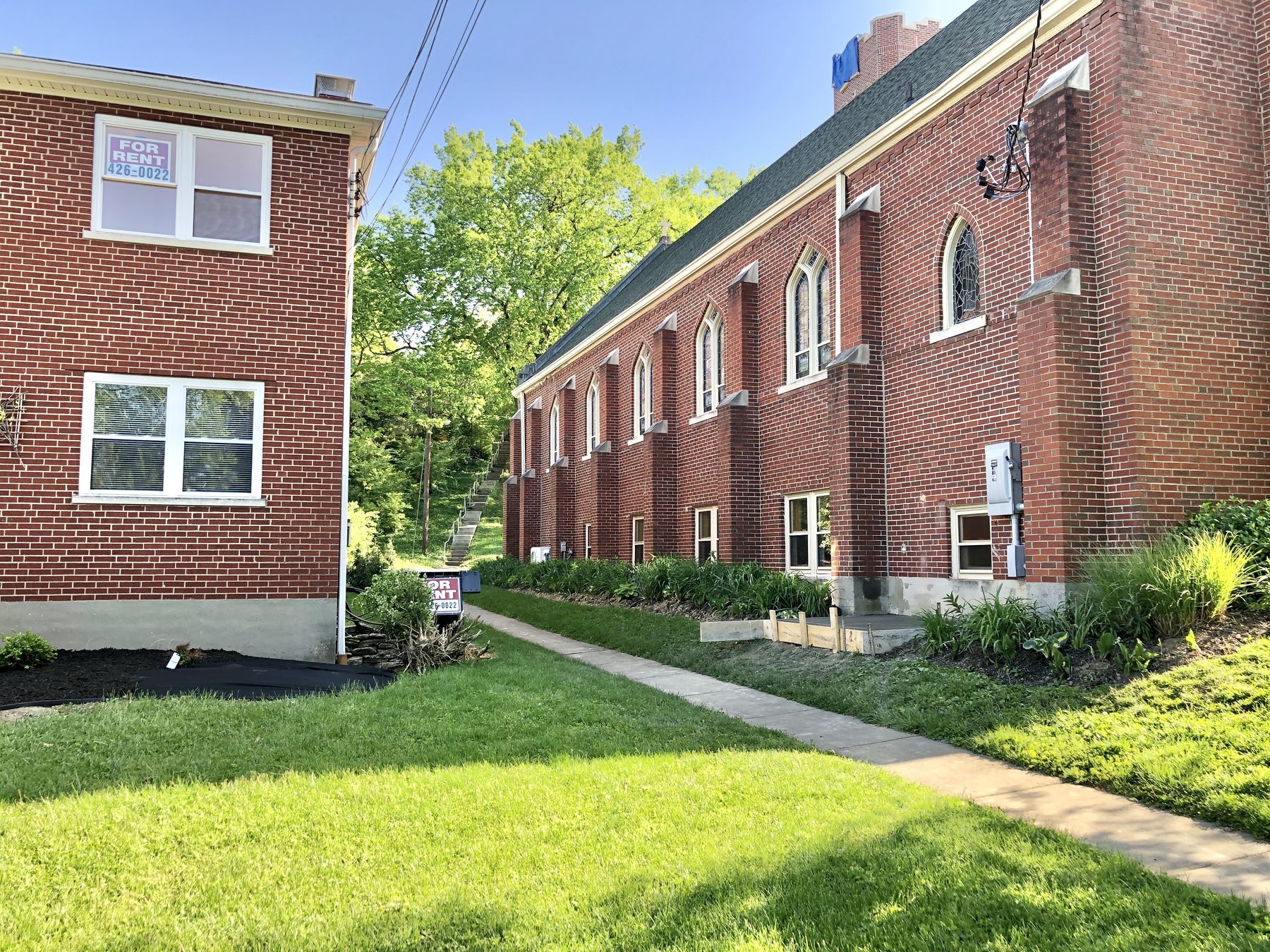
Our Lady of Lourdes sits in a residential zone, a few feet from neighboring apartment buildings. (Photo: w_lemay, CC0 public domain dedication, via Wikimedia Commons)
Kentucky's Justices Called It "a Mere Inconvenience"
The priests' defense rested on the Religious Land Use and Institutionalized Persons Act, or RLUIPA. Congress passed it unanimously in 2000 and President Bill Clinton signed it, as Kentucky Attorney General Russell Coleman's office noted. The law bars any zoning rule that places a "substantial burden" on religious exercise unless the government proves a compelling interest and uses the least restrictive means.
Kentucky's court agreed that building the grotto counts as religious exercise. Then it ruled the burden was not substantial for two reasons. The church could put "a smaller grotto or shrine" on the lot it already owned. And the church had brought the problem on itself, because its own application letter admitted the grotto was "not directly permitted by the current local zoning ordinance."
Official record
Missionaries of Saint John the Baptist, Inc. v. Frederic, 727 S.W.3d 400 (Ky. Dec. 18, 2025), reprinted at pages 1a to 39a of the appendix to the cert petition in No. 25-1131.
"[W]e conclude that St. John's ability to build a smaller shrine or grotto than what it desires falls more into the category of a mere inconvenience than a burden with 'some degree of severity.'"
Supreme Court of Kentucky, page 25a
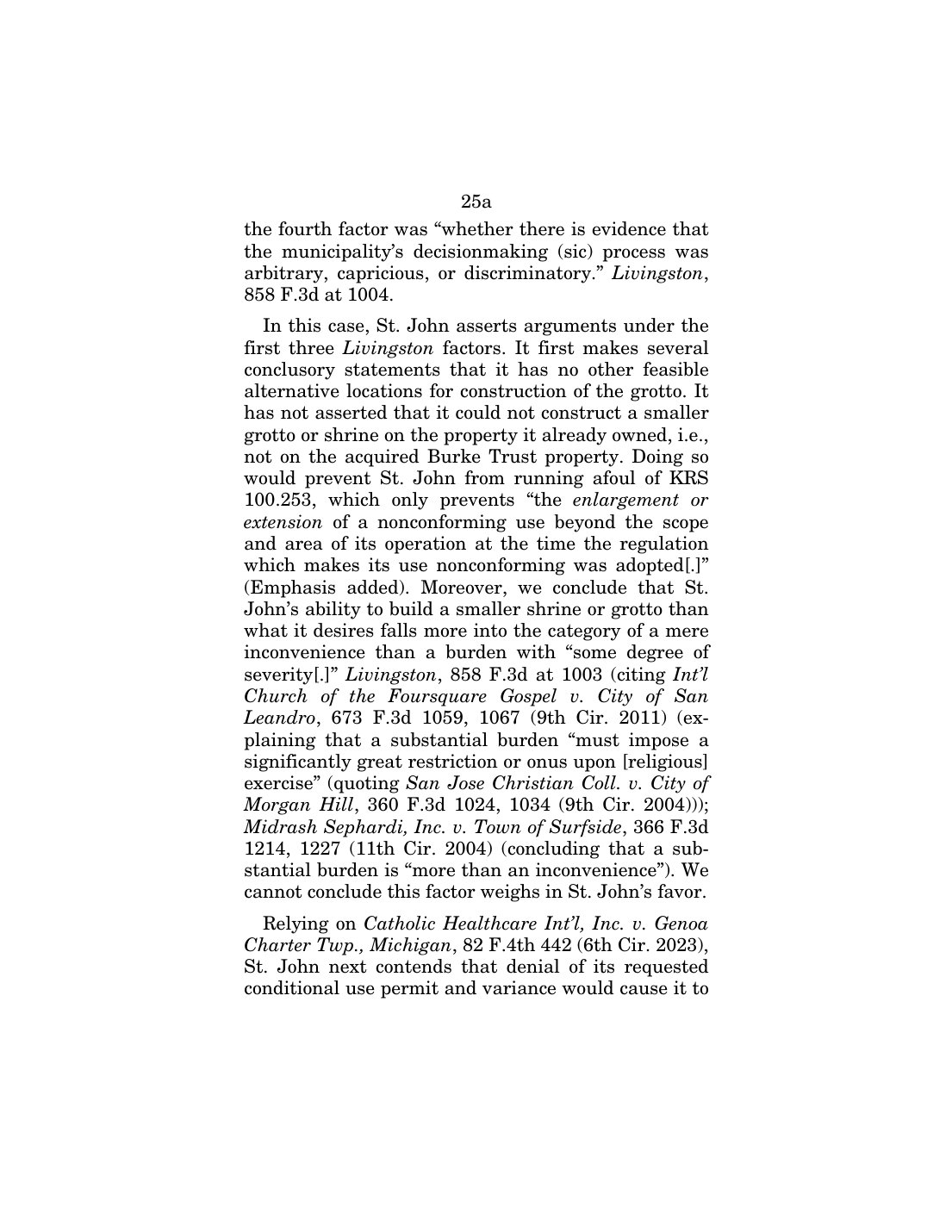
Read or download the full 39-page Kentucky Supreme Court opinion (PDF) · Supreme Court order list, Oct. 1, 2026
Here is a detail worth noticing. Justice Thompson dissented, but not on the shrine. His separate opinion says he agrees "that the Protection of Religious Exercise in Land Use and by Institutionalized Persons Act (RLUIPA) was not violated." He objected only to how the majority treated the town board's state-law authority. So on the federal religious-liberty question, the church lost without a single vote on the Kentucky high court.
What the Justices Actually Agreed to Decide
The petition, filed in March by First Liberty Institute and the law firm Quinn Emanuel, asked two questions. Question 1 asks whether blocking a religious building on a church's own property is a "substantial burden." Question 2 asks whether Park Hills broke RLUIPA's Equal Terms Provision, because its ordinance makes churches sit on arterial streets while public schools, parks, libraries, nursery schools, golf courses and country clubs face no such rule.
The Court's Oct. 1 order list reads: "The petition for a writ of certiorari is granted limited to Question 1 presented by the petition." The golf-course argument is gone. SCOTUSblog's write-up described both of the church's RLUIPA arguments but did not report that the grant was limited. Neither did the EWTN News or Northern Kentucky Tribune reports we read.
That choice tells you what the Court wants. The neighbors' brief in opposition argued that nine of the ten federal circuits to weigh in read the Equal Terms Provision about the same way. Their sharper point was that the church raised it for the first time at the Kentucky Supreme Court, leaving no factual record. On "substantial burden," though, the petition says courts are "deeply divided" and that the Supreme Court "has never construed" the land-use provision in the 26 years since RLUIPA passed.
Why This Matters Far Beyond One Hillside in Kentucky
Kentucky did not invent its test. It adopted the Sixth Circuit's four-factor framework from a 2017 case, Livingston Christian Schools v. Genoa Charter Township, and declared that "henceforth" it governs every land-use religious claim in Kentucky courts. Two of those factors decided this case: whether a "feasible alternative location" exists, and whether the burden is "self-imposed" because the church knew the zoning rules going in.
Think about how far those two factors reach. Almost any church can be told to build something smaller, or somewhere else. Almost every zoning code already restricts what a church can build before the church ever asks. If both of those facts defeat a claim, the "substantial burden" protection Congress wrote could rarely help a congregation that wants to build. The petition quotes RLUIPA's own command that it be "construed in favor of a broad protection of religious exercise, to the maximum extent permitted."
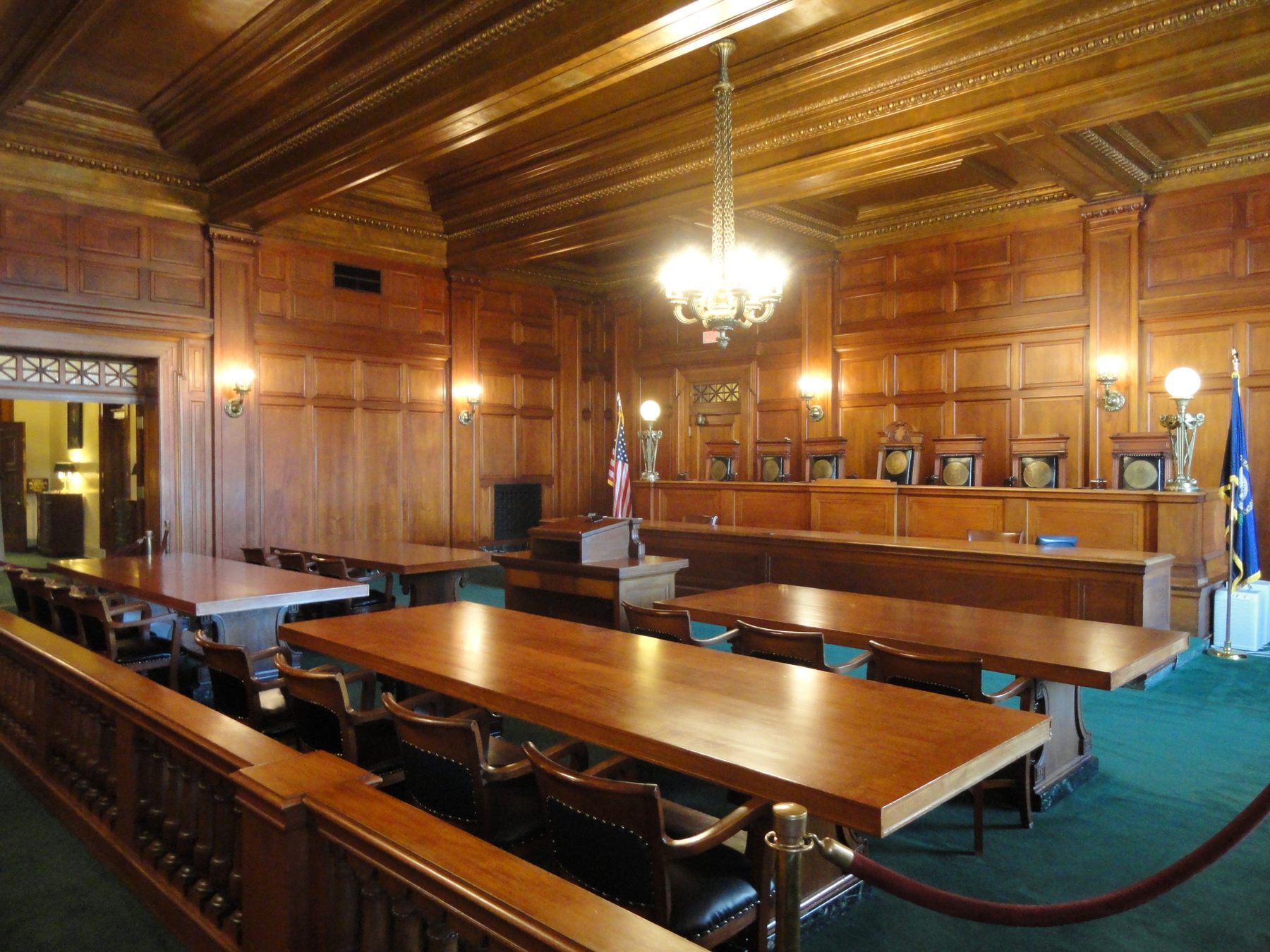
The Supreme Court chamber in the Kentucky State Capitol in Frankfort. (Photo: Daderot, CC0 public domain dedication, via Wikimedia Commons)
Kentucky's Own Attorney General Is Fighting Kentucky's Court
The church has an unusual ally. Coleman, a Republican, sided with the priests at the Kentucky Supreme Court in 2024 and lost. In April he led a 20-state amicus brief asking the U.S. Supreme Court to take the case. Alabama, Arkansas, Florida, Georgia, Idaho, Iowa, Kansas, Louisiana, Mississippi, Missouri, Montana, Nebraska, Oklahoma, Pennsylvania, South Carolina, South Dakota, Tennessee, Utah and West Virginia joined him.
"We're taking Kentucky's fight for religious liberty all the way to the U.S. Supreme Court," Coleman said in an Oct. 1 statement. "For the faithful at Our Lady of Lourdes and for every American, this fundamental freedom must be protected." First Liberty's Kelly Shackelford, quoted by EWTN, called it "outrageous" to tell "a church it can't build a modest place for prayer and reflection on its own property."
The Neighbors Have a Real Argument, Too
The Frederics' lawyers at Skadden, Arps make a point that should not be waved away. The church itself asked Kentucky's top court to adopt the Livingston test, calling it the "correct standard." Now it attacks the result. The brief also argues the case may rest on an independent state-law ground: Kentucky courts held the board had no power to make the "individualized assessment" that triggers RLUIPA's substantial-burden rule at all. If the justices agree, they could dismiss the case without deciding the big question.
The Frederics also contrast this dispute with Apache Stronghold, where the Court declined to hear a tribe's challenge to the destruction of a sacred site. "This zoning dispute over Park Hills traffic," they wrote, "is a far cry" from that. The church's answer is simple. RLUIPA asks whether religious exercise is substantially burdened, and a town forbidding a shrine where the faith says it belongs is a burden on that exercise.
Two RLUIPA Cases in One Term
This is the second RLUIPA land-use case the Court has taken for the 2026-27 term. In June it agreed to hear Grand v. City of University Heights, an Ohio man's challenge over prayer gatherings in his home. That case asks when a religious claimant can sue. The Kentucky case asks the harder question of what counts as a burden once they do.
Arguments are expected early next year, with a ruling likely by summer 2027. For now, the hillside next to Our Lady of Lourdes stays empty. If the justices side with the priests, every town in America will have to think twice before telling a congregation that a smaller, relocated version of its faith is good enough.