A federal judge in Washington on Monday struck down the Trump administration's plan to hold back 20% of roughly $1 billion in homeland security grants from states that refused to check their voter rolls against DHS citizenship data. Read the 24-page opinion and a footnote on page 5 changes the midterm story: the administration's own lawyers told the court that states had "three years to meet" the conditions.
A Biden Appointee Just Wiped Out FEMA's Election Strings
U.S. District Judge Amir Ali issued the memorandum opinion on September 28 in Metropolitan Government of Nashville and Davidson County v. U.S. Department of Homeland Security, Case 1:26-cv-02886. He granted partial summary judgment to six local governments and vacated every election condition FEMA had attached to its fiscal 2026 Homeland Security Grant Program, along with the 20% holdback and FEMA's August 10 guidance memo explaining how to comply.
Ali is a Biden appointee. His core holding is short: the grant statute lets FEMA fund counterterrorism projects that states propose, and it gives the agency no power to "induce states or high-risk urban areas to carry out the federal government's preferred projects at their own expense."
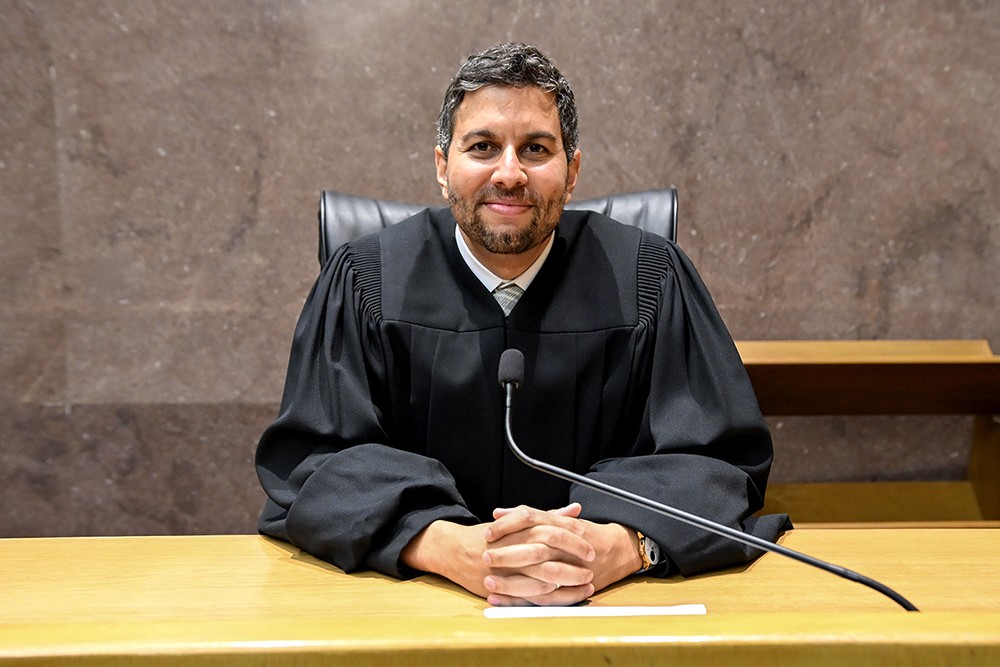
U.S. District Judge Amir Ali of the District of Columbia, who vacated FEMA's election conditions on September 28. (U.S. District Court for the District of Columbia, public domain, via Wikimedia Commons)
What the Conditions Actually Required
FEMA published the requirements in its June 2026 Notice of Funding Opportunity, and the opinion reprints them in full on pages 3 and 4. States and their high-risk urban areas had to submit a plan to move off voting systems that count votes from bar codes or QR codes and onto hand-marked paper ballots. They had to prove compliance with a 5% post-election manual audit and reconcile the number of voters with the number of ballots cast in every federal election.
The two conditions that drew the loudest fight dealt with citizenship. States had to run their entire voter registration database through the federal SAVE system within 120 days of accepting the award and remove verified noncitizens "consistent with applicable law." They also had to verify the citizenship of anyone working a polling place or operating election equipment, including temporary workers and vendors. Until a state proved compliance, FEMA would keep 20% of its grant, a holdback the opinion puts at "over $200 million" nationwide.
DHS Secretary Markwayne Mullin pitched the package this summer as election security. Just the News reported that Mullin warned in an August 24 letter that voting machines built with components from foreign adversaries pose "significant security risks."
Who Sued, and Who Represented Them
The plaintiffs are Nashville's Metro government, the Texas counties of Harris, Dallas, Travis and El Paso, and the city of Columbus, Ohio. All six are big urban jurisdictions that lean Democratic. Their lawyers included the Brennan Center for Justice and Protect Democracy, two left-leaning legal groups that have spent the year fighting the administration's election orders, according to the Brennan Center's own announcement.
"Conditioning our counterterrorism funding on an unproven citizenship-verification system was reckless," El Paso County Attorney Christina Sanchez said in that release. The same statement called SAVE "error-filled." That is the same system the Supreme Court let election officials start using again only three days earlier, when it stayed the injunction against the expanded SAVE check on September 25.
The counties also told the court the conditions would cost real money. Dallas County said it would need $7.25 million in printing equipment to switch to hand-marked ballots, according to page 13 of the opinion. Harris County's clerk swore the county "would not be able to" meet state counting deadlines using only hand-marked paper ballots on its current equipment.
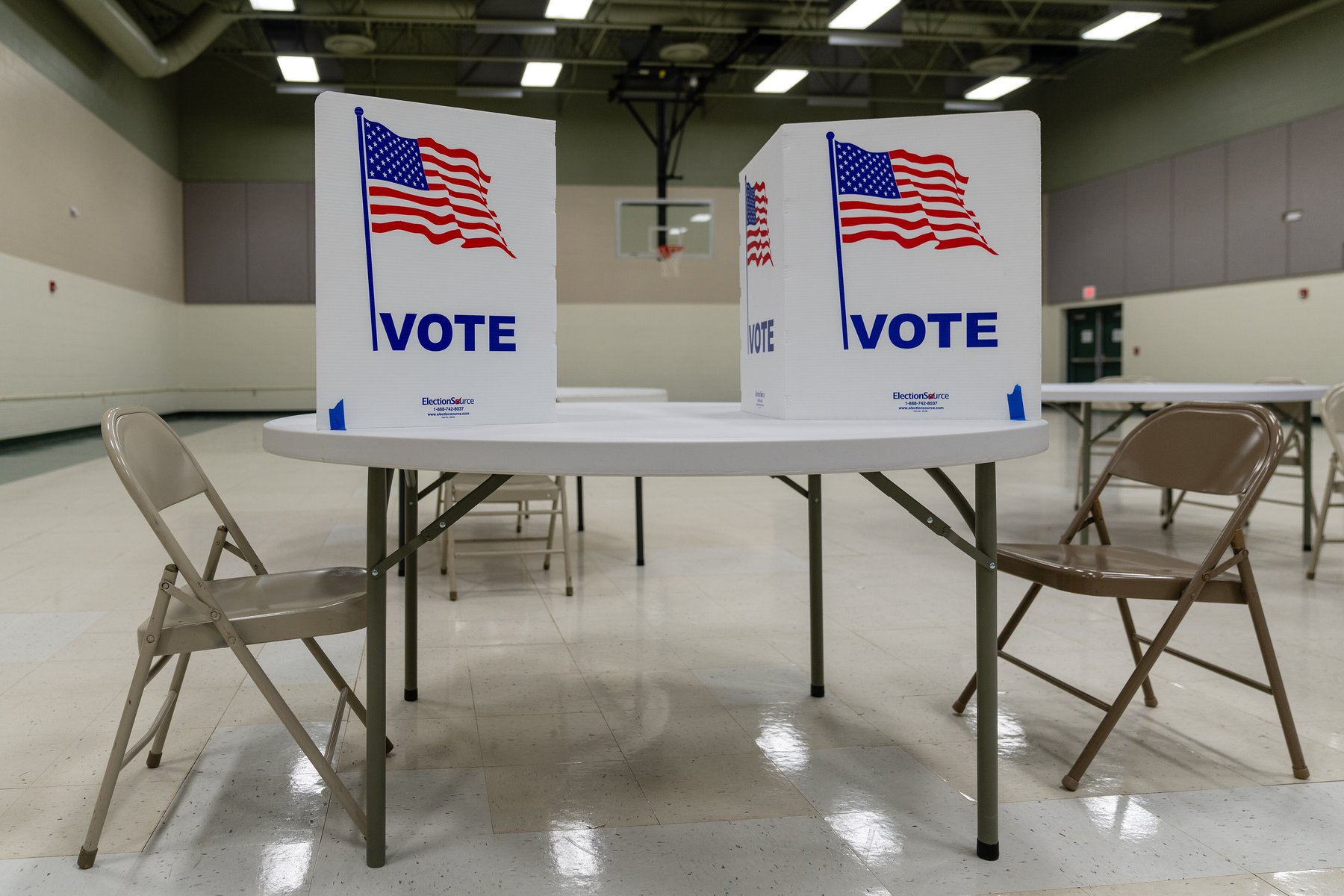
Voting booths inside a combined polling place at Zion Lutheran Church in Grand Rapids, Minnesota, on Election Day 2023. (Photo by Lorie Shaull via Wikimedia Commons, CC BY 2.0)
The Footnote the Headlines Missed
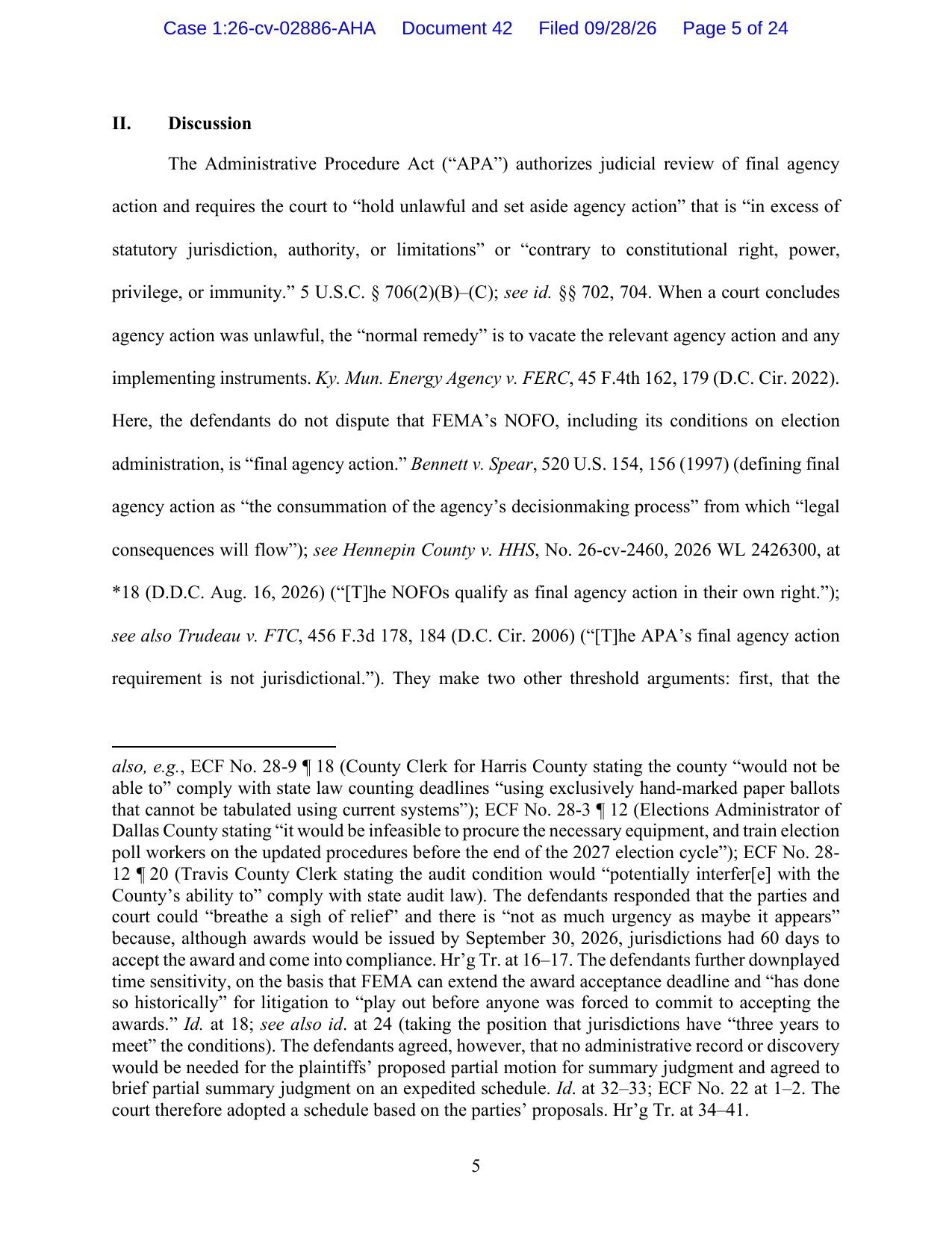
Much of the coverage framed Monday's ruling as a fresh blow to Trump's push to secure the November 3 midterms. Footnote 1 of the opinion shows the administration's own lawyers had already told the judge the conditions were never going to bite before Election Day.
At a September 2 hearing, government counsel said the parties and the court could "breathe a sigh of relief" and that there was "not as much urgency as maybe it appears." Awards would go out by September 30, the lawyers explained, and jurisdictions would then have 60 days to accept. They added that FEMA can extend that deadline and "has done so historically" so litigation can "play out before anyone was forced to commit to accepting the awards."
Then came the line that matters most. Per the opinion, the government took "the position that jurisdictions have 'three years to meet' the conditions." A 60-day acceptance window starting September 30 runs to late November, after the election. Even FEMA's own guidance only set 120-day deadlines for the ballot plan and the SAVE check, counted from acceptance, which lands in 2027. A three-year window runs into 2029. On the administration's own telling in court, the SAVE check and the hand-marked ballot plan were long-range requirements, and Monday's ruling does not change how anyone votes this fall.
Official record
Metropolitan Government of Nashville and Davidson County, Tennessee, et al. v. U.S. Department of Homeland Security, et al., Civil Action No. 26-02886 (AHA) (D.D.C.), Memorandum Opinion, Document 42, filed September 28, 2026. Copy on CourtListener.
"The defendants responded that the parties and court could 'breathe a sigh of relief' and there is 'not as much urgency as maybe it appears' because, although awards would be issued by September 30, 2026, jurisdictions had 60 days to accept the award and come into compliance."
Memorandum Opinion, page 5, footnote 1
Read or download the full 24-page opinion (PDF) · plaintiffs' case page
Six Counties Won Relief for All 50 States
The second thing buried in the opinion is its reach. The government argued that any relief should cover only the six plaintiffs. Ali rejected that on pages 22 and 23, holding that vacatur under the Administrative Procedure Act "is not restricted to the parties before the court." He leaned on Justice Brett Kavanaugh's concurrence in last year's Trump v. CASA, the ruling that reined in universal injunctions, which noted that district courts can still set aside an agency rule for everyone under the APA.
So a lawsuit brought by four Texas counties, one Tennessee metro and one Ohio city now frees every state in the country from the conditions, including Republican-led states that might have been glad to comply. The government also argued the plaintiffs had to drag all 50 states into the case as required parties. The judge called that "not a close argument either" and noted that no state intervened.
The Judge Never Said the Election Rules Were Bad
Read past the headlines and Ali goes out of his way to avoid ruling on whether voter-roll citizenship checks or paper ballot audits are good policy. "The court's analysis does not wade into the policy debate about how to administer elections with integrity," he wrote on page 18. On page 20 he said of FEMA's stated goal of election integrity: "the court does not question that this may be a laudable goal, but it is not a counterterrorism goal."
He also wrote that "any state that wishes to adopt those conditions on its own remains free to do so." The ruling leaves standing a separate NOFO requirement that grant recipients spend at least 3% of their awards on physical and cyber election security, something the plaintiffs never challenged. It also says the statute "would plainly authorize" FEMA to fund protection against terrorist attacks on election infrastructure.
The opinion does take a shot at how Washington defended the rules. Ali wrote that the government "largely do[es] not defend any of FEMA's election administration conditions on their own terms," lumping them together under the label "Election Security Conditions." He found no explanation of how SAVE checks or poll-worker vetting tie back to "shoring up vulnerabilities to terrorist attacks."
What Comes Next for Election Integrity
The administration can take this to the D.C. Circuit, and FEMA's September 30 award deadline means the grants should now go out without the 20% holdback unless a higher court steps in. UPI's report on the ruling carried no response from DHS or FEMA, and we found no announced appeal as of Tuesday morning.
The bigger lesson is where this fight belongs. Ali's reasoning rests on the text Congress wrote in 2007, which lists threats such as biological, chemical, cyber, nuclear and explosive attacks and says nothing about ballots. He also invoked the major questions doctrine, the same tool conservative justices used against Biden's student-loan forgiveness in Biden v. Nebraska. If Republicans want citizenship checks on every voter roll, the durable path runs through Congress or through the states themselves, where the ruling says those rules are still fair game.
For November 3, voters in Texas, Tennessee, Ohio and everywhere else will cast ballots under their states' existing rules either way. The government's own lawyers said as much in September.
Top photo: FEMA and Department of Homeland Security seal on the agency's headquarters building in Washington, D.C., February 2025. (Photo by G. Edward Johnson via Wikimedia Commons, CC BY 4.0)