The Institute for Supply Management's factory price gauge registered 71.1 percent for August, unchanged from July and the 23rd consecutive month American manufacturers reported paying more for raw materials. Of the 18 industries ISM surveys, 15 said their input costs rose in August. Not one said they fell.
Manufacturing growth is cooling. The cost side is not moving at all.
ISM issued the report Tuesday. The headline Manufacturing PMI came in at 54.6 percent, a full point below July's 55.6, and short of the 55.2 the street expected. New orders fell three points to 53.7. Order backlogs fell 3.2 points to 51.8. The employment index slid to 51.2 against an expected 53.0.
Every one of those numbers got worse. The Prices Index did not budge. Survey chair Susan Spence pinned the reading on steel and aluminum prices working through the entire value chain, plus tariffs on many imported goods. She also named petroleum-based products, which have gotten dearer because of the Middle East conflict now working through the refinery system. Pricing volatility turned up in 57 percent of panelists' negative comments. Tariffs turned up in 29 percent.
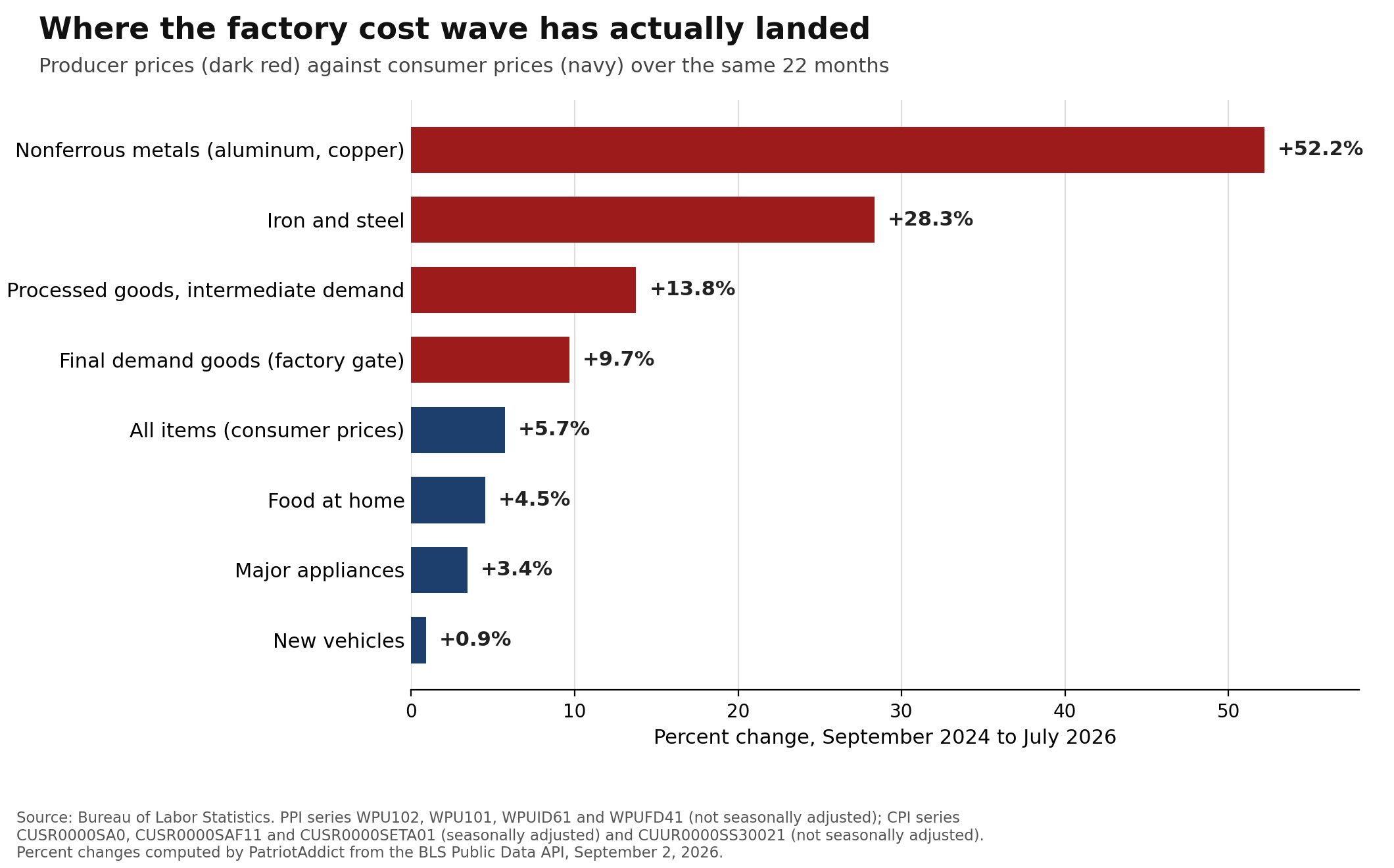
Percent change in eight Bureau of Labor Statistics price indexes over the 22 months from September 2024 to July 2026, the window ISM's price streak covers. Chart built by PatriotAddict from the BLS Public Data API; series identifiers and seasonal-adjustment status are printed on the chart.
Twenty-three months of rising metal prices had to land somewhere
We pulled the BLS series and ran the numbers rather than take a summary for it. ISM's own report says a Prices Index above 52.8 percent, sustained over time, lines up with a rise in the BLS producer price index for intermediate materials. It has been north of 70 all summer. BLS agrees.
Over those 22 months the producer price index for nonferrous metals, meaning the aluminum and copper family, rose 52.2 percent. Iron and steel rose 28.3 percent. Processed goods for intermediate demand, the material that goes into other material, rose 13.8 percent. Finished goods leaving the factory gate rose 9.7 percent. Consumer prices for all items rose 5.7 percent. New vehicle prices rose 0.9 percent.
These are separate baskets, not one accounting identity, so the shrinkage at each step is a direction and not a receipt. The direction is still unmistakable. The cost wave is real at the front of the chain and it gets smaller at every step toward the register. Major appliances, built out of the metal that went up 52 percent, are up 3.4 percent.
So who is paying for it?
Manufacturers are, for now, and the employment index is where that shows. It fell 1.6 points in August, and the ratio of positive to negative hiring comments fell with it. A Machinery panelist told ISM that suppliers are quoting fast-rising energy, steel and labor costs, and that the company has "moved more products to offshore sources to try to minimize cost impacts." A Transportation Equipment panelist said high steel and aluminum prices "continue to make profitability a challenge," and a second panelist in that same industry said its main customer is shifting production from U.S. plants to Mexico plants.
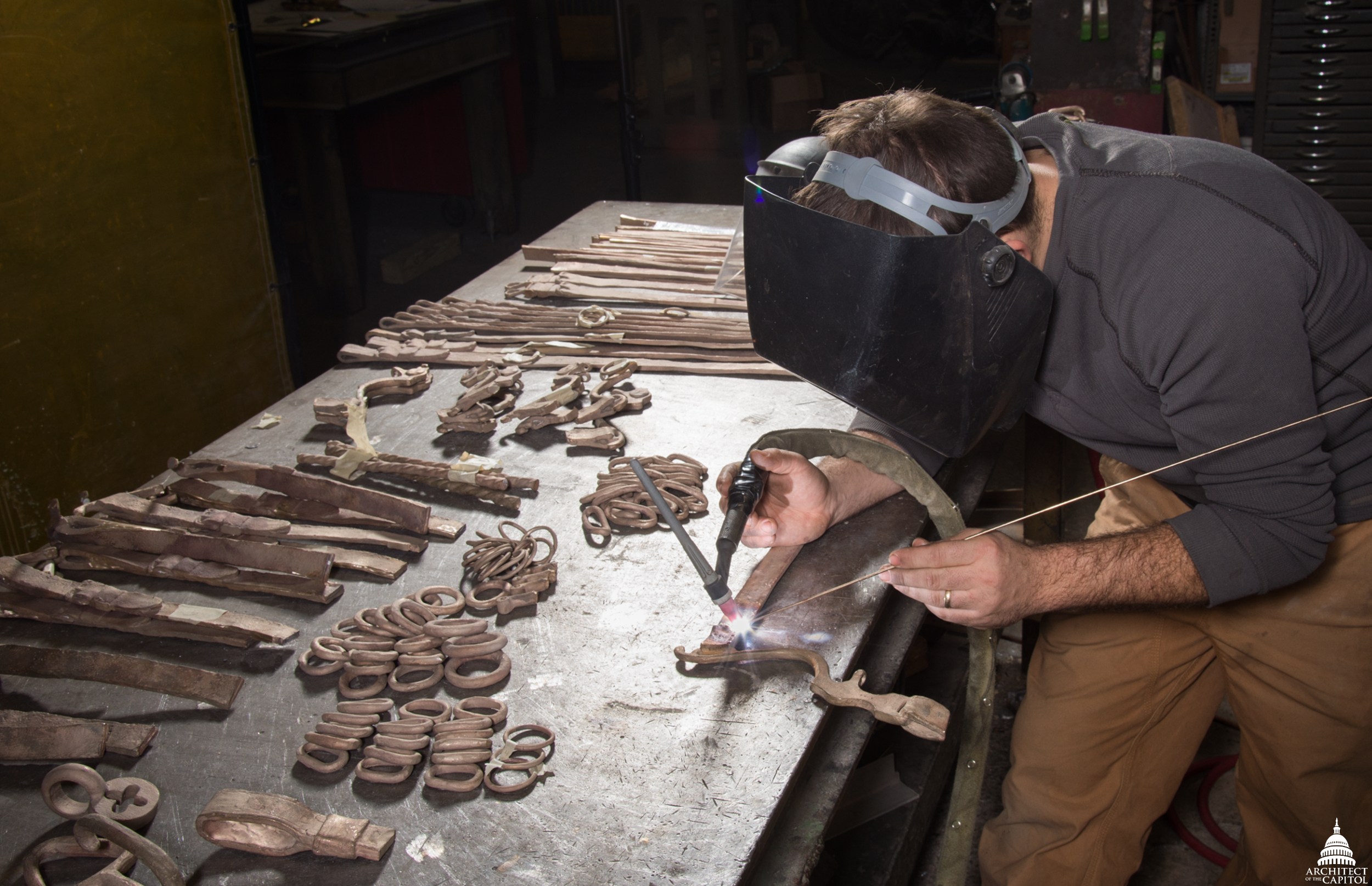
A metalworker finishes freshly cast bronze elements at a Philadelphia foundry in January 2016, during a restoration project for the U.S. Capitol. Fabricated Metal Products was one of the 15 ISM industries reporting higher raw-material prices in August. (Architect of the Capitol, public domain.)
The administration's own paperwork concedes the shortage is still there
Aluminum has been on ISM's list of commodities up in price for 33 straight months, longer than any other item, though ISM also carries it on the down-in-price list for a minority of panelists. Steel has been up for 10 months. That is not a mystery. In Proclamation 11021, signed April 2, the President set a 50 percent duty on aluminum, steel and copper products, 25 percent on derivative products mostly made of those metals, and a temporarily reduced 15 percent on fixed industrial machinery and power equipment.
What makes the July follow-up worth reading is the admission inside it. Eight years into Section 232, the Commerce Secretary reported that domestic primary aluminum is still short.
Official record
Proclamation 11045 of July 20, 2026, "Further Strengthening Actions Taken To Adjust Imports of Aluminum Into the United States," 4 pp., published at 91 FR 46635 on July 23, 2026. View it on the Federal Register.
"The Secretary has informed and advised me of his opinion that, despite the benefits from the aluminum tariff regime, the domestic production and supply of primary aluminum, which is critical to the U.S. economy and defense industrial base, is still in insufficient supply." — Proclamation 11045, paragraph 5
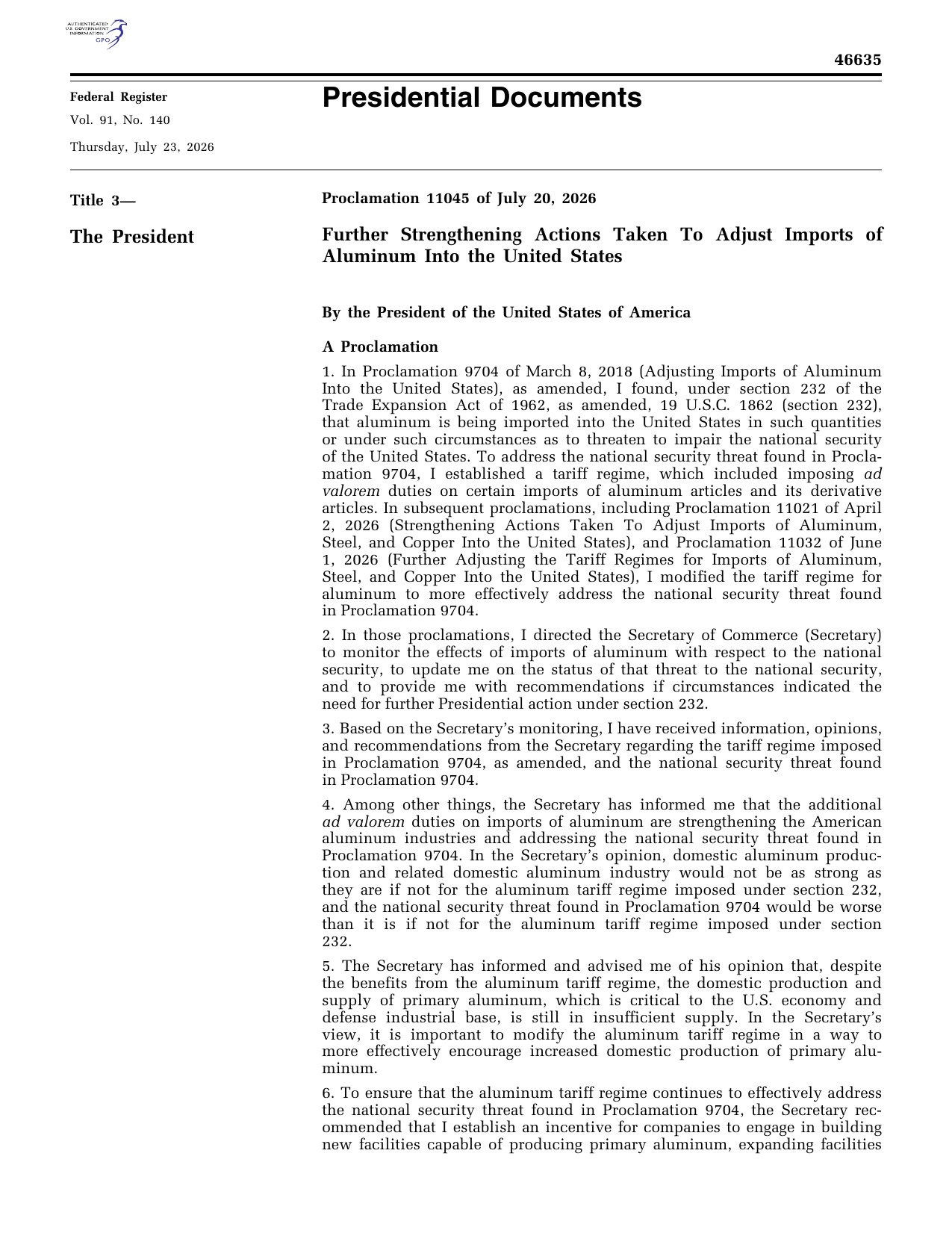
Page 1 of Proclamation 11045 as printed in the Federal Register. Read or download the full 4-page proclamation (PDF), or view it on the official Federal Register page linked above. (Government Publishing Office, public domain.)
Clause 1 lets Commerce approve "onshoring plans" from companies that commit to build or expand a U.S. primary aluminum facility, with construction starting by January 20, 2029. Approved firms then import primary aluminum at half the Section 232 rate, in a volume matched to what the new plant should produce. That trade only makes sense if the metal is genuinely scarce.
What to watch in the next two weeks
The front of the pipeline is still filling. Iron and steel producer prices hit 374.100 in July, the highest since August 2022, after eight straight monthly increases. Nonferrous metals sat at 526.133, a level only two months have exceeded since 2007, and both of those were earlier this year. None of that has worked its way to a store shelf yet.
BLS has August consumer prices scheduled for September 11. If they come in soft again, the gap in that chart gets wider, which means factory margins and factory payrolls are still absorbing the hit. If they come in hot, the absorbing is over. Either way the bill exists, and the only open question is whose name is on it.
Header photo: the steel plant on the Cuyahoga River in Cleveland, Ohio, photographed December 19, 2016, by Roy Luck, used under the Creative Commons Attribution 2.0 Generic license.