Yale University told reporters from three news organizations they could not cover a September 1 rally on its campus and ordered them off university property. The rally was a protest against Yale's own limits on speech and assembly.
Who told the press to leave, and who got shut out
Two Yale public affairs staffers, Fred Mamoun and Bess Connolly, delivered the instruction as the event was starting. Connecticut Public reported that they told reporters from Connecticut Public, Hearst Connecticut Media Group and the Chronicle of Higher Education "that they were not allowed to cover the event on campus," and that "the reporters were told to leave university property." Speakers gave interviews afterward on a public sidewalk off campus.
The Connecticut Mirror logged the same thing, noting in a parenthetical that journalists "were not allowed to attend and would have to wait by the street." Hundreds turned out on Cross Campus. Organizers timed the rally to collide with a mandatory program for incoming freshmen titled "The University and Democracy."
What the protest was actually about
The coalition calls itself Democratize Yale, and it has four demands: change how trustees are picked, expand free expression protections and limit university interference in peaceful demonstrations, write academic freedom commitments into the faculty handbook, and walk away from settlement talks with the Justice Department over admissions.
"Yale is cracking down on free speech and assembly," Yale College Council President Alex Chen told the crowd, according to the Connecticut Mirror. "It is negotiating with the Department of Justice over an unfounded admissions investigation, and refusing to codify academic freedom protections for its faculty, all under the governance of an undemocratic, unaccountable Board of Trustees."
A Yale spokesperson told Connecticut Public the university keeps a "longstanding dedication to academic freedom, free expression, and constructive dialogue across differences," and confirmed the Justice Department is investigating admissions at the medical school, Yale College and the law school. The spokesperson would not discuss an ongoing legal matter.
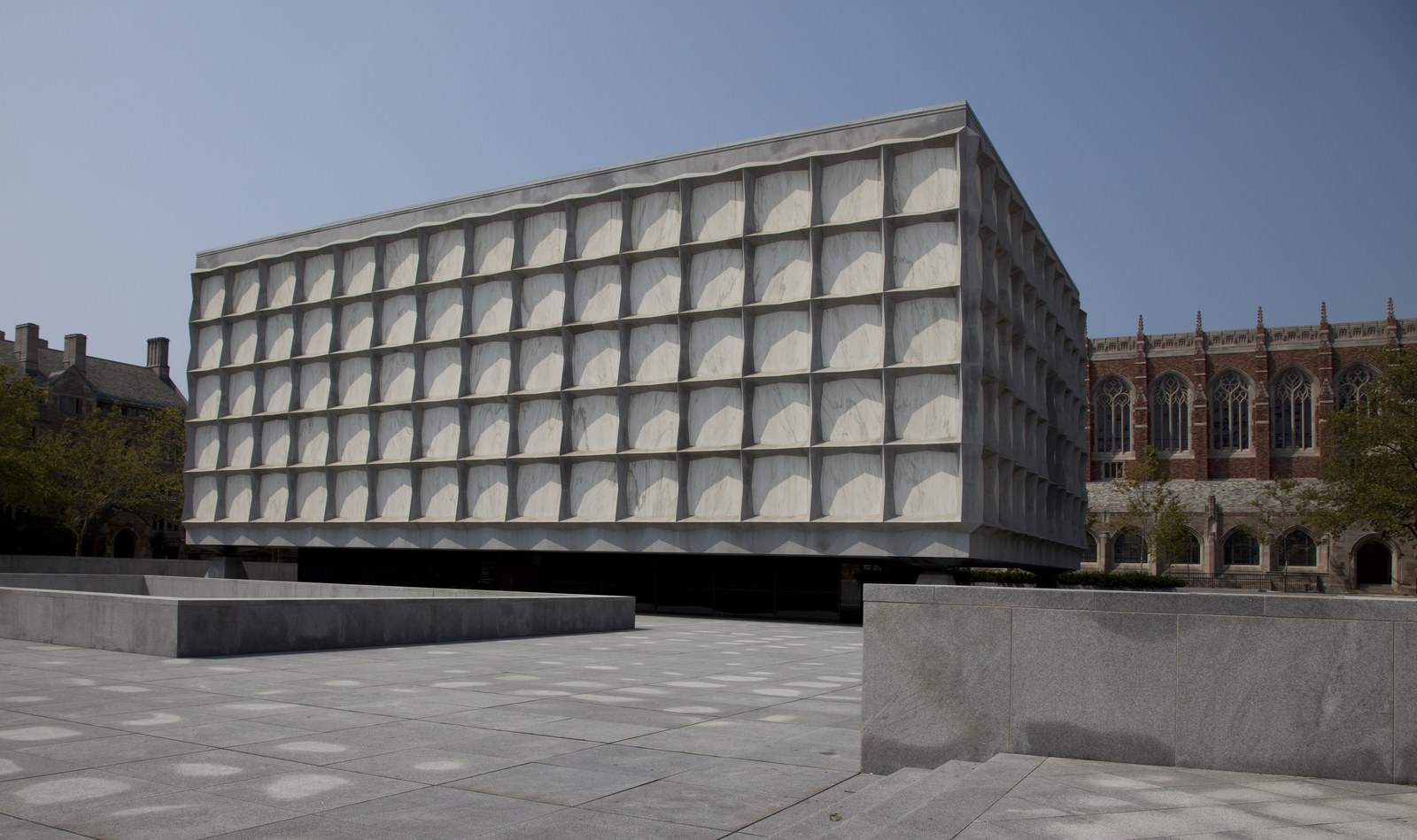
Beinecke Plaza at Yale, where university police arrested dozens of protesters in April 2024. The rules Yale wrote afterward are among the things Democratize Yale wants repealed. (Carol M. Highsmith via Wikimedia Commons, public domain)
The Justice Department says Yale picked medical students by race
The investigation the protesters call unfounded produced a six-page letter of findings on May 14. The Civil Rights Division concluded that Yale's medical school violated Title VI of the Civil Rights Act in the incoming classes of 2023, 2024 and 2025, and that the discrimination is ongoing.
The letter is worth reading rather than taking anyone's word for. It cites an internal Yale admissions retreat presentation titled "Race-Neutral Admissions: Examples from Literature" that it says "draws a roadmap for using racial proxies to circumvent Harvard's prohibition on racial discrimination." It flags a 2024 guidance slide bearing only the words "Admissions post-SCOTUS," which the Department reads as a sign that instructions on race were given verbally and never written down.
Official record
Letter of Findings, Yale School of Medicine, U.S. Department of Justice Civil Rights Division, May 14, 2026, addressed to Yale's outside counsel at Hogan Lovells.
"Based on our preliminary review of the applicant-level data, Yale's use of race resulted in a Black applicant being as much as 29 times higher odds of getting an interview for admission than an equally strong Asian applicant with similar academic credentials." — Letter of Findings, page 5
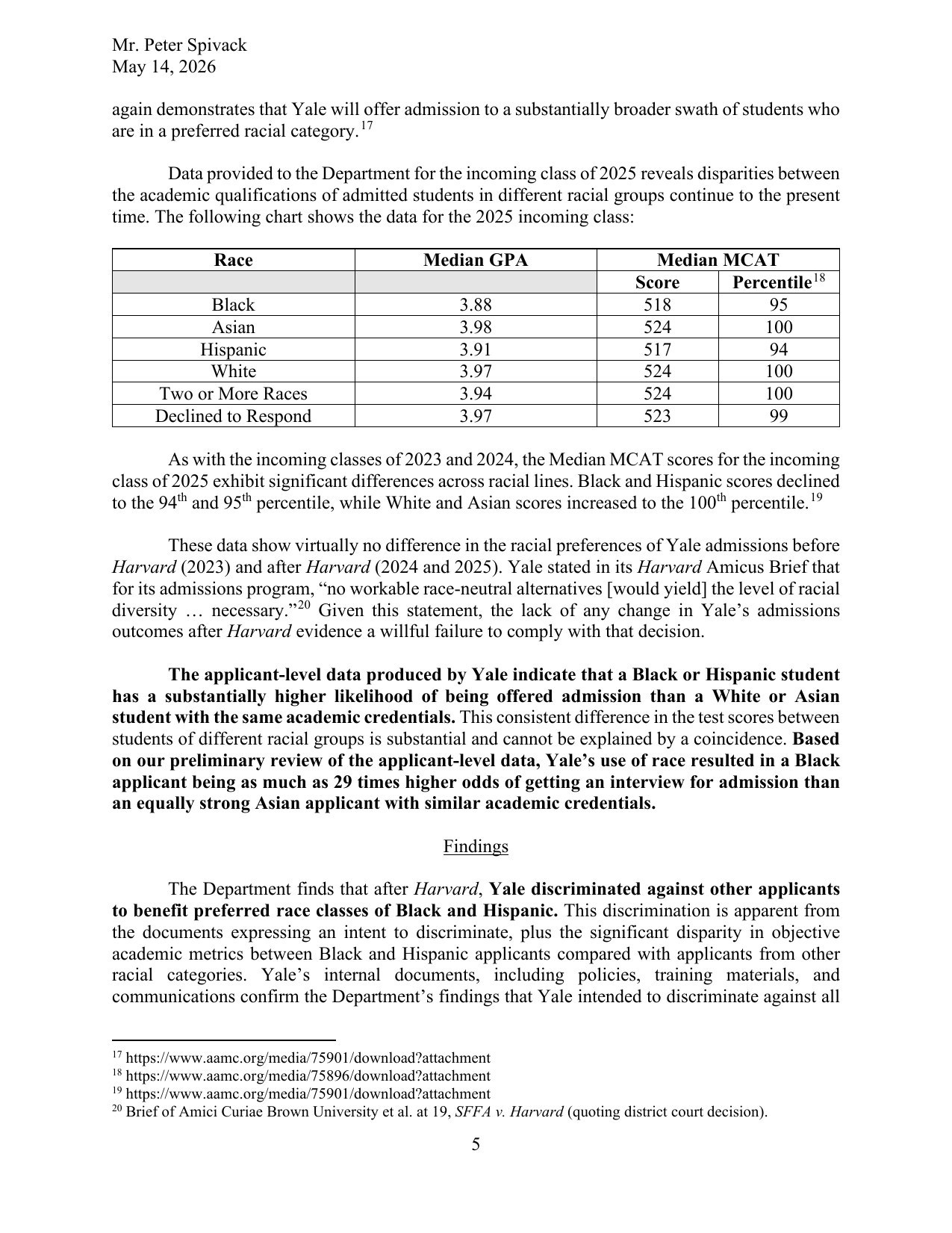
Read or download the full 6-page letter of findings (PDF) · view the copy hosted by the Justice Department
The faculty complaint about the numbers is not baseless
In July, lawyers at Sher Tremonte working with Yale's American Association of University Professors chapter wrote to President Maurie McInnis calling the findings bogus and "cherry-picked, statistically weak, and presented without appropriate context or support in the record."
On the statistics they have a point that deserves saying out loud. The letter's tables are medians, not a regression. For the class of 2025 it reports a median MCAT at the 95th percentile for Black admits against the 100th for White and Asian admits, and median GPAs of 3.88 against 3.97. Those gaps hold across all three years, but they amount to five percentile points and about a tenth of a grade point. The dramatic 29-to-1 figure appears once, and the Department labels it preliminary.
Why Yale is at the table anyway
Because the alternative is a lawsuit, and the Department said so five days before the rally. Announcing a nearly identical finding against George Washington University's medical school on August 27, the Civil Rights Division wrote that where it finds a violation it pursues a settlement, and "if those efforts fail, the Department will file suit." Yale hired McGuireWoods, the firm that handled the University of Virginia's settlement.
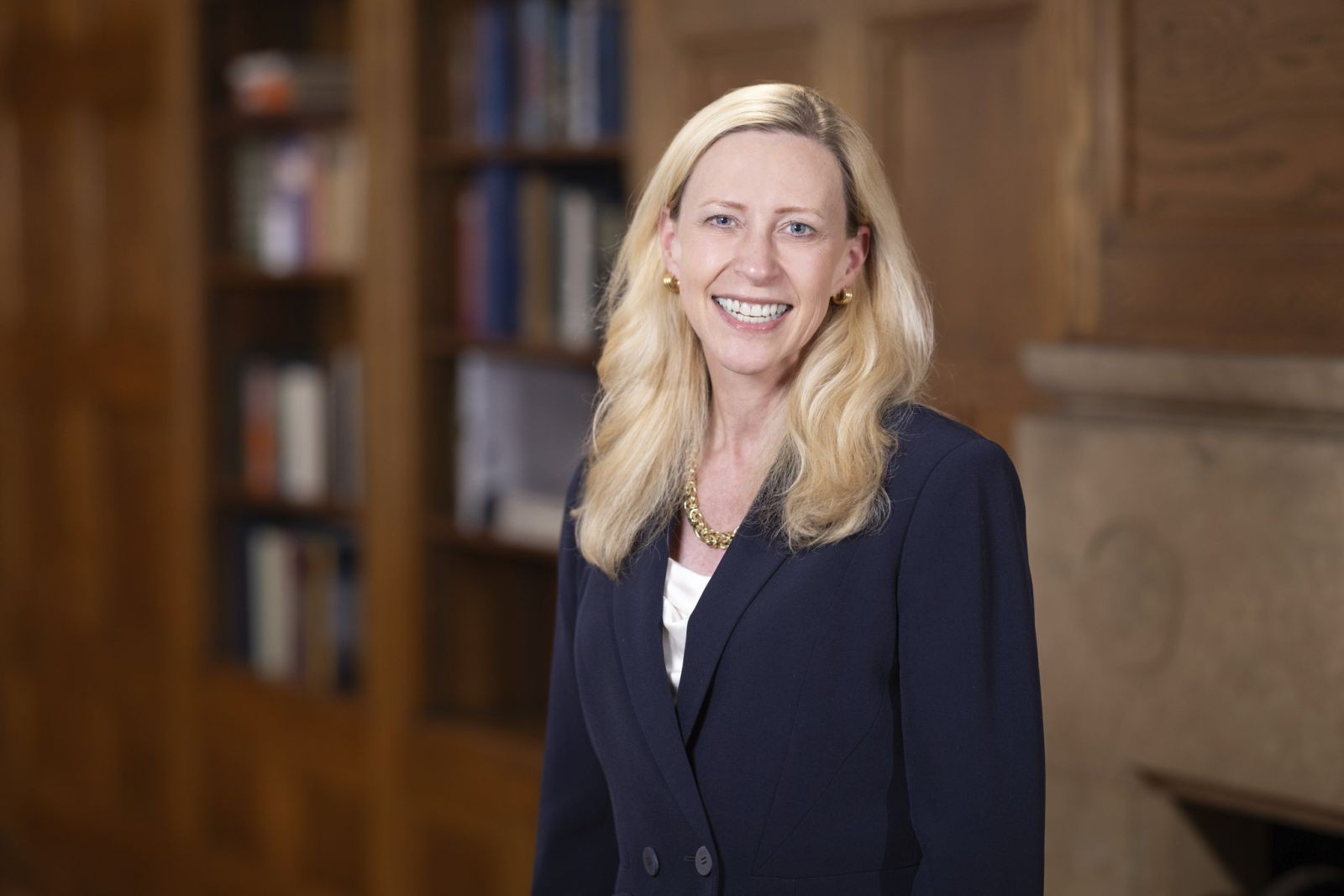
Yale President Maurie McInnis, who is continuing the settlement negotiations the September 1 rally was organized to stop. (Yale University via Wikimedia Commons, CC BY 4.0)
The irony nobody at the podium mentioned
Yale's own speech record does not support the picture of a university defending open inquiry against Washington. After the April 2024 encampment, when campus police arrested dozens of protesters on Beinecke Plaza, the university rewrote its outdoor-space rules. Yale's current policy requires events to end by 11 p.m., bars sleeping outdoors overnight, and accepts space requests only from registered groups in good standing. FIRE's most recent College Free Speech Rankings put Yale 58th of 257 schools with a D-minus speech climate grade.
The fight at Yale does not divide neatly into one side defending speech and one side attacking it. The faculty want the university to stop letting the federal government set its admissions standards. The Justice Department wants Yale to stop selecting doctors by skin color. Both have a real case to make, and Yale will have to answer one of them in writing. Its answer to the other was to tell three newsrooms to get off the grass.