

A federal judge in Oregon ruled Monday that ICE "routinely violated" a court order limiting warrantless immigration arrests, and found that one officer lied in an official record. The ruling is real and harsh, but what it orders is narrower than the headlines: more disclosure, not a halt to arrests.
What did the judge actually find?
U.S. District Judge Mustafa Kasubhai issued the opinion and order on Nov. 2 in M-J-M-A v. Hernandez, No. 6:25-cv-02011. It grants a motion by the plaintiffs to enforce a preliminary injunction he issued in February. The order says "Defendants have routinely violated the terms of the Court's preliminary injunction order" and that ICE agents in Oregon "have continued to conduct warrantless arrests" without the required pre-arrest determination.
I read the order through a text extraction of the PDF, and the last few pages were cut off, so I could not see the closing section. Everything below comes from the portion I could read, plus KATU's report on the ruling.
What rule was ICE supposed to follow?
Federal law lets immigration officers arrest without a warrant only in narrow cases. The order describes the statute, 8 U.S.C. 1357(a)(2), as requiring probable cause that the person is in the country illegally and is "likely to escape before a warrant can be obtained." The judge's February injunction says officers must make that escape-risk judgment about the individual, before the arrest, based on facts they know at that moment.
The injunction covers civil immigration arrests in the District of Oregon only. It does not bar arrests made with a warrant, and the government's appeal of the injunction is still pending, according to the order.
Official record
Opinion and Order, M-J-M-A v. Hernandez, U.S. District Court, District of Oregon, Nov. 2, 2026 (page numbers per the PDF).
"Defendants have routinely violated the terms of the Court's preliminary injunction order." (p. 40)
"Such disclosure might not be necessary if Defendants conducted and documented warrantless immigration arrests lawfully." (p. 45)
How many arrests are we talking about?
The order says ICE arrested 574 people in Oregon from Feb. 5 to July 31, and 504 of those were non-custodial arrests. The government reported only 13 warrantless arrests in the period through Aug. 5. The judge found that ICE officers "conducted significantly more than thirteen warrantless arrests." He did not name a new total in the pages I read.
That matters for fairness. The ruling does not say all 574 arrests were unlawful. It says the government's own count of warrantless ones was too low to trust.
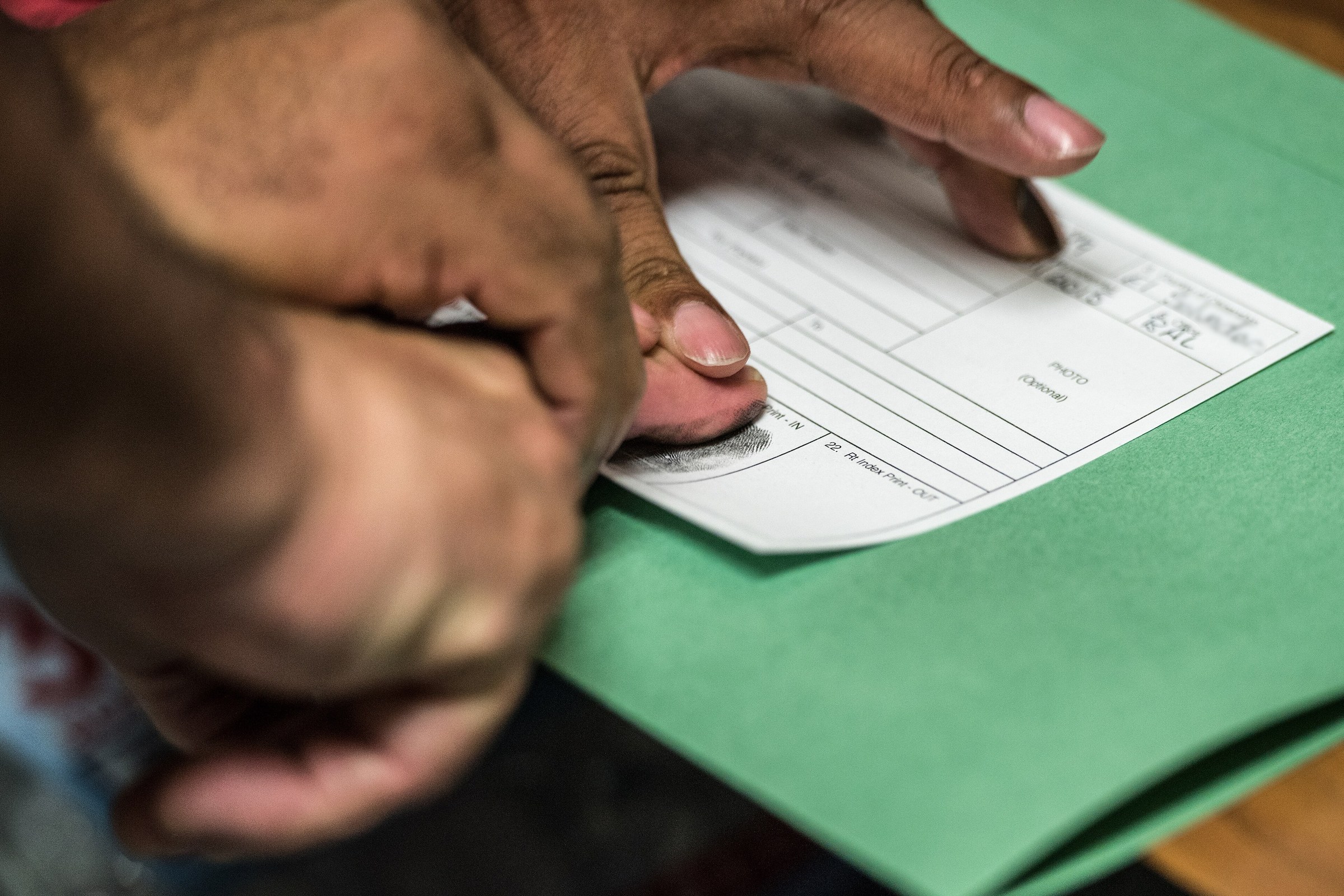
A fingerprint card being completed during immigration processing. File photo, not from Oregon. Photo: U.S. Immigration and Customs Enforcement via Wikimedia Commons (public domain). Cropped and resized.
Did an officer really lie?
The order says yes, for one officer. In the case of a man identified as H-D-G-H-, the officer admitted the Form I-213 narrative was inaccurate, and the court wrote: "This Court found he lied after evaluating his live testimony and the documentary evidence." KATU reports the incident was a July arrest at Emigrant Lake, where the report said the man had a warrant and the officer later testified that was wrong.
The judge found problems in two other arrests, including a wrong vehicle and location in one I-213. He also found one encounter was a lawful investigatory stop supported by reasonable suspicion, not an unlawful arrest. So the record is mixed: several documented violations, and one finding for the government. He also wrote that ICE "is not capable or competent in conducting its investigative and enforcement activities with integrity," a sweeping line that rests on the paperwork errors in this record.
What does the order require now?
It orders ICE to resend the injunction to its officers, employees and contractors every 30 days and certify that to the court. It orders documents produced without redactions and widens disclosure to I-200s, I-213s and the underlying evidence. Body-worn camera footage is required only for arrests on or after Sept. 1, 2026.
It also declines a request to bar reliance on a DHS memo the parties call the Lyons memo. The judge said the record does not show Oregon officers relied on it, and the request "may be renewed." Nothing in the pages I read stops ICE from making lawful arrests, and DHS and ICE did not respond to KATU's request for comment.
What to watch
The government can still win or lose on appeal, and the same appeal may test how far a district court can go while it is pending. The judge says he has authority to enforce the order meanwhile. Whether any officer is disciplined, or whether DHS answers the 574-versus-13 gap on the record, is the next thing to look for.
Header photo: ICE Enforcement and Removal Operations officers conducting an arrest. File photo, not from Oregon. Photo: U.S. Immigration and Customs Enforcement via Wikimedia Commons, public domain. Resized.















