

Headlines say a federal judge threw out the Justice Department's bid to block certification of Alaska's Senate race if Sen. Dan Sullivan loses. The 20-page order says something narrower and more useful to know: the court never decided whether the "decoy" candidate was a scheme, and it dismissed the case because no judge could order the remedy without breaking ballot secrecy.
What did DOJ actually ask the court to do?
In United States v. State of Alaska, No. 3:26-cv-00376, filed Oct. 22, DOJ argued that a second candidate, Daniel J. Sullivan Jr., would confuse voters and could hand the seat to Democrat Mary Peltola. According to the Order Dismissing Action signed by Judge Sharon Gleason, the amended complaint cited the National Voter Registration Act and the Supremacy Clause.
Its requested relief was to bar Alaska from certifying "any result that may be impacted by voter confusion" while an investigation determined whether votes for Daniel J. were meant for Dan S. The order describes a result as "impacted" if the incumbent loses but would have won had every Daniel J. vote gone to him under ranked-choice counting.
Official record
U.S. District Court for the District of Alaska, Order Dismissing Action, Document 79, filed Nov. 1, 2026 (Judge Sharon L. Gleason).
"Simply, the Court cannot grant the United States the relief it seeks because the United States has failed to establish the redressability prerequisite for Article III standing." (p. 12)
"the United States provides no workable plan as to how it proposes to segregate ballots cast for Daniel J. Sullivan on Election Day and then conduct a court-ordered unspecified 'investigation' of those ballots in a manner that would preserve voter secrecy." (p. 14)
Did the judge rule that the decoy claim was wrong?
No. Gleason wrote that the facts in the amended complaint "are accepted as true for the purpose of deciding the motions to dismiss." She decided only standing, specifically whether a court order could fix the harm DOJ described. Because a court without standing "is powerless to reach the merits," the dismissal is without prejudice, which the order notes in a footnote.
That matches what a DOJ spokesperson said, as reported by CBS News: the judge ruled on procedural grounds and did not dispute DOJ's argument. I read CBS's account, not a DOJ statement, so the wording is secondhand. The order is also not a win for the decoy theory. It records that the state elections director "de-certified" Daniel J.'s candidacy in June, and that the Alaska Superior Court found the decision was not based on applicable law, a ruling the Alaska Supreme Court summarily affirmed on June 29.
Why was the remedy the sticking point?
Alaska's argument, which the judge adopted, was that no ballot marking reveals why someone voted for Daniel J. Ballots are separated from voter identity and mixed together, and the state constitution says "Secrecy of voting shall be preserved." The order says DOJ answered with a single sentence about segregating ballots and gave "no rebuttal" on secrecy.
The judge also quoted an Oct. 30 press conference by the U.S. Attorney for Alaska, who said law enforcement was working "to make sure that your vote counts in a way that you meant and intended it to count." Gleason wrote that this statement, with no explanation in DOJ's filings, could leave voters worried about "law enforcement officers" pursuing "a court-ordered investigation of their intent in the voting booth."
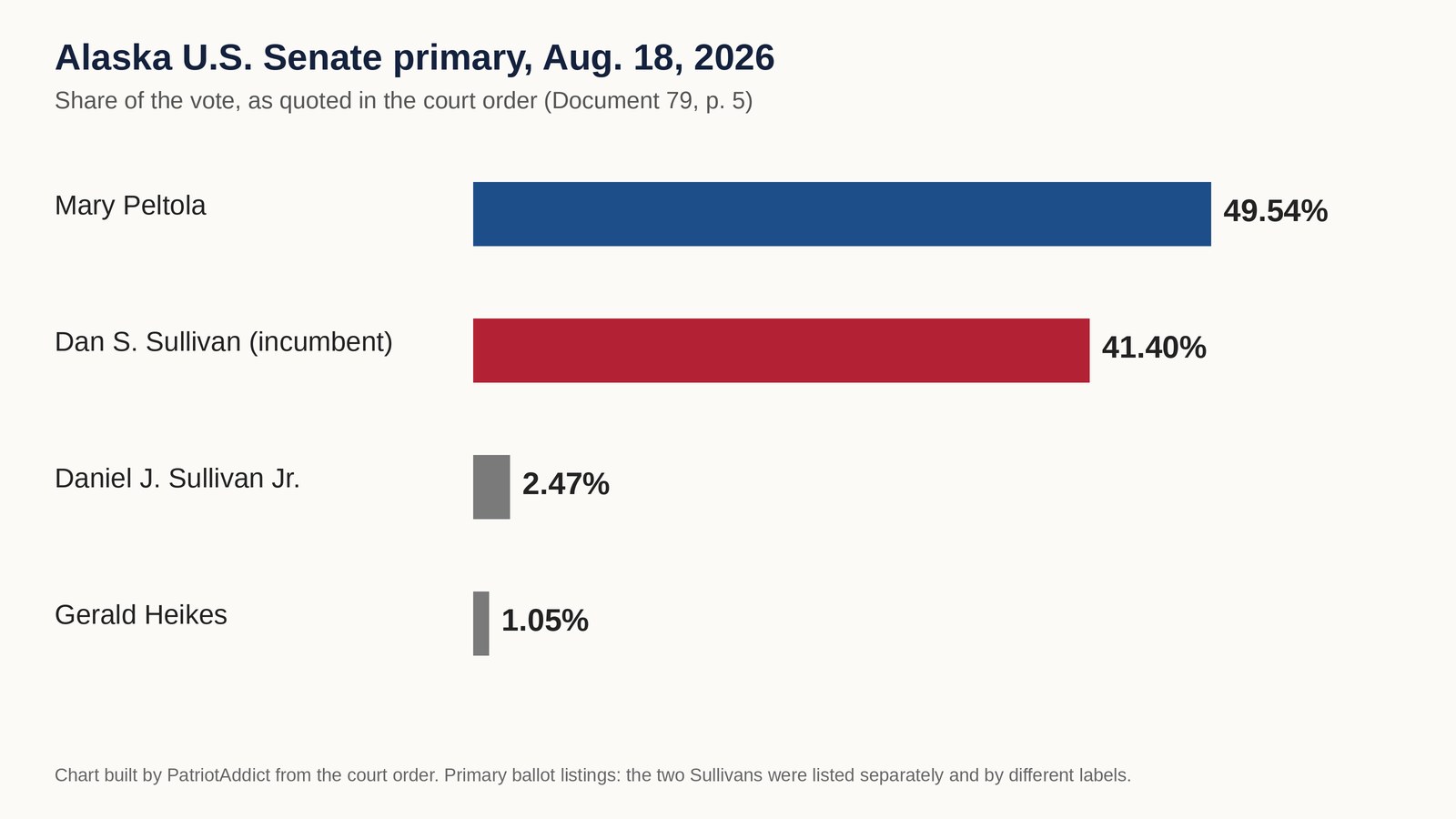
Alaska Senate primary results as quoted in the court order. Chart built by PatriotAddict from the order, which cites the state's official primary summary report (public court record).
What do the numbers and the ballot show?
The order lists primary results of 49.54% for Peltola, 41.40% for Dan S. Sullivan, 2.47% for Daniel J. Sullivan and 1.05% for Gerald Heikes. In that primary, even adding every Daniel J. vote to the incumbent's total gives 43.87%, still short of Peltola. That is my arithmetic on August numbers, and the general election is a different contest with ranked-choice counting, so it predicts nothing.
The order also says the general-election ballot lists the two men differently: "Sullivan, Dan S. (Registered Republican) Incumbent" and "Sullivan, Daniel J. Jr." with no party. The court notes it is "unaware of any challenge" to those listings. It adds that ranked-choice rules move votes from a defeated candidate to each ballot's next choice, so a voter who ranks both Sullivans can do so.
Is there a second reason the court gave?
Yes. Gleason added that the Supreme Court's Purcell principle "strongly cautions" against changing election rules just before voters go to the polls, and she rejected DOJ's claim that it was not altering the time, place or manner of the election. She also denied leave to amend, citing the state's burden of filing two motions in four days with the election two days away.
The case is not over. According to the Just Security litigation tracker, DOJ appealed to the Ninth Circuit the same day (No. 26-7304). I could not read that appeal, so check the docket before treating anything past Nov. 1 as settled. Reporting also says DOJ is separately investigating how Daniel J. got on the ballot, which the order does not address.
Header photo: official portrait of Sen. Dan Sullivan (R-AK), U.S. Senate, 2015, via Wikimedia Commons, public domain (U.S. Senate work). Cropped and resized.















