

The Supreme Court hears St. Mary Catholic Parish v. Roy on Tuesday, Election Day, and the coverage will tell you it is about Catholic preschools turning away gay families. The two questions the justices actually agreed to decide are narrower, and in some ways bigger: when a state can lump religious schools in with everyone else under a "neutral" rule.
What Colorado built, and what the Archdiocese wants
Colorado voters approved a universal preschool program in 2020. It pays for 15 hours a week of preschool, and parents can spend the money at a public, private or faith-based provider. Providers must follow an "equal opportunity" mandate that bars enrollment preferences based on, among other things, religious affiliation, sexual orientation and gender identity. According to the petitioners' merits brief, the Archdiocese of Denver, which oversees 34 Catholic preschools, asked in 2023 for a religious exemption and was told by the state that an exemption "would be inconsistent with statute and therefore void."
Two parishes, the Archdiocese and a pair of parents sued. A federal district court and then the Tenth Circuit, on September 30, 2025, sided with Colorado, applying the 1990 rule from Employment Division v. Smith that neutral, generally applicable laws survive the Free Exercise Clause.
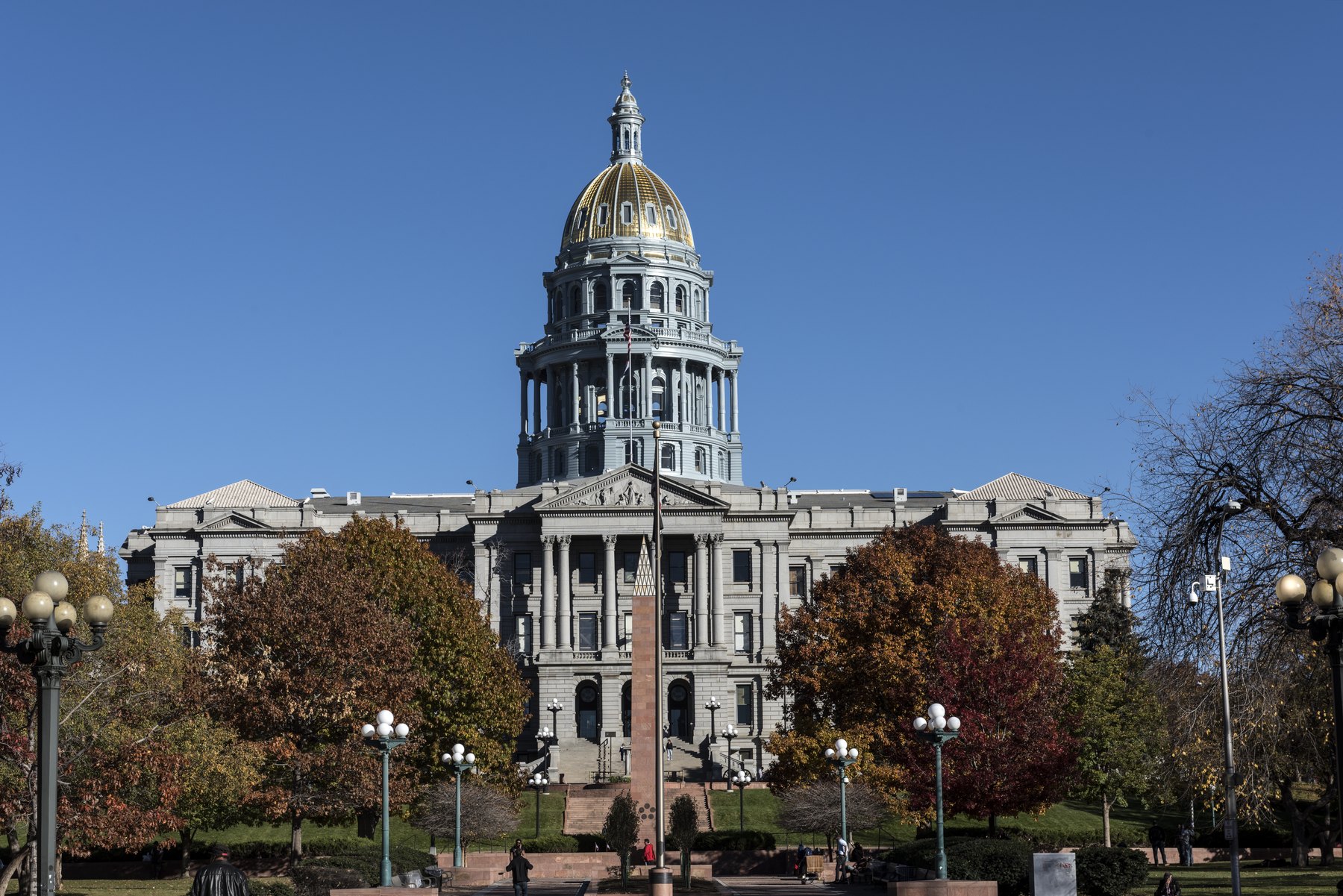
The Colorado State Capitol in Denver. The state's universal preschool program was created by a 2020 ballot measure and a law passed by the General Assembly. (Carol M. Highsmith, Library of Congress, no known restrictions on publication)
The two questions the Court took
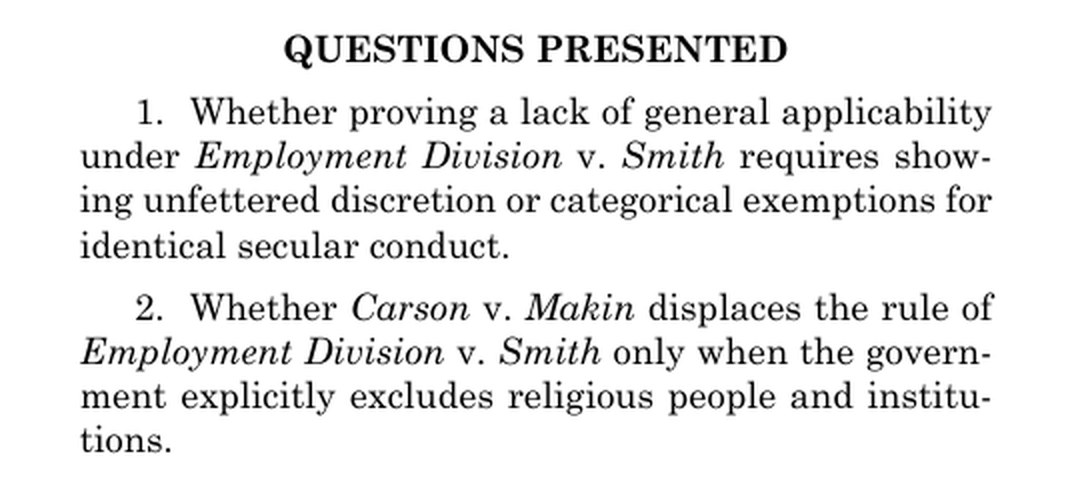
The Court granted review on April 20, limited to the first two questions in the petition. Read the actual wording, because it is not what the headlines imply.
Official record
Questions Presented, Brief for Petitioners, St. Mary Catholic Parish in Littleton v. Roy, No. 25-581 (U.S. Supreme Court). Argument set for November 3, 2026.
"Whether proving a lack of general applicability under Employment Division v. Smith requires showing unfettered discretion or categorical exemptions for identical secular conduct." — Question 1
"Whether Carson v. Makin displaces the rule of Employment Division v. Smith only when the government explicitly excludes religious people and institutions." — Question 2
Read or download the petitioners' brief (PDF) · view the Supreme Court docket
Neither question asks the Court to throw out Smith. Both ask how hard it is to show a law is not "generally applicable," and whether Carson v. Makin, the 2022 decision on religious schools and public tuition aid, reaches only open, explicit exclusion. The Tenth Circuit said it did, and that Colorado's rule was not an explicit exclusion because other religious schools are welcome in the program.
The exemptions at the center of it
The petitioners' brief makes a specific factual case, and it is worth knowing it is their account. They say the state approved ten categories of enrollment preferences, including limits to low-income families or to children with certain disabilities, and a catchall for preschools serving a "specific community." They say the state's program director testified that the catchall would allow a school to prioritize "gender-nonconforming children," "children of color," or children of the LGBTQ community. If Colorado will bend its rule for those, the argument goes, it is not treating its rule as uniform, and Catholic schools are the one group denied a bend.
The brief also says the state at first allowed faith-based schools to prefer members of their congregation, redefined the term after the suit was filed, and then repealed the exemption while the case was on appeal. The Tenth Circuit, per the same brief, found the other exemptions were not "comparable" because they touched different protected characteristics, and that the Department had no discretion to grant individual exceptions.
Colorado's answer, and who is lined up behind each side
Colorado does not claim to exclude religion. As summarized by the National Constitution Center, whose account of the state's brief I read secondhand, the state says religious providers participate and the Catholic schools "remain welcome" if they follow the same rules as everyone else. The Deseret News reported Gov. Jared Polis saying faith-based schools "have always been welcome," with at least 68 taking part in 2023-24.
Solicitor General D. John Sauer's office backs the parishes. Its brief says Colorado's mandate "lacks exemptions for religious conduct, but exempts certain secular conduct and allows for discretionary exceptions." The Court granted the government divided argument time on October 5. The Constitution Center puts 21 Republican-led states with the parishes and 18 Democratic-led states with Colorado, and expects a ruling by early summer.
What to watch Tuesday
Skip the culture-war framing and listen for a narrower thing: whether any justice thinks a state that grants some exceptions to a funding condition can refuse the one exception a church asks for. The petitioners say that is the whole case. Colorado says its rule applies to every school equally. One side will lose, and the loser's rule will bind every state that attaches conditions to taxpayer money.















